Where a Man Becomes a Goddess
The Kathmandu Valley’s great festivals — Dashain, Tihar, the Rato Machhindranath Jatra, Biska Jatra — are well documented. They appear in travel guides. They have Wikipedia pages. Photographers know when to show up.
The Nuwakot Sindure Jatra does not appear in travel guides. It has no English Wikipedia page. Almost no international visitor has ever attended it. And it is, by any reasonable measure, one of the most extraordinary living religious rituals in the Himalayas.
The festival takes place in Nuwakot — a fortified hilltop town at 900 meters elevation, roughly 75 kilometers northwest of Kathmandu along the old trans-Himalayan trade route to Tibet. The name “Nuwakot” derives from “Nawa Kort” — “nine forts.” It was from this citadel that King Prithvi Narayan Shah launched the military campaigns that unified Nepal in 1744. The Sattale Durbar — his seven-story palace with five-meter-thick walls — still stands. The Bhairabi Temple, where the festival centers, was built in 1783 and restored after the 2015 earthquake. The strategic and spiritual architecture of Nuwakot is inseparable from its political history.
At Alpine Luxury Treks, we arrange access to the Sindure Jatra for a very small number of guests each year. This guide explains what the festival is, what happens during its twelve days, and why it matters — not as a tourist spectacle, but as one of the rarest windows into the syncretic, tantric, shamanic religious tradition that still operates beneath the surface of modern Nepal.
In This Guide
- The setting: Nuwakot’s fortress, temple, and river confluence
- The mythology: two divine sisters and a fisherman’s stone
- The Dhami: the man who becomes the goddess
- The ritual hierarchy: Kumari, Bajracharya Guru, and the state representative
- The twelve-day festival: what happens day by day
- The secret prophecy at Devighat
- The chariot and the twelve masks
- Visiting Nuwakot: logistics and what to expect
- Frequently asked questions
The Setting: A Fortress, a Temple, and a River Confluence
The festival moves through three specific locations, each carrying distinct spiritual weight.
The Nuwakot Durbar Square sits on a hilltop dominated by the Sattale Durbar — Prithvi Narayan Shah’s seven-story fortress-palace. The square includes the Ranga Mahal (a Malla-era entertainment hall), the Garad Ghar (the army garrison), and the Taleju Temple. This is where the festival’s massive gatherings take place and where the 63-foot wooden pole is erected to signal the start.
Two hundred meters south of the palace sits the Bhairabi Temple — the home of the festival’s patron goddess. Built in the traditional pagoda style, the temple features a western-facing entrance guarded by stone and metallic lions, with sculptures of two women holding hands, adorned with sindoor, flanking the main staircase. In 1793, Bahadur Shah installed a copper roof and plate inside the temple, declaring Nepal’s victory in the First Sino-Nepalese War. Weapons captured in that conflict were stored on the second floor. The goddess is both a spiritual patron and a martial one.
The third location is Devighat — the sacred confluence of the Tadi (Suryamati) and Trishuli (Gandaki) rivers at the base of the hill. This is the sanctuary of Jalapa Devi, the elder sister of Bhairavi, and the site where Prithvi Narayan Shah was cremated in 1775. The festival’s chariot must travel from the hilltop temple down to this river confluence and back — a four-to-five-hour journey each way — because the younger sister must visit the elder sister every year. That familial obligation is the narrative engine of the entire twelve days.
The Mythology: Two Divine Sisters and a Fisherman’s Stone
The theological core of the Sindure Jatra is a family story. Goddess Bhairavi of Nuwakot is the younger sister. Goddess Jalapa Devi of Devighat is the elder. The twelve-day festival is the younger sister’s annual visit — a narrative that humanizes the divine and reinforces the familial structures that define traditional Nepali society.
Jalapa Devi’s origin story involves a fisherman from the Rai caste who kept hauling up the same heavy stone instead of fish at the Devighat confluence. Frustrated by his empty nets, he was visited by the goddess in a dream. She revealed that the stone was her physical form and instructed him to install it in a temple. The fisherman obeyed. To this day, local fishermen offer fish to the Dhami during the festival, honoring the deity’s aquatic emergence.
The origin of the possession ritual traces to a merchant from Kirtipur who, passing through Devighat and seeing the stone’s worship, spontaneously offered a goat sacrifice. The moment the blood was spilled, the merchant was overwhelmed by Lord Bhairav's energy, leading him to drink the raw blood. This event established the precedent for the human channeling of divine energy that defines the Sindure Jatra to this day.
Anthropological assessments of the festival describe it as an elaborate appeasement mechanism. The community believes that Bhairavi and Jalapa Devi must be satisfied through blood sacrifice. Failing to do so would invite divine wrath in the form of the ‘awl’ — a severe fever that historically swept through the population as an epidemic. The sacrifice is not symbolic. It is epidemiological insurance, rooted in centuries of lived experience with disease and the community’s understanding of how to prevent it.
The Dhami: The Man Who Becomes the Goddess
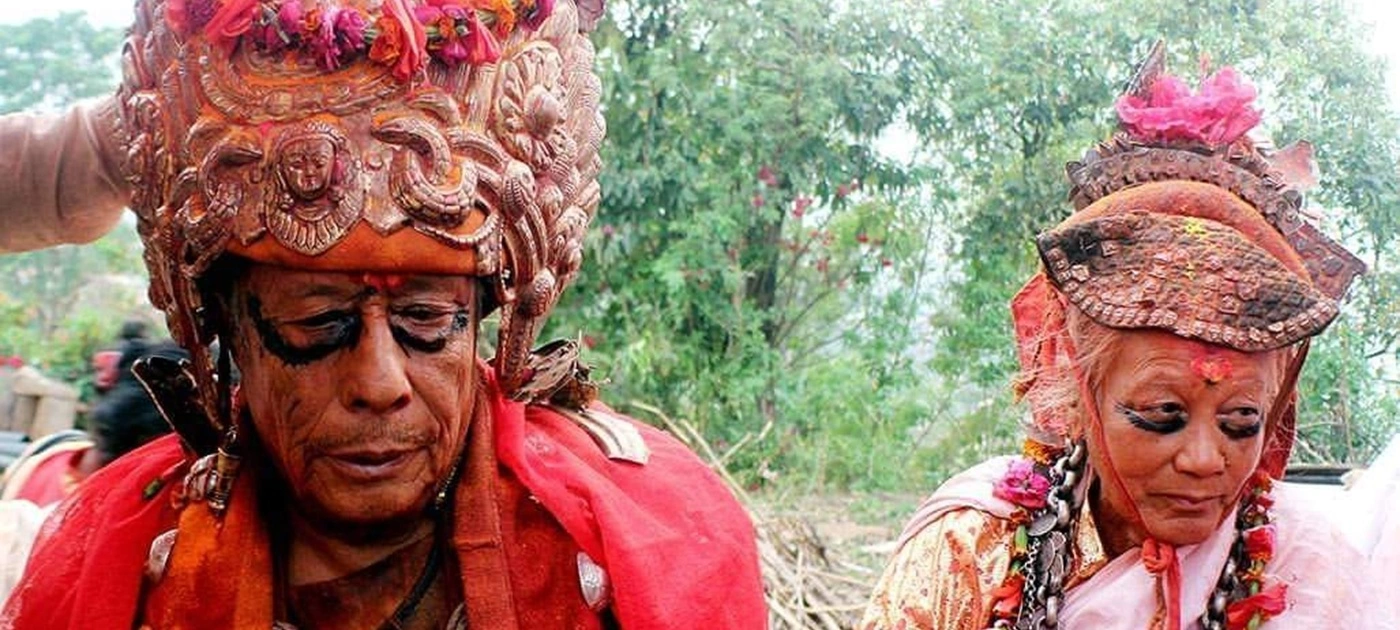
The central figure of the Sindure Jatra is the Dhami — a hereditary shamanic priest who functions as the physical vessel for Goddess Bhairavi. During the festival, the Dhami’s consciousness is completely integrated with the divine energy. He is no longer a man performing a ritual. He is the goddess occupying a human body.
The position is strictly hereditary: upon the death of a Dhami, his firstborn son inherits the role. A historical restriction forbids the Dhami from crossing the Trishuli and Tadi rivers without the ruling monarch’s permission. In recent festivals, the role has been held by Hari Man Singh Dangol, a man in his eighties who continues to meet the grueling physical demands of the twelve-day ritual — including consuming sacrificial blood.
The Dhami’s Political Power
The Dhami is not merely a spiritual figure. Archival records from the Shah period show that Dhamis held genuine administrative authority. They managed the Nuwakot palace, oversaw customs operations, and were authorized to influence the transfer of government employees — a right they won after formally complaining to the central government about being excluded from administrative decisions.
In 1816, during Prime Minister Bhimsen Thapa’s tenure, a government policy favoring Newar merchants over the indigenous Parbate hill populations caused severe social friction in Nuwakot. It was the Dhami who interceded with the King on behalf of the populace, securing equality between the two groups. The shamanic priest was simultaneously a spiritual conduit and a political mediator — a role that has no equivalent in any other Nepali festival.
The Ritual Hierarchy: Kumari, Bajracharya Guru, and the State
The Sindure Jatra is not officiated by conventional Brahmin priests. It operates through a unique hierarchy that blends indigenous shamanism, Vajrayana Buddhism, and state bureaucracy.
The Living Goddess Kumari
Before the Dhami can safely channel Bhairavi’s energy, he must be purified by a Living Goddess Kumari — a prepubescent girl from the Buddhist Shakya clan, selected as the living embodiment of Taleju Bhawani. In the Nuwakot tradition, the Kumari is typically the daughter of the Dhami’s brother, keeping the spiritual power within the family lineage. During specific rituals, Kumaris are assigned one of sixteen divine names based on the nature of the ceremony — including Kalika, Bhairavi, Rudrani, and Ambika.
The Bajracharya Guru
The theological mechanics of summoning a Hindu goddess into a human body are overseen by a Bajracharya Guru — the highest-ranking Vajrayana Buddhist priest in the Newar caste system. His title translates to “holder of the vajra.” A Buddhist tantric master directing the rituals of a Hindu goddess: this is the syncretism of Nepali religion made visible. The Guru uses Vajrayana mantras to induce the Dhami’s trance, opening the human vessel to receive Bhairavi’s entry, and safely closing the connection when the rituals conclude.
The Dware: The Government Representative
The Dware is the national government's designated representative, embedded in the festival’s core ritual structure. He scatters the first sindoor to open the celebrations, presents ceremonial garments to the deities, and — most critically — is the sole recipient of the Dhami’s secret national prophecy at Devighat. The state’s integration into a shamanic ritual is not incidental. It is structural.
The Twelve Days: What Happens
|
Day
|
What Happens
|
|
Day 1
|
Evening: Kumari purifies the Dhami with water. Dhami dons divine vestments — a golden nine-headed Naga crown, an Astamatrika necklace, and red ceremonial garments. Bajracharya Guru induces trance through Vajrayana mantras. Dhami sprints to the Dwares’ house in a frenzy of possession. Two 63-foot Yosin poles were raised at the Bhairabi and Budhi Bhairavi temples.
|
|
Day 2
|
State feast: Dware presents garments to deities. Sindoor explosion — Dware scatters vermillion, triggering mass celebration. Twelve deity masks are installed in the chariot. 36 Tamang men carry the chariot on a 4–5 hour descent to Devighat. Tantric puja at the river confluence. THE SECRET PROPHECY: possessed Dhami whispers the nation’s future to the Dware, who relays it to Kathmandu. Midnight return.
|
|
Day 3
|
Chariot rests at Dharampani until the afternoon. Resumes ascent to Bhairabi Temple with State Army gun salute. Overnight vigil. Mass blood sacrifice at the temple — goats and buffaloes. At Devighat, 108 uncastrated he-goats were sacrificed. Dhami drinks blood directly from the animals, consuming it three times as mandated by the liturgy.
|
|
Days 4–10
|
Restoration period. Twelve deity masks were removed from the chariot and returned to permanent sanctuaries. Community feasting (syabaji) at Tulaja Bhawani temple. Families gather. Social bonds renewed. Seven days of communal meals function as a sociological pressure valve.
|
|
Day 11
|
Concluding puja at Bhairabi Temple. The first 63-foot Yosin pole is lowered to the ground.
|
|
Day 12
|
The second pole lowered at Budhi Bhairavi Temple. Chhyama Puja — ritual of atonement and forgiveness for any errors committed during the twelve days. The festival formally closes.
|
The festival’s preparation begins weeks before Day 1. On the 8th lunar day, the Dhami collects rice from households for sacred fermentation, beating a drum as he walks through Nuwakot. On the 9th day, a specific pine tree is identified in the forest, ritually worshipped to appease tree spirits, then felled and shaped into a 63-foot pole. On the 12th day, deep ditches are dug in front of both temples. On the 13th day, nine men journey to Devighat with an offering of a fully black or fully white uncastrated goat to formally invite the gods to participate.
The Secret Prophecy at Devighat
This is the element of the Sindure Jatra that has no parallel in any other Nepali festival—and arguably none anywhere in South Asian religious practice.
At Devighat, at the confluence of the Tadi and Trishuli rivers, in the presence of the elder sister Jalapa Devi, the Dhami enters the deepest state of possession. Empowered by the combined grace of both goddesses, he is granted the ability to foresee the nation’s future for the coming year. He whispers this prophecy exclusively to the Dware — the government’s representative. The Dware is strictly obligated to keep the revelation secret and relay it directly to the head of state in Kathmandu.
This is not folklore. This is institutionalized clairvoyance woven into the structure of national governance. If the goddess foresees prosperity, it validates the current administration. If she foresees turmoil, the state can prepare. The shamanic priest’s trance operates as a form of celestial intelligence gathering. The government monopolizes the divine mandate by keeping the prophecy secret.
For a visitor standing at Devighat watching the Dhami’s eyes roll back as his body shakes under possession, knowing that the words coming out of his mouth will reach the office of the head of state within days, the distance between “ancient ritual” and “modern governance” collapses entirely.
“In April 2025, we took Alessandro and Beatrice Conti from Florence to the Nuwakot Sindure Jatra. Alessandro, a professor of comparative religion at the University of Florence, had studied Vajrayana-Hindu syncretism for twenty years but had never seen it enacted. On Day 2, standing at Devighat while the Bajracharya Guru chanted Vajrayana mantras to summon a Hindu goddess into the Dhami’s body, he was quiet for a very long time. Then he said to Beatrice: ‘I have read about this in manuscripts. I have taught it in lecture halls. I have never understood it until this moment. The Buddhist priest is the technician. The Hindu goddess is the passenger. The shaman is the vehicle. And the state is the client. It is the most elegant spiritual engineering I have ever witnessed.’”
The Chariot and the Twelve Masks
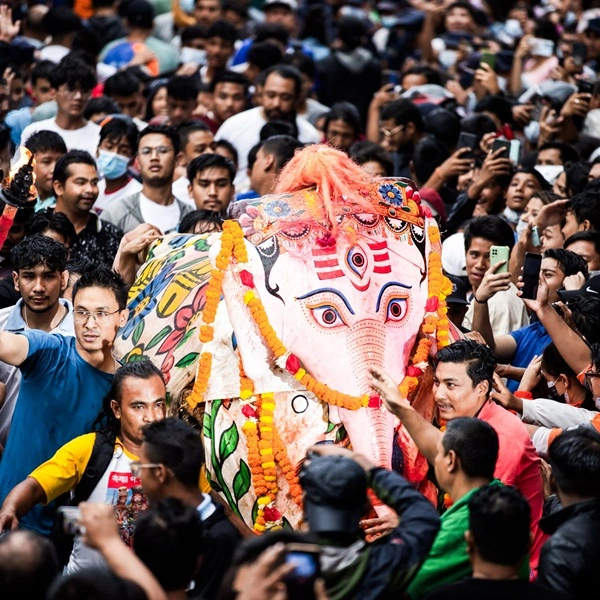
The chariot is not wheeled like the Machhindranath or Biska Jatra chariots. It is carried — physically hoisted by thirty-six men from the Tamang community of Lachang. The four-to-five-hour journey from the hilltop temple to the river confluence at Devighat is an exhausting descent over rough terrain, and the midnight return up the hill is even more grueling.
Inside the chariot sit twelve sacred masks, each representing a specific deity from the Nuwakot tantric pantheon.
|
#
|
Deity
|
Role
|
|
1
|
Goddess Bhairavi
|
Central patron goddess of Nuwakot; consort of Bhairav
|
|
2
|
Lord Ganesh
|
Remover of obstacles; invoked at the start of all Newar rites
|
|
3–10
|
The Astamatrikas
|
The Eight Divine Mothers (Brahmi, Maheshvari, Kaumari, Vaishnavi, Varahi, Indrani, Chamunda, Mahalaxmi) — fierce protective energies
|
|
11
|
Syangini
|
A Dakini (tantric female spirit), celestial guardian
|
|
12
|
Byangini
|
Second Dakini, paired with Syangini to complete the esoteric pantheon
|
An attendant walks beside the chariot carrying a Khadga — a sacred sacrificial sword wrapped in white cloth. The sword symbolizes the raw, unmanifested tantric power overseen by the deities. It is not a display prop. It is the instrument of sacrifice.
The Blood Sacrifice: What Actually Happens
The blood sacrifice on Day 3 is the festival’s most visceral element, and we are transparent about what it involves because international visitors need to make an informed decision about whether they want to witness it.
At the Bhairabi Temple, goats and buffaloes are slaughtered in the temple precincts. At Devighat, the ritual demands the offering of 108 uncastrated he-goats. The Dhami — in deep trance, fully possessed — takes the sacrificed animals into his lap, slices their necks, and drinks the hot blood directly, three times per animal as mandated by the ritual liturgy. He also consumes raw flesh.
This is not theatrical. The elderly Dhami is channeling what the community believes to be the goddess’s literal hunger for blood. The act appeases Bhairavi’s wrath and ensures that epidemics and misfortune are averted in the coming year. The community’s belief in the direct connection between the sacrifice and their physical health is absolute.
FOR VISITORS: A SENSITIVE REALITY
We do not include the mass sacrifice in standard visitor itineraries unless a guest specifically requests it and understands what they will witness. The sindoor-throwing ceremonies, the chariot procession, the pole erection, and the Devighat river-confluence rituals are all profoundly moving and culturally rich without the sacrifice component. Guests who do choose to attend the sacrifice night should approach it as they would any deeply held religious practice — with silence, respect, and the understanding that they are witnessing something the community considers essential to their survival.
Visiting Nuwakot: Logistics and What to Expect
Getting There
Nuwakot is approximately 75 kilometers northwest of Kathmandu. The drive takes 55 minutes to 2 hours, depending on the route and road conditions. The fastest route follows the Prithvi Highway to Galchhi and then turns north along the Trishuli River. The road through Kakani offers scenic views but is slower. We provide private vehicle transfers with experienced drivers who know both routes.
Where to Stay
Nuwakot has limited accommodation. The Famous Farm is a heritage property that offers comfortable lodging with views of the Ganesh Himal range. Hotel Trishuli and Hotel Water Tower in Bidur provide standard options. For guests who want to be close to the festival action, we arrange stays in Nuwakot village itself with local families — basic but atmospheric, within walking distance of Durbar Square and Bhairabi Temple.
Most of our Sindure Jatra guests day-trip from Kathmandu, departing at dawn and returning after the evening ceremonies. For the chariot procession to Devighat (Day 2), we recommend an overnight stay in Nuwakot to witness the midnight return.
What to Expect as a Visitor
This is not a festival with spectator infrastructure. There are no grandstands, no designated viewing areas, no tourist information desks. You are standing in a working hilltop town during its most sacred days. Our cultural guides — including team members with direct personal connections to the Nuwakot community — position you respectfully and interpret what you are seeing in real time.
The sindoor-throwing ceremony on Day 2 will coat you in orange vermillion. Wear clothes you do not mind staining. The chariot procession to Devighat is a long, physically demanding walk over hilly terrain. Wear sturdy shoes. Bring water. The temperatures in late March to early April are warm in the valley (20–28°C).
How Many International Visitors Attend
Almost none. In a typical year, the number of international visitors at the Nuwakot Sindure Jatra is in the single digits. This is partly because the festival is genuinely obscure — it does not appear in standard guidebooks. It is partly because the logistics require a level of local knowledge that independent travelers simply do not have. And it is partly because the festival's content (shamanic possession, blood sacrifice, state prophecy) is culturally intense in ways that require genuine preparation and contextual understanding.
For the right traveler — someone with genuine intellectual curiosity about how religion, politics, and community actually function in the Himalayas — the Sindure Jatra is among the most extraordinary cultural experiences available in Nepal. We arrange access for 2–4 guests per year.
Frequently Asked Questions
What is the Nuwakot Sindure Jatra?
The Sindure Jatra (also called Bhairavi Jatra or Devi Jatra) is a twelve-day festival in Nuwakot, Nepal, centered on the worship of Goddess Bhairavi and her elder sister Jalapa Devi. It features shamanic possession by a hereditary priest (the Dhami), a chariot procession between the hilltop Bhairabi Temple and the river confluence at Devighat, the erection of a 63-foot ceremonial pole, mass blood sacrifice, the throwing of sindoor (vermillion), and a secret prophecy whispered to a government representative. The festival takes place annually in March-April during the Nepali New Year.
When does the Nuwakot Sindure Jatra take place?
The festival follows the lunar calendar, occurring during the bright fortnight of Chaitra and extending into Baishakh (approximately late March to mid-April). Preparation rites begin approximately two weeks before the main twelve-day festival. Specific dates shift annually with the lunar calendar. We monitor Guthi announcements and confirm exact dates for interested guests 2–3 months in advance.
What is the Dhami?
The Dhami is a hereditary shamanic priest who serves as the physical vessel for Goddess Bhairavi during the festival. Through Vajrayana tantric rituals administered by a Bajracharya Guru, the Dhami enters a state of complete divine possession. The position passes from father to firstborn son. The current Dhami, Hari Man Singh Dangol, is in his eighties and continues to perform the demanding physical and spiritual rituals of the twelve-day festival.
What is the secret prophecy?
At the river confluence of Devighat, the possessed Dhami whispers a prophecy about the nation’s future for the coming year to the Dware, the designated government representative. The Dware is obligated to keep the prophecy secret and relay it directly to the head of state in Kathmandu. This institutionalized clairvoyance weaves indigenous shamanism into the structure of modern national governance.
What is the chariot procession?
The festival’s chariot carries twelve sacred deity masks from the Bhairabi Temple on the hilltop down to the river confluence at Devighat — a four-to-five-hour journey each way over hilly terrain. The chariot is physically carried (not wheeled) by thirty-six men from the Tamang community. The procession symbolizes the younger sister (Bhairavi) visiting her elder sister (Jalapa Devi) at the rivers.
How does the Buddhist-Hindu syncretism work?
A Vajrayana Buddhist priest (Bajracharya Guru) administers the tantric rituals that summon a Hindu goddess (Bhairavi) into the body of a shamanic priest (Dhami). The Buddhist priest is the ritual technician. The Hindu goddess is the invoked power. The shaman is the vessel. This reflects the deep, living syncretism of Nepali religion, where Vajrayana Buddhism and Hindu Shakti traditions operate not as competitors but as complementary systems within a single ritual framework.
Is the blood sacrifice mandatory to witness?
No. We do not include the mass sacrifice (Day 3 overnight) in standard visitor itineraries unless specifically requested. The sindoor-throwing ceremonies, the chariot procession, the pole erection, and the Devighat river rituals provide profound cultural depth without the element of sacrifice. Guests who choose to attend the sacrifice should approach it with silence and respect.
How do I get to Nuwakot from Kathmandu?
Nuwakot is approximately 75 kilometers northwest of Kathmandu. By private vehicle, the drive takes 55 minutes to 2 hours, depending on the route. We provide private transfers with experienced drivers. Public buses run from Kathmandu’s Machhapokhari terminal (approximately 8 hours). We recommend private transport for festival visits to allow flexible timing around the day’s rituals.
Where should I stay during the festival?
Most guests day-trip from Kathmandu. For overnight stays, The Famous Farm is a heritage property near Nuwakot with views of the Ganesh Himal range. Standard accommodation is available in Bidur. We also arrange stays with local families in Nuwakot village for guests who want to be within walking distance of the festival sites. For the Day 2 chariot procession and midnight return, an overnight stay is recommended.
How many international visitors attend?
Almost none. The typical number of international visitors at the Nuwakot Sindure Jatra in any given year is in the single digits. The festival does not appear in standard travel guides and requires local knowledge to access. We arrange attendance for 2–4 guests per year and provide cultural guides with direct personal connections to the Nuwakot community.
The Final Word
There are festivals you attend. There are festivals that change how you understand a country. The Nuwakot Sindure Jatra is the second kind.
A Buddhist priest summons a Hindu goddess into a shaman’s body. A government official receives a secret prophecy from the possessed man’s lips. Thirty-six men carry a chariot of twelve masks down a mountain to a river where a king was cremated 250 years ago. A man in his eighties drinks blood from a sacrificed goat because he believes — and his community believes — that the act will protect them from disease for another year.
None of this is performed for outsiders. It is not staged. It is not promoted. It simply happens, every spring, in a hilltop fortress town 75 kilometers from your Kathmandu hotel. If you want to see it, tell us. We will take you there.
Interested in the Nuwakot Sindure Jatra?
We arrange access for a very small number of guests each year. Tell us your March-April travel window, and we will confirm the festival dates, arrange transport, and pair you with a cultural guide who knows the community personally.