How to Enter Tibet in 2026: Visas, Permits & Direct Flights
The single biggest shift in Tibet travel for 2026 isn’t a new hotel or a paved road — it’s the disappearance of friction. What used to require weeks of advance paperwork and connecting flights through Beijing or Chengdu can now be done with a passport scan and a single direct flight. The barriers haven’t been removed — they’ve been absorbed by agencies like ours, so the traveler only feels the ease.
1. Visa-Free Entry for 50+ Countries
China’s expanded visa-free transit policy now covers travelers from more than 50 countries — including most EU nations and key Asian markets — for stays of 15 to 30 days. For luxury travelers combining Tibet with other Chinese destinations, this eliminates one of the historically heaviest administrative hurdles. You land, you clear immigration, you’re in.
2. Tibet Travel Permit Is Still Mandatory
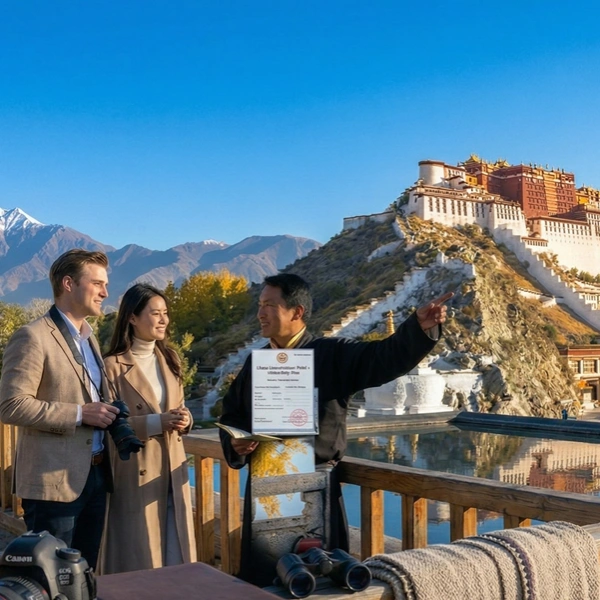
Here’s the critical nuance: visa-free entry gets you into China, but Tibet requires its own separate permit. The Tibet Travel Permit can only be secured through a registered travel agency — no exceptions, no workarounds. Our Lhasa-based team manages this end-to-end. You provide a passport scan; we deliver the permit. The process is invisible to the guest, but without it, you don’t cross the border into the Tibet Autonomous Region.
3. New Direct International Flights to Lhasa
This is the game-changer for 2026. Direct routes now connect Lhasa to Singapore and Kathmandu, removing the long layover in mainland Chinese hub cities that historically added a full day to the journey. The Kathmandu–Lhasa route is particularly significant for travelers combining Nepal and Tibet itineraries — a one-hour flight over the Himalayan crest, with Everest visible from the cabin window. From Singapore, Lhasa is now reachable in a single flight, positioning Tibet as a viable long-weekend luxury destination for Southeast Asian travelers for the first time.
4. No Group Required — Private Travel Is the Standard
A persistent myth about traveling to Tibet is that you must join a group tour. This is incorrect. While “independent” travel (without a guide) is prohibited, “private” travel is not only permitted but actively encouraged by the tourism infrastructure. You don’t share a vehicle, a guide, or an itinerary with anyone. Your party travels alone, on your schedule, in your private SUV. The guide requirement isn’t a restriction — it’s a concierge service built into the regulatory framework.
Our process: you book the itinerary, we process the Tibet Travel Permit, Alien Travel Permit, Military Permit (for EBC), and Frontier Pass. Four permits, zero burden on you. The visa-free policy handles the rest. From inquiry to arrival in Lhasa, the administrative load on the guest is a single passport scan.
Luxury Hotels, Altitude Wellness & Infrastructure in Tibet
The defining anxiety of traveling in Tibet has always been altitude. At 3,650 meters, Lhasa sits higher than any European capital, any African city, and most ski resorts. Everest Base Camp, at 5,200 meters, offers roughly 50% of the oxygen at sea level. For decades, this meant headaches, sleepless nights, and a general sense of physical compromise. In 2026, luxury infrastructure has rendered that anxiety irrelevant.
5. Lhasa Is Now a Five-Star Luxury Hub
The Lhasa of 2026 bears little resemblance to the backpacker waypoint of a decade ago. The St. Regis Lhasa Resort, Shangri-La Lhasa, and the boutique Songtsam Linka Retreat now offer international five-star standards — heated floors, spa facilities, curated Tibetan dining, and the kind of service infrastructure that luxury travelers expect globally. The Songtsam properties, in particular, have mastered the art of altitude hospitality: intimate scale, locally sourced materials, and staff trained specifically in high-altitude guest care.
6. Oxygen-Enriched Rooms Are Now Standard at Top Hotels
The most significant upgrade in Tibet’s luxury tier isn’t thread count or lobby design — it’s oxygen. Top-tier hotels in Lhasa and Shigatse now offer oxygen-enriched rooms as standard, with adjustable flow rates controlled from the bedside. Several properties maintain in-house medical clinics staffed by physicians experienced in altitude medicine. For guests arriving from sea level, the first two nights in an oxygen-enriched suite make a measurable physiological difference — deeper sleep, faster acclimatization, and the elimination of the low-grade headache that used to define the arrival experience in Tibet.
7. Fully Paved Roads to Everest Base Camp and Namtso Lake
The roads to Everest Base Camp and Namtso Lake are now fully paved. This is a quiet revolution. A decade ago, the journey to EBC involved hours of bone-rattling washboard gravel, turning a 350-kilometer drive into a 12-hour endurance test. Today, a private luxury SUV covers the same route on smooth asphalt. The landscape hasn’t been domesticated — the passes still hit 5,000 meters, the yak herds still cross the road — but the vehicle no longer fights the surface. The journey to Everest is now genuinely comfortable, not merely survivable.
8. Medical-Grade Oxygen in Every Private Vehicle
On our tours, every private SUV carries medical-grade oxygen canisters for the duration of the trip. This isn’t an emergency measure — it’s a comfort standard. Whether crossing the Gawu La Pass at 5,198 meters or arriving at EBC after a long drive, a few minutes of supplemental oxygen eliminates the lightheadedness and fatigue that altitude imposes. Our guides carry portable pulse oximeters and monitor blood oxygen saturation throughout the journey. If levels dip, we intervene before symptoms develop. Altitude management in 2026 is proactive, not reactive.
9. 5G Connectivity at Everest Base Camp
Yes, you can video-call from 5,200 meters. China’s 5G network now covers Everest Base Camp with a strong signal and data speeds sufficient for streaming. For the luxury traveler, this means real-time sharing of the North Face sunrise, coordination with offices back home, and the psychological comfort of connectivity in one of the world’s most remote locations. Our tours additionally provide private portable Wi-Fi hotspots to ensure consistent access regardless of network congestion during peak season.
10. Private SUV Self-Driving Is Now Legal for Tourists
A major 2026 development: international tourists can now legally self-drive in Tibet, provided they travel with a licensed guide and support vehicle. For independent-minded luxury travelers — particularly driving enthusiasts — this transforms the Lhasa-to-Everest route from a chauffeured transfer into a personal road trip across the highest plateau on earth. Your guide rides alongside, handling checkpoints and navigation, while you control the pace. It’s a niche offering, but for the right traveler, it’s the defining experience of the journey.
Oxygen-enriched suite in Lhasa + acclimatization days built into the itinerary + medical-grade oxygen in every vehicle + pulse oximeter monitoring + paved roads to EBC = the altitude experience, minus the suffering. That’s the 2026 standard.
Best Time to Visit Tibet: Seasons, Privacy & VIP Access
Luxury travel isn’t about speed — it’s about access, privacy, and the quality of time spent. Tibet in 2026 offers all three, partly by design and partly by geography. The enforced speed limits, the winter closure of mass tourism, and the private-guide requirement create a framework where exclusivity isn’t a marketing term — it’s a structural reality.
11. The “Slow Travel” Speed Limits Work in Your Favor
Tibetan highways enforce strict speed limits of 30–70 km/h between checkpoints. For budget travelers in shared minibusses, this is a frustration. For luxury travelers in a private SUV, it’s a gift. The Shigatse-to-Everest drive takes 8–9 hours not because the road is bad (it’s now fully paved) but because the system demands you slow down. Every checkpoint becomes a chance to step outside, breathe the high-altitude air, and photograph a landscape that changes character every 30 minutes. We don’t fight the speed limits. We build the itinerary around them, with curated stops at viewpoints, monasteries, and nomadic settlements that group tours drive past.
12. Winter Means Free Entry and an Empty Potala Palace
From November to March, the Tibetan government offers free entry to major A-level sites, including the Potala Palace, Jokhang Temple, and Norbulingka. The crowds that define summer visits vanish entirely. What remains is the Tibet that Tibetans experience — pilgrims prostrating around the Barkhor circuit, monks chanting in half-empty halls, and the Potala Palace in a solitude that summer visitors never witness. Nights drop to -10°C, and some high-altitude roads close, but for travelers focused on Lhasa and the central valleys, winter offers a depth of cultural immersion that no other season matches. Hotel rates drop 40–60%, and the best suites are available on arrival.
13. The Golden Seasons and the Shoulder-Month Strategy
April–May and September–October remain the conventional peak for clear weather, Everest visibility, and comfortable trekking temperatures. But luxury travelers in 2026 are increasingly targeting the shoulder months — late March, early June, late August, and early November — for a specific reason: privacy. The weather is marginally less predictable, but the trails are empty, the monasteries are uncrowded, and the hotels offer their best rates and room categories. For travelers who value solitude over certainty, the shoulder months are the smartest play.
14. VIP Access to Restricted Monastery Halls
This is where the private-tour framework pays its highest dividend. Luxury tours can arrange access to monastery halls and ceremonial spaces that are restricted for large groups. At Tashilhunpo in Shigatse, certain chapels open on request for small private parties. At Drepung outside Lhasa, your guide can coordinate a visit to residential quarters and debate courtyards during off-hours. These aren’t public offerings — they’re relationship-based, built over years of trust between agencies and monastic communities. It’s the difference between visiting a site and being received by it.
15. Respectful Exploration: The New Luxury Standard
Luxury travel in 2026 carries a responsibility that earlier eras ignored. The most thoughtful operators — ours included — emphasize what the industry calls “Respectful Exploration”: prioritizing locally owned hotels over international chains where possible, employing Tibetan-born guides who bring lived cultural knowledge rather than scripted commentary, and ensuring that tourism revenue filters directly into the communities that sustain these sacred sites. The Potala Palace, Tashilhunpo, and Everest Base Camp are not attractions — they’re living cultural ecosystems. How you visit them matters as much as whether you visit them.
THE DISCERNING TRAVELER’S CHECKLIST
Visa-free entry confirmed for your nationality. Tibet Travel Permit handled by your agency. Direct flight booked (Singapore or Kathmandu to Lhasa). An oxygen-enriched hotel is reserved for the first three nights. Private SUV with medical-grade oxygen confirmed. Shoulder-month dates selected for privacy. Down jacket packed. Everything else is handled.
FINAL WORD
Why Tibet in 2026 Is the Ultimate Luxury Destination
The Tibet of 2026 isn’t the Tibet of guidebooks written a decade ago. The logistics are smoother, the comfort is genuine, and the access — for travelers willing to invest in a private, professionally managed journey — is deeper than it’s ever been. The altitude hasn’t changed. The monasteries haven’t changed. The way Everest catches the first light at dawn hasn’t changed. What’s changed is that you no longer have to suffer to see it.
The 15 facts above aren’t trivia. They’re the architecture of a trip that works — where every permit is handled, every room is oxygenated, every drive is curated, and the only thing left for you to do is pay attention to where you are. That’s the luxury.
Ready to witness the North Face of Everest without the crowds?
Inquire about our Signature 2026 Private Tibet Departures and let our local experts handle every detail — from permit to Potala.