The best route to Kailash is the one that fits the traveler, because the mountain offers three genuinely different doors: the Kerung road overland from Kathmandu, the long Lhasa drive across Tibet, and the Simikot–Hilsa helicopter corridor through far-western Nepal.
We run all three, and we tell every guest the same thing at the first call — this is a decision about your time, your body, and what you want the journey to contain, not about which brochure shouts loudest.
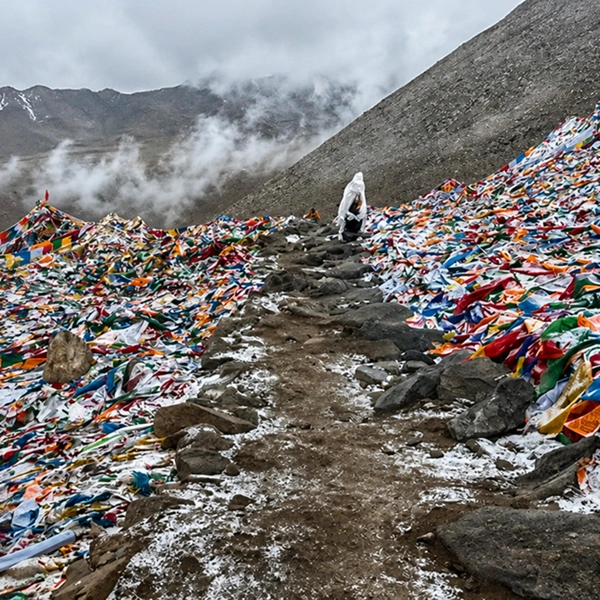
All three routes converge at Darchen and end with the identical prize: the three-day, 52-kilometer kora over the Dolma La at about 5,630 meters. Nobody's circuit is shorter, easier, or holier than anybody else's.
So the choice is entirely about the approach. Here are the three, straight, followed by the comparison and the honest matchmaking.
Route One: The Kerung Road — The Balanced Overland Classic
The Kerung corridor runs roughly 1,100 kilometers from Kathmandu through the Rasuwagadhi–Gyirong border, and its genius is its elevation profile: Kathmandu at 1,400 meters, two nights in the forested Gyirong valley at 2,700, a night at Saga near 4,600, then the lakes. The road itself performs the acclimatization.
It is also the route of quiet riches — Milarepa's cave at Drakkar Taso, the Newari-built Paba Monastery, Pelkhu Tso under Shishapangma — covered in full in our Kerung-route guide.
Plan for 12 to 14 days for the complete yatra. Among the three, this is our default recommendation for first-time pilgrims in reasonable health: the best acclimatization per day spent, at the middle of the cost range.
Route Two: The Lhasa Drive — Tibet Entire, Then the Mountain
The Lhasa route is the maximalist's answer: fly into Lhasa at 3,650 meters, then travel roughly 1,300 kilometers west along the G318 and G219, gathering the Potala, the Jokhang, Yamdrok Lake, Gyantse's Kumbum, Tashilhunpo, Sakya, and Everest's north face before Kailash appears. Our Lhasa-route guide walks it sight by sight.
The trade is time and budget. Thirteen to fifteen days is the honest minimum; permit processing is the most layered of the three, and the per-trip cost runs highest of the overland pair.
Choose it when Tibet itself is half the pilgrimage — and when you would regret standing at Kailash without having stood in the Jokhang first. Many of our most contented guests are exactly these travelers.
Route Three: The Helicopter Corridor — Speed, Priced Accordingly
The Hilsa route is the fastest door: a jet to Nepalgunj, a mountain aircraft to Simikot at 2,910 meters, then a 25-minute helicopter through the Humla Karnali gorges to the border at 3,640 meters. 10 to 11 days door-to-door, buffer days included — the full mechanics are in our helicopter-route guide.
The speed carries two honest costs. The per-day price is the highest of the three, and charter aviation is handling the pricing. And the compressed ascent demands discipline: the Simikot night and the Taklakot rest day are not optional, and the 12-kilogram luggage limit is set by physics, not policy.
Choose it when leaving work —not budget —is the scarcest resource—it exists precisely for pilgrims who could not otherwise come at all.
The Three Routes, Side by Side
| |
Kerung Road |
Lhasa Drive |
Helicopter (Hilsa) |
| Total duration |
12–14 days |
13–15 days |
10–11 days |
| Approach |
~1,100 km overland from Kathmandu |
~1,300 km overland from Lhasa |
Three flights + short drives |
| Acclimatization quality |
Excellent — gradual staircase |
Very good — starts high at Lhasa, climbs gently |
Demanding — safe only with fixed rest stops |
| Relative cost |
Middle |
Higher (longest itinerary) |
Highest per day (charter aviation) |
| Signature sights en route |
Gyirong valley, Milarepa's cave, Pelkhu Tso, Shishapangma |
Potala, Gyantse Kumbum, Tashilhunpo, Sakya, Everest north face |
Humla gorges by air, Tegla Kar caves, Khorzhak Monastery |
| Physical demand before the kora |
Long drive days |
Longest drive days |
Minimal — flights replace the approach |
| Permit complexity |
High |
Highest (adds Lhasa entry stack) |
High, on both sides of the border |
| Best for |
First-timers; best all-round balance |
Culture-first travelers with time |
Time-poor pilgrims; shortest leave window |
| Think twice if |
You have under 12 days |
Budget or leave is tight |
Uncontrolled heart/lung conditions, or you dislike weather uncertainty |
Choosing by What Actually Constrains You
If time is the constraint, the helicopter corridor is the only honest answer under twelve days, and nothing shorter than its ten is honest at all. Schedules that promise Kailash in a week achieve it by cutting the acclimatization that keeps you well.
If the budget is the constraint, the Kerung road wins. It shares Kathmandu as its base, uses vehicles rather than charters, and spends its nights in modest guesthouses upgraded by crew rather than in aviation fuel.
If health or age is the consideration, think in staircases, not difficulty grades. The Kerung road's profile is the friendliest; the Lhasa route is close behind once the first days in Lhasa are respected; the helicopter route asks the most of the body in the shortest time.
Every route requires physician clearance for heart and lung health, and none exempts the fit from altitude's arithmetic. For pilgrims who cannot walk the full kora, vehicle darshan of the mountain and the Mansarovar rituals remain profound — tell us, and we design for it.
If the journey itself is the point, the Lhasa drive is unmatched: no other approach lets you study the civilization before meeting its holiest mountain.
If the mountain's story is what draws you, start with our guide to the Mount Kailash mysteries — then notice that the mysteries read differently once you have chosen how you will arrive.
The Hybrid: In via Lhasa, Out via Kerung
The strongest itinerary we built is not on the comparison table because it combines two of its columns: fly into Lhasa, travel west, gathering Tibet as you go, complete the kora, and exit down the Kerung corridor to Kathmandu.
No kilometer repeats, both permit stacks are handled as one, and the journey ends where Himalayan journeys should — descending into green.
It costs the most days of any option, sixteen to eighteen in comfort, and it is the version our returning guests describe as the complete pilgrimage.
A quieter hybrid also exists for the time-pressed: helicopter in via Hilsa, road out via Kerung, keeping the flying to one direction and giving the body a gentler exit. We price both on request.
Our Verdict, Plainly
Pressed for a single answer, we give this one: the Kerung road for most first-time pilgrims, the Lhasa drive when Tibet's monuments matter as much as the mountain, the helicopter when your calendar — not your curiosity — is the limiting factor, and the Lhasa-in, Kerung-out arc when you want it all and can spare the days.
What we will not do is sell speed to a body that needs stages, or economy to a heart set on the Potala. The route is the first act of the yatra, and it should be cast as carefully as the mountain deserves.
Our private Kailash Mansarovar journey runs all three corridors and both hybrids on the same standards we keep across all our luxury travel in the Himalayas. Tell us your constraint — time, budget, body, or wonder — and we will tell you your route in one conversation.
FAQs — Choosing Your Kailash Route
Which is the best route for the Kailash Mansarovar Yatra?
For most first-time pilgrims, the Kerung road from Kathmandu is the best acclimatization profile of the three approaches, with a mid-range cost. Choose the Lhasa drive instead if Tibet's monuments matter as much as the mountain, and the Simikot–Hilsa helicopter route if time is your hardest limit. All three end with the identical three-day kora.
Which Kailash route is cheapest?
The Kerung overland road, typically. It is based in Kathmandu, uses vehicles instead of charter aviation, and has the shortest total distance of the overland pair. The Lhasa route costs more due to added days and a longer permit stack; the helicopter corridor charges the highest per-day rate because charter flights from Nepalgunj, Simikot, and Hilsa set the economics.
Which Kailash route has the best acclimatization?
The Kerung road, by design rather than luck: Kathmandu at 1,400 meters, two nights in Gyirong at 2,700, a night at Saga near 4,600, then the lakes — a staircase the body climbs naturally. The Lhasa route acclimatizes well once its first high days are respected. The helicopter route compresses the ascent the most and depends entirely on its fixed Simikot and Taklakot rest stops.
Which Kailash route is best for older pilgrims?
Generally the Kerung road, for its gradual profile and recoverable overland logistics, provided a physician has cleared heart and lung health — mandatory at any age on every route. The helicopter corridor's rapid altitude gain asks the most of an older body in the least time. For pilgrims who cannot walk the full kora, we design vehicle-based darshan and Mansarovar ritual journeys instead.
Can you combine two Kailash routes in one trip?
Yes, and the combination is our strongest itinerary: enter via Lhasa, travel west through Tibet's monuments, complete the kora, and exit down the Kerung corridor to Kathmandu — sixteen to eighteen days with no repeated kilometers. A faster hybrid flies in via Hilsa and drives out via Kerung. Both are built on a single coordinated permit stack arranged well in advance.
Which Kailash route is fastest from Kathmandu?
The helicopter corridor via Nepalgunj, Simikot, and Hilsa: 10 to 11 days door-to-door, including the kora, permit days in Kathmandu, and weather buffers. Nothing legitimately shorter exists — itineraries advertising a week reach that number by removing the acclimatization stops that keep pilgrims out of medical trouble at 5,000 meters.
Do all three Kailash routes end with the same kora?
Yes — every route delivers you to Darchen, and from there the circuit is identical for everyone: roughly 52 kilometers over three days, overnighting at Dirapuk and Zutulphuk, crossing the Dolma La at about 5,630 meters. No approach shortens, eases, or upgrades the kora itself. The routes differ only in how you arrive at its gate, in what state, and having seen what.
Which route to Kailash has the best scenery?
They win different categories. The Lhasa drive owns human grandeur: the Potala, Gyantse's Kumbum, and Everest's north face. The Kerung road owns the transition from a subtropical gorge to a plateau in two days, with Shishapangma over Pelkhu Tso. The helicopter route has a single unrepeatable spectacle: the flight through the Humla Karnali gorges. Choose the gallery; the mountain hangs in all three.