The Dolma La Pass, at about 5,630 meters, is the crux of the Kailash kora: a pre-dawn start, a relentless climb on the "hell slopes" in roughly half of sea-level oxygen, fifteen careful minutes at the summit, and a steep descent that every pilgrim — pony or no pony — walks on foot. Here is the whole day, honestly.
Dolma La Pass: The Hardest Day of the Kailash Kora

The Dolma La Pass is where the Kailash Yatra earns its reputation. Every route to the mountain — Kerung road, Lhasa drive, or helicopter — delivers pilgrims to the same 52-kilometer kora, and the kora saves its full price for one crossing: the long stage from Dirapuk to Zutulphuk over the pass at about 5,630 meters, where the air carries roughly half its sea-level oxygen.
We brief every guest on this day with the same honesty we would want ourselves. It is not a technical climb — no ropes, no crampons — but it is nine to twelve hours of sustained effort at an altitude most human bodies have never visited, on footing that punishes fatigue.
It is also, by every pilgrim's testimony, the day the yatra becomes what they came for. Here is the whole crossing, phase by phase, and how we prepare you to meet it.
Why This One Stage Is the Crux
The arithmetic explains most of it. From Dirapuk at about 5,080 meters, the trail climbs some 550 vertical meters to the pass, then drops over 800 to Zutulphuk at 4,790 — roughly 22 kilometers of walking with the highest point of the entire pilgrimage in the middle. The first stage of the kora, by contrast, is a gradual valley walk; the final stage is a gentle descent. The mountain concentrates its whole examination into this one crossing.
Tradition frames the same fact differently. The crossing is understood as a ritual death and rebirth: what you were is left on the climb, and what you become walks down the far side.
Both framings are true at once, which is very Kailash. The body meets its limits; the pilgrim meets the point.
The Pre-Dawn Start
The crossing begins in the dark, typically between three and four in the morning, and the timing is meteorology, not machismo. The pass brews violent weather by afternoon — gale winds, hail, sudden snow even in high summer — so the summit must be reached and left while the morning holds.
Those first hours are their own trial: hard frost, headlamps, a body asked to work before it has fully woken. We counter it with hot breakfast before departure, chemical warmers issued the night before, and a pace set deliberately below what anyone believes they can do.
The reward comes an hour in, when the sky begins to pale behind the mountain, and the line of headlamps ahead resolves into fellow pilgrims from half the world.
The Hell Slopes and the Oxygen Math
The climb's final three to four kilometers carry a local nickname that requires no translation: the hell slopes. Steep switchbacks of loose gravel take back half of every step, and legs flood with the burn of work done in air that no longer cooperates.
The true adversary is invisible. Above 5,300 meters, effective oxygen falls to roughly half of sea level, and the body compensates the only ways it can — breathing hard and fast, heart climbing toward rates usually reserved for running, even at a standstill. The numbers along the yatra tell the story plainly:
| Location | Altitude | Approx. oxygen vs sea level |
|---|---|---|
| Kathmandu | 1,400 m | 85% |
| Gyirong | 2,700 m | 80% |
| Saga | 4,600 m | 70% |
| Mansarovar / Darchen | 4,590 m / ~4,575 m | 65% |
| Dolma La Pass | 5,630 m | 50–60% |
Our guides run this stretch on a fixed discipline: micro-pacing — twenty slow steps, pause, breathe — hourly oximeter checks, sips of warm fluid at every halt, and oxygen carried within reach, not at the bottom of a yak load. Nobody on our departures races the hell slopes. The slopes always win races.
Shiva Tsal: The Little Death
Midway up the climb, near 5,330 meters, the trail crosses a strange rocky expanse scattered with clothing, hair, photographs, and small belongings. This is Shiva Tsal, and nothing on the kora lands harder unprepared.
Tradition holds this ground as the realm of the Lord of Death, where the pilgrim dies a symbolic death before the rebirth of the pass. Each leaves something of themselves — a garment, a lock of hair, an old photograph — surrendering the person they were, with their sins and attachments, to the mountain.
We tell guests the night before so they can choose their offering with intention rather than improvise one breathless at 5,300 meters. Many later name those few minutes, not the summit, as the moment of the entire yatra.
The Pass Itself: Fifteen Minutes at the Top
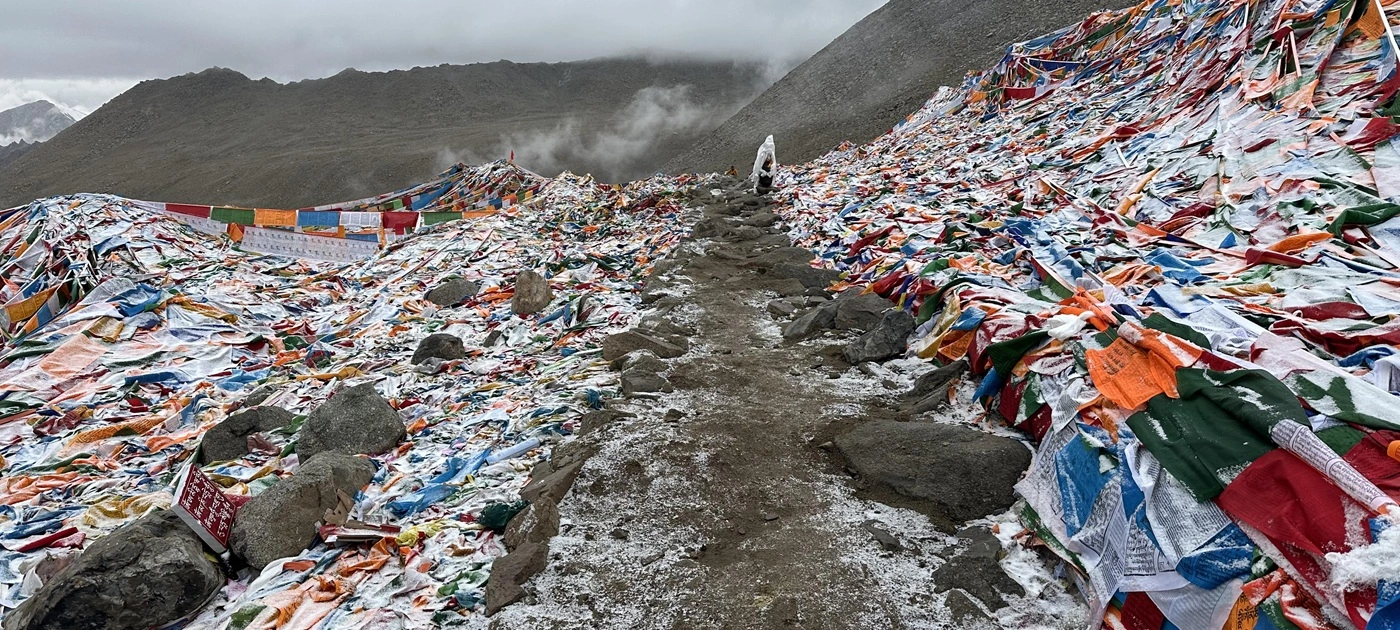
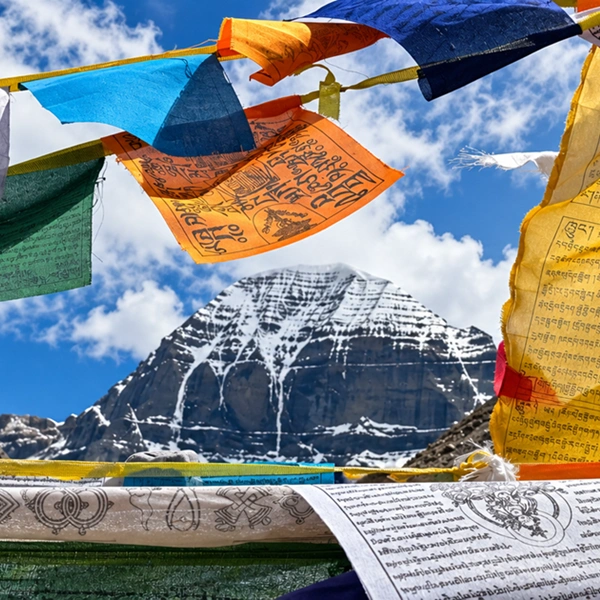
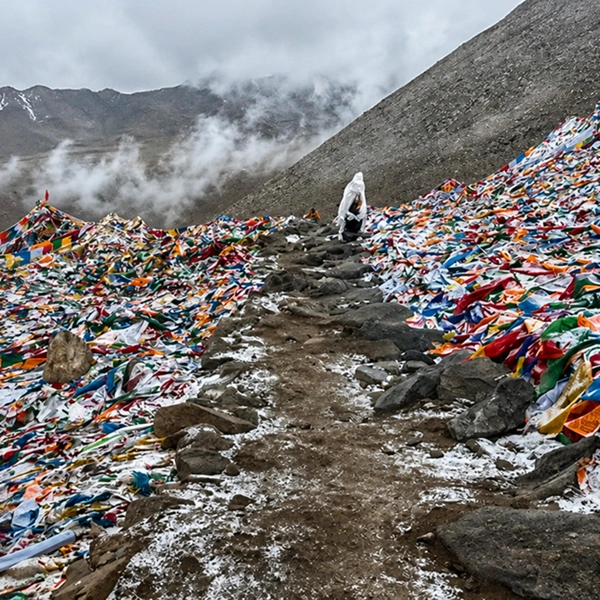
The summit of the Dolma La announces itself in color: thousands upon thousands of prayer flags strung between boulders, roaring in the wind, the accumulated prayers of centuries. At the center sits the Dolma Stone, where legend says the master Gotsangpa — who first opened this kora route — was guided through the mists by twenty-one wolves, emanations of the goddess Tara, who merged into the rock at the top.
The pass bears her name: Dolma in Tibetan, Tara in Sanskrit, compassion in any language.
Arrival is overwhelming and brief by design. The summit offers no shelter, its weather turns in minutes, and at this altitude every extra minute spent oxygen the body cannot spare. Fifteen to twenty minutes — prayers, photographs, a flag tied, katas offered — and our guides begin the gentle, firm process of moving everyone off the top.
Pilgrims sometimes protest the hurry. An hour later, watching afternoon cloud swallow the pass from far below, they understand it.
The Descent: Why Everyone Walks
What the climb does to lungs, the descent does to knees. Directly over the lip of the pass, the trail drops away steeply on loose scree and shifting stone — the stage's most injury-prone stretch, arriving precisely when legs are most spent.
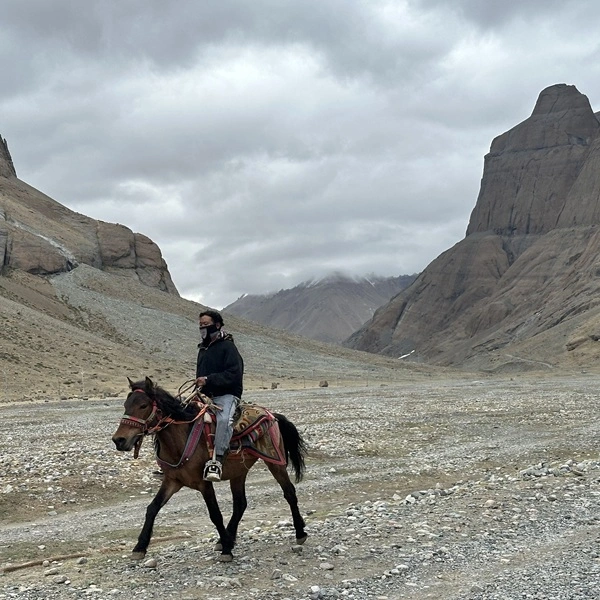
One rule here surprises pilgrims more than any other: the ponies stop. Riders who hired horses at Darchen for the ascent must dismount at the top, because the grade and the moving gravel make a laden animal's slip too dangerous to permit.
Every pilgrim — every age, every condition — walks this section on foot until the trail levels at the valley floor, where mounts are allowed again.
This is why we insist on two unglamorous things for every guest: trekking poles, used properly, and boots broken in over real distance before the trip. On this descent, they are not gear. They are joints and ankles, outsourced.
Gauri Kund: Look, Don't Touch
Below the pass, cupped in the rocks off the trail's edge, appears a small, perfectly round lake of impossible emerald: Gauri Kund, the Lake of Compassion, Parvati Sarovar. The Shiva Purana sets one of Hinduism's most beloved stories here — Parvati shaping her son Ganesha from turmeric paste at her bath, the guardian boy beheaded by Shiva in anger and restored with an elephant's head.
Devotion meets a hard limit at the shoreline, or rather, well above it. There is no safe path down; the water sits near freezing under part-ice even in summer; and immersion at this altitude is a fast route to hypothermic collapse.
Bathing here is both forbidden and, frankly, impossible to survive well.
The compliant ritual is the beautiful one anyway: darshan from the trail, and a sprinkle of water brought up in a bottle by a guide, touched to the head in blessing. The lake gives what it gives from a distance.
The Long Exhale to Zutulphuk
Past Gauri Kund the trail relents, flattening into a gradual valley walk of roughly ten kilometers to Zutulphuk at 4,790 meters — the Cave of Miracles, built around Milarepa's cell with its hand-pressed ceiling. The final hours are quiet ones; most pilgrims walk them saying very little, and not from exhaustion alone.
Arrival is its own ceremony: butter tea, soup, guesthouse beds upgraded with our bedding, and the particular sleep of people who have been over the top. The last morning's walk out to Darchen is short and gentle, three to four hours of decompression along the gorge.
Tradition adds a grace note to the whole crossing that we love to tell at dinner: the only being ever to reach Kailash's actual summit, the stories insist, was Milarepa himself — not by climbing, but by riding a ray of the morning sun to win his contest with the Bon master. Everyone else gets the pass. The pass is enough.
Preparing for the Crossing
The Dolma La is trained for months before it is walked. We ask guests to build toward it over at least twelve weeks: daily brisk walking rising to eight or ten kilometers, stair sessions several times weekly to teach the legs sustained ascent, and — the piece most people skip — downhill practice with poles, because it is the descent that finds the unprepared.
Breathing practice such as pranayama measurably helps calm the mind and build lung discipline at altitude.
Medically, the day is the reason the whole yatra's screening exists: physician clearance for heart and lungs, a pre-trip conversation about altitude medication such as acetazolamide, and the humility to report symptoms early.
On the mountain, our protocol does the rest — the acclimatization staircase of whichever route you chose, hydration held at three to four liters daily, no alcohol, daily oximeter checks, oxygen and evacuation cover carried throughout.
Which route you arrive by matters more than most pilgrims realize; our comparison of the three Kailash routes exists largely because of this one day.
A word on the inner kora, since the question always follows: a far harder circuit does pass beneath the south face, high, unmarked, and without shelter or rescue.
Access is heavily restricted and has been closed to pilgrims in recent years, and we neither run it nor recommend pursuing it—the story of that closed path is told in our Mount Kailash Mysteries guide. For every pilgrim we serve, the outer kora and the Dolma La are the summit of the journey.
And when you are ready to stand under those prayer flags yourself, our private Kailash Mansarovar journey builds the whole yatra — route, rest days, ponies, poles, and all — around getting you over this one pass well, on the standards we keep across all our luxury travel in the Himalayas.
FAQs — The Dolma La Pass
How difficult is the Dolma La Pass crossing?
It is the hardest single stage of the Kailash Yatra: roughly 22 kilometers over nine to twelve hours, climbing from Dirapuk at about 5,080 meters over the 5,630-meter pass and descending steeply to Zutulphuk, all in air holding roughly half of sea-level oxygen. No technical climbing is involved — the difficulty is altitude, duration, weather, and loose footing, in that order.
What is the hardest part of the Kailash Yatra?
The crossing of the Dolma La Pass, without serious competition. The approach routes are long but motorized, and the kora's first and last stages are moderate valley walks. The crossing stage concentrates the pilgrimage's highest altitude, longest hours, steepest descent, and most volatile weather into a single pre-dawn-to-dusk effort — which is precisely why tradition reads it as death and rebirth.
What is Shiva Tsal on the Kailash kora?
Shiva Tsal is a rocky expanse near 5,330 meters, midway up the climb to the Dolma La, understood in Hindu and Buddhist tradition as the realm of the Lord of Death. Pilgrims leave behind an item of clothing, a lock of hair, or a photograph, symbolically surrendering their past self and its karmic burdens before the rebirth of the pass above. Choose your offering the night before.
Why can't horses carry riders down from the Dolma La?
Because the descent's grade and loose, shifting scree make a slip by a laden animal unacceptably dangerous for the rider beneath it. Ponies hired at Darchen may carry pilgrims up the ascent, but every rider dismounts at the pass and walks the steep section on foot — regardless of age or fatigue — until the trail levels at the valley floor, where riding resumes.
Can you bathe in Gauri Kund?
No. The emerald lake below the Dolma La is among the yatra's most sacred sights, but immersion is forbidden and physiologically reckless: the water sits near freezing under partial ice, there is no safe path to the shoreline, and cold-water exposure at this altitude invites rapid hypothermia. Pilgrims take darshan from the trail, and guides sprinkle collected water as a symbolic blessing.
What time do pilgrims start the Dolma La crossing?
Between roughly three and four in the morning, by headlamp. The early start is weather strategy: the pass reliably brews wind, hail, and snow by afternoon, so the summit must be crossed while the morning is stable. The pre-dawn cold is severe, which is why warm layers, hot breakfast, and a deliberately slow opening pace are part of every sound plan.
What is the inner kora of Mount Kailash?
A shorter but far more dangerous circuit beneath the mountain's south face — high, unmarked, without lodges, water, or rescue, reaching well above the Dolma La. Access is heavily restricted and has been closed to pilgrims in recent years, and responsible operators do not run it. For virtually all pilgrims, the 52-kilometer outer kora over the Dolma La is the complete and definitive circuit.
How much oxygen is there at the top of the Dolma La?
Roughly half to sixty percent of sea-level oxygen availability, the consequence of barometric pressure falling with altitude. The body compensates with rapid breathing and an elevated heart rate even at rest, which is why the summit halt is kept to fifteen or twenty minutes and why hydration matters so much — fast breathing in freezing, bone-dry air dehydrates climbers faster than sweat ever would.
Need Help? Call Us+977 9851013196orChat with us on WhatsApp
Need Help? Call Us+977 9851013196