The Bumdra trek is the shortest overnight trek in Bhutan, and the only one that ends inside Tiger's Nest.
You climb from the Sang Choekhor Buddhist college above Paro to a wide meadow at about 3,800 meters, sleep beside a cliff monastery under more stars than seem reasonable, and walk down into Taktsang the next morning through its upper temples.
Two days. One camp. One unforgettable arrival.
Most visitors to Bhutan see Tiger's Nest the same way: a steep half-day climb from the valley floor, shoulder to shoulder with every other traveler in Paro. Bumdra flips the approach. You come to the monastery from the mountain above it, on a trail almost nobody else is walking.
This guide covers the route in both directions of effort — the climb to camp and the descent into Taktsang — plus the season windows, the fitness picture, what the night at altitude actually feels like, and how we run it as a private camp.
What is the Bumdra trek?
The Bumdra trek is a two-day, one-night camping trek in the Paro Valley that links Sang Choekhor College to Tiger's Nest Monastery over the ridge where Bumdra Monastery stands.
The full walk covers roughly 12 kilometers: six to seven up on the first day, five to six down on the second.
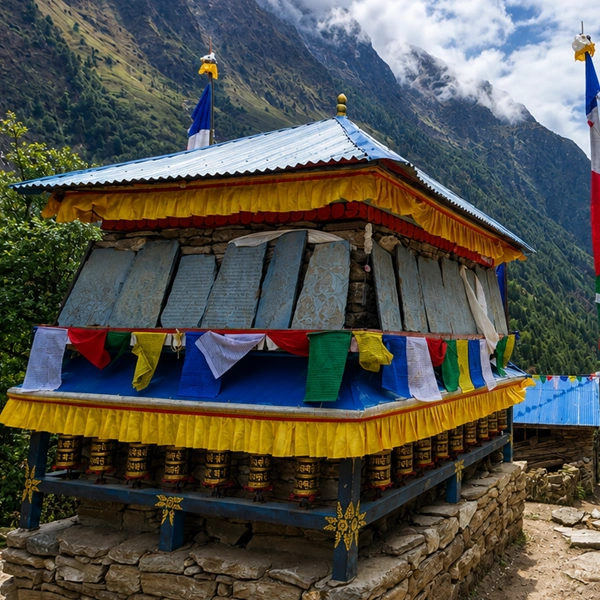
Bumdra itself is a small cliffside hermitage. The name is usually translated as the rock of a hundred thousand footprints — legend holds that a host of dakinis, the sky-dancers of Himalayan Buddhism, descended here and left their prints in the stone.
Monks still live at the hermitage, and the meadow below it is one of the finest legal campsites in Bhutan.
Here is the fact worth planning a trip around. The descent trail drops off the Bumdra ridge and delivers you to the topmost temples of the Taktsang complex, so you enter Tiger's Nest from above rather than climbing to it from the car park.
It is the same monastery every guidebook cover shows — reached through a door most visitors never learn exists.
The climb: Sang Choekhor to the meadow at 3,800 meters
The first day of the Bumdra trek climbs about 900 meters in four to five hours, almost all of it in the forest.
We drive you about forty minutes from Paro up to Sang Choekhor, a working Buddhist college at roughly 2,900 meters, where young monks in red robes watch the day's walkers set off with open amusement.
The trail starts in blue pine, cool and resin-scented, then shifts into oak and rhododendron as you gain the ridge. In spring, the rhododendrons flower in reds and pinks along whole sections of the path.
In autumn, the forest floor crunches, and the air is sharp enough that you can see every fold of the Paro Valley through the gaps in the trees.
About two-thirds of the way up, you reach Choe Tse Lhakhang, a small temple on a shelf of hillside with a straight view down the valley to Paro's airstrip.
Watching a Drukair jet thread the ridges below your boots is a strange and wonderful piece of perspective. It also makes a natural lunch stop, and our crew sets it accordingly.
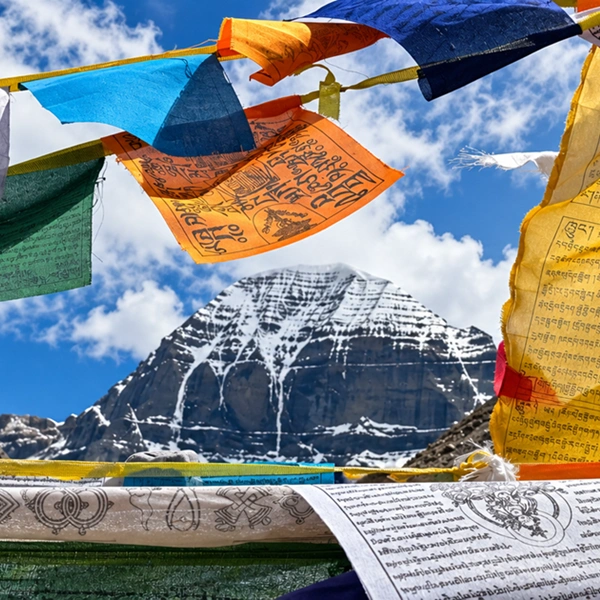
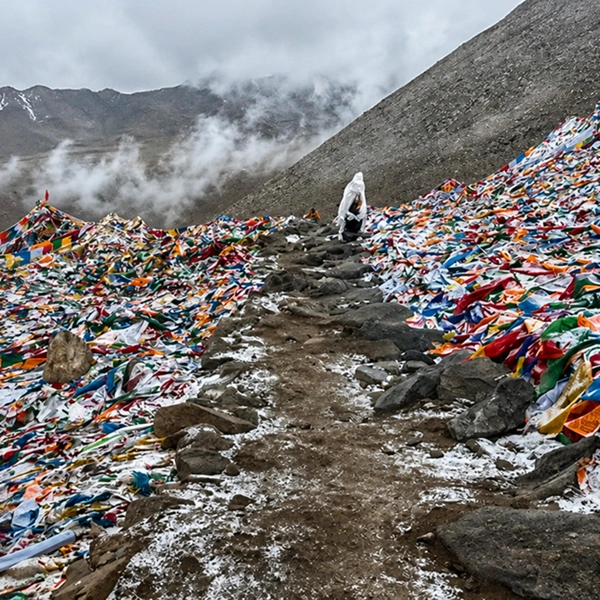
From the temple, the trail eases along the ridge through strings of prayer flags, then crests into the Bumdra meadow. The hermitage sits against the cliff above; the camp waits below it.
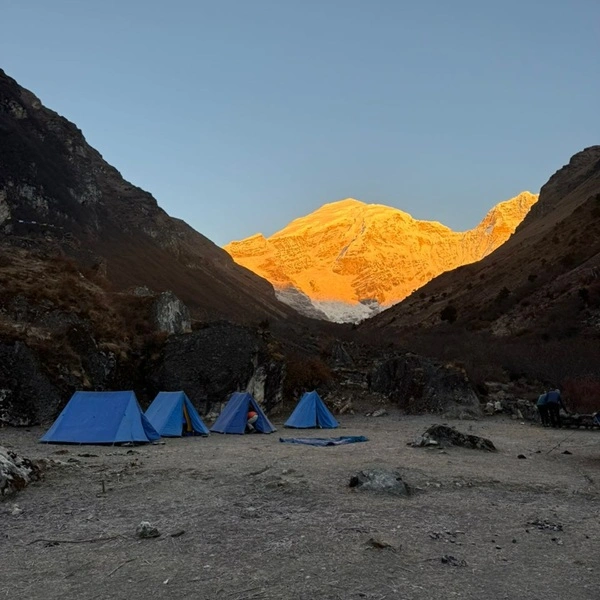
On clear evenings, the northern horizon shows snow peaks on the Tibetan border — climb thirty minutes above camp before sunset, and the wall of the high Himalaya opens up, with Jomolhari and Jichu Drake the giants among them.
The night at Bumdra camp
A night at Bumdra camp is the heart of this trek, and it is a proper camp, not an endurance exercise.
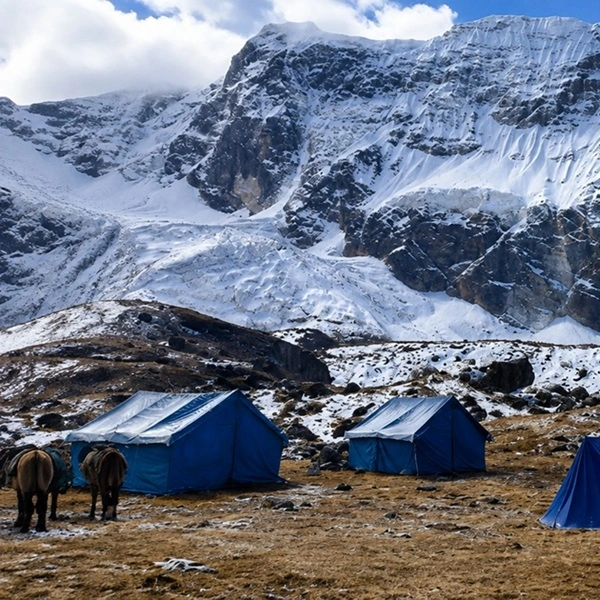
This is a standing camp on a legal site, which means real structure: walk-in tents, raised beds, a dining tent with a table set for dinner, and a toilet tent that does not require apologies.
Our crew walks in ahead of you to raise camp, so you arrive to butter tea and a fire already going.
Dinner is cooked on site — expect Bhutanese dishes like ema datshi alongside familiar comfort food, because chilies and cheese at 3,800 meters divide opinion, and we plan for both.
Hot water bottles go into the sleeping bags before you do.
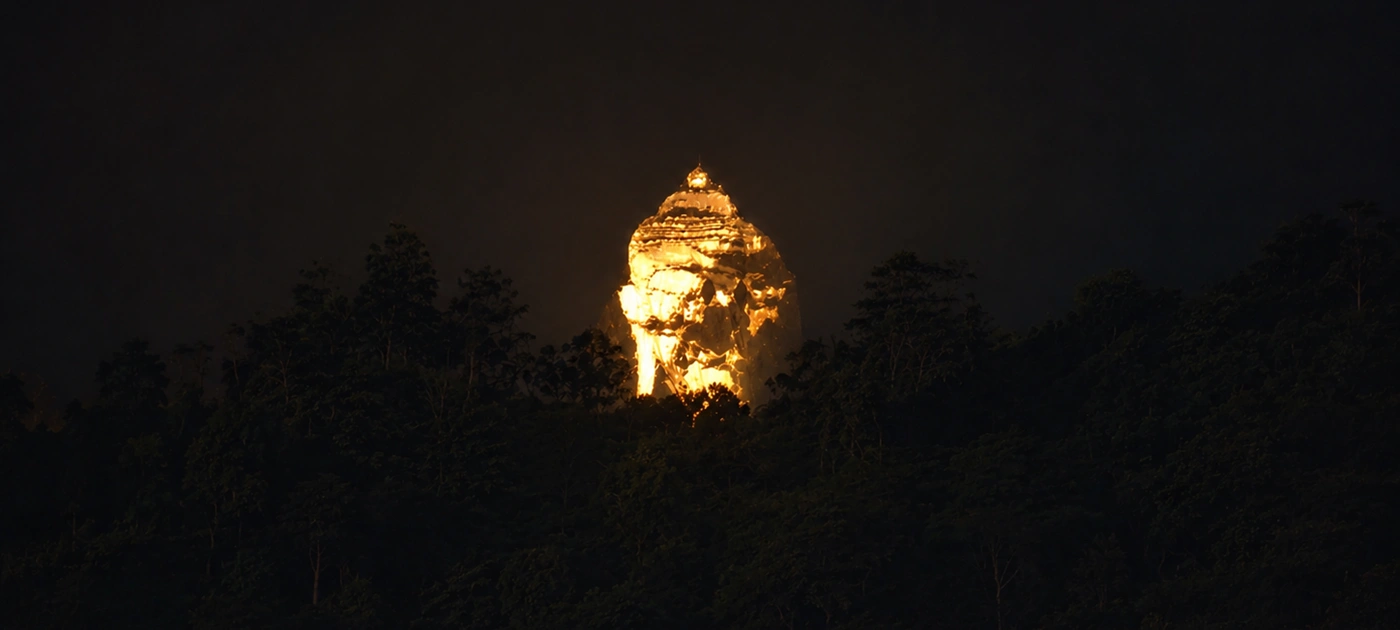
The temperature drops fast once the sun leaves the meadow. That is the trade for the sky you get. At this altitude, with no valley light below, the stars come out in layers, and the silhouette of the hermitage against them is the image guests describe longest afterward.
In the morning, the monks' horns sometimes carry down from the cliff before breakfast.
The descent into Tiger's Nest from above
The second morning involves a descent of around 1,000 meters over two to three hours, ending inside the Taktsang complex.
The trail leaves the meadow and falls steeply through old-growth forest, with wooden steps built into the sharpest sections. Trekking poles earn their place here; the gradient is honest.
Partway down, the temples begin. You pass Zangto Pelri and then Yoselgang, small gold-roofed lhakhangs stacked on the cliff line above Taktsang, each with its caretaker and its view.
By the time you reach the upper gate of Tiger's Nest itself, you have already been walking among its satellite shrines for half an hour.
Then the reveal. Tiger's Nest clings to its cliff 900 meters above the valley floor, and you look at it first from slightly above — the angle the postcards never show.
You tour the monastery with your guide, then continue down past the main viewpoint, the prayer wheels, and the cafeteria to meet your vehicle at the Ramthangkha road head.
The day-hikers you pass are still climbing. You are finishing.
We time the descent so you reach the monastery gate in the late morning, after the first crowd surge has thinned — one of the quieter windows Taktsang offers, and you arrive at it downhill, fresh.
Bumdra trek vs the standard Tiger's Nest hike
The Bumdra trek and the standard Tiger's Nest day hike end at the same monastery and share almost nothing else.
The day hike climbs about 700 meters from the Ramthangkha car park, takes four to six hours return, and travels the busiest trail in Bhutan. It is a fine walk. It is also everyone's walk.
Bumdra gives you the mountain as well as the monastery. You gain a night at altitude, a Himalayan sunrise, four cliff temples the day-hikers never see, and an approach to Taktsang with the crowds subtracted. The physical cost is one additional day and a longer, steeper descent.
Our honest steer: if your knees argue with sustained downhill, take the day hike. For everyone else with a spare night in Paro, Bumdra is the better version of the same pilgrimage.
Best time for the Bumdra trek
The best seasons for the Bumdra trek are spring (March to May) and autumn (late September to November). Spring brings the rhododendron bloom through the middle section of the climb and mild nights at camp.
Autumn brings the clearest air of the year, which matters here — the Jomolhari panorama above camp is an autumn specialty.
Winter treks run on clear, cold spells; the camp sits in hard frost, and we double the bedding, but the light is extraordinary, and the trail is empty.
The monsoon months from June to early September are the one window we steer guests away from — the descent's wooden steps turn slick, and clouds sit on exactly the views you came for.
Because this is a private trek, dates flex around you rather than a fixed departure list. We watch the forecast in the days before and can shift the camp night to catch a clear spell.
Difficulty, fitness, and altitude on the Bumdra trek
The Bumdra trek is moderate: about 900 meters of ascent on day one and a steep 1,000-meter descent on day two, on good trails. Anyone who can comfortably walk uphill for four to five hours will manage the climb. The descent asks more of knees than lungs.
Altitude deserves respect but not fear. Camp sits near 3,800 meters, high enough that some guests feel the thinner air on the final rise to the meadow.
We build the trek onto the back of two or three valley days in Paro and Thimphu at around 2,300 to 2,400 meters, which allows acclimatization to proceed quietly. Your guide carries a pulse oximeter and checks readings at camp as standard practice.
There is no technical ground anywhere on the route. It is a walk — a steep, high, beautiful one.
Packing for one night at 3,800 meters
Pack for a summer day and a winter night, because the Bumdra trek serves both within 24 hours. The climb is warm work in a base layer; the meadow after sunset needs a down jacket even in May. Our camp supplies the sleeping bags, liners, and hot-water bottles, so your list stays short.
- Broken-in hiking boots with ankle support
- Down jacket for camp
- Warm hat and gloves
- Base layers and a fleece
- Waterproof shell jacket
- Trekking poles for the descent
- Headlamp
- Sun hat, sunglasses, and high-SPF sunscreen
- Refillable water bottle
- Personal medications and blister care
Everything else — tents, bedding, dining kit, food, first aid, oxygen backup — travels with the crew, not with you. You carry a daypack; ponies carry the rest.
Arranging the Bumdra trek
Every Bumdra trek is run through a licensed Bhutanese operator, and we arrange the whole trip: your Bhutan visa, the Sustainable Development Fee, the licensed guide, the camp crew, and the Drukair or Bhutan Airlines flights into Paro.
There is no separate trekking permit to chase — Bhutan folds trail access into the visa and guide system, which is one reason its trails stay this quiet.
The trek slots naturally into a longer Bhutan journey. Most of our guests walk it in the middle of the week, which also covers Thimphu, Punakha, and the Paro Valley's dzongs, with the camp night placed after the valley days have done their acclimatizing work.
If Bumdra reads like your kind of night out, our Bhutan Bumdra trek sets out the full private program — the valley days around it, the camp standard, and the flight logistics — and we shape the rest of the week around what you want Bhutan to be.
Bumdra trek FAQs
How hard is the Bumdra trek compared with the standard Tiger's Nest hike?
The Bumdra trek is a clear step up but still moderate. The day hike to Tiger's Nest climbs about 700 meters; Bumdra climbs 900 meters to camp and then descends 1,000 meters the next morning, spread over two days. Fitness that handles a long uphill hill-walk handles Bumdra. The extra rewards — the camp night, the sunrise, the upper temples — sit on the far side of that extra effort.
How cold are the nights at the Bumdra camp?
Expect a real mountain night. In spring and autumn, the meadow typically falls to around freezing after dark, and winter nights sit well below it. The camp provides four-season sleeping bags, liners, hot-water bottles placed before you turn in, and a heated dining tent for the evening. You will want your down jacket from the moment the sun leaves the meadow.
Do I need a separate trekking permit for the Bumdra trek in Bhutan?
No. Bhutan does not have a standalone trekking permit system like Nepal does. Access to the Bumdra trail comes bundled with your Bhutan visa and the requirement to travel with a licensed guide, both of which we arrange. Your part of the paperwork is a passport with six months' validity; the rest is handled at our desk in Kathmandu before you fly.
Which peaks can you see from the Bumdra meadow?
On a clear evening, the ridge above Bumdra camp opens a long view of the snow peaks along Bhutan's northern border, with Jomolhari — the sacred mountain at 7,326 meters — and the sharp pyramid of Jichu Drake, the two you will remember. Autumn gives the most reliable panorama. The viewpoint is about thirty minutes above camp, and we time the walk up for the pre-sunset light.
What time do you reach Tiger's Nest on the Bumdra descent in the morning?
Late morning, by design. Leaving camp after a relaxed breakfast puts you at the upper gate of Taktsang around the time the first wave of day-hikers is thinning, so you tour the monastery in one of its quieter windows. You then walk down past the main viewpoint to the Ramthangkha road head and are usually back at your Paro hotel by mid-afternoon, in time for a hot stone bath.
Can the Bumdra trek be done in winter?
Yes, on clear spells, and it can be spectacular — hard-frost mornings, empty trails, and the sharpest mountain light of the year. The camp runs colder, so we add bedding and keep the dining tent heated, and we build flexibility into the schedule to place the camp night within a settled-weather window. If a front moves in, we walk the route as two valley day hikes instead and keep the Taktsang visit.
How far do you walk each day on the Bumdra trek?
Day one covers about 6 to 7 kilometers and 900 meters of ascent, normally taking four to five hours of walking with a temple lunch stop. The descent day covers five to six kilometers, dropping roughly 1,000 meters in two to three hours, plus your time inside Tiger's Nest. Twelve-ish kilometers in total — short on distance, generous on everything else.
Who runs the camp on a private Bumdra trek?
Your own crew. On our private departures, the camp team walks in ahead of you to raise the tents, cook, and set the dining table, and a licensed Bhutanese guide walks the trail with you throughout. Ponies carry the loads, so you climb with a daypack. It is the same crew-to-guest logic we use at our Nepal camps: the mountain does the drama; the team removes the friction.