Bumthang is where Bhutan keeps its oldest stories. Four valleys in the center of the kingdom hold the temple where Buddhism first touched this soil, the rock bearing Guru Rinpoche's body imprint, and a gorge pool where a saint dived in holding a burning lamp and emerged with treasure.
Ask a Bhutanese guide which single district they would show a guest, and Bumthang comes up more than anywhere else.
It is also further than most itineraries reach. The valleys sit between two mountain passes east of Punakha, which is exactly why they stay quiet.
This guide covers what to see, the walk that links the three great temples, the truth about the Burning Lake, and why Bumthang is the natural hinge for a journey into eastern Bhutan.
Where is Bumthang in Bhutan, and how do you reach it?
Bumthang lies in central Bhutan, roughly 260 kilometers east of Paro by road, and you reach it either by a short domestic flight or a full day's drive through Trongsa.
The flight from Paro to Bathpalathang Airport near Chamkhar town takes about 35 minutes and is the single biggest time-saver in Bhutan travel, though it operates only on set days and depends on morning weather.
Schedules shift by season, so we confirm flights at booking and always hold a road plan in reserve.
The drive earns its hours. From Punakha, the road crosses Pele La at around 3,420 meters, drops past Trongsa Dzong on its ridge above the Mangde Chhu, then climbs again over Yotong La at a similar height before easing down into the Chhume valley.
We break the journey with a night in Trongsa rather than pushing through, so you arrive in Bumthang rested instead of road-worn.
Bumthang itself is not one valley but four: Chhume, Choekhor, Tang, and Ura. Choekhor is the main valley, home to Chamkhar town, Jakar Dzong, and the three temples that this guide is built around. Tang hides the Burning Lake. Ura, the highest, is the doorway east.
The Choekhor temple walk: three temples, one morning
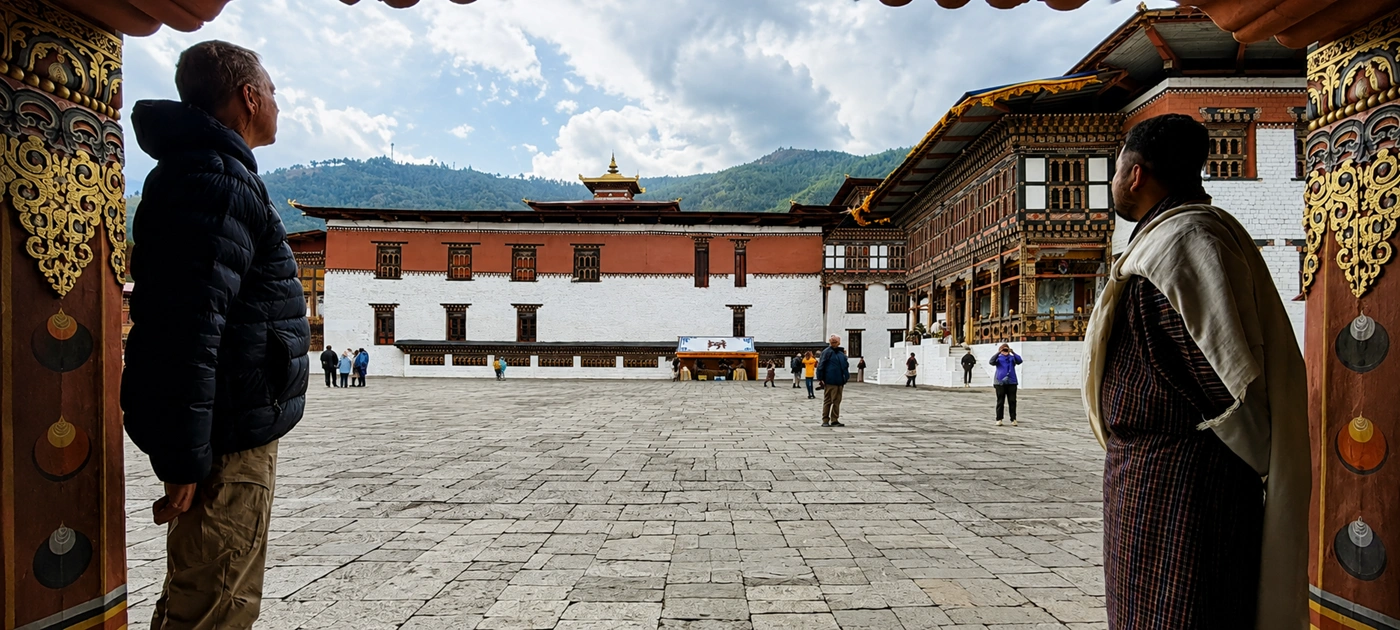
The three temples of the Choekhor valley, Jambay Lhakhang, Kurjey Lhakhang, and Tamshing Lhakhang, can be walked as a single loop of under four kilometers.
Most visitors drive between them and see car parks. We walk it, because the lane between Jambay and Kurjey passes farmhouses drying chilies on their roofs, and the crossing to Tamshing is a suspension bridge strung with prayer flags over the grey-green Chamkhar Chhu.
We walk the loop clockwise, starting at Jambay Lhakhang, which puts you at Tamshing before the midday vehicles arrive from town. Allow a full morning. Rushing three of the holiest buildings in the Himalayas into ninety minutes misses the point of coming this far.
Jambay Lhakhang: the 7th-century beginning
Jambay Lhakhang is one of the oldest temples in Bhutan, built in the 7th century by the Tibetan king Songtsen Gampo. Legend holds he built 108 temples in a single day to pin down a demoness who lay across the Himalayas; this one holds her left knee, while Kyichu Lhakhang in Paro pins her left foot.
Standing in both on one journey means touching the two oldest points of Buddhism in the kingdom.
The temple's inner sanctum keeps a statue of Jampa, the Buddha of the future, behind a chain-link curtain darkened by twelve centuries of butter-lamp smoke. Walk the outer corridor slowly.
The prayer wheels here are turned by grandmothers from the surrounding farms, morning and evening, the same way they have been for generations.
Kurjey Lhakhang: the body imprint in the rock
Kurjey means "body imprint," and the name is literal. In the 8th century, Guru Rinpoche meditated in a cave here while subduing Shelging Karpo, the local deity who had sickened the king of Bumthang, and the rock is said to hold the print of his back.
The oldest of the three temples on the site encloses that cave; the newer two were added by Bhutan's first king and, later, by the royal grandmother.
A wall of 108 whitewashed chortens rings the complex, and a tall Himalayan cypress stands behind the upper temple, traditionally said to have grown from the Guru's walking staff.
Pilgrims circle the wall clockwise. Join them for one circuit before you go in, and keep your right shoulder to the chortens.
Tamshing Lhakhang: Pema Lingpa's own temple
Tamshing Lhakhang was founded in 1501 by Pema Lingpa, Bhutan's great treasure-revealer, and he is said to have painted parts of it with his own hands.
The murals inside are among the oldest surviving in Bhutan, faded to soft ochres and blues, and the low inner corridor still holds the cloak of iron chain mail he forged himself.
Pilgrims lift it onto their shoulders and carry it three times around the sanctum for merit; it is heavier than it looks, and the monks will grin when you discover that.
The temple appears on UNESCO's tentative World Heritage list, yet on an ordinary morning you may share it with only a caretaker monk and the sound of the river. That ratio of significance to crowd exists almost nowhere else in the Himalayas.
Membartsho: Why the Burning Lake burns
Membartsho, Bhutan's famous Burning Lake, is not a lake at all: it is a deep, still pool in a narrow gorge of the Tang Chhu River, about a 40-minute drive from Chamkhar into the Tang Valley.
The name comes from Pema Lingpa. In the 15th century, challenged by a doubting crowd, he dived into the pool holding a lit butter lamp and surfaced holding a treasure chest, the lamp still burning. The site has been sacred ever since.
You reach the gorge on a short forest path, cross a small footbridge sheeted in prayer flags, and look down into water so dark it reads as bottomless.
Rock niches above the pool hold rows of butter lamps. Our guides bring lamps from Chamkhar so you can light one yourself and place it among them, turning a viewpoint stop into the quiet ritual the place deserves.
Go early. The gorge holds its stillness at first light, and the flags overhead move before the wind reaches the water.
Beyond the temples: Jakar Dzong, Chhume weaving, and Ura
Jakar Dzong, the "castle of the white bird," watches the whole Choekhor valley from its ridge above Chamkhar, and its curtain wall runs longer than almost any dzong in Bhutan. It is a working district headquarters rather than a museum, which is precisely its appeal.
Time your visit for the late afternoon, when the light comes up the valley and the courtyards empty.
The other valleys reward a slower itinerary. In Chhume, the village of Zugney weaves yathra, the boldly patterned wool cloth that belongs to Bumthang alone, and you can watch it come off backstrap looms at the roadside.
In Tang, beyond Membartsho, the manor of Ogyen Choling runs a family museum of pre-modern Bhutanese life that we rate among the finest small museums in the Himalaya.
Ura, at around 3,100 meters, is the highest and oldest of the four valleys, a tight cluster of stone houses around its own lhakhang. The road through it climbs to Thrumshing La and drops into eastern Bhutan. Stand at the pass and the entire eastern half of the kingdom opens below you.
What Bumthang tastes like
Bumthang's kitchen is built on buckwheat because the valleys sit too high for rice. Khule, thin buckwheat pancakes, come folded warm off a farmhouse griddle; puta, buckwheat noodles, arrive tossed with mustard oil and Sichuan pepper. Both taste of the place in a way imported rice never could.
The valley also carries a Swiss inheritance. A dairy project founded here decades ago still produces Bhutan's best-known cheese, and the same legacy gave rise to Chamkhar's small brewery, whose unfiltered wheat beer is poured across the country.
Add dark Bumthang honey and autumn apples, and you have the most distinct regional table in Bhutan. We build a farmhouse lunch into every Bumthang program, and the khule is the dish guests mention afterward.
When to visit Bumthang
The reliable windows are spring, from March to May, and autumn, from late September to early December, when skies are clearest and the passes on the drive stay open.
Spring brings blossoms to the apple orchards and rhododendrons to the pine forests. Autumn brings harvest, buckwheat cut and stacked in the fields, and the festival season.
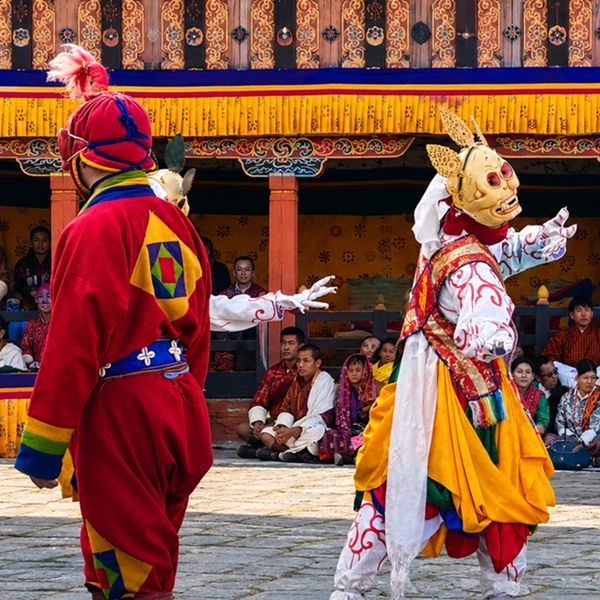
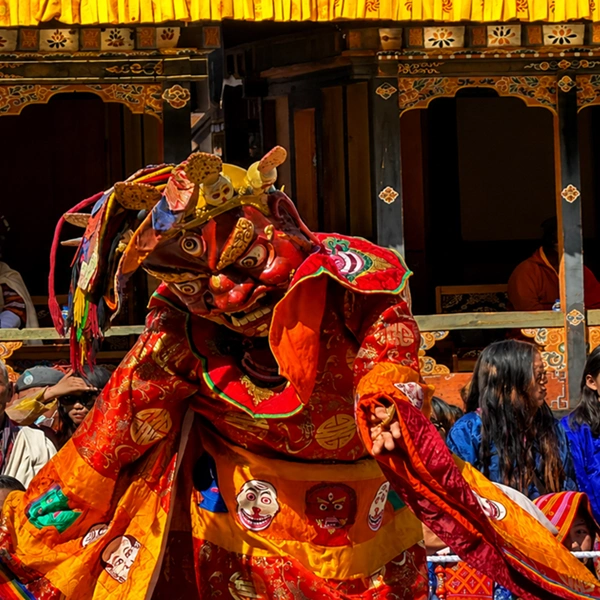
The valley's great gathering is the Jambay Lhakhang Drup, held in autumn around the ninth month of the lunar calendar, with exact dates fixed each year by astrologers and confirmed at the time of booking.
Its Mewang fire blessing sends the crowd running beneath a burning gate of dry grass after dark, and the temple's rarest rites are danced at night.
It is raw, crowded, and unforgettable; our Bhutan festival guide covers how the tshechu calendar works and how far in advance festival departures need to be booked.
Winter is underrated. The valleys stay open, mornings are frosted and brilliant, and you will have Tamshing to yourself. Only midsummer, with its monsoon clouds and slow roads, argues against the trip.
How many days, and where does Bumthang fit your route
Give Bumthang at least three nights. One day for the Choekhor temple loop and Jakar Dzong, one for Tang with Membartsho and Ogyen Choling, and one to breathe, walk a ridge, or sit in a farmhouse kitchen.
Two nights force choices this valley should never have to make.
Altitude is gentle by Himalayan standards. Bumthang sits between roughly 2,600 and 3,100 meters, high enough to feel alpine but low enough that most travelers acclimatize without difficulty, especially after nights in Thimphu and Punakha on the way in.
The Sustainable Development Fee and visa apply here, as they do everywhere in Bhutan, and we arrange both as part of your booking.
The strategic point is this: Bumthang is where the road east begins. Most itineraries turn back to Paro from here, and the flight home from Bathpalathang makes that easy.
But cross Thrumshing La instead, and you enter Mongar, Lhuentse, and Trashigang, the least-visited luxury frontier in the Himalaya, with Bumthang as your last familiar base.
Our private journey through eastern Bhutan is built on exactly that logic, using these valleys as a gateway rather than a terminus. However far you take it, Bumthang is the part of Bhutan that stays with you the longest.
Frequently Asked Questions
How do you get from Paro to Bumthang — fly or drive?
Both work, and the best luxury pattern uses each once. The Paro–Bathpalathang flight takes about 35 minutes but operates on limited days and depends on clear mornings, so we confirm schedules at the time of booking. The road takes a full day over Pele La and Yotong La via Trongsa. We usually drive eastward with an overnight in Trongsa, then fly back, so you see the interior once without repeating it.
Can Jambay Lhakhang, Kurjey Lhakhang, and Tamshing Lhakhang be visited in one day?
Yes, comfortably, and on foot. The three temples form a walking loop of under four kilometers in the Choekhor valley, linked by a farm lane and a suspension bridge over the Chamkhar Chhu. We give the loop a full morning, starting at Jambay Lhakhang, so each temple gets unhurried time, and you reach Tamshing before day-trip vehicles arrive.
Why is Membartsho called the Burning Lake if it isn't a lake?
The name records a miracle, not geography. Membartsho is a deep pool in a gorge of the Tang Chhu where, in the 15th century, the saint Pema Lingpa dived in, holding a lit butter lamp, and surfaced with a treasure chest, the lamp still alight. "Burning Lake" preserves that image. The site is reached by a short forest path and a prayer-flag-covered footbridge.
What altitude is Bumthang at, and is altitude sickness a concern there?
Bumthang's valleys sit between about 2,600 meters at Chamkhar and 3,100 meters at Ura, which most travelers handle easily. Serious altitude illness is rare at these heights, particularly on itineraries that reach Bumthang after nights in Thimphu and Punakha. The drive-in does cross passes above 3,400 meters, but you sleep well below them, which is what matters physiologically.
When is the Jambay Lhakhang Drup held?
The Jambay Lhakhang Drup takes place in autumn, around the ninth month of the Bhutanese lunar calendar, with exact dates set annually by astrologers. Its night ceremonies include the mewang, where the crowd runs beneath a burning gateway of dry grass for blessing. Because dates shift each year and the valley's rooms fill early, we confirm festival departures well in advance and lock in accommodation at booking.
What food is Bumthang Valley known for?
Buckwheat defines the Bumthang table: khule pancakes and puta noodles, both grown and made in the valley because it sits too high for rice. The valley's Swiss-founded dairy legacy adds Bhutan's best-known cheese and an unfiltered wheat beer brewed in Chamkhar, alongside dark local honey and autumn apples. A farmhouse lunch here is the single best regional meal in Bhutan.
How many nights does a luxury itinerary need in Bumthang?
Three nights is the honest minimum. One day covers the Choekhor temple loop and Jakar Dzong, a second covers the Tang Valley with Membartsho and the Ogyen Choling Museum, and a third leaves room for Chhume's yathra weavers or simply a valley walk. Two nights mean seeing Bumthang; three mean feeling it.
Is Bumthang the right base for continuing into eastern Bhutan?
Yes — it is the gateway. The lateral road climbs from Ura over Thrumshing La and descends into Mongar, opening Lhuentse and Trashigang beyond. Bumthang is the last valley with a domestic airport and the natural place to rest, provision, and acclimatize to the Bhutanese rhythm before the east. Our eastern journeys are structured around it for exactly that reason.