Chitwan vs Bardia comes down to one trade-off: Bardia offers Nepal's best wild tiger odds, while Chitwan offers easier access and the country's strongest rhino and gharial viewing. Serious tiger-trackers should choose Bardia, first-timers short on time should choose Chitwan, and anyone who can spare ten days should do both.
Chitwan vs Bardia: Which Is Better for a Nepal Tiger Safari?

Chitwan vs Bardia is the first real decision anyone planning a Nepal tiger safari has to make. Both are protected lowland parks in the Terai. Both hold Royal Bengal tigers, greater one-horned rhinos, and wild elephants. But they are not interchangeable, and picking the wrong one for your priorities is the difference between a trip that delivers and one that leaves you wishing you'd gone west. We run private safaris in both parks every dry season, so here is the honest comparison, not the brochure version.
The short answer
If tigers are the whole point, go to Bardia. If you want the surest rhino sightings, the easiest logistics, and a shorter trip, go to Chitwan. Bardia National Park has lower visitor numbers, more open grassland, and a higher tiger density, which is why we build our longer safaris around it. Chitwan National Park is Nepal's most accessible reserve and the best first taste of the jungle. The two answer different questions, and the rest of this guide is about matching the park to yours.
Where each park sits, and how you get there
Access is the clearest split between the two. Chitwan lies in south-central Nepal, a 20-minute flight from Kathmandu to Bharatpur, followed by a short drive, which is why it draws the bulk of Nepal's wildlife visitors.
Bardia sits in the far west, harder to reach and all the better for it. Most travelers fly from Kathmandu to Nepalgunj, then drive a couple of hours north to the park edge near Thakurdwara. That extra leg is exactly what keeps Bardia quiet. While Chitwan can feel busy at the popular river crossings in peak season, Bardia's tracks are often empty, and a tiger sighting there is rarely shared with a line of other jeeps.
Tigers: why Bardia wins for big cats
Bardia is the strongest place in Nepal to track a wild tiger, full stop. At 968 square kilometers, it is the largest national park in the Terai, with wide phanta grasslands and the braided channels of the Karnali and Babai rivers, the kind of open country where a cat crosses in plain view rather than melting into thick forest.
Nepal has been one of conservation's rare tiger success stories, roughly tripling its wild tiger population since the late 2000s low point. The Babai Valley in Bardia, resettled and left to wildlife, has become one of the densest tiger pockets in the country. On our March departures, we've watched a tigress move two cubs across the dry Karnali floodplain from a machan while the group held its breath for close to an hour.
Chitwan is home to tigers, too, and sightings are common. But the denser forest and heavier footfall make them harder to see. For the trip built around the tiger itself, Bardia is the answer.
What Chitwan does better
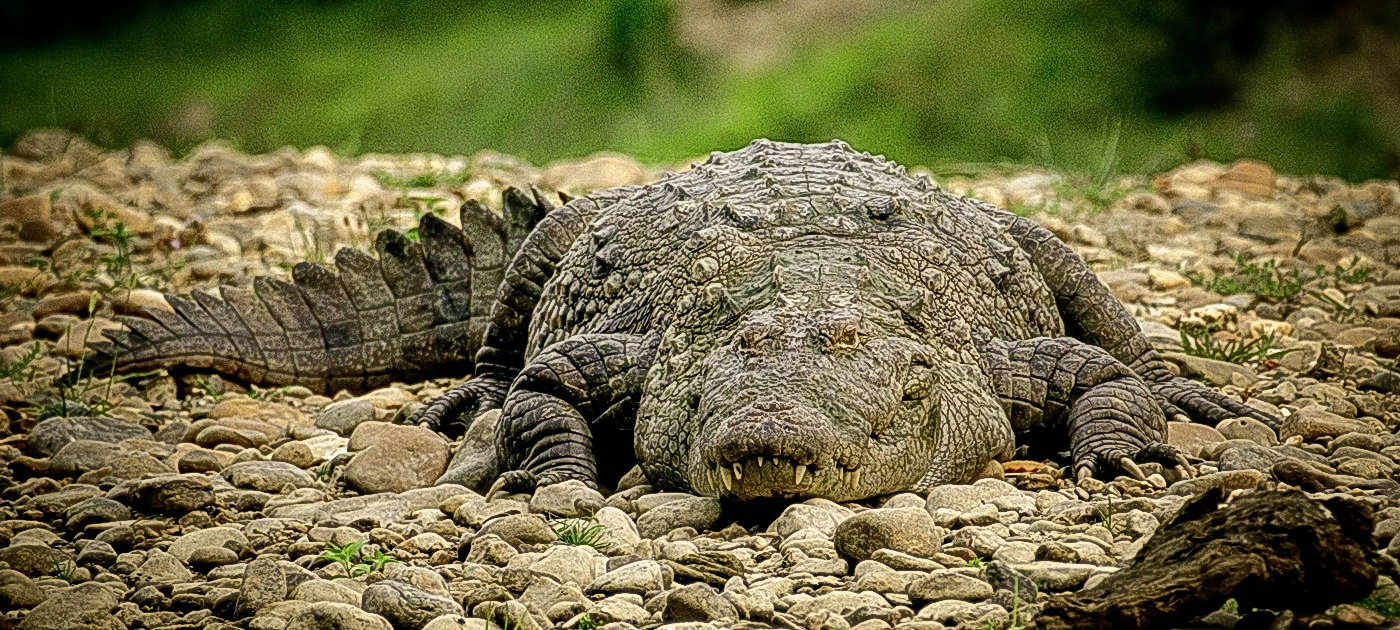
Chitwan wins on rhinos, access, and ease. It protects Nepal's largest population of greater one-horned rhinos, and on a morning drive through the elephant grass and riverine forest, your odds of a close rhino encounter are excellent. This is also the park to see both of Nepal's crocodilians well: the broad-snouted marsh mugger and the rare, fish-eating gharial, best found drifting the Narayani or Rapti by canoe.
As Nepal's first national park, gazetted in 1973 and inscribed as a UNESCO World Heritage Site in 1984, Chitwan has the most developed guiding and the smoothest logistics in the country. For a first Nepal safari, a family trip, or a short add-on to a mountain holiday, it's the sensible pick. You reach it fast, you see a great deal quickly, and the walking is gentle.
The wider cast: what else you'll see
Both parks reward patience with far more than their headline species. Wild Asian elephant, sloth bear, spotted and swamp deer, and the elusive four-horned antelope range across both.
Bardia holds one animal Chitwan cannot match easily: the Gangetic river dolphin, a blind freshwater porpoise that surfaces in the deeper bends of the Karnali, one of only a handful of Nepalese rivers where it survives. Birdlife is exceptional in each park, with hundreds of species from giant hornbills to kingfishers strafing the water. A good naturalist keeps a running list, and by the end of a week, it runs long.
Best time to visit each park
The seasons that suit Chitwan and Bardia are the same, and they matter more than the choice of park. The two windows are mid-March to mid-June and mid-October to mid-December.
Spring, before the monsoon, is peak tiger season in both parks. The grass has been cut and burned back, water sources have shrunk, and animals concentrate near the rivers, which sharply increases sighting odds. It is hot, often well above 35°C by midday. Autumn, after the rains, brings clear, comfortable air, green forest, and superb birding, but taller grass and harder cat sightings. Both parks scale back during the summer monsoon, when tracks flood, so we don't run this route in July or August.
Crowds, cost, and how many days you need
Give Chitwan two to three nights and Bardia three to four. Chitwan's highlights: rhino drives, a river canoe, a walking safari, and land in a couple of full days. Bardia asks for more time because tiger tracking is a waiting game, and the extra day is often the one on which the sighting happens.
On cost, the parks are broadly similar for permits and lodging at the luxury end, and the real variable is how you travel and how private you go. A shared, standard tour of Chitwan is the cheapest way into the jungle. A private safari with your own naturalist and vehicle, especially one that reaches remote Bardia, sits higher, and buys you flexibility the group bus can't.
Standard tour vs private luxury safari
The bigger decision often isn't the park but the style. A standard Chitwan package puts you in a shared jeep on a fixed schedule with a group you didn't choose, which is fine for a quick look and hard on a real sighting, since noise and timing aren't yours to control.
A private safari flips that. Your naturalist, your jeep, your pace, and a day that bends to the animals rather than the timetable. On a tiger stakeout, control is the whole game. It's also what makes pairing the parks practical, because the logistics of moving from Chitwan across to Bardia are handled for you rather than left to public transport and guesswork.
Why do we run both, not one
Most operators sell Chitwan alone because it's close and easy. We think that misses the better half of Nepal's wildlife. Our answer to Chitwan vs Bardia is to stop treating it as either-or.
Our 10-day private safari links them, Chitwan for rhino, gharial, and an easy start, then west to Bardia for the serious tiger tracking, with Lumbini, the birthplace of the Buddha, threaded in between. You get the surest sightings of the accessible park and the wild heart of the remote one, without doubling back or wrestling the logistics yourself. If you have the time, that's the trip we'd point you toward.
Chitwan vs Bardia FAQs
Is Bardia or Chitwan better for seeing a wild tiger?
Bardia is better for tigers. It has lower visitor numbers, more open grassland along the Karnali and Babai rivers, and a higher tiger density than Chitwan. Chitwan holds tigers too, but its denser forest and heavier footfall make them harder to spot. For a trip built around the cat, choose Bardia.
Can you visit both Chitwan and Bardia on one trip?
Yes, and it's the strongest option if you have the time. A single route can start in Chitwan for rhino and river life, then move west to Bardia for tiger tracking, often with Lumbini in between. Around 10 days comfortably cover both parks without rushing or backtracking.
How much harder is it to reach Bardia than Chitwan?
Noticeably harder, which is part of its appeal. Chitwan is a 20-minute flight from Kathmandu, plus a short drive. Bardia usually means a flight to Nepalgunj in the far west, followed by a two-plus-hour drive to the park. That extra distance is exactly why Bardia stays quiet.
Which park is quieter, Chitwan or Bardia?
Bardia is far quieter. Chitwan is Nepal's most visited park, and its popular river crossings can feel busy in peak season. Bardia's tracks are often empty, and tiger sightings there are rarely shared with a queue of other vehicles, which makes the whole experience feel wilder.
Do you need more days in Bardia than in Chitwan?
Usually, yes. Chitwan's main experiences can be done in two to three nights. Bardia rewards three to four days because tiger tracking is a waiting game, and the extra day is often when the sighting comes. If your priority is tigers, weigh your nights toward Bardia.
Which national park is better for a first-time Nepal safari?
For a first safari or a family trip, Chitwan is the easier pick. It's easy to reach, the guiding is well established, the walking is gentle, and rhino and crocodile sightings are nearly reliable. Travelers set on tigers, or on a wilder feel, should add Bardia or choose it outright.
Planning your first Nepal tiger safari? Our private Luxury Nepal Wildlife Safari links Chitwan and Bardia over ten unhurried days, so you don't have to choose. We'd be glad to help you shape it around your dates.
Need Help? Call Us+977 9851013196orChat with us on WhatsApp
Need Help? Call Us+977 9851013196