Dingboche vs Pheriche is the acclimatization decision that shapes the second half of every Everest Base Camp trek. Dingboche sits 170 meters higher, with a better climb-high day hike. Pheriche holds the region's aid post. Most well-built itineraries use Dingboche going up and Pheriche coming down.
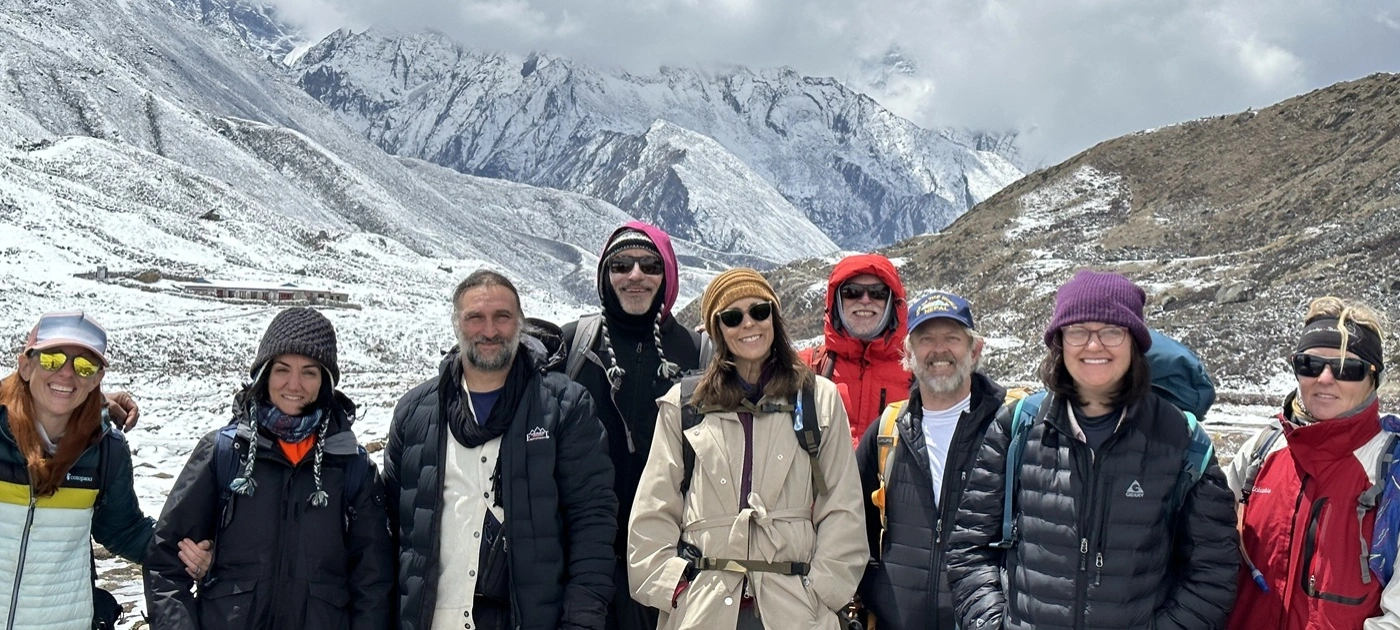
Dingboche vs Pheriche: Which Acclimatisation Stop Belongs in Your Everest Trek

The Dingboche vs Pheriche question decides where you spend the two most important nights of an Everest Base Camp trek. Both villages sit just above 4,200 meters.
Both are an easy walk apart. Yet they do completely different jobs for your body, and picking the wrong one costs people their trek every season.
We run this section of trail through both peak windows each year. Here's how we choose, and why our guests almost always sleep in both.
Dingboche vs Pheriche: the short answer
Dingboche is the better place to acclimatize, and Pheriche is the better place to be unwell. Dingboche sits at 4,410 meters in the Imja valley, sheltered from the wind, with a steep ridge above it that makes a proper climb-high day possible.
Pheriche sits at 4,240 meters in a wind-funnel valley and holds the Himalayan Rescue Association aid post.
The two are roughly three kilometers apart and about 45 minutes of walking over the low ridge between them. That short distance hides a genuine difference in how each village treats your body.
Our Khumbu programs stop two nights in Dingboche on the way up and one night in Pheriche on the way down. You get the adaptation where you need it and the medical cover where you're most likely to need it.
Where the trail actually splits
The fork comes shortly above Orsho, at a flat gravel area local guides call Samso Ogma. Up to that point every trekker walks the same trail from Tengboche through Pangboche and Shomare, rhododendron giving way to juniper scrub and then to nothing but stone.
The right-hand branch drops to a bridge over the Imja Khola and climbs into the Imja valley towards Dingboche. The left-hand branch stays high on the northern side and runs up the Pheriche valley.
They rejoin at Thukla, at the foot of the moraine. From there everyone climbs the same brutal 45-minute slope to the memorial cairns on the Thukla pass at about 4,830 meters, then continues to Lobuche. So the choice is a two-night detour, not a change of route.
How high is each village, and does 170 meters matter?
Dingboche is 4,410 meters. Pheriche is 4,240 meters. On paper, the 170-meter gap looks like nothing. In practice it's the difference between a night that pushes your adaptation and a night that lets it idle.
Sleeping altitude is what drives acclimatization, not the highest point you reached during the day. Every night you spend at 4,410 meters is a night your kidneys and lungs are working harder to catch up, which is exactly the preparation you need for Lobuche at 4,940 meters.
Oxygen saturation at this altitude typically reads in the mid-80s for a well-acclimatized trekker, against 98 percent at sea level. That number alone doesn't decide anything. Cold fingers give false low readings, and a reading only means something next to how you actually feel and how you slept.
The microclimate gap: sun in Dingboche, wind in Pheriche
Dingboche is warmer in the afternoon, and that matters more than it sounds. The village sits on a broad, south-facing shelf that catches sun from mid-morning until the shadow line comes over the ridge, and the surrounding ridges block most of the wind that pours down the main Khumbu corridor.
Pheriche has no such shelter. Its valley acts as a funnel, and the wind starts most afternoons around one o'clock and doesn't ease until dark. Air temperatures in the two villages are close to identical. The wind chill is not.
Staying warm at altitude is expensive. Shivering burns oxygen your body would rather spend on adapting, so a cold, wind-battered afternoon spent hiding indoors is an afternoon of acclimatization you didn't get.
That's the real cost of the Pheriche wind. Not discomfort — lost adaptation time. In Dingboche, people wander the stone-walled barley terraces after lunch, which is precisely the gentle movement that helps.
Why Dingboche wins the acclimatization day
Dingboche has the better rest-day hike, and it isn't close. Directly above the village, the Nangkartshang ridge rises to 5,083 meters, reached by a steep, unrelenting trail that starts from the top houses.
What the Nangkartshang morning involves
The standard walk climbs to roughly 5,000–5,100 meters and comes straight back down for lunch. That's about 600 vertical metres up and 600 back, in three to four hours, on loose ground with prayer flags marking each false summit.
It is a rehearsal. The altitude you touch on that ridge is higher than Gorak Shep, so your body gets the shock in daylight and recovers it in sleep. People who do this walk properly tend to have a far easier time on the Lobuche night.
The Chhukung alternative
Walking east up the Imja valley towards Chhukung at 4,730 meters gives similar adaptive load with far less gradient. We use it for guests whose knees dislike steep descent, or when wind on the ridge makes the climb unpleasant.
Pheriche has nothing comparable. The walks from there run up the flat valley floor towards Thukla or up modest side ridges. Gentle, pleasant, and not enough vertical to trigger the same response.
Why Pheriche holds the medical advantage
Pheriche is the safest village in the upper Khumbu because of the Himalayan Rescue Association aid post. It opened in 1973 in a rented yak hut and has run in the same valley ever since, staffed each season by volunteer physicians who specialize in high-altitude medicine.
The post was placed at this altitude deliberately. Around 4,200 meters is where poorly acclimatized trekkers start to fall over, and where descent is still quick and simple.
What the aid post can do that a lodge cannot
The clinic carries oxygen, diagnostic equipment, and portable hyperbaric bags. A hyperbaric bag is a sealed nylon chamber pumped up by hand; raising the pressure inside simulates roughly 1,000 to 1,500 meters of descent without moving the patient at all.
It buys time, nothing more. Once the bag opens, the patient is back at 4,240 meters, and symptoms return, so it exists to hold someone through a storm or a night until they can walk down or fly out.
The clinic also runs daily talks on altitude illness through the season. If you're the anxious sort or your body has surprised you already, an afternoon walk over to Pheriche from Dingboche to sit in on one is time well spent.
Two things to know before you count on it: the post runs only through spring and autumn, and it closes entirely in winter and through the monsoon.
What altitude illness looks like at this height
Altitude sickness at 4,300 meters starts as a headache that doesn't clear with rest, fluid, and a paracetamol. Add nausea, no appetite, dizziness, or fatigue that doesn't match the day you've had, and you're looking at acute mountain sickness.
Two conditions escalate from there. Fluid on the brain shows up as confusion and a loss of coordination — the person can't walk a straight heel-to-toe line. Fluid on the lungs shows up as breathlessness at complete rest, a wet cough, and a rattle in the chest.
Both are emergencies. Descent is the treatment, and it works fast. Medication and oxygen stabilize someone for the walk down; they don't replace it.
Talk to a travel-medicine doctor before you fly about preventive medication and what to carry — that conversation belongs with your own physician, not a trekking blog. This section is general information, not medical advice.
How we build these two nights into our Everest itineraries
We treat the Dingboche stop as non-negotiable and the Pheriche stop as the descent's safety margin. Two nights in Dingboche on the way up, the Nangkartshang walk on the middle morning, then one night in Pheriche after Gorak Shep on the way home.
Our guides log a pulse-oximeter reading and a resting pulse every morning and every evening, and they read them as a trend across days rather than as a single verdict. A turnaround time is set before anyone starts up the ridge, and it holds regardless of how good the weather looks.
We also fly our Khumbu guests by helicopter in both directions between Kathmandu and Lukla. That removes the fixed-wing backlog at both ends, which is what usually pressures groups into compressing the acclimatization days they most need.
Accommodation at this altitude is honest teahouse standard, upgraded where the village allows it — a heated dining room, a private twin room, hot water, and food we've vetted. Nobody has built anything grand at 4,410 meters, and we'd rather tell you that now. We confirm the exact property in your booking proposal.
When Pheriche is the better place to sleep
Choose Pheriche on the way up if you're already struggling. If you arrive from Namche with a headache that won't shift, a lower sleeping altitude and a doctor 200 meters from your bed beat 170 extra meters of adaptive stimulus every time.
Pheriche is also the quieter village by a distance. Dingboche takes the Three Passes traffic, the Island Peak climbers, and the main Base Camp flow, and its dining rooms in October can hold sixty people and sound like it. Plywood walls carry every one of those voices.
Sleep is not a luxury at altitude — it's part of the physiology. For a light sleeper coming down exhausted from Kala Patthar, a half-empty Pheriche lodge does more good than any view.
Three Passes and Island Peak: Dingboche isn't optional
Anyone crossing the Kongma La must stage from Dingboche. The approach runs east into the Chhukung valley and over the pass at 5,535 meters, and the Pheriche valley sits on the wrong side of the ridge entirely.
The same goes for Island Peak. Its base camp lies up the Imja valley past Chhukung, so the Dingboche stop is simply where that trek goes.
If your itinerary includes either objective, the Dingboche vs Pheriche debate never begins. Geography decides it.
Winter and monsoon change the answer
In winter, Dingboche wins outright. Nights at this altitude drop to between −15°C and −25°C, and the Pheriche wind turns that into a frostbite risk rather than an inconvenience.
Dingboche's south-facing aspect thaws pipes and warms stone walls through the middle of the day. Most teahouses above Namche close for the season, and the aid post shuts, so the medical argument for Pheriche disappears exactly when the wind argument against it peaks.
The monsoon brings its own problem. The Pheriche valley floor goes soggy, while Dingboche's terraced ground drains better — but Dingboche observes a local closed season through the height of summer, when families move livestock to high pasture to protect the barley and potato crop, and the village effectively shuts.
Neither village is worth visiting in that window. We run the Khumbu mid-March to mid-June and mid-October to mid-December, and there's a reason.
How to decide in one pass
- Going up, healthy, standard Base Camp trek: Dingboche, two nights.
- Going up, symptomatic or slept badly at Namche: Pheriche, and reassess in the morning.
- Coming down from Gorak Shep: Pheriche — quieter, lower, and next door to a doctor.
- Three Passes or Island Peak: Dingboche, no choice.
- December through February: Dingboche, for the sun and the wind shelter.
- Noise-sensitive sleeper in peak season: Pheriche, and accept the gentler day hike.
Dingboche vs Pheriche FAQs
Is Dingboche or Pheriche higher on the Everest Base Camp trek?
Dingboche is higher, at 4,410 meters against Pheriche's 4,240 meters. The 170-meter gap makes Dingboche the stronger sleeping altitude for building tolerance before Lobuche and Gorak Shep. Pheriche's lower elevation is an advantage for anyone already showing symptoms, since it takes some load off while keeping the aid post close.
How far apart are Dingboche and Pheriche?
About three kilometers, or roughly 45 minutes of walking over the low ridge between the two valleys. The trails split above Orsho and rejoin at Thukla below the moraine climb. Guests staying in Dingboche can walk across to the Pheriche aid post and back in a morning if they want a check-up.
Why do Everest itineraries stop two nights at Dingboche?
Because the climb from Namche Bazaar at 3,440 meters to 4,410 meters is a bigger jump than the body should absorb in one night. The second night, with a climb-high walk in between, is what makes Lobuche and Gorak Shep survivable. Skipping it is the single most common cause of a trek ending early.
What is the Nangkartshang hike above Dingboche?
It's the standard acclimatization walk from Dingboche, climbing a steep ridge to about 5,000–5,100 meters and returning the same day to sleep at 4,410 meters. It takes three to four hours round trip. The high point is above Gorak Shep, which makes it a useful rehearsal for the days ahead.
Is the Pheriche medical clinic open all year?
No. The Himalayan Rescue Association aid post runs during the spring and autumn trekking seasons only, and closes in winter and through the monsoon. Anyone trekking outside those windows should plan on their guide's own oxygen, evacuation cover, and a lower threshold for turning around, because there is no clinic backup.
Is Pheriche colder than Dingboche?
Air temperatures are close to the same, but Pheriche feels considerably colder because of afternoon valley wind. Dingboche's ridges block most of it and its aspect catches far more sun. The practical result is that people stay outdoors and moving in Dingboche, which quietly helps acclimatization more than the thermometer suggests.
Can I stay in Pheriche instead of Dingboche on the way up?
Yes, and it's the right call if you arrive unwell or want the clinic nearby. You give up the Nangkartshang climb-high walk and 170 meters of sleeping altitude. On our private trips we make that swap on the day, based on how the guest is actually doing rather than on what the itinerary printed months earlier.
Do Three Passes trekkers stay in Pheriche?
Not on the ascent. The Kongma La approach runs east from Dingboche into the Chhukung valley, and Pheriche sits on the far side of the dividing ridge. Three Passes trekkers stage from Dingboche or Chhukung. Some rejoin Pheriche later in the circuit depending on the direction they walk it.
Planning your own Khumbu acclimatization
Get these two nights right, and the rest of the trek looks after itself. If you'd like to see how the Dingboche and Pheriche stops sit inside a full private program — with the helicopter transfers, the rest-day walks, and the daily checks built in our Everest Base Camp luxury trek- it lays it out day by day. We're happy to adjust the pacing to suit you.
Need Help? Call Us+977 9851013196orChat with us on WhatsApp
Need Help? Call Us+977 9851013196