Gokyo Ri vs Kala Patthar comes down to what you want from the climb: Kala Patthar (5,545 m) gives the closest walkable view of Everest above the Khumbu Glacier, while Gokyo Ri (5,357 m) rewards a steeper ascent with four 8,000-metre peaks and the turquoise Gokyo lakes on one skyline.
Gokyo Ri vs Kala Patthar: Which Viewpoint Earns Your Legs?

Gokyo Ri vs Kala Patthar is the choice every Everest trekker meets sooner or later: two walkable summits, two very different rewards. One puts you close enough to trace the seracs of the Khumbu Icefall. The other lines up four 8,000-meter peaks on a single horizon.
We climb both every season with our guests, and the honest answer is that neither wins outright. They answer different questions. This guide compares altitude, effort, views, crowds, and light so you can pick the climb that fits the trek you actually want.
Gokyo Ri vs Kala Patthar at a Glance
Kala Patthar (5,545 m) is higher and gives the closest walkable view of Everest; Gokyo Ri (5,357 m) is the bigger climb, with a wider panorama that takes in four 8,000-meter peaks and the Gokyo lakes. That single sentence settles most arguments. The detail behind it decides your itinerary.
Kala Patthar rises about 380 vertical meters above Gorak Shep (5,164 m), the last settlement before Everest Base Camp. Most of our guests reach the prayer-flag ridge in 90 minutes to two hours. Gokyo Ri climbs roughly 570 m from Gokyo village (4,790 m) on relentless switchbacks, and two to two and a half hours is a fair budget.
Kala Patthar sits about 190 m higher than Gokyo Ri, but Gokyo Ri demands more climbing — around 570 m of ascent from Gokyo village against roughly 380 m from Gorak Shep. Height and effort are split between the two summits, which is exactly why the comparison never dies.
What You See From Kala Patthar
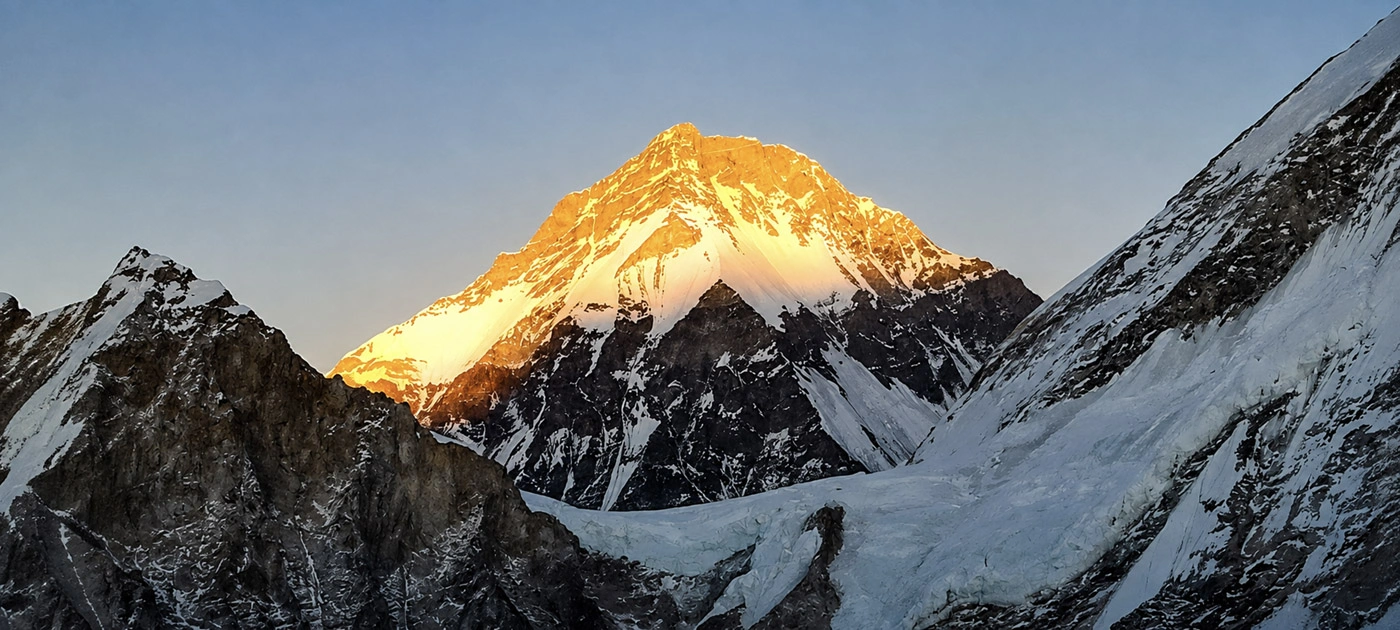
Kala Patthar exists for one reason: Everest's summit is hidden from Base Camp itself, and this dark ridge above Gorak Shep is the closest walkable point that shows it. From the top, the summit pyramid stands behind the Nuptse wall, close enough that on a still morning you can pick out the plume streaming off the top.
Pumori (7,161 m) rises directly overhead, so near it feels like the mountain is leaning over you. Below, the Khumbu Glacier grinds down-valley in grey waves, with the Icefall breaking white at its head. Ama Dablam, Thamserku, and the long line of the valley you walked fill the view behind.
The scene is intimate rather than wide. You're inside the amphitheater, not looking at it from across the room. Our guests on the Luxury Everest Base Camp Trek usually rate this climb — not Base Camp — as the emotional summit of the journey.
What You See From Gokyo Ri
Gokyo Ri is the only walkable viewpoint in the Khumbu that shows four 8,000-meter peaks at once: Everest, Lhotse, Makalu, and Cho Oyu. Everest sits further away here than from Kala Patthar, and that distance is the point. You see the whole massif in proportion, not a close-up of one face.
Beneath you, the Ngozumpa Glacier — the longest in the Nepal Himalaya at around 36 km — runs like a rubble highway the full length of the valley. On its far side, the third Gokyo lake, Dudh Pokhari, holds a turquoise so saturated it looks retouched. The Gokyo lakes are a Ramsar-listed wetland, and the color is real glacial flour, not filters.
The climb itself is honest work: steep, loose in places, and sustained. Our full route notes for the valley are in our Gokyo valley trek guide, including how we pace the approach through Dole and Machhermo.
Which Climb Is Harder?
Gokyo Ri is the harder climb, despite being the lower summit. It carries roughly 190 m more vertical gain than Kala Patthar, on steeper and more sustained switchbacks. Fit trekkers feel the difference in their legs.
Kala Patthar fights back with altitude. You start at 5,164 m, sleep at Gorak Shep the night before, and every step happens in noticeably thinner air. Nights at Gorak Shep are also the roughest of the standard route, which is why acclimatization matters more here than raw fitness.
On both climbs, our private guides run pulse-oximeter checks each evening and set a pace measured in breaths, not minutes. Neither summit needs ropes or technical gear — trekking poles, a down jacket, and patience cover it. If altitude is your worry, read our guide to altitude safety on luxury Everest treks before you choose either.
Crowds, Quiet, and the Light
Kala Patthar is the busier summit by a wide margin, because it sits on the main Everest Base Camp trail. At dawn in high season, headlamps string up the ridge like fairy lights. Gokyo Ri, one valley west, sees a fraction of that traffic, and you can still have the top nearly to yourself on a spring afternoon.
Light is where our standing practice differs from the crowd. Sunrise on Kala Patthar puts the sun behind Everest, so the famous dawn climb delivers a backlit silhouette in brutal cold. We send our guests up in late afternoon instead: the sun drops behind you and lights the summit pyramid gold while the dawn photographers are asleep in Gorak Shep.
On Gokyo Ri, mid-morning is the sweet spot, when the sun clears Cho Oyu's shoulder and switches the lakes to full color. The best windows for either climb are the classic Nepal seasons: mid-March to mid-June (spring) and mid-October to mid-December (autumn), with autumn giving the sharpest long-range visibility for Makalu.
Can You Do Both? The Cho La Link
Yes — one trek can take in both summits, because the Cho La pass (5,420 m) links the Gokyo and Khumbu valleys. The classic circuit climbs Gokyo Ri first, crosses the Cho La's glacier shelf, then joins the Base Camp trail in time for Kala Patthar. It adds three to four days over a standard Base Camp itinerary.
Strong trekkers with more time can go further and add Renjo La (5,360 m) for the full three-pass circuit. We've broken that route down pass by pass in our Everest Three Passes trek guide.
Both routes sit inside Sagarmatha National Park, and the same paperwork covers them: the park entry permit and the Khumbu Pasang Lhamu Rural Municipality fee, both of which we arrange before you land. On our Khumbu journeys, helicopters fly you between Kathmandu and Lukla in both directions, so no trekking day is spent on a road.
Which Should You Choose?
Choose Kala Patthar if this is your one Everest trek and standing close to the mountain is the memory you came for. Choose Gokyo Ri if you'd trade proximity for the wider canvas — four 8,000ers, the glacier, the lakes — and fewer people sharing it. Choose the Cho La circuit if your legs and your calendar can carry both.
Photographers lean Gokyo. First-timers lean Kala Patthar. Returning trekkers almost always go west to the lakes, which tells you something.
There's no wrong summit here, only a wrong match between the climb and the traveler. It's the kind of decision we help our guests settle over coffee in Kathmandu before any boots touch a trail — part of how we approach luxury travel in the Himalayas generally: the route bends to you, not the other way around.
Gokyo Ri vs Kala Patthar FAQs
Is Gokyo Ri or Kala Patthar higher?
Kala Patthar is higher at 5,545 m against Gokyo Ri's 5,357 m — a gap of roughly 190 m. Gokyo Ri is still the harder climb, because it rises about 570 m from Gokyo village while Kala Patthar gains only around 380 m from Gorak Shep. Altitude and effort don't line up neatly between the two, which surprises most trekkers.
Can you see Everest Base Camp from Kala Patthar?
Yes. From the Kala Patthar ridge you look straight down on the Khumbu Glacier, and in expedition season the tent city of Base Camp is clearly visible on the ice below. You also get what Base Camp itself can't offer: a clear line to Everest's summit, which the Nuptse wall hides from the camp.
How long does the Gokyo Ri climb take from Gokyo village?
Most trekkers need two to two and a half hours to climb from Gokyo village (4,790 m) to the summit of Gokyo Ri (5,357 m), and about half that to descend. The trail is steep, switchbacked, and loose near the top. We start after breakfast rather than pre-dawn, aiming to summit as the morning sun reaches the lakes.
Do you need climbing gear for Gokyo Ri or Kala Patthar?
No. Both are non-technical walking summits with no ropes, crampons, or climbing experience required. Trekking poles, a warm down jacket, and sound acclimatization are the real equipment. The one exception is the Cho La pass between the two valleys, where microspikes can help on the glacier shelf in colder months.
Which is better for photography, Gokyo Ri or Kala Patthar?
Gokyo Ri gives the wider frame: four 8,000-meter peaks, the Ngozumpa Glacier, and the turquoise lakes in one sweep. Kala Patthar wins for drama — Everest and Pumori fill the lens. For Everest itself, we favor late afternoon on Kala Patthar, when the light hits the summit pyramid instead of silhouetting it as sunrise does.
Can one trek include both Gokyo Ri and Kala Patthar?
Yes. The Cho La pass (5,420 m) connects the Gokyo valley to the Everest Base Camp trail, so a single circuit can climb Gokyo Ri, cross the pass, and finish on Kala Patthar. Plan three to four extra days over a standard Base Camp itinerary, with acclimatization already banked before the crossing.
If the lakes and the four-peak skyline are pulling ahead as you read, our private Luxury Everest Gokyo Lakes Trek builds the whole valley — Gokyo Ri included — around your pace, with helicopters at both ends and lodges chosen for the view from the pillow.
Need Help? Call Us+977 9851013196orChat with us on WhatsApp
Need Help? Call Us+977 9851013196