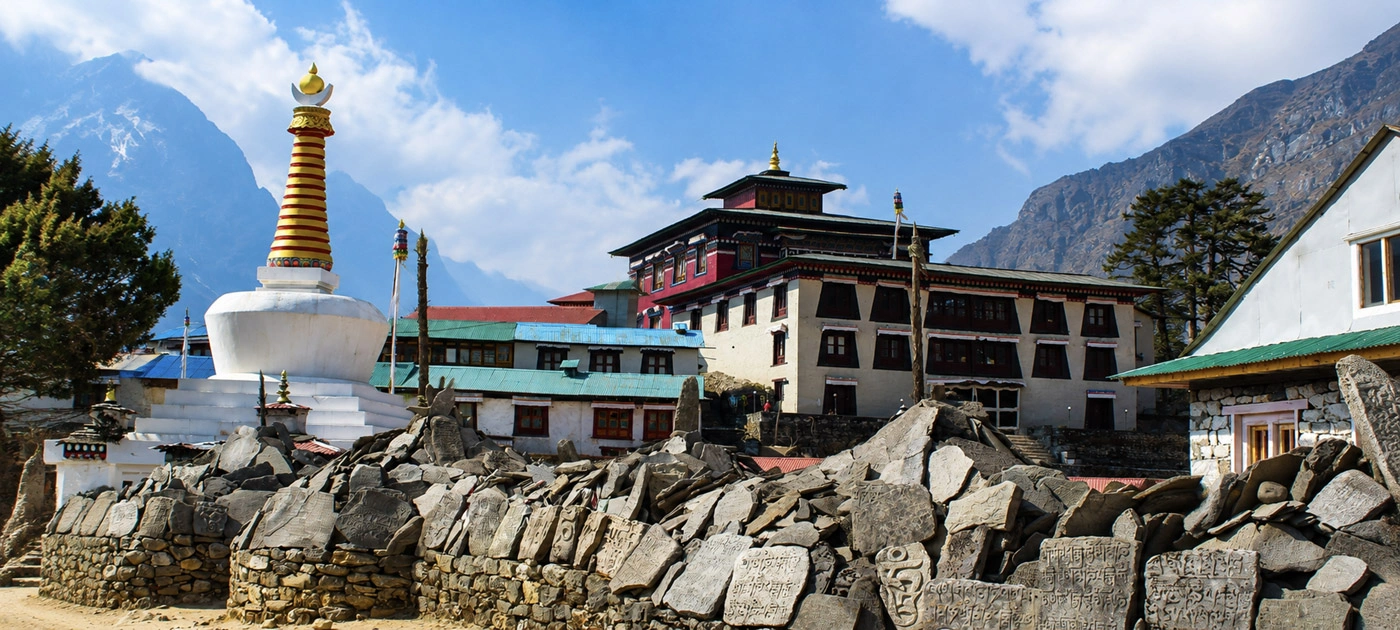
Tengboche Monastery is the spiritual center of the Khumbu, a working Nyingma Buddhist monastery standing at 3,867 meters on a ridge above the meeting point of the Dudh Koshi and Imja Khola rivers.
Most trekkers know it as the place where Ama Dablam fills the courtyard view on the walk to Everest Base Camp. That framing sells it short.
Around 60 monks live, study, and pray here through the full monastic year, not just during the famous autumn festival. The monastery has burned to the ground, been leveled by an earthquake, and been rebuilt both times by the Sherpa community and its friends.
On our private Khumbu journeys, we treat the ridge as a destination in its own right, and this guide explains why it deserves that.
Where Tengboche Monastery Stands
Tengboche Monastery sits inside Sagarmatha National Park, a UNESCO World Heritage Site, on a forested ridge in the Solukhumbu district of eastern Nepal. Everest, Lhotse, and Nuptse rise to the north.
Thamserku and Kangtega stand behind the courtyard, and Ama Dablam holds the eastern skyline almost close enough to touch.
The ridge anchors our own luxury travel in the Himalayas portfolio for the same reason it anchored the prophecy: nothing else in the valley commands this ground.
The setting is not accidental. Tibetan Buddhist tradition regards the high Khumbu as a beyul, a hidden valley blessed by Guru Rinpoche as a sanctuary for times of crisis.
The Sherpas who settled here from the 1530s onward saw themselves as custodians of that sacred landscape, and the monastery grew out of that belief.
You will also hear the site called Dawa Choling Gompa, its formal name, or Thyangboche in older trekking literature. All three refer to the same golden-roofed complex on the same ridge.
A Footprint in Stone and a 1916 Founding
The monastery fulfilled a prophecy made roughly 250 years before its first stones were laid. In the seventeenth century, the revered master Lama Sangwa Dorje meditated on this ridge and, tradition holds, left his footprint pressed into solid rock as a sign that a great religious center would one day rise on the spot. He went on to found the Khumbu's oldest temple at Pangboche around 1667, while the Tengboche ridge waited.
It waited until 1916. A devout practitioner named Chatang Chotar, known throughout the valley as Lama Gulu, received the blessing and direction of the abbot of Rongbuk Monastery on Everest's Tibetan side, who was recognized as a reincarnation of Sangwa Dorje himself. That link forged a mother-daughter bond between Rongbuk and Tengboche that spans the mountain to this day.
Three wealthy Sherpa benefactors financed the build, villagers from across the Khumbu gave their labor, and master carpenters walked in from Lhasa to raise the prayer hall. The footprint stone still rests at the entrance to the main hall, cracked by a later fire but venerated as ever.
How One Monastery Changed Sherpa Society
Tengboche was the Khumbu's first celibate monastery, and its founding rearranged Sherpa religious life. Before 1916, religion in these valleys ran through married village priests called ngakpas, who handled household rituals and kept peace with local mountain spirits. Orthodox monastic Buddhism, with its celibate scholars and formal study of scripture, arrived with Tengboche.
The anthropologist Sherry B. Ortner, in her study High Religion, traced why the shift happened when it did. Wealth from the Nangpa La salt trade and early mountaineering work was straining Sherpa society, and a grand monastery gave prosperous families a way to turn money into merit and standing. For poorer families, sending a younger son into robes preserved the family land for the eldest while giving the boy education and a respected path.
The result centralized spiritual authority on this ridge. Every gompa built in the Khumbu since has grown in Tengboche's shadow, and the Sherpa culture of the Everest region still orbits this ridge.
Fire, Earthquake, and Two Rebuildings
The monastery standing today is the third to occupy the ridge. The 1934 Nepal-Bihar earthquake, a magnitude-8.0 event, flattened the original buildings, and Lama Gulu died shortly after seeing his life's work in ruins. His successor led the rebuild with continued support from Rongbuk, and the Tibetan artist Kappa Kalden painted the interior murals that defined the monastery for the next fifty years.
Then came the night of 19 January 1989. An electrical fault linked to a newly installed micro-hydropower system sparked a fire that the ridge winds drove through the timber-framed complex. No one died, but centuries-old scriptures, bronze statues, and every one of Kappa Kalden's murals were lost, and the heat fractured the footprint stone itself.
The second rebuilding drew help from around the world. Sir Edmund Hillary's Himalayan Trust and other international donors funded the work, Sherpas from Khumjung, Kunde, Phortse, Pangboche, and Namche Bazaar volunteered thousands of hours, and the new stone structure was consecrated in 1993. Its earthquake-resistant masonry passed a brutal test in 2015, when a magnitude-7.8 quake caused only minor, repairable damage here.
Inside the Dokhang: Art Worth Slowing Down For
The Dokhang, the main prayer hall, centers on a two-story statue of Shakyamuni Buddha seated in the earth-touching gesture that marks the moment of enlightenment. Manjushri, the bodhisattva of wisdom, and Maitreya, the future Buddha, flank him. Butter lamps burn along the altar in every season.
After the 1989 fire, the master painter Tarke-la repainted the interior in deep reds, golds, and lapis blue, filling every surface in the maximalist style of Tibetan sacred art. The entrance murals do protective work: the Four Guardian Kings watch the cardinal directions, and wrathful deities in sacred union embody the merging of wisdom and compassion that sits at the heart of Vajrayana practice.
Give it time. Ten unhurried minutes in the Dokhang, with a guide who can read the iconography aloud, changes the hall from decoration into a legible map of Buddhist cosmology.
The Sound of the Ridge
Morning puja at Tengboche begins before dawn, and you hear it before you see it. Paired dungchen, brass horns up to twelve feet long, produce a bass note that villagers compare to the voice of the divine and that carries across the valley. The gyaling, a double-reed oboe played with circular breathing, weaves an unbroken melodic line above the chant.
Hourglass damaru drums, clashing cymbals, and the paired bell and vajra each carry doctrinal meaning rather than mere rhythm. The bell stands for wisdom, the vajra for compassion, and ringing them together signals their union. For the Sherpa community, these sounds are understood as healing in themselves, not performance.
Trekkers are welcome to sit quietly at the back of the hall during puja. Arrive early, keep still, and let the ninety minutes wash over you. It is the single best free experience on the entire Everest trail.
Mani Rimdu and the Monastic Year
Mani Rimdu, Tengboche's great festival, is a 19-day ritual cycle held in the tenth month of the Tibetan lunar calendar, which usually falls in October or November. Exact dates shift each year with the lunar calendar and are confirmed well in advance, so we align festival departures once the monastery publishes them.
The popular image of a three-day dance festival misses most of what happens, and we cover the Mani Rimdu festival in depth in its own guide.
For the first sixteen days, the monks work behind closed doors, building an intricate sand mandala grain by grain and consecrating the small red blessing pills that give the festival its name.
Only the final three days are open to the public: a blessing ceremony under the full moon, then the Chham masked dances, then a closing fire ritual. The dances are moving meditation, an enacted victory of wisdom over ignorance, performed in heavy brocade and carved wooden masks.
On the last day the sand mandala, two weeks in the making, is swept up and offered to the river. There is no sharper lesson in impermanence anywhere in the Himalaya.
Outside festival season, the calendar continues with the six-week yarney monsoon retreat, when monks stay within the compound in study and purification, and summer celebrations honoring Guru Rinpoche's birth.
Deboche: The Quieter Sister Down the Hill
A twenty-minute descent through rhododendron and pine, about 120 meters below the ridge, brings you to the Deboche Nunnery, established in 1925 as one of the Khumbu's oldest houses for Buddhist nuns. In Tengboche's earliest years, nuns practiced alongside the monks; the separate convent preserved the celibate monastic code while giving women their own place of study.
Deboche endured decades of hardship, with nuns wintering in crumbling stone huts, until an international restoration effort begun in 2006 rebuilt the convent with warm, quake-resistant quarters. Today the soft chanting at Deboche offers a gentler counterpoint to busy Tengboche, and the forest path between the two is one of our favorite short walks in the valley.
There is a practical note here too. If mild altitude symptoms appear at Tengboche, descending those 120 meters to sleep at Deboche is a standard relief measure.
Walking to Tengboche from Namche
The walk from Namche Bazaar
to Tengboche covers about 11 kilometers and takes five to six hours. The trail contours high above the Dudh Koshi with Ama Dablam ahead, then drops sharply to the river crossing at Phunki Tenga at 3,250 meters.
What follows is the day's honest work: a steady two-hour climb through rhododendron and pine, gaining more than 600 meters to the ridge at 3,867 meters.
That profile, a long descent straight into a long climb, is why we treat this as a full walking day and never rush it.
Our guides run pulse-oximeter checks each evening from Namche onward, and the acclimatization day in Namche before this stage is built into every Khumbu itinerary we operate.
Drink three to four liters of water, skip the beer until you descend, and talk to your travel doctor about altitude medication before you fly; our guide to altitude sickness on the Everest trail covers the full protocol.
Most trekkers reach the ridge in the days after their Namche rest, sleeping here or at Deboche before continuing toward Everest Base Camp.
Because there are no roads in the Khumbu, every journey begins with the Kathmandu-Lukla air link; on our private trips we fly guests by helicopter in both directions, which removes the fixed-wing weather lottery on the return.
Visiting Well: Etiquette, Timing, and Small Practicalities
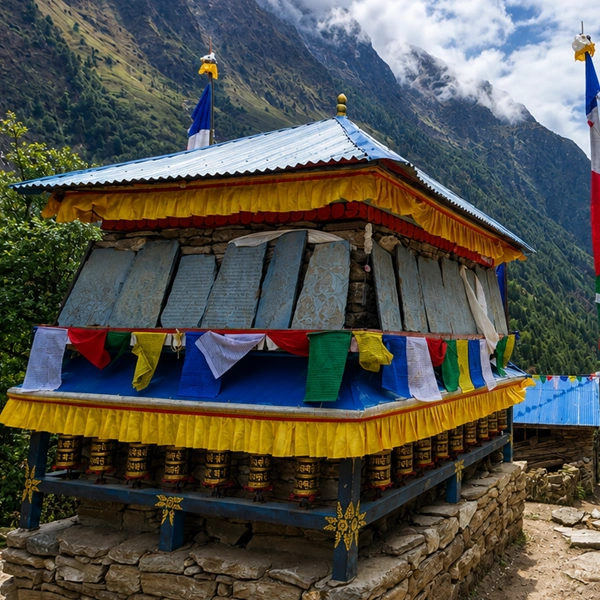
Respect at Tengboche follows a few clear rules. Walk clockwise around the monastery, the stupas, and the mani walls, some of whose carved stones are more than a century old. Dress modestly with shoulders and knees covered, remove hats and shoes at the prayer-hall threshold, and keep your voice low during prayers.
Photography is fine in the courtyard and forbidden inside the Dokhang. Never touch statues, altars, or instruments, and never photograph monks close-up without asking. A modest entry fee, payable in cash, supports the monastic school and local clinic; there are no card machines or ATMs anywhere on the ridge, so carry rupees.
Timing shapes the whole experience. In the walking seasons, mid-March to mid-June (spring) and mid-October to mid-December (autumn), the courtyard fills with day-trekkers through late morning.
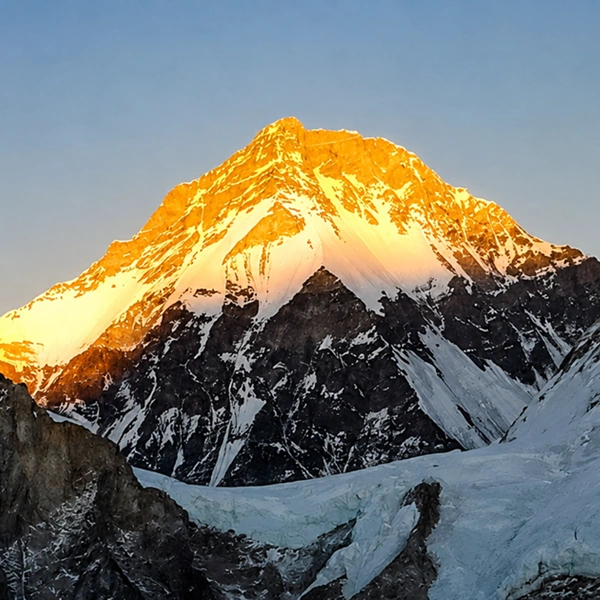
We plan our Namche-to-Tengboche stage to reach the ridge by mid-afternoon, when the crowds have moved on, the light on Ama Dablam turns gold, and the afternoon prayers begin.
The famous bakery below the gompa serves fresh coffee and warm apple pie at nearly 4,000 meters, which still strikes us as a small miracle of Khumbu logistics.
The Ridge That Holds the Valley Together
Tengboche is the rare place on a world-famous trail that rewards the traveler who lingers. It carries the Khumbu's history in its stones: prophecy and founding, destruction and stubborn rebuilding, a community that keeps choosing its heritage over a century of upheaval.
The monastery also anchors the valley's ecological conscience, leading solar, waste, and sacred-sites initiatives inside the national park.
Come for the mountain view if you like. Stay for the horns before dawn.
If you would like to experience the ridge with the walking, permits, and pacing handled privately, our Luxury Everest Base Camp Trek spends unhurried time at Tengboche on the way up the valley, and we shape the schedule around puja and, in season, the festival calendar.
FAQs
How high is Tengboche Monastery, and will the altitude affect me?
Tengboche Monastery stands at 3,867 meters (12,687 feet), an altitude where mild acclimatization symptoms are common. Most visitors feel light breathlessness on the final climb and nothing worse, provided they have taken the standard rest day in Namche Bazaar first. Walk slowly, drink three to four liters of water daily, and descend to Deboche, 120 meters lower, if symptoms persist overnight.
When does the Mani Rimdu festival take place at Tengboche Monastery?
Mani Rimdu falls in the tenth month of the Tibetan lunar calendar, which usually means October or November, with dates shifting every year. The full ritual cycle runs 19 days, but only the final three days, the public blessing, the masked Chham dances, and the closing fire ritual, are open to visitors. We confirm exact dates against the monastery's published calendar when you book.
Can trekkers attend the morning puja at Tengboche Monastery?
Yes. Visitors may sit quietly at the back of the Dokhang during the pre-dawn and afternoon prayer sessions, and no booking is required. Arrive before the ceremony begins, remove shoes and hats, keep completely silent, and take no photographs inside the hall. Staying overnight on the ridge or at Deboche makes the early start easy.
How long is the walk from Namche Bazaar to Tengboche?
The stage covers roughly 11 kilometers and takes five to six hours at a sensible acclimatization pace. The trail descends to the river at Phunki Tenga, 3,250 meters, then climbs more than 600 meters through rhododendron forest to the ridge. It is one of the finest walking days in the Khumbu, with Ama Dablam in view for most of it.
Is photography allowed inside Tengboche Monastery?
Photography is prohibited inside the main prayer hall, including any use of flash. The courtyard, the exterior buildings, and the mountain panorama are all fine to photograph, and during Mani Rimdu the public dances may be photographed respectfully from the courtyard. Always ask before taking close portraits of monks anywhere on the grounds.
Why has Tengboche Monastery been rebuilt twice?
The original 1916 buildings were destroyed by the magnitude-8.0 earthquake of 1934, and the rebuilt monastery burned down in January 1989 after an electrical fault ignited its timber structure. The current stone complex, consecrated in 1993 with international and local support, was engineered against both threats and came through the 2015 earthquake with only minor damage.
What is the Deboche Nunnery below Tengboche?
Deboche is a nunnery founded in 1925 about 120 meters below the Tengboche ridge, a twenty-minute walk down through forest. It is one of the oldest convents in the Khumbu and, after a restoration effort begun in 2006, now offers the nuns warm, safe quarters. Its shaded lodges also make a quieter, slightly lower overnight alternative to the ridge itself.
Do I need a permit to visit Tengboche Monastery?
You need the two standard Khumbu permits: the Sagarmatha National Park entry permit and the Khumbu Pasang Lhamu Rural Municipality fee, both checked on the trail below Namche. The monastery itself charges a small cash entry fee that supports its school and clinic. On our private journeys, we arrange all permits before you arrive, so nothing is queued for on the mountain.
Can you reach Tengboche by helicopter?
Yes, helicopters serving the Everest trail can land near the ridge, weather permitting, and we use them for guests who want the monastery without the full trek. On our walking itineraries we fly by private helicopter between Kathmandu and Lukla in both directions, which protects your schedule from the fixed-wing cancellations common at Lukla.