The Lukla flight has a reputation that reaches people before Nepal does. Friends mention it; documentaries dramatize it. Somewhere between booking and departure, almost every Everest Base Camp guest asks us the same quiet question: how worried should I be?
Our answer starts with respect for the facts. Tenzing-Hillary Airport is a serious piece of mountain aviation, and pretending otherwise would insult your intelligence. But the honest picture is less about danger and more about reliability — and reliability is exactly why we stopped putting our guests on the fixed-wing flight at all.
This guide lays out what the flight involves, why it gets delayed, what the Ramechhap shuffle means, and how the helicopter alternative changes the shape of a Khumbu trip.
What the Lukla Flight Actually Involves
The Lukla flight is a short-takeoff-and-landing (STOL) hop from the Kathmandu Valley — or from Ramechhap in peak seasons — to Tenzing-Hillary Airport, the gateway airstrip of the Khumbu. Small aircraft such as the Twin Otter and Dornier 228 fly the route, carrying fifteen to nineteen passengers at a time.
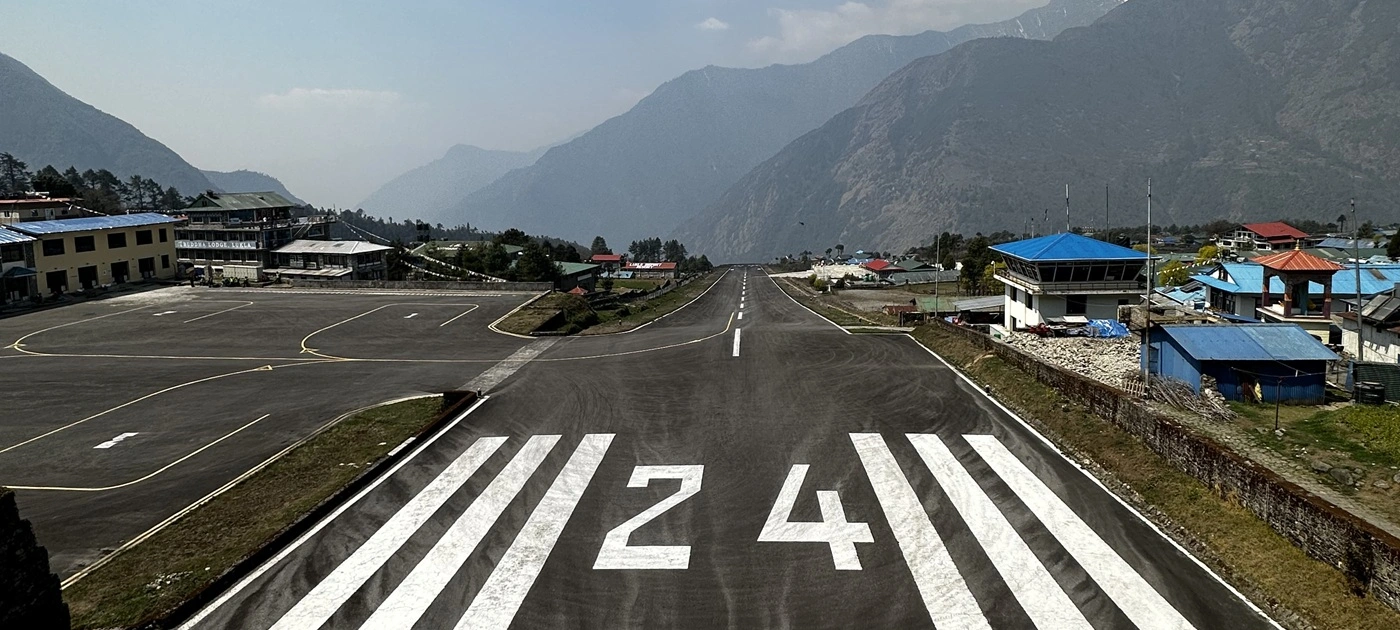
Tenzing-Hillary Airport sits at 2,846 meters, and its single runway is 527 meters long with a gradient of almost 12 percent. Aircraft land uphill and take off downhill, using the slope the way a runaway-truck ramp uses one. There is no go-around: once a pilot commits to final approach over the Dudh Kosi gorge, the mountain wall behind the runway closes the option of a second try.
From Kathmandu the flight takes roughly 35 minutes. From Manthali Airport in Ramechhap it is closer to 20. Either way you land in a different world — thin air, prayer flags, and the trailhead to Phakding a few steps from the fence.
Why Lukla Flights Get Delayed So Often
Lukla flights get delayed because the airport operates under visual flight rules only, and Khumbu weather rarely cooperates past mid-morning. Pilots must see the runway to land on it. No instrument approach exists, and none is likely on a strip this short.
The daily pattern is remarkably consistent: dawn usually brings the clearest air of the day. By nine or ten, warm air rises from the valleys, and cloud builds along the Dudh Kosi, first as wisps at the ridgelines, then as a lid over the airfield. Afternoon flying is the exception, not the plan.
So the entire fixed-wing schedule compresses into a two-to-four-hour morning window. When that window shrinks — a slow-clearing fog in Kathmandu, cloud sitting on the Lukla threshold — flights stack up, and the backlog rolls into the next day. In poor spells, trekkers wait two or three days in either direction.
Travel insurance with helicopter-evacuation and trip-delay cover is not a formality on this route; it is the safety net the schedule assumes.
The Ramechhap Question
In recent peak trekking seasons, most fixed-wing Lukla departures have been moved from Kathmandu to Manthali Airport in Ramechhap to relieve congestion at Tribhuvan International Airport. At the time of writing, that remains the peak-season pattern, though the arrangement is reviewed season by season — we confirm the current operating base for your dates before you travel.
The practical cost is the drive. Manthali lies about 130 kilometers east of Kathmandu, four to five hours by road, which means a departure around two or three in the morning to make a dawn flight slot. You trade the shortest mountain flight in Nepal for the longest pre-dawn transfer.
For a standard trek that is an accepted tax on the itinerary. For a private journey built around rest, acclimatization, and arriving fresh, it undermines the point of the first days entirely. This, as much as weather, pushed us to a different answer.
Is the Lukla Flight Safe? An Honest Answer
The Lukla flight is flown thousands of times each season safely by crews who specialize in it, and calling Tenzing-Hillary "the world's most dangerous airport" says more about television than about a normal flying day there. The label is a media shorthand. The daily reality is experienced pilots, strict weather minimums, and a lot of canceled flights precisely because nobody pushes a marginal morning.
That said, the margins are real. A 527-meter sloped runway at altitude, visual-only approaches, and fast-changing mountain weather leave little room for error, and the route's accident history — though concentrated in decades past — is part of why the Civil Aviation Authority of Nepal keeps its restrictions tight.
Our view after years of operating in the Khumbu: the fixed-wing flight is acceptably safe and chronically unreliable. Guests rarely lose sleep over the landing. They lose days over the schedule.
Why Our Khumbu Trips Fly Helicopter Instead
We fly private helicopter in both directions, Kathmandu to Lukla and back, on every luxury Khumbu itinerary — never fixed-wing on the return. The decision comes down to four things a helicopter does that a Twin Otter cannot.
It departs from Kathmandu regardless of season. Your morning starts with a short drive to the domestic apron at Tribhuvan, not a 2 a.m. run to Ramechhap.
A helicopter charter reaches Lukla in about 45 minutes, tracing the Dudh Kosi valley low enough that you pick out the suspension bridges you will cross on foot two days later.
It uses weather differently. Helicopters fly slower, route around cloud, and can hold or set down when a corridor closes, so a morning that grounds the fixed-wing fleet often still works by helicopter.
Cancellations still happen — the mountain always votes — but far less often, and our schedule keeps a Kathmandu buffer night before your international departure so a weather day never becomes a missed flight home.
It carries only your party. And on the return from Everest Base Camp, when you have earned every meter of descent, it lifts you from the hill above Pheriche's valley back to a hot shower in Kathmandu the same afternoon.
How We Run the Flight Decision
Our operations desk treats the Lukla leg as a live decision, not a fixed booking. The evening before you fly, we brief you on the forecast over dinner. From first light, our team is on the phone with the pilots and watching conditions at both ends of the corridor, and we hold the final go until the crew is satisfied — not until a timetable says so.
That standing practice is the quiet difference between the two ways into the Khumbu. The fixed-wing system asks you to fit a narrow window shared with dozens of flights. A private helicopter asks the window to fit you, within what the mountain allows.
The best flying, for what it is worth, comes in the classic seasons: mid-March to mid-June (spring) and mid-October to mid-December (autumn), when stable mornings give the corridor its widest openings. Acclimatization planning matters just as much as the flight itself once you land at 2,846 meters, and we build both into every itinerary from the first draft.
Lukla Flight FAQs
Why do fixed-wing Lukla flights leave from Ramechhap instead of Kathmandu?
In recent peak trekking seasons, authorities have shifted most fixed-wing Lukla departures to Manthali Airport in Ramechhap to ease congestion at Tribhuvan International Airport in Kathmandu. The trade-off is a four-to-five-hour pre-dawn drive to reach Manthali. Helicopter charters are unaffected and continue to depart directly from Kathmandu, which is one reason every Khumbu trip we run flies by helicopter.
How long does the helicopter from Kathmandu to Lukla take?
About 45 minutes apron to apron. The helicopter follows the Dudh Kosi valley east from Kathmandu, crossing ridgelines the fixed-wing route overflies at altitude, so you see villages, bridges, and terraced hillsides at close range. Add the short city transfer to Tribhuvan's domestic terminal and you are typically at Lukla within two hours of leaving your Kathmandu hotel.
What makes the runway at Tenzing-Hillary Airport so demanding?
The runway is 527 meters long with a gradient of almost 12 percent, perched at 2,846 meters above the Dudh Kosi gorge. Aircraft land uphill to shed speed and take off downhill to gain it, and the terrain rules out a go-around once a pilot commits to the approach. Only short-takeoff-and-landing aircraft flown by specially certified crews operate there, under visual flight rules and daylight only.
What happens if weather cancels flying on my Lukla departure day?
On our itineraries, very little changes for you. Helicopters get more usable weather than fixed-wing aircraft, so outright cancellations are uncommon, and when one happens we re-fly at the next opening — usually the following morning. Your itinerary already includes a Kathmandu buffer night before international departure, and our team rebooks lodges and adjusts pacing without you touching the logistics.
Can a helicopter really fly to Lukla when the planes cannot?
Often, yes — helicopters cruise slower, follow the valley rather than a fixed approach path, and can route around cloud, hold, or land safely short of Lukla if a corridor closes. That flexibility turns many marginal mornings into flyable ones. It has limits — a fully closed valley grounds everything — but across a season the difference in completed flights is substantial.
Does Alpine Luxury Treks ever use the fixed-wing Lukla flight?
No. Every luxury Khumbu itinerary we operate flies private helicopter in both directions between Kathmandu and Lukla. We made the change for reliability and for the shape of the trip: no Ramechhap transfer, a departure timed to your morning, a private cabin, and a same-day return to Kathmandu comfort at the end of the trek.
Flying into the Khumbu should be the first highlight of the journey, not its first gamble. If you would like the trek measured to your pace with the flying already solved, our Everest Base Camp luxury heli trek is where most of our guests begin the conversation.