Lo Manthang is a medieval walled city at 3,840 meters in Upper Mustang, Nepal — the former capital of the Kingdom of Lo, founded in 1380 and closed to foreigners until 1992. Its earthen walls protect painted monasteries, a royal palace, and a living Tibetan Buddhist community. We arrange private journeys there with helicopter access.
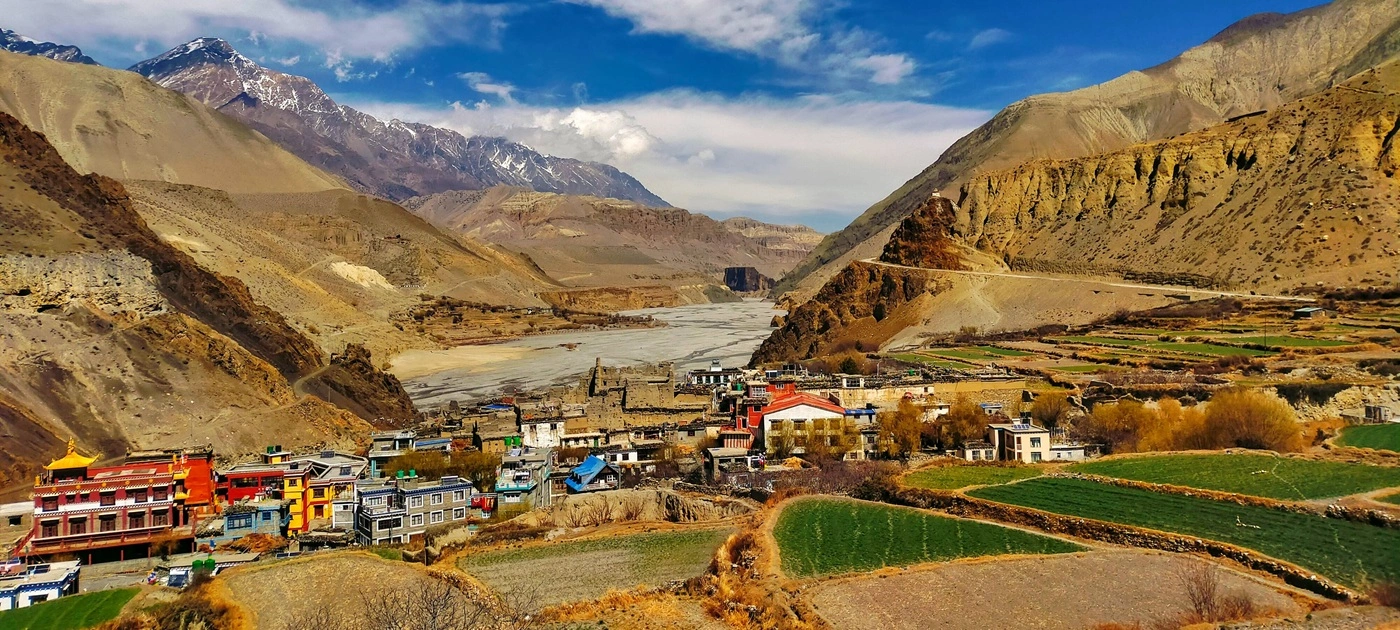
Lo Manthang: Inside the Walled City of Upper Mustang, Nepal
Lo Manthang is a medieval walled city at 3,840 meters in Upper Mustang, Nepal, and one of the last places where a complete Tibetan Buddhist kingdom survives intact.
Its rammed-earth walls have stood since 1380. Behind them sit a royal palace, monasteries painted floor to ceiling, and roughly 170 flat-roofed houses threaded by alleys barely wide enough for two people to pass.
We plan private journeys to Lo Manthang in every season the city is open. This guide covers what the walled city is, how it came to be, and how to visit it well — access, permits, the festival calendar, and the etiquette its monasteries expect.
What Is Lo Manthang?
Lo Manthang is the former capital of the Kingdom of Lo, a walled settlement of houses, four monasteries, and a royal palace at the northern end of Nepal's Mustang District, a short distance from the Tibetan border.
King Ame Pal founded it in 1380, and in the local Loke language the name translates roughly as the "plain of aspiration" — the heart's desired land.
The people of Lo call themselves Loba. They speak Loke, follow Tibetan Buddhism of the Sakya school, and farm barley and buckwheat on gravity-fed irrigation channels in a high desert that sees very little rain. The wider rural municipality counts fewer than 2,000 residents, and many families still move south for the coldest months.
Two facts explain why the city feels the way it does. Lo Manthang sits in the rain shadow behind Annapurna and Dhaulagiri, so its mud architecture has survived centuries that would have dissolved it anywhere wetter. And the whole of Upper Mustang was sealed to foreign visitors until 1992, which spared the city the rebuilding that changed so many Himalayan towns.
The Kingdom of Lo: Six Centuries Behind the Walls
The Kingdom of Lo grew rich on one thing: the salt trade. The Kali Gandaki river cuts the lowest corridor through the high Himalaya, and caravans moving Tibetan salt and wool south, and grain north, all passed through Lo's territory.
Ame Pal's line taxed that traffic, declared full independence by 1440, and ruled for 25 generations.
Gorkha armies folded the kingdom into a unifying Nepal in the late eighteenth century, but distance protected Lo's way of life. The Rajas of Mustang kept real local authority and deep ceremonial standing.
Nepal's monarchy was abolished in 2008 and the royal title formally lapsed with it; the last king, Jigme Dorje Palbar Bista, 25th in Ame Pal's line, died in 2016, and his family remains a respected presence in the city.
The twentieth century added a stranger chapter. After 1959, Tibetan resistance fighters used Upper Mustang as a base for cross-border operations, with covert American backing, until Nepal disarmed them in 1974.
That episode kept the region a closed zone for decades — and is a large part of why the city you walk into today is so remarkably preserved.
Inside the Walls: How the City Is Built
Everything in Lo Manthang is built from the ground it stands on — rammed earth, sun-dried adobe brick, stone, and timber. The city wall rises up to six meters, and local tradition holds that herds of yaks were driven over the clay to compact it. For most of the city's history, a single northern gate, locked at night, was the only way in.
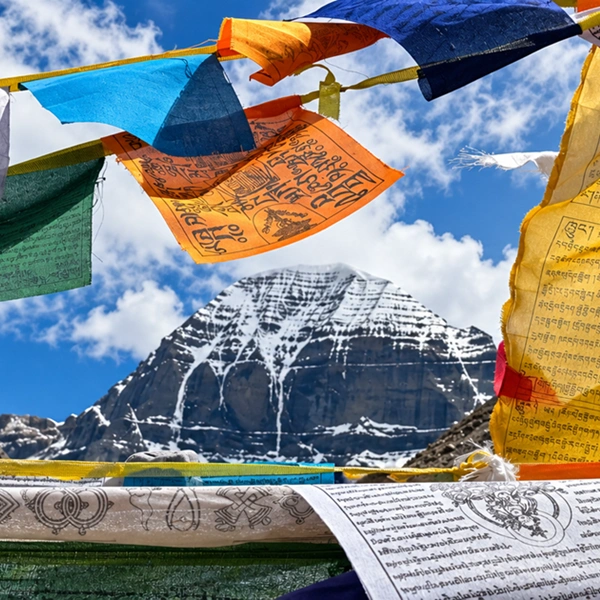
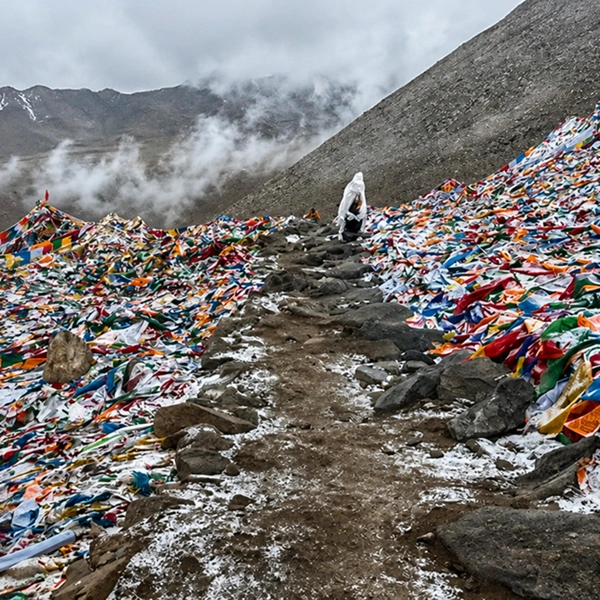
The alleys inside were made deliberately narrow and winding. That confused raiders once; today it breaks the afternoon wind, which matters just as much. Flat clay roofs double as work terraces, stacked with firewood and strung with prayer flags, and whitewashed walls carry bands of ochre and grey that mark sacred buildings.
Nothing here is a museum set. Households, monks, horses, and goats share the lanes, and the smell of juniper smoke drifts over the walls at dawn.
The Monasteries of Lo Manthang
Three great monasteries anchor the walled city — Jampa Lhakhang, Thubchen Gompa, and Chode Gompa — with the smaller Choprang Gompa nearby. Jampa Lhakhang is the oldest, raised in the 1440s under Ame Pal's son. Inside, a colossal painted-clay figure of Maitreya, the future Buddha, rises through the building's three stories, and the surrounding walls carry 108 gold-ground mandalas painted by master artists brought in from the Kathmandu Valley.
Thubchen Gompa followed a generation later as the kingdom's great assembly hall: one vast room under a high ceiling held up by a forest of carved wooden pillars, its murals worked in lapis, malachite, and cinnabar. Chode Gompa is the city's working heart. Its monks run a monastic school, keep the ritual calendar, and stage the city's festivals.
Centuries of roof leaks and snowmelt nearly destroyed the oldest murals. From 1999, an international conservation effort backed by the American Himalayan Foundation cleaned and stabilized them, and trained Loba young people in heritage conservation along the way — skills the city still uses.
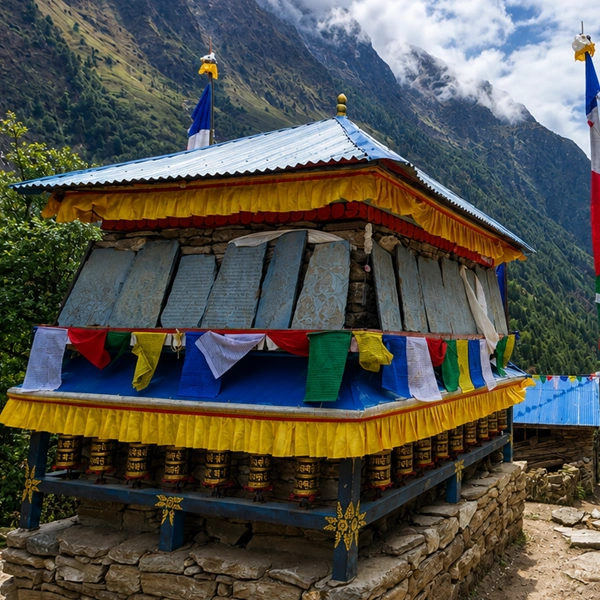
Visiting them asks a little of you. The pigments are light-sensitive, so photography inside is restricted and needs permission from the resident monks, usually with a small fee. Walk clockwise around every chorten, mani wall, and temple, speak softly, and never point your feet at the images.
The Tiji Festival: Three Days That Chase Out a Demon
The Tiji Festival is Lo Manthang's great annual ritual, held over three days each spring in the courtyards of the royal palace and Chode Gompa. Its exact dates follow the lunar calendar and shift every year, so we confirm them at booking. The name abbreviates Tempa Chirim — a prayer for peace.
The festival enacts the legend of Dorje Jono, a protective deity who defeated the demon that brought drought and disease to Mustang. Monks in masks perform slow, precise cham dances on the first day beneath a giant antique thangka. The choreography turns fierce on the second, and the ritual peaks when the lead dancer drives a dagger through a straw effigy of the demon.
The closing day belongs to the whole city — a procession through the lanes and handfuls of roasted barley flour thrown to the wind. Our full guide to the Tiji Festival covers the legend and how we build a private journey around it.
The Sky Caves of Chhoser
North of the walled city, the cliffs of the Chhoser valley are honeycombed with man-made caves — part of an estimated 10,000 dug into the region's rock faces over 3,000 years. Archaeologists trace three lives for them: burial chambers first, then fortified homes during centuries of raiding, then meditation hermitages once the kingdom brought peace.
The most accessible complex, Shija Jhong, climbs five stories inside the cliff through some 40 rooms linked by ladders and light shafts. You can reach it in under an hour from Lo Manthang, and climbing through it is the single best way to grasp how hard-won life on this plateau has always been.
Some caves still hold murals and chortens. Those remain sacred spaces, and our guides will tell you which chambers are open and which are not.
How We Reach Lo Manthang
There are three ways in: the classic trek, the overland drive, and the helicopter. The trekking route runs north from Jomsom through Kagbeni, Chele, Ghiling, and Tsarang, climbing gradually through the Kali Gandaki's canyon country over roughly ten to twelve days round trip.
A rough jeep road now covers the same corridor in a fraction of the time, at the cost of dust and hard driving hours.
Our standard on Upper Mustang journeys is private helicopter in both directions. The flight from Pokhara threads the Kali Gandaki gorge between Annapurna I and Dhaulagiri — the deepest valley on earth — and puts you in Lo's high desert in under an hour, with an acclimatization night built in lower down before you sleep at the city's altitude.
One operational note from our side: the Kali Gandaki wind is the metronome of every Mustang day. It funnels up the gorge hard from late morning, so we fly and walk the exposed stretches early. Our guides carry pulse oximeters and check every guest each evening, and the pacing of the journey is theirs to adjust, not a fixed schedule's.
Inside the walls, accommodation means traditional guesthouses run by Loba families — thick mud-brick walls, solar power, satellite Wi-Fi in the dining room, and honest simplicity in the bedrooms.
We book the best of them and confirm the exact property in your booking proposal. Our guide to luxury lodges in Upper Mustang explains what comfort realistically looks like this far north.
Permits, Guides, and the Best Time to Visit
Upper Mustang is a restricted area, so Lo Manthang requires a Restricted Area Permit issued by Nepal's Department of Immigration, arranged only through a registered operator, plus the Annapurna Conservation Area entry permit. A licensed guide is mandatory for all foreign visitors.
We arrange every permit for you; the paperwork never touches your desk.
At the time of writing, Nepal has restructured the restricted-area fee from the old flat ten-day charge to a per-day rate, and solo travelers accompanied by a licensed guide are now admitted. Current figures are on our Nepal permits and fees page and confirmed in your proposal.
Nepal's trekking windows run mid-March to mid-June (spring) and mid-October to mid-December (autumn), and both suit Lo Manthang well — spring brings the festival season, autumn the sharpest light. The rain shadow adds a quiet advantage: Upper Mustang stays dry and open through the summer monsoon, when most of Nepal's trails close. Winter is the one season to avoid, when temperatures bite, and many families shutter their homes and move south.
A City in Transition
Lo Manthang is changing faster now than in the previous six centuries combined. The road has reached the walls. The Korala border crossing with China, about 14 kilometers north of the city at roughly 4,650 meters, has reopened to trade in recent years, and young Loba who once left for Pokhara now find work in cross-border commerce.
Climate change presses from the other direction. Heavier, more erratic rain is a genuine threat to mud architecture engineered for a near-rainless world, and shifting snowmelt strains the irrigation channels the barley fields depend on. Nepal placed the medieval earthen walled city on the UNESCO Tentative List in 2008, and heritage specialists now argue for a wider listing that would protect the caves, chortens, fields, and living traditions as one cultural landscape.
None of this is a reason to stay away. It is a reason to visit thoughtfully, with people who know the city's rules — and to see it while the wall still holds a kingdom inside.
Planning a Private Journey to Lo Manthang
Lo Manthang rewards slowness: two full days inside the walls at minimum, timed around morning light and monastery hours, with the caves and Ghar Gompa reached as quiet excursions. We build each itinerary privately around your dates, fitness, and interest — festival, art, archaeology, or simply the silence of the high desert.
Start with our Upper Mustang luxury guide for the wider region, and explore our private luxury journeys across the Himalaya to see how we work. When you are ready to look at a route in detail, our nine-day luxury Upper Mustang trek with helicopter return is the journey most guests build from.
FAQs
How high is Lo Manthang, and do I need to acclimatize before visiting?
Lo Manthang sits at 3,840 meters, high enough that arriving directly from low altitude is unwise. We build in a night lower in the Kali Gandaki valley before you sleep in the city, and our guides run evening pulse-oximeter checks throughout. Most reasonably fit travelers adjust comfortably with that staging; the walking around the city itself is gentle.
Can you drive to Lo Manthang, or do you have to trek?
You can now drive: a jeep road runs the full corridor from Jomsom to the walled city. Trekking remains the richest way to arrive, over roughly ten to twelve days round trip through Kagbeni, Ghiling, and Tsarang. On our private journeys, we typically replace the rough road hours with helicopter flights in both directions, keeping the walking you actually want.
What permits does the walled city of Lo Manthang require?
Every foreign visitor needs Nepal's Restricted Area Permit for Upper Mustang, issued by the Department of Immigration through a registered operator, plus the Annapurna Conservation Area entry permit, and must travel with a licensed guide. Independent applications are not possible. We arrange all permits as part of every journey, so nothing is left to you but your passport.
Is the Tiji Festival worth planning a Lo Manthang journey around?
Yes — it is the strongest single reason to choose spring. For three days the palace courtyard fills with masked cham dances, ending with the ritual defeat of the drought demon and a procession through the lanes. Dates follow the lunar calendar and shift each year, so we confirm them at booking and plan the helicopter and rooms well ahead; the city fills fast.
Is Lo Manthang a UNESCO World Heritage Site?
Not yet. Nepal placed the medieval earthen-walled city on the UNESCO Tentative List in 2008, the formal first step toward World Heritage status, and specialists are pressing for a broader cultural-landscape listing that would also cover the sky caves, chortens, and farmland around the city. Visiting now means seeing it before any listing changes how the site is managed.
Are the sky caves near Lo Manthang open to visitors?
The main Chhoser complexes, including the five-story Shija Jhong cave, are open and reachable within an hour of the city. You climb through the rooms on wooden ladders, so a basic head for heights helps. Caves that hold murals or shrines remain sacred, and access varies; our guides know which chambers are open and handle any local fees.
Can I take photographs inside Lo Manthang's monasteries?
Only with permission. The murals in Jampa Lhakhang and Thubchen Gompa are painted in light-sensitive mineral pigments, so interior photography is restricted and usually carries a small fee agreed with the resident monks. Outside, photograph freely, but ask before pointing a lens at people. Walk clockwise around all sacred structures and keep your voice low inside the halls.
Is there Wi-Fi and hot water inside the walled city?
More than you might expect. Guesthouses in Lo Manthang now run solar power and satellite internet in their dining rooms, and hot bucket showers are available for a small charge. Bedrooms are unheated, so good sleeping layers matter even in season. We select the most comfortable houses in the city and confirm the exact property in your booking proposal.
Why was Lo Manthang closed to foreigners until 1992?
Geopolitics sealed it. After Tibetan resistance fighters based themselves in Upper Mustang in the 1960s and were disarmed by Nepal in 1974, the whole region stayed a restricted frontier zone for security reasons. The closure lasted until 1992, and that long isolation is precisely why the walled city's architecture, art, and daily life survive so completely today.
Need Help? Call Us+977 9851013196orChat with us on WhatsApp
Need Help? Call Us+977 9851013196