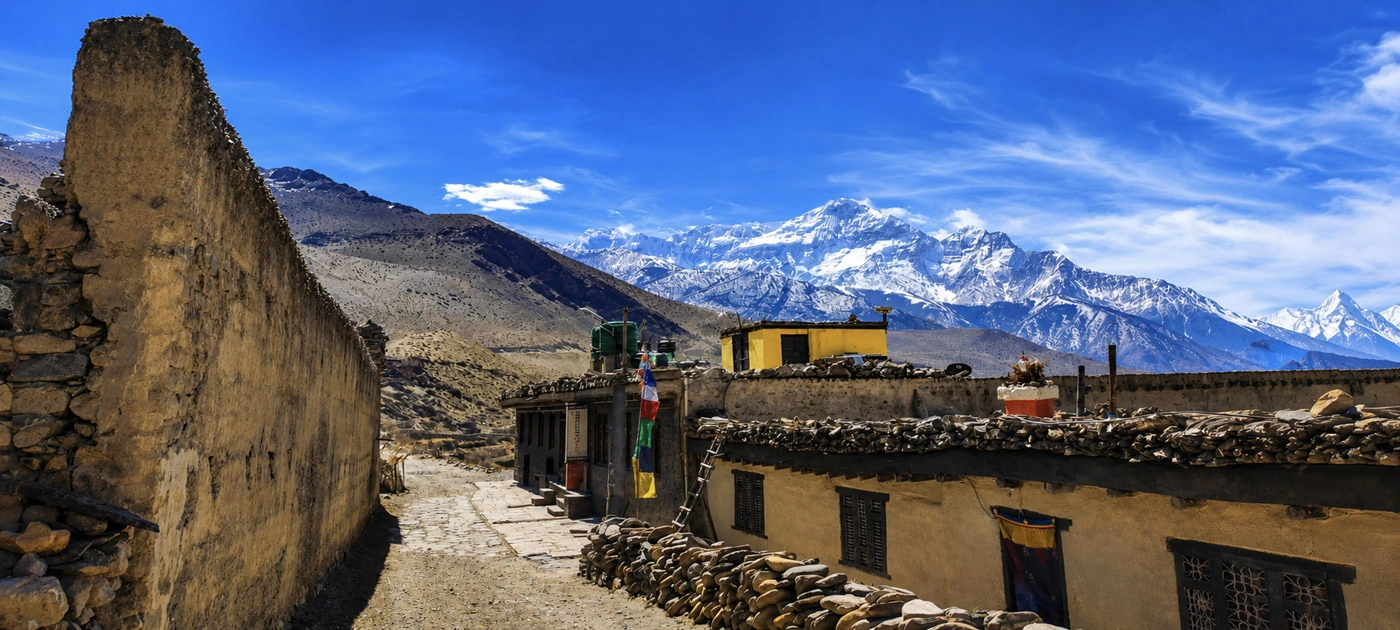
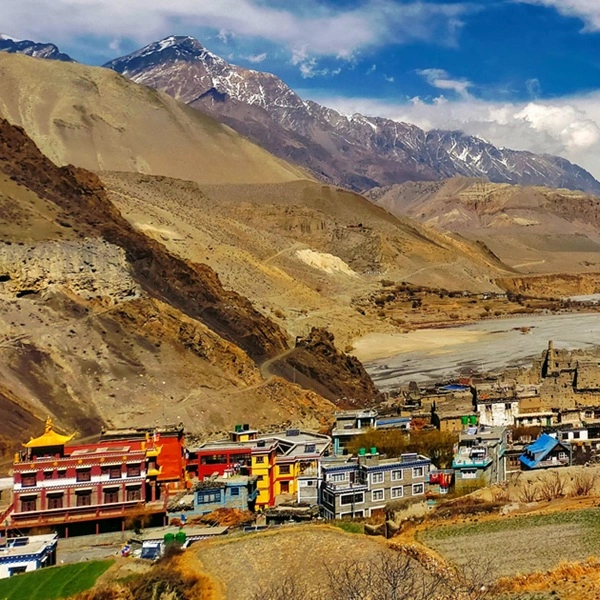
How to get to Upper Mustang is the first real decision of the journey, and it shapes everything after it. The former Kingdom of Lo sits behind the main Himalayan wall, north of Kagbeni, in a desert of wind-carved cliffs that feels closer to Tibet than to the Nepal most visitors know.
Three doors open into it. A short mountain flight to Jomsom, a long jeep road up the Kali Gandaki, or a helicopter straight onto the plateau. We run all three from Kathmandu, and the right one depends on your time, your altitude plan, and how you want Lo Manthang to arrive.
How to Get to Upper Mustang: Your Three Options
There are exactly three practical ways in: fly to Jomsom and continue north by road or on foot, drive the whole way by private jeep, or charter a helicopter direct to Lo Manthang or Jomsom.
Every route funnels through the Kali Gandaki valley, and every traveler crosses the restricted-area checkpoint at Kagbeni, at about 2,810 meters.
The comparison is not really about comfort. It is about hours, weather exposure, and how quickly you gain altitude. A flight puts you in Jomsom, at 2,720 meters, twenty minutes after leaving Pokhara.
The road takes the better part of two days from Kathmandu. The helicopter can put you beside the walls of Lo Manthang, at roughly 3,840 meters, before lunch. For everything beyond the journey in, see our full Upper Mustang luxury guide.
Flying to Jomsom: The Classic Gateway
The standard way in is a two-stage flight: Kathmandu to Pokhara, then Pokhara to Jomsom on a small STOL aircraft. The Pokhara leg takes about 25 minutes. The Jomsom leg takes roughly 20 minutes and threads the Kali Gandaki, the deepest gorge on earth, between Dhaulagiri at 8,167 meters and Annapurna I at 8,091 meters. You look up at both from the window.
Jomsom flights operate only in the early morning. That is not an airline preference; it is physics. As the sun heats the valley, air funnels up the gorge, and the wind at the airstrip builds until fixed-wing operations stop, usually by mid to late morning.
We book our guests on the first departures of the day and hold a private jeep in Pokhara as a same-day contingency. If the wind window closes early, your journey still moves. That standing arrangement is the difference between a delay of two hours and a lost day.
From Jomsom, the route north runs through Kagbeni, where your restricted-area permit is checked and stamped, and on toward Lo Manthang, on foot or by jeep, depending on your itinerary.
The Road to Lo Manthang: Overland by Private Jeep
Yes, you can now drive to Lo Manthang. A motorable road runs the full length of the Kali Gandaki from Beni through Jomsom and Kagbeni to the walled city, and in dry conditions a private 4WD covers Jomsom to Lo Manthang in a long day.
Doing the entire journey overland from Kathmandu means Kathmandu to Pokhara, Pokhara to Jomsom via Beni, then the upper valley.
Count on two full driving days at minimum, on surfaces that swing from smooth tarmac to river-bed track within an hour. The Beni to Jomsom section is the rough heart of it.
The road has one real advantage beyond weather independence: it acclimatizes you gradually. You sleep low, climb slowly, and arrive at Lo Manthang with two or three nights of altitude adjustment already behind you. For guests with generous time and a taste for the slow reveal of the landscape, it earns its hours.
It costs comfort, though. Dust, corrugations, and river crossings are part of the deal, and no vehicle suspension fully hides them. We use it selectively: as a contingency, as a one-way leg paired with a flight, or for guests who specifically want the overland journey.
Helicopter Access: The Plateau in About an Hour
A private helicopter is the fastest and most flexible way to reach Upper Mustang. From Kathmandu, the flight to Lo Manthang takes a little over an hour; from Pokhara, around 45 minutes.
Helicopters also tolerate the Kali Gandaki wind far better than fixed-wing aircraft, which widens the daily operating window and makes schedules dependable in a valley famous for breaking them.
This is why our house standard for Upper Mustang is helicopter-supported travel. Where the alternative is four or more hours of mountain road, we fly.
On our 9-day journey, the return leg from Lo Manthang to Kathmandu is always by private helicopter, which converts two days of driving into a morning of flight along the whole Annapurna and Dhaulagiri front.
The helicopter's one demand is respect for altitude, which brings us to the question we field most often.
Altitude: The Question Every Fast Arrival Raises
Lo Manthang stands at roughly 3,840 meters, about 1,100 meters higher than Jomsom. Flying there directly from Kathmandu, at 1,400 meters, is a big single-day gain, and we do not treat it casually.
Our itineraries solve this in the routing. We arrive lower and travel upward over several days, so the body adjusts before the highest nights.
When guests do fly high early, our guide carries a pulse oximeter, checks readings morning and evening, and holds the authority to slow the program.
The road, as noted, acclimatizes you by default. The Jomsom flight lands you at a moderate 2,720 meters, which is a comfortable first night for most travelers. The helicopter demands the most deliberate planning, and gets it.
Permits: What You Need Before Any of This Moves
Upper Mustang is a restricted area, and entry beyond Kagbeni requires a Restricted Area Permit issued through a registered Nepali operator, plus the Annapurna Conservation Area Permit.
The restricted-area fee is charged per person for the first ten days, with a daily rate beyond that. Current figures are on our Nepal permits and fees page and with the Department of Immigration.
You cannot obtain the restricted-area permit independently. It is issued only through an operator like us, which is why every Alpine Luxury Treks journey includes complete permit handling: we collect your passport details and visa copy in advance, and the paperwork is stamped and in your guide's hands before you leave Kathmandu.
One practical note: your Nepal visa must be valid for the full duration of the permit. We check this when we prepare your file, so it never surfaces as a border-day surprise.
When to Travel to Upper Mustang
The best windows are mid-March to mid-June (spring) and mid-October to mid-December (autumn). Spring brings the Tiji festival
to Lo Manthang, three days of masked ritual in the royal square, timed by the lunar calendar and confirmed each year at booking.
Upper Mustang holds one advantage almost nowhere else in Nepal can claim. It sits in the rain shadow of the Annapurna and Dhaulagiri massifs, which keeps the district largely dry even through the summer monsoon.
Trails stay open when the rest of the country is under cloud, though monsoon-season flights to Jomsom can still face delays at the Pokhara end.
Winter is possible but hard. The wind sharpens, many villagers move south, and some guesthouses close, so we plan winter journeys only with full private logistics.
Which Way In Is Right for You?
For most of our guests, the answer is a pairing: fly in via Jomsom for the gorge crossing and the gradual altitude profile, then helicopter out from Lo Manthang for the fastest, most comfortable return. You experience the valley twice, from two heights, without repeating a single hour of road.
And where you'll sleep once you arrive deserves the same care as how you get there.
Travelers short on days take the helicopter both ways with a carefully built acclimatization plan. Travelers rich in days and curiosity take the road at least one way. There is no wrong door, only a wrong match between the door and the traveler.
That matching is our work. Every journey we run to the Kingdom of Lo is private, guided, and built around your dates, your pace, and your appetite for the road. Held, not handled.
FAQs
Why do flights to Jomsom only operate in the early morning?
Because the Kali Gandaki valley generates strong daytime winds. As morning sun heats the gorge, air accelerates up-valley and gusts at the Jomsom airstrip exceed safe limits for small fixed-wing aircraft, typically by mid to late morning. Airlines therefore schedule all Jomsom departures at first light. We book the earliest slots and keep a private jeep on standby in Pokhara in case the window closes.
Can you drive all the way to Lo Manthang by jeep?
Yes. A motorable road now runs from Beni through Jomsom and Kagbeni to Lo Manthang, and a private 4WD can cover Jomsom to Lo Manthang in one long day when conditions are dry. From Kathmandu, the full overland journey takes at least two driving days. The surface varies from sealed road to rough river-bed track, so we treat it as an adventure leg, not a transfer.
How long does a helicopter from Kathmandu to Upper Mustang take?
A little over an hour direct from Kathmandu to Lo Manthang, or around 45 minutes from Pokhara. Helicopters handle the Kali Gandaki wind far better than fixed-wing aircraft, so they can operate later into the day. On our Upper Mustang journeys, the return to Kathmandu is by private helicopter as standard, replacing two days of driving.
Do you need a special permit to travel beyond Kagbeni into Upper Mustang?
Yes. Everything north of Kagbeni is a restricted area requiring a Restricted Area Permit, issued only through a registered Nepali operator, alongside the Annapurna Conservation Area Permit. The restricted-area fee applies per person for the first ten days, with a daily charge after that. We arrange both permits before departure, and your guide carries them through every checkpoint.
Is it safe to fly straight into Lo Manthang without acclimatizing?
It requires care. Lo Manthang sits at roughly 3,840 meters, and flying there directly from Kathmandu is a gain of over 2,400 meters in a morning. We design fast-entry itineraries with easy first days, twice-daily pulse-oximeter checks by your guide, and the flexibility to slow down. Where schedules allow, we prefer arriving via Jomsom at 2,720 meters and ascending gradually.
Is Upper Mustang accessible during the monsoon?
Yes, and that is one of its rarest qualities. The district lies in the rain shadow of the Annapurna and Dhaulagiri ranges, so it stays largely dry while most of Nepal is in cloud from June to September. Trails and roads generally remain open. The main monsoon complication is flight reliability at the Pokhara end, which is one more reason we favor helicopter support in that season.
Planning your own journey behind the Annapurna wall? Our 9-day private Upper Mustang trek with helicopter return builds all of this in — first-light flights, full permits, and the flight home along the eight-thousander front.