Luxury lodges in Upper Mustang now span the design-led Shinta Mani Mustang in Jomsom, the heritage Red House Lodge in medieval Kagbeni, and heated boutique inns up to the walled capital of Lo Manthang. This guide covers where to stay across the old Kingdom of Lo and how to plan around permits and festivals.
Luxury Lodges in Upper Mustang
Luxury lodges in Upper Mustang barely existed a decade ago, and their arrival has quietly rewritten how you can travel the old Kingdom of Lo. This trans-Himalayan desert north of the Annapurnas was closed to outsiders until 1992, and for years the only beds were mud-brick teahouses with unheated rooms and shared squat toilets.
Today, you can stand in the whitewashed alleys of Lo Manthang or the sky caves of Chhoser by day, then sleep warm behind glass with hot water and a real dinner. We run private Mustang journeys every season, so here is an honest look at the lodges and how to choose between them.
What does "luxury" mean at 3,800 meters
Up here, luxury is defined by warmth and logistics, not grandeur. Most of Upper Mustang sits above 3,500 meters in a cold, wind-scoured rain shadow, and the single hardest thing to deliver is a heated room with reliable hot water.
Getting there is the whole feat. Electricity, hot showers, and multi-course meals at this altitude take serious solar and hydro engineering, plus supply chains that fly produce into Jomsom or truck it up from Pokhara. When a lodge pulls it off, the payoff isn't only comfort. A warm, oxygen-rested night genuinely helps your body cope with the thin air, the fierce afternoon dust storms, and the punishing UV of the Kali Gandaki corridor.
So the properties below aren't judged on chandeliers. They're judged on heat, hygiene, food, and how gracefully they sit in one of the most dramatic landscapes on earth.
Shinta Mani Mustang: the flagship in Jomsom
Shinta Mani Mustang is the most ambitious hotel in the Nepalese Himalayas, and the natural base for a first, comfort-first taste of the region. It sits in Jomsom at around 2,800 meters, the gateway town with a domestic airport and daily flights from Pokhara, making it a sensible place to start acclimatizing.
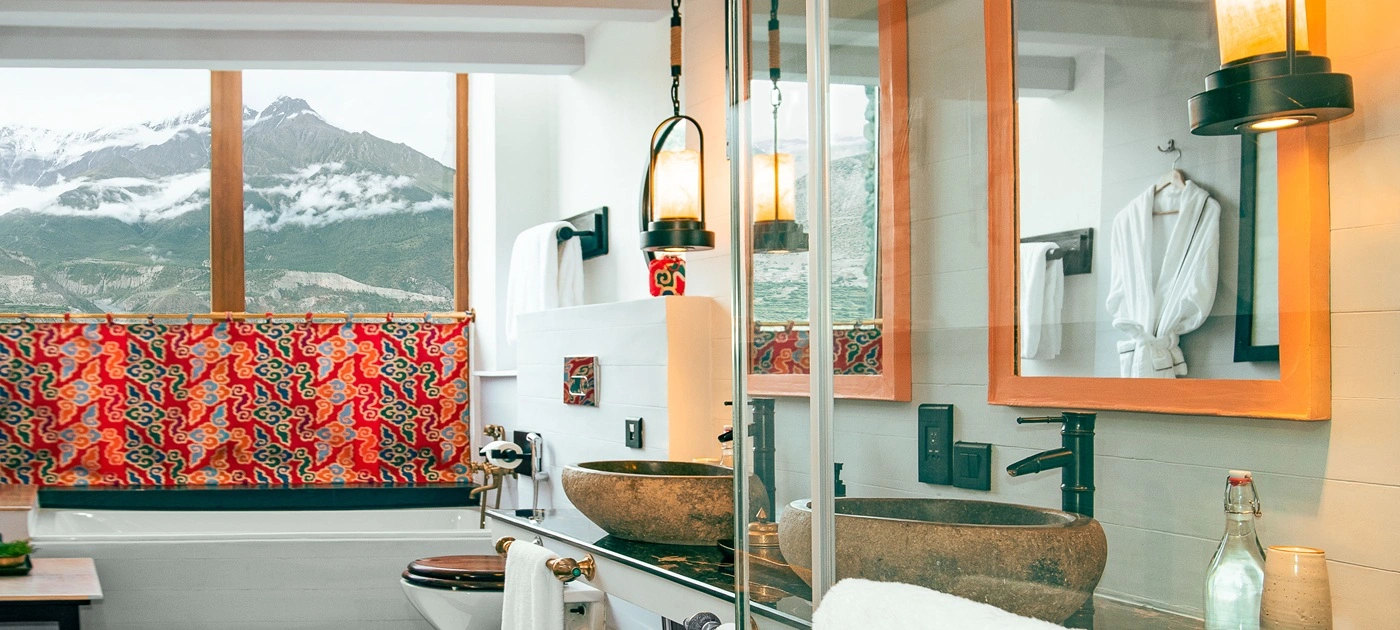
The property reopened in 2023 after a full rebuild, designed by Bill Bensley and set low into the mountainside so it almost disappears against the rock. An internal courtyard and thick insulation blunt the wind that funnels down the valley every afternoon, and the interiors lean into Tibetan highland style with bold color, upcycled pieces, and locally woven textiles. It has been recognized as one of the world's leading hotels by National Geographic.
There are 29 suites all open-plan, so the floor-to-ceiling views of the Nilgiri range stay uninterrupted from the bed. Rates run from roughly US$1,890 to US$2,200-plus per night, all-inclusive, on a five-night minimum stay that reflects how long the region really takes to absorb.
Each guest gets a dedicated adventure butler who guides private excursions tailored to your fitness and interests, from Marpha, with its apple orchards and brandy, to the 800-year-old Bon village of Lubra. The wellness program is the standout, built on genuine Amchi medicine: an 11th-generation Tibetan doctor consults with you on arrival and prescribes treatments for your stay, from SoRig massage to herbal steam. It's the rare spa that funds the tradition it draws from.
Red House Lodge: heritage inside medieval Kagbeni
Red House Lodge is the pick for travelers who want history over polish, set inside the walls of a 300-year-old monastery building in Kagbeni. The village sits at about 2,800 meters at the confluence of the Kali Gandaki and Jhong rivers, a medieval warren of dark alleys and mud-brick towers guarded by carved animist figures older than Buddhism itself.
The building carries real weight. During the mid-century Khampa resistance, it stored rations for fighters, and a legendary resistance general is said to have lived in its upper rooms. At its heart is a shrine that survived both a partial collapse and a fire, untouched, holding old Tibetan texts and a five-foot clay statue of the Maitreya Buddha, said to be the second-largest in Mustang after the one in Lo Manthang.
There are 22 rooms, twenty with private en-suite bathrooms, which is a genuine rarity in these ancient lanes. Rooms are named for Himalayan landmarks and built from local materials, and rates remain remarkably accessible, ranging from US$25 to US$80. The kitchen serves a strict farm-to-table Loba menu rather than a Westernized one, and there's a small art gallery on-site. The real luxury here is authenticity, not thread count.
For dinner one night, the village's playfully named "Yac Donald's" is worth the walk, praised by travelers for its yak burger, fresh-baked bread, and vegan and gluten-free thali sets, with a rare village sauna attached.
Lo Mustang Himalayan Resort: warmth at Muktinath
The Lo Mustang Himalayan Resort is the strongest base near Muktinath, the temple sacred to Hindus and Buddhists alike. It sits high at around 3,800 meters, and it's built to beat the cold, which matters when you're acclimatizing before the Thorong La or a diversion deeper into Mustang.
Rooms come with heater units, electric blankets, and heavily insulated walls, dressed in handcrafted Tibetan furniture and local danphek rugs. There are comfortable standard rooms and larger family rooms of around 30 square meters with full mountain views. Rates generally run US$160 to US$216, which is a strong value for the heating and hygiene at this height.
The kitchen is a highlight, with a wide breakfast spread and inventive regional fusion at dinner, including a much-loved yak lasagna. There's genuinely fast Wi-Fi for the altitude and round-the-clock service, so it suits pilgrims and trekkers who want reliability at the foot of the high passes.
Hotel Royal Mustang, Ghami: the mid-route sanctuary
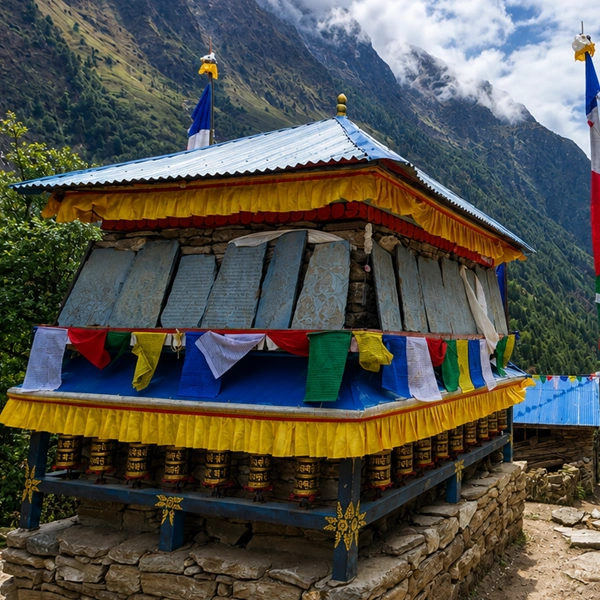
Hotel Royal Mustang has lifted the standard of accommodation in Ghami single-handedly, and it's a welcome halt on the long haul north. Ghami sits at about 3,510 meters, an unexpectedly green village of buckwheat and mustard fields against red cliffs, famous for the longest Mani wall in Nepal.
Where the village once offered only austere teahouses, this lodge provides private en-suite bathrooms with hot showers, a serious logistical feat given the limited solar power and scarce water here. Beds come with electric blankets against the sub-zero nights that seep through stone walls, and the dining and sleeping areas are hung with old Tibetan art and Thangka paintings.
Meals lean on local ingredients and land far above standard teahouse fare. As a strategic overnight between the checkpoint and the capital, it turns what used to be the roughest stretch of the journey into a warm, restful night.
Maya's Heritage Inn, Tsarang: the finest on the road north
Maya's Heritage Inn is the best lodge on the trekking route outside the capital itself, set in the dramatic village of Tsarang at around 3,560 meters. Tsarang is dominated by a 14th-century red monastery and the crumbling ruins of an old royal palace, and it's usually the last stop before Lo Manthang.
The inn blends Nepalese hospitality with traditional Tibetan building, using local wood carving, metalwork, and stonemasonry, and it frames wide views of the wind-sculpted valleys from the rooms. It offers larger rooms and roomy suites with private sitting areas, both prioritizing warmth and space over the thin-mattress cells of standard lodges. Heating comes from convection heaters and electric heated bed pads.
Rates run from roughly US$150 to US$250-plus per night, or US$500 to US$800 per person on full-board packages. The lodge also arranges guided day trips to the Luri Gompa cave monastery, the red cliffs of Drakmar, and the 8th-century Ghar Gompa, associated with Guru Rinpoche. For most travelers, it's the highlight stop of the road north.
Royal Mustang Resort: staying inside the walled capital
Royal Mustang Resort is the finest place to stay in Lo Manthang and the only property in the capital that delivers consistent four-star comfort. It sits just outside the old walls, a six-to-eight-minute walk from the four-story royal palace, built low in local stone to sit easily among the mud-brick city.
Lo Manthang sits at around 3,840 meters, founded in 1380 by the warrior-king Ame Pal, and its temperatures can swing from mild afternoons to hard frost within hours. The resort answers that with heavy insulation and dedicated room heating, and every room has an en-suite with hot water, good bedding, a television, and Wi-Fi. Rooms scale from standard up through larger rooms to suites, styled with contemporary finishes over Tibetan color and motif.
Rates run from about US$220 to US$625 depending on the room, with a festival surcharge during Tiji. The restaurant serves Nepali, Tibetan, and international menus, and there's a well-stocked bar with a fire for after the dusty walk out to the Chhoser sky caves. The front desk serves as a proper concierge, arranging 4WD support and access to the north from the Kora La border area.
What you'll pay
Upper Mustang spans an unusually wide price range, and rates shift with season and demand, so treat these as indicative and confirm before booking. At the top, Shinta Mani Mustang sits in four-figure all-inclusive territory per night. The capital's best resort and the heritage inns on the road north sit in the low-to-mid hundreds, while historic village lodges like Red House stay genuinely modest.
Most upper-tier properties run all-inclusive or full-board models, covering meals, activities, and often permits and transfers, which removes daily friction in a place where paying as you go is impractical. Whatever the tier, the value benchmarks well against comparable high-altitude luxury elsewhere, because so few operators can deliver heat and hot water this far into the desert.
Permits and getting there
Upper Mustang is a Restricted Area since it borders Tibet, so you need a Restricted Area Permit, the Annapurna Conservation Area Permit, and a licensed guide through a registered agency to enter. We arrange all permits for you, so you only need to carry your passport.
The permit system was reported to have recently changed, moving toward a per-day Restricted Area fee and allowing solo travelers with a licensed guide, rather than the old flat ten-day fee and two-person minimum. Because these rules and fees change, we confirm the exact current structure when you book rather than quoting a figure that may have already changed.
Access itself has two ways in. A private helicopter charter from Kathmandu or Pokhara skips the rough roads entirely, landing at Jomsom or Lo Manthang, with charter costs roughly US$4,600 to US$6,000 per flight. The alternative is a private 4WD journey up the Kali Gandaki, stopping only at the better lodges, which trades speed for the full drama of the gorge from a warm cabin.
Timing your visit around the festivals
Two festivals shape the Mustang calendar, and both are worth building a trip around. The rain shadow also makes summer viable here, even as the rest of Nepal is under the monsoon, so Mustang runs long.
Tiji is a sacred three-day Buddhist festival held in the monastery courtyards of Lo Manthang in spring, usually in May, featuring masked Cham dances that depict the victory of the deity Dorje Jono over a demon. Because it falls in peak trekking weather, it draws the highest concentration of travelers, and the best lodges book out months in advance, with festival surcharges applied. On our spring Tiji departures, we've watched the final day's dances fill the Thubchen courtyard while guests warmed their hands on butter tea between acts.
Yartung comes later, around the August full moon, marking the end of summer with bareback horse racing, archery, and community feasting. It's wilder and far less touristed than Tiji, and the dry summer weather makes it a fine window for travelers who want authenticity over spectacle. Exact dates for both follow the Tibetan lunar calendar and are confirmed at the time of booking, so we lock in your rooms early once the monastery sets them.
How we build your Mustang journey
We don't own lodges in Mustang; we choose and secure them for you, which lets us place you in the property that fits your trip rather than one house we happen to run. For most travelers, that means starting warm and low at Shinta Mani in Jomsom, then working north through heritage stops to a proper night inside the walls of Lo Manthang.
Once we know your dates, pace, and appetite for altitude, we build the whole thing: permits, flights or helicopter transfers, guiding, and the right lodge at each stage. Tell us what you want the days to feel like, and we'll shape the route around it.
FAQs
Which is the best luxury lodge in Upper Mustang?
It depends on where you are on the route. Shinta Mani Mustang in Jomsom is the most refined base overall, Maya's Heritage Inn is the finest stop on the road north, and Royal Mustang Resort is the best bed inside the walled capital of Lo Manthang. We match the property to each stage of your journey.
Is Shinta Mani Mustang worth the price?
For travelers who want genuine five-star comfort at the gateway to Mustang, yes. The all-inclusive rate covers meals, private guided excursions, a personal butler, permits, and a lineage-based Amchi wellness program you won't find elsewhere. The five-night minimum suits a slower, deeper trip rather than a quick stopover, which is how the region is best seen anyway.
Are there heated lodges in Lo Manthang?
Yes. The capital now has a four-star resort with proper insulation, dedicated room heating, and en-suite hot-water bathrooms, a major change from the unheated guesthouses of a few years ago. Temperatures in Lo Manthang can drop below freezing within hours, so heated rooms make a real difference to comfort and recovery at 3,840 meters.
Do you need a special permit for Upper Mustang?
Yes. Upper Mustang is a Restricted Area bordering Tibet, so you need a Restricted Area Permit and the Annapurna Conservation Area Permit, plus a licensed guide through a registered agency. Permit rules and fees have been changing, so we confirm the current structure and arrange everything for you, leaving you to carry only your passport.
When is the Tiji Festival in Upper Mustang?
Tiji is held over three days in spring, usually in May, in the monastery courtyards of Lo Manthang. Exact dates follow the Tibetan lunar calendar and are set by the monastery each year, so we confirm them at the time of booking. Because it falls during peak season, the best lodges fill up months in advance and apply festival surcharges, so book early.
Can you reach Upper Mustang luxury lodges by helicopter?
Yes. Private helicopter charters run from Kathmandu or Pokhara to Jomsom and on to Lo Manthang, skipping the rough overland roads entirely. It's the fastest, most comfortable way in, ideal for shorter luxury itineraries, and it can be combined with a multi-day lodge stay or a same-day scenic return. We arrange the charter as part of your trip.
Need Help? Call Us+977 9851013196orChat with us on WhatsApp
Need Help? Call Us+977 9851013196