The Everest Champagne Breakfast is a five-hour private helicopter expedition from Kathmandu to the Khumbu region — landing at Kala Patthar (5,545m), then descending for a champagne breakfast facing Everest at over 3,800 metres. This guide covers the full flight route, what actually happens at altitude, honest pricing, best season, and whether it delivers what it promises.
Everest Champagne Breakfast Helicopter Tour

The Everest helicopter champagne breakfast puts you in front of the world's highest peak for a meal — without a single day of trekking. Five hours. A private helicopter. Champagne at 4,250 meters. And Everest, filling the entire window.
We've run this flight for clients who had three days in Nepal, clients in their seventies who couldn't trek, and honeymooners who wanted something no resort could replicate. The experience is real. But the details matter. Here's exactly what happens, what you'll feel, and what you should know before you book.
What the Flight Actually Looks Like
Departure is early — 6:00 to 6:30 AM from Tribhuvan International Airport's domestic terminal in Kathmandu (1,338m). That early start is not optional. Morning air in the Himalayas is stable. By midday, thermal winds build in the valleys, and cloud closes around the peaks. You fly in the window, or you don't fly.
The first leg takes roughly 45 minutes. You cross the terraced lower hills, gain altitude over the Lamjura-La Pass at 3,550 meters, and descend into Lukla. Tenzing-Hillary Airport (2,860m) is where the helicopter stops for 15 minutes to refuel. Step out, breathe the thin air, and watch the Sherpa porters loading the next round of expedition equipment. It grounds you immediately in where you are.
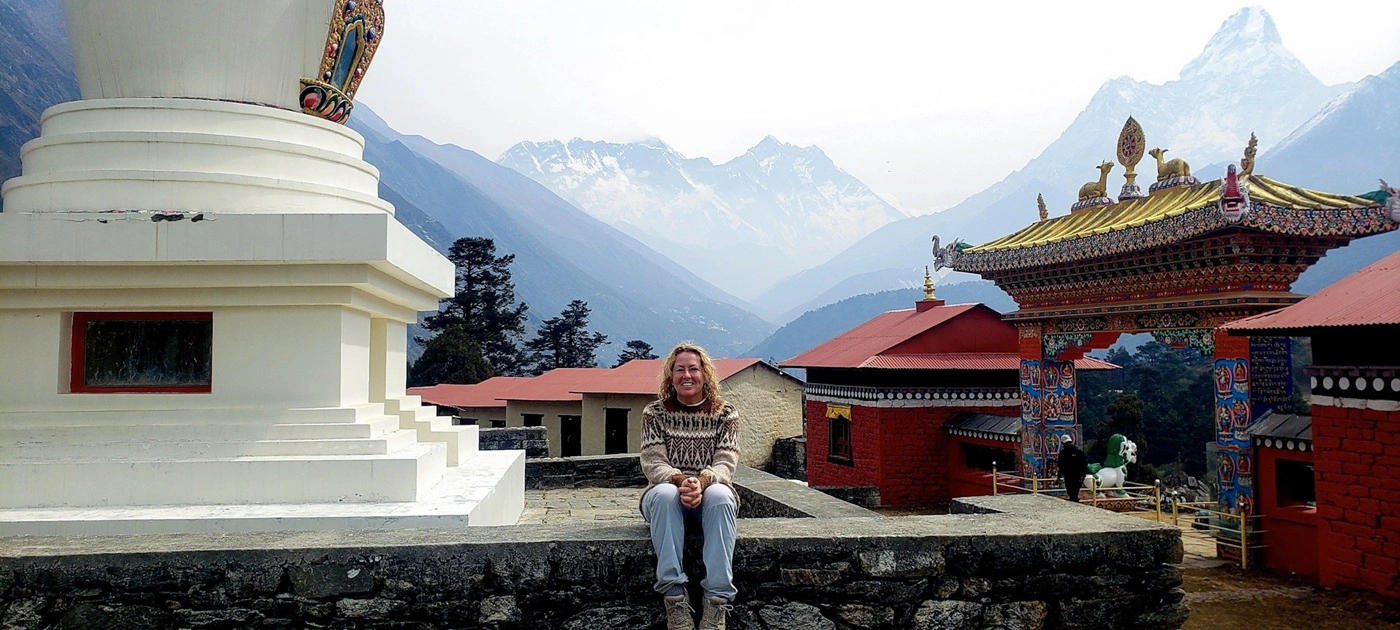
Departing Lukla, the flight tracks the Dudh Koshi gorge north, Namche Bazaar's horseshoe of stone buildings at 3,440m passes beneath you, then Tengboche Monastery on its ridge between the glaciers. Above 4,000 meters, the terrain shifts. The valleys widen into glacial moraines, the light turns blue-white, and Everest slides into view on the left.
The Kala Patthar Landing
Kala Patthar sits at 5,545 meters — 18,192 feet. It is the best viewpoint in the entire Khumbu region, period. Everest Base Camp (5,364m) is actually lower and partially obscured by the mountain's own shoulder. From Kala Patthar, you look directly at the Southwest Face, Lhotse (8,516m) stacked immediately to its right, Nuptse (7,861m) to the left, and Pumori rising sharp and clean just north.
You have 10 to 15 minutes on the ground. That is not a scheduling inconvenience — it is an altitude safety limit. At 5,545 meters, the air contains roughly half as much oxygen as at sea level. Without prior acclimatization, anything beyond 15 minutes starts to increase the risk of Acute Mountain Sickness, with symptoms including dizziness, headache, and confusion. The pilots keep the rotors turning. If the weather moves in fast, you're back in the aircraft in under two minutes.
One thing we always tell our clients: move slowly up there. Walk, don't stride. Breathe steadily. The instinct is to rush to the edge and photograph everything at once. Don't. Give your body 60 seconds to adjust, then move calmly. You'll feel the altitude. That sensation — the slight breathlessness, the cold biting through your jacket at −10°C — is part of what makes this different from any other breakfast in the world.
Payload and the Pheriche Shuttle
This is the detail most operators gloss over, so we explain it up front. At sea level, the Airbus AS350 B3e helicopter carries up to five passengers plus the pilot. At 5,500 meters, reduced air density cuts the safe payload almost in half, to around 220–240 kilograms. That means the pilot can carry only two passengers at a time to Kala Patthar.
For a group of four or five, the helicopter stages at Pheriche (4,371m), shuttles two passengers up, returns, and then takes the next pair. It adds time — roughly 30 to 40 minutes total — but every passenger gets the landing. On a private charter for one or two people, there is no shuttle. You go direct, land, step out together.
The Champagne Breakfast
After Kala Patthar, the helicopter descends to the breakfast venue. Two options exist, and the difference between them is significant.
Hotel Everest View, Syangboche — 3,880m
This is the standard breakfast stop for most shared and many private flights. The hotel sits on a ridge above Namche Bazaar with a stone terrace facing directly toward Everest and the striking pyramid of Ama Dablam. It holds a Guinness World Record as the highest-placed hotel in the world (as of 2004, at 3,880 meters).
There is no road to Syangboche. Every kilogram of food arrives by helicopter or on the backs of Sherpa porters and yaks. That supply chain discipline shows in the kitchen. The Special Breakfast Set runs approximately NPR 4,500 (around USD 35) and includes customized omelets, bacon, fresh juice, and organically sourced coffee. The à la carte menu is broader than you'd expect — Japanese katsudon, Continental fillet of beef, pasta — a surprising range given the altitude and the logistics required to stock it.
Kongde Lodge (Yeti Mountain Home) — 4,250m
For clients booking a fully private charter who want the definitive version of this experience, we route the flight to Kongde Lodge instead. At 4,250 meters, beneath the Kongde Ri peak, a Sherpa team sets a white-tablecloth breakfast on the terrace facing Everest. Champagne — Moët & Chandon or Dom Pérignon, depending on preference — is opened in full view of the summit.
This is the option we use for honeymoon charters and milestone celebrations. The seclusion is complete. No shared terrace, no other guests. Just the two of you, the champagne, and the mountain.
What Champagne Tastes Like at 4,250 Meters
This is not a trivial detail. The physics genuinely change the experience.
At sea level, a bottle of champagne holds CO₂ dissolved under five to six atmospheres of internal pressure. At 4,250 meters, ambient atmospheric pressure is roughly 40% lower than at sea level. The moment the cork comes out, that pressure differential causes the dissolved gas to escape much faster than normal. Bubbles form more readily, grow larger, and rise faster through the liquid.
The effect on the palate is real and immediate: the aggressive effervescence numbs the tongue slightly and softens the apparent acidity. The wine tastes rounder, less sharp. But the carbonation also dissipates faster — the glass goes flat in a fraction of normal time. The aromatic compounds that make a vintage champagne complex depend on steady bubble columns dragging volatile esters to the surface. With larger, faster bubbles, those aromatics scatter inefficiently. Your olfactory sensitivity is also reduced at altitude, so the subtle bouquet diminishes further.
The net effect: altitude champagne is texturally bold and immediately satisfying, but drinks fast. Drink it while it's alive. Don't hold the glass and admire the view — do both at once.
Photography Notes from 5,545 Meters
The temperature at Kala Patthar routinely falls below −10 °C. Lithium-ion batteries lose voltage fast in the cold — a fully charged camera can be dead within minutes if it's been sitting in a bag. Carry spares in your jacket's inner pocket, against your body, not in your daypack.
In-flight photography through the helicopter windows: wear dark clothing and press the lens directly against the glass to eliminate cabin reflections. A circular polarising filter cuts the intense glare off the glaciers and the Khumbu Icefall. Wide angles — 14mm to 24mm — capture the scale of the terrain far better than anything longer. At 5,545 meters, the summit of Everest is just 3,303 meters above you. The proximity is staggering in a wide frame.
What It Costs
Pricing depends on whether you book a shared or private trip and whether your route includes the Kala Patthar landing.
| Option | Price range | Notes |
|---|---|---|
| Shared, overfly only | USD 1,195–1,399 per person | No Kala Patthar landing. Breakfast at Hotel Everest View is included. |
| Shared, with landing | USD 1,399–1,500 per person | Kala Patthar shuttle included. Up to 5 passengers per aircraft. |
| Private, 1–2 passengers | USD 4,500–5,200 per flight | Exclusive aircraft. No shuttle required. Fully customizable route. |
| Private, 3–5 passengers | USD 6,500–8,500 per flight | Exclusive aircraft. Shuttle at Pheriche for Kala Patthar. |
Add permits on top: Sagarmatha National Park entry (USD 30), Khumbu Pasang Lhamu Rural Municipality tax (USD 20–23), and domestic airport departure tax (USD 7). That's approximately USD 57–60 per person in permits regardless of the flight tier you choose. Shared flights typically do not include the Hotel Everest View breakfast — budget an additional USD 35 per person for that.
For reference, an Annapurna Base Camp helicopter excursion from Pokhara runs USD 2,200–2,400 for a private charter. The Everest flight commands a premium because of the greater distance, higher altitude ceiling, and the payload-management complexity at 5,500 meters.
Who Books This Flight
Our clients for this trip fall into a few clear groups.
Time-constrained travelers — executives or professionals with three to four days in Nepal who want Everest without committing to a fifteen-day trek. The helicopter condenses the visual experience into a morning.
Clients for whom trekking is not medically viable — senior travelers, those recovering from injury, or guests with cardiovascular conditions that preclude high-altitude acclimatization over multiple weeks. We always recommend a conversation with your doctor before any high-altitude helicopter flight; the Kala Patthar landing still takes you to 5,545 meters, and even fifteen minutes at that elevation without prior acclimatization is a physiological event.
Honeymooners want something beyond a resort experience. Champagne at 4,250 meters, private aircraft, Everest through the window — there is a strong argument that nothing else competes in Nepal for sheer occasion.
Trekkers who walked to Base Camp want to fly back. One-way helicopter returns from Gorakshep (5,164m), or Lobuche run approximately USD 1,200–1,400 per person on a shared basis. Three to four days of descent, eliminated in 45 minutes.
Best Season to Book
Autumn is the strongest window, mid-October through late November. The monsoon has washed the atmosphere clean; visibility is exceptional, and weather cancellation rates drop below 5%. This is the season we recommend for first-time clients and for anyone with a fixed travel window.
Spring — mid-March through mid-May — is the secondary window. The valleys below are brilliant with rhododendron bloom, temperatures are milder at the breakfast stop, and Everest itself remains clear. Ground stops at Kala Patthar are considerably more comfortable in spring than in winter.
Winter (December to February) produces the sharpest, most photogenic skies — high contrast, crystalline clarity — but jet-stream winds descend on the peaks and cut into operational thresholds. Not impossible, but higher cancellation risk and genuinely cold ground stops.
Monsoon (June through August) is not viable. Cloud cover and thermal instability push cancellation rates toward 40%. We do not recommend booking in this window.
Is It Worth It?
We get this question directly from clients before every booking, so we'll answer it directly here.
If you are booking the shared overfly-only option at USD 1,195–1,399 and expecting the Kala Patthar landing, no, that option doesn't include it, and the flight alone without the landing is beautiful, but not the complete experience. Be clear on what you're booking.
If you're booking the private charter at USD 4,500–5,200 for one or two people, yes — unambiguously. No shuttle wait, guaranteed Kala Patthar landing, route customized to your timing and the weather window on the day. The flight pays for itself through the clarity it delivers.
The shared-with-landing option at USD 1,399–1,500 is the right call for solo travelers or couples who don't need the full private aircraft. The shuttle adds time, but every passenger still gets the landing. It works.
The one situation where we push back is when clients are drawn to the champagne breakfast as the centerpiece and consider the flight itself secondary. The flight is the experience. The breakfast is the exhale at the end of it. If your primary goal is a luxury meal in the mountains, there are alternatives that are easier to reach and more comfortable to sit in. If your goal is Everest — close, real, and immediate — this is the right vehicle.
FAQs
Does the Everest champagne breakfast helicopter tour include a landing at Kala Patthar?
- It depends on the option you book. The shared overfly-only flight does not land at Kala Patthar. The shared-with-landing and all private charter options include the Kala Patthar landing at 5,545 meters, with passengers shuttled in pairs when required by weight limits.
How long do you actually spend on the ground at Kala Patthar during the helicopter tour?
- Approximately 10 to 15 minutes. That limit is set by altitude safety, not scheduling. At 5,545 meters without prior acclimatization, prolonged exposure increases the risk of Acute Mountain Sickness. The helicopter typically keeps its rotors running for immediate departure if conditions change.
Do I need trekking experience or fitness preparation for the Everest breakfast helicopter flight?
- No trekking experience is required. The flight is designed for clients who cannot or choose not to trek. However, the Kala Patthar landing takes you to 5,545 meters without any acclimatization period. We recommend consulting your doctor before booking if you have cardiovascular conditions, respiratory issues, or have not been to altitude before.
Why does champagne taste different during the Everest helicopter breakfast at altitude?
- Lower atmospheric pressure at 4,000+ meters causes dissolved CO₂ to escape the bottle faster when opened. Bubbles form more aggressively, the wine feels softer and rounder on the palate, but carbonation dissipates faster too. Drink it while it's active — the glass goes flat quicker than at sea level.
What is the difference between Hotel Everest View and Kongde Lodge for the champagne breakfast?
- Hotel Everest View in Syangboche (3,880m) is the standard breakfast venue for shared flights and most private charters — a stone terrace with direct views of Everest and Ama Dablam, a full kitchen, and a menu that includes local and international dishes. Kongde Lodge (4,250m) is reserved for private charters seeking complete seclusion — a white-tablecloth Sherpa breakfast directly facing the Everest massif at a higher altitude, with no other guests.
Can I book a one-way helicopter return from Everest Base Camp after trekking there on foot?
- Yes. We arrange one-way helicopter returns from Gorakshep (5,164m) or Lobuche for trekkers who have completed the walk to Base Camp. Shared return flights run approximately USD 1,200–1,400 per person and take around 45 minutes back to Lukla, saving three to four days of descent.
Need Help? Call Us+977 9851013196orChat with us on WhatsApp
Need Help? Call Us+977 9851013196