Luxury wellness retreats in Nepal run deeper than spa holidays: Ayurvedic physicians on the Kathmandu Valley rim, clinical Panchakarma in the city, an 11th-generation Amchi practicing Sowa Rigpa in Mustang, monastery mornings, and helicopter landings at 4,500 meters of silence. Here is how we design private wellness journeys across all of it.
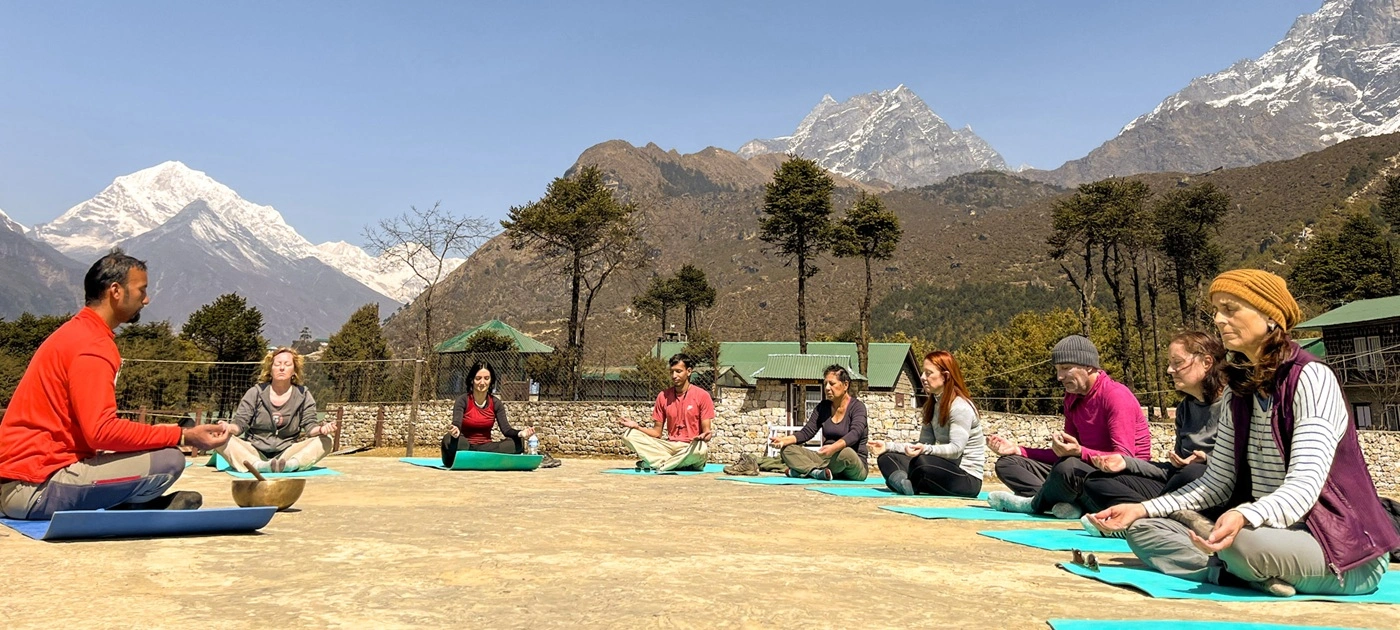
Luxury Wellness Retreats in Nepal

The luxury wellness retreats in Nepal now stand in comparison with anywhere in Asia — and they hold three things Bali and the Maldives cannot buy.
Ancient healing systems are still practiced within unbroken family lineages. Himalayan altitude as a genuine therapeutic tool. And a quality of silence that has become the world's scarcest luxury.
We plan private wellness journeys in Nepal for clients who have done the famous resort islands and want something that goes deeper. For the broader Himalayan context, see our full overview of luxury travel in the Himalayas. Here is what we actually recommend, and why.
What Makes Nepal Different for Wellness
The honest answer is a combination that nowhere else can replicate. Altitude itself becomes therapy on the rim of the Kathmandu Valley — cleaner air, measurable quiet, and a physiological slowdown the body cannot refuse.
The healing systems practiced here are not imports. Ayurvedic physicians work in residence at the rim retreats, and in Mustang a Tibetan doctor practices Sowa Rigpa — the classical Tibetan medical system inscribed on UNESCO's Representative List of the Intangible Cultural Heritage of Humanity — as the 11th generation of his family to do so.
Add private helicopters, and the geography folds into the program. You can stand at 4,500 meters of absolute silence facing the Annapurna range in the morning and be under a stream of warm Shirodhara oil by ten. No other wellness destination offers that arithmetic.
The Kathmandu Valley Rim: Retreats Above the City
The strongest concentration of luxury wellness properties in Nepal sits an hour east of Kathmandu, where the valley rim rises to between roughly 1,700 and 2,100 meters — close enough to the airport to be genuinely accessible, high enough to feel removed from the city entirely.
Dwarika's Resort, Dhulikhel — the benchmark
Built from lime plaster, timber, and terracotta in the Newari and Gurung tradition, with forty suites, a 25-acre private forest, and an infinity pool facing the Langtang range.
The Pancha Kosha Himalayan Spa is the most comprehensive program we have seen at this altitude, working through the five layers of Vedic philosophy — physical, energetic, mental, intellectual, and the deepest meditative state.
Treatments run from chakra sound therapy and Shirodhara to sessions in a dedicated Himalayan salt room, where ionized air is used for respiratory work in 45-minute sittings, and a crystal-therapy space for energy rebalancing.
A resident Ayurvedic physician opens your stay with Nadi Pariksha, the pulse-based diagnosis, and stays with you throughout your program — structured detox formats run for three, five, or seven nights.
The kitchen pulls from six on-site organic farms, and the Krishnarpan restaurant serves multi-course feasts tailored to your morning Dosha assessment. Food here is medicine in the literal Ayurvedic sense.
Kavya Resort & Spa, Nagarkot — altitude as the tool
At 2,100 meters, Kavya sits highest on the rim, and its Tevana Spa treats that altitude as the primary therapeutic instrument: programs are structured around the measurable effect of thinner, cleaner air on the nervous system.
Villas run up to two bedrooms with 220-degree Himalayan panoramas — Everest included on a clear morning.
Kavya also introduced Nepal's first internationally trained butler service, which matters more in wellness than anywhere else: precise scheduling of treatments, meals, and rest periods is half the clinical result. Building a Nagarkot sunrise into a longer stay is covered in our luxury resorts in Nagarkot guide.
Dusit Thani Himalayan Resort, Dhulikhel — the structured journey
At the Namo Buddha stupa, the Dusit offers the most packaged format of the three: three-night and five-night journeys that combine the Devarana Spa's lymphatic and body-balancing work with Tibetan singing-bowl therapy and guided walks to the adjacent Thrangu Tashi Yangtse Monastery for morning chanting with the resident monks. Seventy-two rooms, infinity pools, a private yoga pavilion.
Panchakarma: The Clinical Layer in Kathmandu
Panchakarma is the five-phase Ayurvedic deep-detoxification protocol, practiced for roughly three thousand years, and it is the most medically serious offering in Nepali wellness.
For clients who want the clinical version rather than the resort version, we arrange programs at a medically supervised Ayurvedic center in Kathmandu — featuring certified physicians, comprehensive pulse-based Dosha consultations across Vata, Pitta, and Kapha, and a protocol built on therapeutic oil massage, herbal steam, and nasal administration.
The rooms are comfortable; the focus is on medical function, not aesthetics. The framework these physicians work within is the same one governed in India by the Ministry of AYUSH, the regulatory body for Ayurveda and its sister disciplines.
We often open with a longer itinerary here — two days in the city for consultation and initial protocols — before moving clients to the rim for the residential program.
Key Ayurvedic Therapies: What They Actually Feel Like
Clients new to Ayurveda ask us what the treatments are like in the body. Plain descriptions of the core modalities across the rim retreats:
- Abhyanga — full-body warm herbal-oil massage, often with two therapists working in exact tandem. Sixty to ninety minutes. The body feels heavy and quiet afterward; it is the standard opening treatment because it prepares the lymphatic channels for deeper work.
- Shirodhara — a thin, continuous stream of warm oil poured over the forehead for thirty to forty-five minutes. Chronically poor sleepers consistently report the deepest sleep of their lives afterward. Oil temperature and flow pressure are calibrated to the individual, which is why resident physicians monitor them closely.
- Udvartanam — a vigorous dry massage with warm herbal powders, stroked upward, the opposite of Western technique. Prescribed for metabolic stimulation once the channels are open, usually after several days of Abhyanga.
- Kati Basti — a dough ring built on the lower back, filled with warm pooling oil, held for thirty to forty-five minutes. The standard prescription for spinal tension — which includes most of our trekking clients freshly down from a fourteen-day Annapurna route.
- Nasya — medicated oil applied gently into the nasal passages. Sounds confronting; it is not. The sinus clearing and the sharpness of mind that follow within twenty minutes explain why it appears in almost every multi-day program.
- The Dosha consultation that precedes all of this is not a formality. The physician asks about sleep, digestion, skin, emotional temperature, and stress triggers before prescribing anything, and the resulting program is yours, not a menu item.
Sound, Stone, and the Morning Kora
Tibetan singing bowls, forged from seven metals and hand-hammered, are placed on the chest, abdomen, and forehead and struck; the vibration travels through tissue, and the measured effects — slower heart rate, lower cortisol, deep parasympathetic activation — are why we treat sound healing as therapy rather than ambiance. We arrange private sessions at the Rim Retreats and with practitioners at the monastery in the valley.
The other city ritual we build into nearly every itinerary costs nothing: the dawn kora at Boudhanath. A private circumambulation of the great stupa with a Buddhist scholar, prayer wheels turning, butter lamps lit, monks in maroon setting the pace. It is walking meditation, and as an opening for the morning, it sets the tone for the entire journey.
Upper Mustang: Sowa Rigpa at the Edge of Nepal
Upper Mustang is a different category of experience. The region borders the Tibetan plateau, sits behind a Restricted Area Permit that keeps annual visitors to a few thousand, and preserves Tibetan Buddhist culture with an intactness almost impossible to find elsewhere.
At the contemporary luxury lodge above Jomsom at 2,800 meters — twenty-nine suites of stone and slate, with hand-painted Tibetan motifs, facing Mount Nilgiri — the healing program is Sowa Rigpa itself, delivered by that 11th-generation Amchi.
This is not a spa treatment with a Tibetan name. The Amchi diagnoses by pulse and observation, assesses the balance of the Wind, Bile, and Phlegm humors, and prescribes a personal protocol: energy-pathway massage, traditional cupping, and herbal steam baths using plants foraged from the Kali Gandaki gorge's own microclimate.
Hot tubs, steam, and sauna handle the post-excursion recovery; the altitude and remoteness do the rest. We fly clients in rather than subjecting them to a full day of mountain road that contradicts everything the program is built for, and we handle the permit paperwork entirely.
The lodge-based journey we run there — nine private days, five all-inclusive nights — is the single strongest wellness program in our portfolio.
Pokhara and the Trail: Wellness in Motion
Pokhara has rebuilt itself around wellness over the past decade — the lake, the silence, and the closeness of the Annapurna range make it the strongest base outside the valley rim.
Tiger Mountain Pokhara Lodge sits on a ridge 300 meters above the valley: eighteen stone bungalows, no televisions — yoga mats and binoculars instead — and sight lines straight to Machhapuchhre. Its sustainability practice predates the industry's talking points by years.
The Pavilions Himalayas runs two properties: contemporary villas among working rice paddies, and off-grid lakeshore tents reached by paddleboat, solar-powered and biogas-fed, with a spa built on hill-foraged botanicals. On Begnas Lake, east of the city, a quieter lakeside retreat runs pulse-based Ayurveda with a resident Yogacharya in private garden pavilions.
Wellness continues onto the trail itself. On the Annapurna Base Camp route, we build the natural hot springs near Jhinu Danda into the itinerary — mineral-rich thermal immersion after a day of altitude gain reduces muscle inflammation and deepens sleep during the trek, not after it — and we arrange private sunrise yoga at the luxury lodges of Ghandruk and Dhampus with the massif as the practice wall. The full route, lodge network, and helicopter options are in our Annapurna Base Camp luxury trek with heli return.
Heli-Wellness: The Format That Changes the Mathematics
The most persistent friction in a wellness journey in Nepal is ground transport — slow, dusty roads that undo the nervous-system recovery the retreats produce. Private helicopter access resolves it entirely.
A heli-wellness morning from Pokhara: depart at 7:00, fly to the Mardi Himal shoulder at 4,500 meters, stand in absolute silence before the Annapurna wall for forty-five minutes, and be back in the spa for Shirodhara by ten.
From Kathmandu, the same logic reaches further — a morning flight to Kala Patthar at 5,545 meters, ten to fifteen minutes on the ground facing Everest, breakfast at a view hotel above Namche at 3,880 meters, home by midday for an afternoon Pancha Kosha session.
We build that as a standalone half-day; the full format is detailed in our guide to seeing Everest without trekking. Above 4,500 meters, we fly landings as two-passenger shuttles — thin air cuts lift margins, and it is a house rule our operations desk applies regardless of the aircraft manifest.
Monastery Immersions: The Psychological Reset
The parts of these journeys our clients carry longest are usually not the treatments. They are the monastery mornings.
Kopan Monastery, on its forested hilltop above the valley, is one of the most significant centers of Tibetan Buddhism outside Tibet, and private retreats there focus on Lojong mind training and Shamatha calming meditation, with silence structuring the day. The recently consecrated Stupa of Complete Victory holds the relics of the late Kyabje Lama Zopa Rinpoche, with subterranean meditation rooms beneath it built for advanced silent practice.
Namo Buddha, one of Nepal's three holiest stupas, adjoins the Thrangu Tashi Yangtse Monastery and its 250 monks. Our ground team arranges seated access to the morning puja as the horns and drums build, guided Vipassana in the hillside stone caves, and — schedule allowing — a conversation with a senior monk. Pema Ts'al, a working valley monastery, offers the fullest immersion: Vipassana instruction from resident monks, singing-bowl sessions, farm meals, and complete digital disconnection, on the monastery's terms rather than yours.
We place guests at the hillside resort by Namo Buddha or in the monasteries' own guest houses, depending on how deep they want to go. Knowing where to put whom is the most important part of the craft.
Maha Shivaratri: When to Build a Festival Into Wellness
Maha Shivaratri — the Great Night of Shiva — falls in late winter each year on the lunar calendar, drawing over a million pilgrims and thousands of Sadhus, Naga ascetics, and Aghoris to Pashupatinath, a UNESCO World Heritage Site. Exact dates shift annually and are confirmed at the time of booking.
For the right client, it is one of the most powerful things we can build into a wellness itinerary: a private bilingual guide, a secure vantage point for the nocturnal Rudra Abhishek, and a position that lets you observe the bonfires and the ash-smeared ascetics without being absorbed by the crowd. It recalibrates what you consider ordinary. It is not for everyone; for guests with a spiritual dimension to their travel, it is a fit.
Chitwan: The Warm Exhale
The subtropical Terai is the deliberate contrast — warm, humid, biologically loud. Chitwan National Park, a UNESCO World Heritage Site and one of the last strongholds of the greater one-horned rhinoceros, pairs dawn drives on the Rapti riverbank with a wellness program built on the five elements, treatments administered to the sound of the jungle river. Private plunge pools, stone-spouted outdoor baths, excellent food.
In a two-week wellness itinerary, Chitwan works as the low-altitude exhale between the rim retreats and the mountain programs — physiologically and experientially.
How We Build a Nepal Wellness Itinerary
A typical private wellness journey runs ten to fourteen days and combines three or four of the elements above. A common structure: arrive in Kathmandu with a full rest day; helicopter to the Dhulikhel rim for three or four Ayurvedic nights with a Namo Buddha morning in the middle; helicopter to Pokhara for two lodge nights and the Mardi Himal flight; a final Kathmandu night before departure — never a same-day connection. Mustang adds three to five nights and its own permits, which we handle entirely.
The through-line is unhurried time. Wellness travel in Nepal fails when compressed — the altitude needs respect, the Ayurvedic protocol needs consecutive days, and the monastery stillness dies in a packed schedule. Budgets depend on season, party size, and program depth, and are confirmed line-by-line in your proposal rather than guessed at here.
FAQs
What is the best luxury wellness retreat in Nepal for a first-time visitor?
The Kathmandu Valley rim retreats — particularly the Pancha Kosha program at Dwarika's Resort Dhulikhel — are the strongest starting points: clinically structured, run by resident Ayurvedic physicians, and accessible from the airport without altitude acclimatization. We recommend a minimum of three nights for the protocol to take effect properly.
Is Sowa Rigpa in Upper Mustang genuinely different from Ayurvedic spa treatments elsewhere in Nepal?
Yes, meaningfully. Sowa Rigpa is the classical Tibetan medical system — distinct from Indian Ayurveda in diagnostic framework and pharmacopeia — delivered in Jomsom by an 11th-generation Amchi who diagnoses by pulse before prescribing anything. Foraged Kali Gandaki botanicals, altitude, and remoteness compound the difference. It is a clinical consultation inside a lineage, not a branded spa menu.
What is Panchakarma, and where can it be done properly in Nepal?
Panchakarma is a five-phase Ayurvedic deep-detoxification protocol, roughly three thousand years old, that combines therapeutic oil massage, herbal steam, and nasal administration under medical supervision. In Nepal, it is done properly at a physician-led Ayurvedic center in Kathmandu rather than a hotel spa; we build it as the clinical opening of longer wellness itineraries.
Are there natural hot springs on the Annapurna Base Camp trek route?
Yes — the geothermal springs near Jhinu Danda on the lower route. We build them into the trekking itinerary itself, because mineral-rich thermal immersion after a day of altitude gain reduces muscle inflammation and deepens sleep during the walk, not after it. Paired with private lodge yoga at Ghandruk and Dhampus, the trek becomes part of the wellness program rather than its opposite.
Can I combine a Nepal wellness retreat with a luxury trekking itinerary?
Yes, and it is one of the most rewarding formats we build. Three to four Ayurvedic nights on the valley rim pair with a private luxury trek in the Annapurna or Khumbu — exertion and altitude on one side, physiological recovery on the other. We build the buffer days and transitions so neither element feels compressed.
What is the best time of year for a luxury wellness itinerary in Nepal?
The classic windows are mid-March to mid-June (spring) and mid-October to mid-December (autumn), when every element — rim retreats, heli-wellness flights, Mustang, monasteries — is at its best. The rim retreats themselves run year-round, and winter brings the deepest silence and quietest properties, which suit intensive detox programs well.
How does private helicopter access enhance a wellness itinerary in Nepal?
It removes the one thing that undoes the work: road transfers. Helicopters connect Kathmandu, the rim, Pokhara, and Mustang in minutes rather than dusty hours, and they add a therapy of their own — landing at 4,500 meters for silence before the Annapurna wall, then descending to a spa session the same morning. We use them as standard wherever geography allows.
Does Alpine Luxury Treks arrange monastery stays and private access for wellness itineraries?
Yes. Our Kathmandu ground team maintains relationships with Kopan, Pema Ts'al, and the Thrangu Tashi Yangtse Monastery at Namo Buddha, arranging access to morning puja, guided meditation, and, where schedules allow, time with resident teachers. Accommodation ranges from the hillside resort to the monastery guest houses for a full immersion. We handle logistics and briefing end-to-end.
Tell us what you want to heal and how much time you have, and we will design the program around it. If Mustang's Sowa Rigpa is calling, our Upper Mustang luxury lodge tour is the journey built precisely for it.
Need Help? Call Us+977 9851013196orChat with us on WhatsApp
Need Help? Call Us+977 9851013196