Family friendly treks in Nepal work when the route matches the child, not the parent. Five routes do this well: Ghorepani Poon Hill, Pikey Peak, the Royal Trek, Mardi Himal and the Balthali heritage circuit. They span 1,580 to 4,065 meters, three to eight days, toddlers to teenagers.
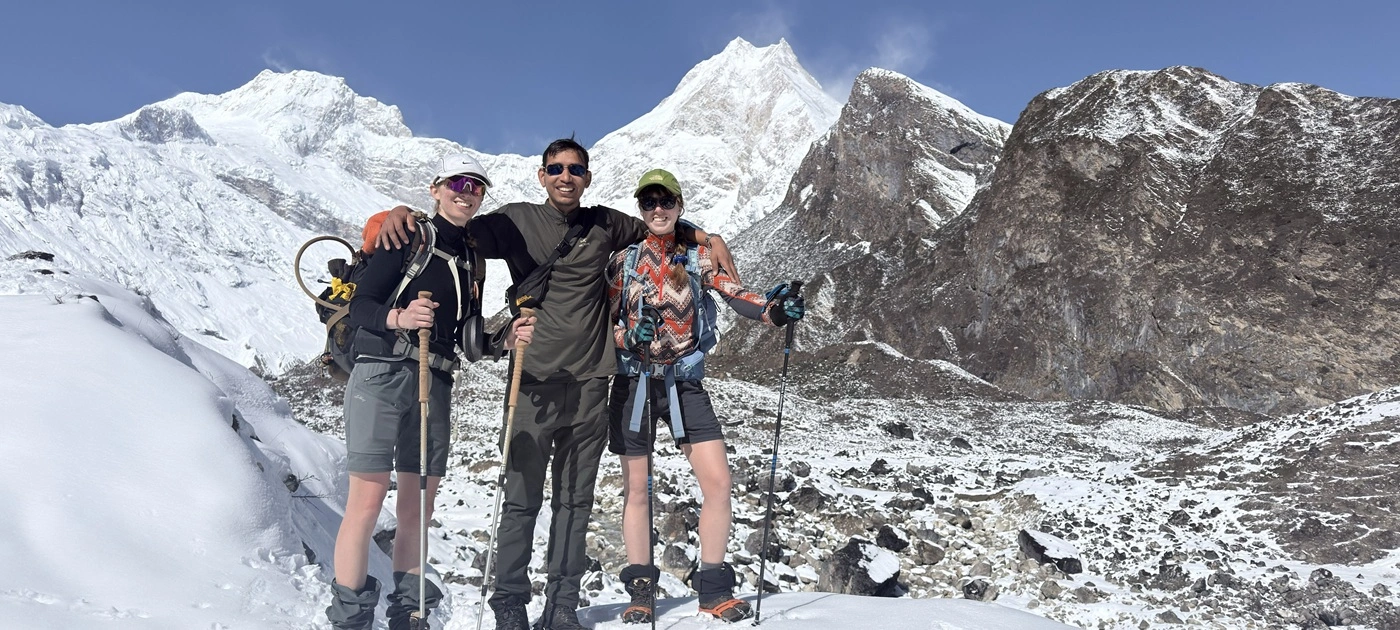
Family Friendly Treks in Nepal: Five Routes That Work With Children

Family friendly treks in Nepal begin with one reversal of the usual planning order: the child sets the ceiling, and everything else is built downward from there. Height comes first, then daily walking hours, then the number of nights. Nobody in a family group needs to reach the highest point on the map.
We run these routes every spring and autumn with children as young as three riding in a carrier and teenagers who out-walk their parents by lunchtime. The five below are the ones we keep coming back to. Each earns its place for a different reason, and none of them is a shortened version of an adult itinerary.
What makes a trek in Nepal family friendly?
A trek is family friendly when the sleeping altitude stays low, the daily distance stays short, and the trail has a road or a helicopter landing zone within reach if the plan changes. Those three things matter more than scenery.
Sleeping altitude is the one parents underestimate. Acute mountain sickness rarely appears below about 2,500 meters, so a route that tops out at 1,730 meters removes the problem completely rather than managing it.
Daily distance is the second lever. Four to five walking hours, broken by a long lunch, keeps a seven-year-old cheerful. Six hours does not.
The third is the exit. We plan every family route around the nearest point a vehicle or a helicopter can reach, and we tell parents where that point is before the first step.
The five family friendly treks in Nepal, compared
Here are the five routes side by side, with the number that actually governs safety — the highest night, not the highest photograph.
| Route | Region | Highest point | Highest sleeping altitude | Days | Suits |
|---|---|---|---|---|---|
| Ghorepani Poon Hill | Annapurna Conservation Area | 3,210 m | 2,860 m (Ghorepani) | 4–5 | Ages 5+ |
| Pikey Peak | Lower Solu, Everest region | 4,065 m | 3,640 m (base camp) | 6–8 | Ages 7+ |
| The Royal Trek | Kaski, east of Pokhara | 1,730 m | 1,730 m (Syaklung) | 3–4 | All ages, including toddlers |
| Mardi Himal | Annapurna Conservation Area | 4,200 m viewpoint | 3,580 m (High Camp) | 5–7 | Ages 10+ |
| Balthali & Namobuddha | Kavrepalanchowk, near Kathmandu | ~1,750 m | 1,580 m (Balthali) | 2–3 | All ages |
Two of these sit entirely below the altitude line. Two more sleep under 3,000 meters at their highest. Only Mardi Himal asks a family to spend a night above 3,500 meters, which is why we grade it for teenagers.
We cross-check every family inquiry against this table before we suggest anything. It settles most conversations in five minutes.
Ghorepani Poon Hill: the classic first Himalayan trek for families
The Ghorepani Poon Hill trek is the best introduction to Himalayan walking for children aged roughly five and up, because it delivers 8,000-meter views from a night that never goes above 2,860 meters. Four days is enough. Five is more comfortable.
The reward is the pre-dawn climb from Ghorepani to the Poon Hill viewpoint at 3,210 meters. From the top, the Annapurna wall stands in front of you with Annapurna South at 7,219 meters, the fluted spire of Machhapuchhre at 6,993 meters, and Dhaulagiri at 8,167 meters closing the western end.
How the road changed the hardest part of this trek
The old objection to this route was the stone staircase above Tikhedhunga — a relentless climb of some three thousand steps to Ulleri that has broken the morale of more children than altitude ever has.
Road building has largely solved it. A private four-wheel-drive now climbs past Ulleri towards the higher trailhead near Banthanti at around 2,250 meters, which removes the entire staircase from the itinerary.
We use that road when it is open and passable, and we say plainly that it is a dirt track. Heavy rain closes it. Our guides check the surface the day before, and we keep the walking option in reserve rather than promising a drive we cannot deliver.
The sunrise morning, handled properly
Above Banthanti, the trail climbs through rhododendron forest, and in spring the canopy above the path turns red and pink with lali gurans, Nepal's national flower. Shade matters here for a second reason: ultraviolet radiation climbs roughly 10 to 12 percent for every 1,000 meters you gain.
The Poon Hill climb takes about 45 minutes in the dark. We break it into ten-minute stages for children, each with a stopping point, and every child carries their own head torch rather than following a parent's beam.
Hot lemon and sweet tea wait at the top. The lodges through Ghorepani and Ghandruk are stone-built village houses with wood stoves in the dining room, hot showers, and menus that run from pancakes and pasta to dal bhat.
Pikey Peak: Everest views without the Lukla flight
Pikey Peak gives families the Everest panorama without the Lukla flight, on rolling ridge terrain that climbs gently instead of in staircases. The summit at 4,065 meters looks across Kanchenjunga, Makalu, Lhotse and Everest in a single sweep, with Manaslu far to the west.
Local guiding tradition holds that Sir Edmund Hillary rated this his favorite view of Everest. We repeat it as the story it is, not as a documented fact.
How we get families in
The standard approach is a seven- to eight-hour drive from Kathmandu along the Sun Koshi to Dhap at 2,850 meters. That is a long day in a vehicle for a child, and it is exactly the case our access rule was written for.
Where the usual route means four hours or more of mountain road, we fly. Private helicopter both ways turns the approach into a short scenic transfer and gives a six-day trek back to the family two full days it would otherwise spend on switchbacks.
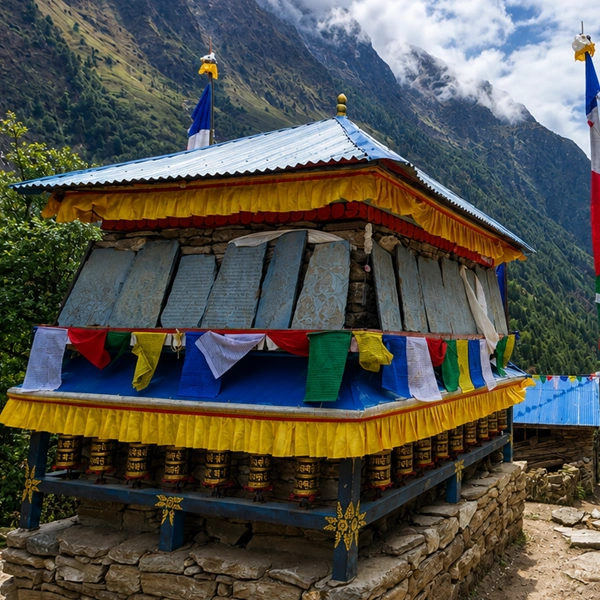
The trail itself runs through pine and open grazing ridges past Jhapre and Bhulbhule, with mani walls and stupas along the way. Walk past them clockwise, and teach the children to do the same.
The cheese ridge and the monastery valley
A working yak-cheese dairy sits on the ridge near the base camp, and it turns into the most popular hour of the trek for most children. They taste the cheese, they meet the yaks, and they get a plain lesson in how a high-altitude family earns a living.
Beyond the summit, the route drops into Junbesi at 2,680 meters, a Sherpa valley with one of the loveliest villages in Solu. An acclimatization day here reaches the monastic complex at Thupten Choling, founded by a lama who crossed from Tibet with his followers.
Monks and nuns still live and study there. Children who have never seen a monastery tend to go very quiet in the prayer hall, which is its own kind of education.
The Royal Trek: the safest start for toddlers and grandparents
The Royal Trek is the right choice for multi-generational families because its highest point, around 1,730 meters at Syaklung, sits well below the altitude at which mountain sickness begins. Three or four days, no hypoxia, no medication conversation.
Its name comes from a British royal trekking party that walked these ridges east of Pokhara decades ago with a very large support entourage. The route has stayed quiet ever since.
Days run four to five hours on broad, well-graded paths through terraced fields, subtropical forest and Gurung and Brahmin hamlets. The gradient forgives short legs and tired knees equally.
The views do not suffer for the low altitude. From the ridge above Kalikasthan, the Annapurna massif, Machhapuchhre, Manaslu and Lamjung Himal fill the northern horizon.
The finish is the part children remember. The trail drops to Begnas Lake, where a wooden boat and a swim close the trek before the short drive back into Pokhara.
Mardi Himal: the ridge walk for teenagers
Mardi Himal suits active children of about ten and older, and it is the only route here that asks a family to sleep above 3,500 meters. High Camp sits at 3,580 meters, and the upper viewpoint at 4,200 meters is a pre-dawn push from there.
The trail's design is what makes it good for strong young walkers. It stays on the ridge instead of dropping to a river and climbing back out, so the ascent is steady rather than repetitive.
From Kande at 1,770 metres the route climbs through Australian Camp and Deurali into old rhododendron, oak and hemlock forest, reaching Forest Camp at 2,600 meters and Low Camp at 2,970 meters.
Above Badal Danda the trees stop. The ridge opens into high pasture where yaks graze among medicinal herbs, and the ice walls of Machhapuchhre stand almost directly overhead.
That transition — jungle to tundra in two walking days — is the clearest ecology lesson available anywhere in the Annapurna region. The descent through the Gurung and Magar village of Siding returns families to farmland and orange trees before Pokhara.
Opened to teahouse trekking barely more than a decade ago, Mardi still feels emptier than the trails on either side of it.
Balthali and Namobuddha: two nights from Kathmandu
The Balthali heritage circuit is the answer for families short on time, because it needs no domestic flight, no long highway drive and no trekking permit at all. Kathmandu to the trailhead takes under two hours.
The walk starts at the Newar hill town of Dhulikhel at 1,550 meters and follows open ridges southeast to Namobuddha, one of the three great Buddhist pilgrimage sites of the Kathmandu Valley alongside Boudhanath and Swayambhunath.
Legend holds that a prince gave his body here to feed a starving tigress and her cubs. The active monastery beside the stupa keeps the story present rather than historical, and morning prayers are open to visitors who arrive quietly.
From Namobuddha the path descends through terraced farms and orange orchards into the Roshi Khola valley to Balthali at 1,580 meters, where the accommodation is a comfortable hillside lodge rather than a village teahouse — real beds, reliable power, hot water.
Children can cycle the village lanes or walk to Panauti, where the Indreshwar Mahadev temple has stood since the thirteenth century. Because the circuit falls outside every national park and conservation area, no ACAP permit and no TIMS card apply.
Altitude and children: what parents actually need to watch
Children are no more susceptible to altitude sickness than adults, but they are much worse at reporting it, which is the real risk on any family trek in Nepal. The condition is common and manageable. Missing it is what turns it dangerous.
Above 2,500 meters, mountain sickness in an older child or teenager looks the same as in an adult: a headache plus at least one of nausea, poor appetite, unusual tiredness or dizziness.
Reading a child who cannot describe it
In toddlers and pre-verbal children, the signs are behavioral, and parents are the only reliable instrument. Watch for unusual fussiness, irritability that does not settle, pale skin, a sharp drop in playfulness, refusal to eat, and sleep that goes wrong in either direction.
The rule we work to is simple. A cluster of those changes with no other obvious cause is treated as altitude sickness until proven otherwise, and the ascent stops that day.
Two conditions need immediate descent, not observation: fluid on the lungs, which shows as breathlessness at rest, a persistent dry cough and blue lips or fingernails; and brain swelling, which shows as confusion or an inability to walk a straight line. Both mean going down 300 to 1,000 metres without waiting for morning.
The ascent rules we build every family itinerary around
Above 3,000 meters, the Wilderness Medical Society advises raising your sleeping altitude by no more than 500 meters a night, with a rest day every three to four days. We build family itineraries inside that limit rather than at its edge.
Climb high and sleep low remains the most reliable acclimatization tool there is. It is why our Pikey Peak days walk higher than the lodge and come back down for the night.
Our guides carry a pulse oximeter and check every child before dinner and again after breakfast. Nobody in the group goes to a higher bed while any member of the family has symptoms, however mild they look.
Medication: the honest version
Acetazolamide is the standard preventive drug for altitude illness, and dexamethasone is a rescue drug used to get someone down safely. Neither belongs in a travel article with a dose attached.
Pediatric prescribing depends on weight, kidney function, drug allergies, and the specific itinerary, and dexamethasone in particular is not used preventively in children. Take the itinerary to a travel-medicine clinic six to eight weeks before departure and let a doctor decide.
We send the full day-by-day altitude profile to every family in advance for exactly that appointment. Hydration does more than most parents expect: pale, clear urine is the target, and oral rehydration salts help when appetite drops.
Permits and rules for family treks in Nepal
Nepal charges no trekking permit fees for children under ten, though every child must still be registered by name for search-and-rescue coverage. That single rule saves a family of four a meaningful amount before they leave Kathmandu.
The Poon Hill, Mardi Himal and Royal Trek routes all sit inside the Annapurna Conservation Area, which covers 7,629 square kilometers and is managed by the National Trust for Nature Conservation. Entry needs an ACAP permit, checked at posts including Birethanti and Chhomrong.
Children aged ten to seventeen pay the full adult rate for their nationality — there is no teenage discount — and a parent or guardian signs the application alongside a passport copy.
The TIMS card is the second registration, and current regulations require foreign trekkers on designated trails to walk with a licensed guide rather than independently. Booking through a licensed operator satisfies both requirements at once.
Pikey Peak sits outside Sagarmatha National Park and uses regional entry permits instead. Balthali and Namobuddha need neither ACAP nor TIMS. We arrange every permit on the family's behalf and carry the paperwork on the trail.
Season, gear, and who carries the toddler
The two Nepal trekking windows are mid-March to mid-June and mid-October to mid-December, and both work for families for different reasons. Spring brings the rhododendron bloom and warmer nights. Autumn brings the cleanest mountain air of the year and the most reliable sunrises.
Below 2,000 meters, on the Royal Trek and the Balthali circuit, the season stretches wider still. Winter days there are mild and bright.
Layering, sun and feet
Cotton is the mistake to avoid, because it holds sweat and pulls heat out of a child fast. Merino or synthetic base layers, two sets, are the foundation of everything else.
Add a fleece mid-layer and a proper down jacket for nights at Ghorepani or Pikey base camp, where the temperature drops hard after sunset. Boots must be waterproof and thoroughly broken in before the flight — a blister on the first morning shapes the whole week.
Category 3 UV400 sunglasses and high-factor sunscreen are not optional at these elevations, for adults or children.
Carriers, porters and pacing
Children under about five, or under roughly 22 kilograms, ride rather than walk on steep ground. A framed child carrier with an internal frame, a load-transferring hip belt, a five-point harness and a sun canopy is the right tool.
On our family departures, a porter can carry that carrier on the steepest sections, which leaves parents walking unloaded and, more to the point, with enough energy left to parent at the end of the day.
Porter loads are capped, and their pay, food, and lodging are handled by us, not negotiated on the trail.
The other thing that happens is harder to plan for and works every time. A child who has run out of patience with their parents will keep walking cheerfully for a Nepali guide who has made the next ridge into a game.
Frequently asked questions
What is the youngest age for the Ghorepani Poon Hill trek with children?
We take children from about five years old on their own feet, and younger children in a carrier. The jeep to the higher trailhead removes the three-thousand-step climb that used to set the practical floor. Nights stay at 2,860 meters, which keeps altitude out of the picture for healthy children.
Is the Pikey Peak trek safe for children without a Lukla flight?
Yes, and avoiding Lukla is part of why we recommend it. Pikey Peak reaches Everest viewing altitude on gentle grazing ridges, sleeping no higher than 3,640 meters at base camp. We replace the long overland drive with a private helicopter transfer, which removes both the aviation anxiety and the seven-hour road day.
How high do children sleep on the Mardi Himal trek?
High Camp at 3,580 meters is the highest night, with the upper viewpoint at 4,200 meters reached as a dawn out-and-back. That single night above 3,500 meters is why we grade Mardi Himal for ages ten and up rather than for younger children.
Do children pay the ACAP permit fee on family treks in Nepal?
Children under ten are exempt from both the ACAP permit fee and the TIMS card fee, though their details are still registered for search and rescue. Children aged ten to seventeen pay the standard adult rate for their nationality. Fees are set by the issuing authorities and confirmed in your proposal.
Can grandparents join the Royal Trek near Pokhara?
The Royal Trek is the route we suggest most often for three generations walking together. It tops out around 1,730 meters, runs four to five hours a day on graded paths, and stays within reach of a vehicle throughout. No altitude medication, no acclimatisation days, no rushed mornings.
How many walking hours a day does the Balthali heritage circuit need?
Three to four hours a day across two or three days, on ridge paths and farm tracks with almost no sustained climbing. It suits families with a short window in Kathmandu, and it works year-round because the whole circuit sits near 1,600 meters.
What happens if a child shows altitude symptoms above Ghorepani?
We stop ascending the same day and reassess after a night's rest and fluids. If symptoms persist or worsen, we descend, and every family route is planned around a known descent line and vehicle point. Your guide carries an oximeter and makes that call with you, not for you.
Can a porter carry a toddler on family-friendly treks in Nepal?
Yes. A porter can carry a framed child carrier through the steepest sections while parents walk unloaded, which is one of the most useful things a private trek can arrange. We agree the arrangement in advance so the right staffing and load limits are set before you arrive.
Planning yours
The choice is usually narrower than families expect. Toddlers and grandparents point to the Royal Trek or Balthali; a first mountain trek for primary-school children points to Ghorepani Poon Hill; Everest views without the flight point to Pikey Peak; teenagers who want a real ridge point to Mardi Himal.
Every one of these runs privately, at your family's pace, with the days shaped around the youngest walker. Tell us their ages and how long you have, and we will send back the profile with the altitude for every night marked.
This article is general information, not medical advice. Consult a travel-medicine professional before trekking at altitude with children.
Need Help? Call Us+977 9851013196orChat with us on WhatsApp
Need Help? Call Us+977 9851013196