Domestic flights in Nepal are the fastest way into the mountains and the least predictable part of any Himalayan itinerary. A 35-minute hop can save you a full day on a mountain road, yet that same flight can sit on the tarmac at Tribhuvan International Airport for three hours waiting on a cloud bank 100 kilometers away.
We plan around this every week of every season. The flying weather over the foothills, not the airline schedule, decides when aircraft move — and once you understand that single fact, everything about Nepali aviation makes sense.
This guide explains how the network works, where delays come from, and the point at which we stop booking fixed-wing seats and instead put our guests in a helicopter.
How Domestic Flights in Nepal Actually Work
Domestic flights in Nepal are short, small, and weather-governed: most mountain sectors run 20 to 40 minutes in 15- to 70-seat aircraft, flown by sight rather than by instruments.
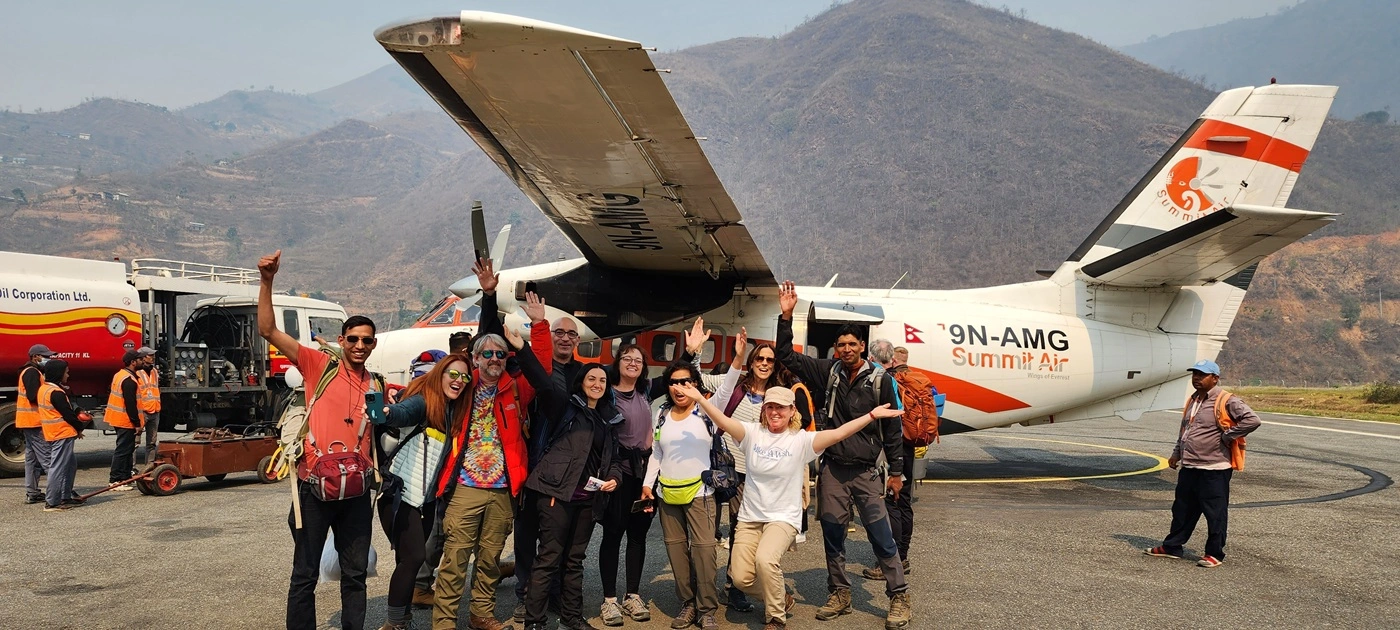
Buddha Air, Yeti Airlines, and Shree Airlines carry the bulk of trunk-route traffic between Kathmandu, Pokhara, Bharatpur, Bhadrapur, and Nepalgunj. The true mountain strips — Lukla, Jomsom, Simikot — belong to short-takeoff specialists flying Twin Otters and Dornier 228s.
The phrase that matters is visual flight rules. Airstrips carved into Himalayan valleys have no instrument approaches, so pilots must see the terrain the whole way in. When a cloud fills a valley, nothing lands there.
Not because anyone is being cautious for show, but because there is physically no other way to arrive.
Mountain airstrips in Nepal, including Lukla at 2,860 meters, operate under visual flight rules only, so aircraft fly when pilots can see the terrain — not by instruments. That one sentence explains almost every delay you will ever hear about.
Why Mornings Win and Afternoons Lose
The most reliable departure window for domestic flights in Nepal is roughly 6:30 to 10:00 a.m., before daytime heating builds clouds and wind over the foothills. Cold, dense morning air sits still. As the sun warms the valleys, convection lifts moisture up the slopes, and by early afternoon the ridgelines that a pilot needs to see are wrapped in cloud.
Wind follows the same clock. Jomsom is the textbook case: the Kali Gandaki valley funnels a katabatic wind that turns anabatic and strengthens through the morning, which is why Jomsom flights from Pokhara are packed into the first hours of daylight and stop entirely once the wind rises. Book an afternoon mountain flight anywhere in Nepal, and you are booking a hope, not a seat.
Season sets the ceiling on all of it. Nepal's flying seasons mirror its trekking seasons: mid-March to mid-June (spring) and mid-October to mid-December (autumn) give the most stable mountain weather.
The monsoon from mid-June to September grounds mountain sectors for days at a stretch, and December-to-January winter mornings add a different problem — valley fog over Kathmandu itself, which can hold even perfectly flyable mountain departures on the ground until it burns off.
Lukla: The Airstrip That Sets the Rules
Lukla's Tenzing-Hillary Airport is the reason flight strategy exists in Nepal at all. Its 527-meter runway sits at 2,860 meters on a 12-degree slope, ends at a wall of mountain, and permits no go-around once an aircraft commits.
Only a handful of aircraft types and specially certified captains operate there.
Capacity is the second constraint. In recent peak trekking seasons, most Lukla fixed-wing services have been rerouted from Kathmandu to Ramechhap (Manthali) airfield — a 4-to-5-hour pre-dawn drive from the city for a roughly 20-minute flight.
The diversion eases congestion at Tribhuvan, but it converts a short flight into a long, early, and distinctly unglamorous travel day. Whether the reroute applies to your dates is confirmed at booking, because the policy has shifted season by season.
This is precisely why our luxury Khumbu programs fly private helicopters in both directions between Kathmandu and the Khumbu, never fixed-wing on the return.
Guests lift off from Kathmandu after breakfast, land 45 minutes later, and skip Ramechhap entirely. Our take on the return leg is covered in detail in our guide to flying from Lukla back to Kathmandu by helicopter.
The Rest of the Network: Where Flights Beat Roads
A domestic flight earns its place any time the road alternative exceeds four hours of mountain driving. Kathmandu to Pokhara is 25 minutes in the air, compared to 6 to 8 hours on the Prithvi Highway.
Bharatpur puts you 20 minutes from Chitwan's jungle lodges. Nepalgunj is the staging point for far-west itineraries toward Bardia and, via Simikot, the Hilsa route toward Mount Kailash.
Baggage is the detail that surprises first-time visitors. Mountain sectors typically allow 10 kg of checked baggage plus 5 kg of hand baggage per passenger, and the Twin Otters weigh everything, including you, on busy days.
We hold surplus luggage securely in Kathmandu as standard practice, so guests carry only their trekking duffel into the hills.
Safety deserves a straight answer rather than a nervous one. Nepal's civil aviation record on mountain sectors reflects genuinely difficult terrain, and the Civil Aviation Authority of Nepal enforces strict daylight, weather, and aircraft-type restrictions on the short strips.
The honest risk-management levers available to a traveler are season, morning departures, buffer days, and operator choice — all of which a well-built private itinerary controls.
When the Helicopter Is the Answer
A helicopter becomes the right call whenever schedule certainty matters more than seat price — and on several routes, it is simply the only sensible option. Helicopters fly lower, route around weather rather than over it, slow down in marginal visibility, and land on helipads instead of runways.
A morning that grounds every Twin Otter at Lukla will often still open a workable corridor for an Airbus H125.
A charter also departs on your clock. There is no queue of 18 scheduled rotations ahead of you, no rebooking scrum when yesterday's cancellations roll over, and no pre-dawn drive to Ramechhap.
When a weather window opens at 9:40 a.m., a charter uses it; a scheduled seat waits its turn and usually loses it.
Our standing rule across all our private programs: wherever the standard access involves four or more hours of mountain road — Langtang, Manaslu, Upper Mustang, Kanchenjunga, Makalu — we fly a private helicopter both inbound and outbound.
Helicopters are still aircraft, and a fully closed valley grounds them too. The difference is that they turn a two-day weather problem into a two-hour one far more often than a fixed-wing schedule ever can, and our overview of Nepal helicopter experiences shows how far that flexibility now reaches.
How We Build Flight Risk Out of a Private Itinerary
Every itinerary we run treats the flight, not the trek, as the fragile link — and armors it four ways. First, mountain flights are always scheduled in the first morning wave, never after 10:00 a.m.
Second, our operations desk in Kathmandu checks the mountain-strip weather reports and webcam feeds before 6:00 a.m. and makes the fly, hold, or reroute call before our guests sit down to breakfast.
Third, every demanding trek includes a buffer night in Kathmandu before the international departure, so a delayed outbound flight never threatens a connection home.
Fourth, for fixed-wing sectors, we hold helicopter contingency as the fallback: if the scheduled service is scrubbed, we move guests to a charter rather than to the next day's waitlist.
Timing your dates inside the stable windows helps most of all, and our guide to the best time to visit Nepal maps those windows month by month.
None of this removes the mountains' veto. It just means the veto costs you hours instead of days—held, not handled, is how we describe it, and flight days are when guests feel that difference most.
FAQs: Domestic Flights in Nepal
Why do Lukla flights sometimes depart from Ramechhap instead of Kathmandu?
Congestion at Kathmandu's Tribhuvan International Airport has pushed most peak-season Lukla fixed-wing services to Ramechhap (Manthali), about a 4-to-5-hour drive east of the city. The flight itself shortens to roughly 20 minutes, but the travel day lengthens dramatically. The policy changes season by season, so we confirm the applicable departure point at booking—or bypass it entirely by helicopter.
How early do mountain flights in Nepal depart?
First rotations leave between 6:15 and 7:00 a.m., and the dependable window closes around 10:00 a.m. Morning air is cold, still, and clear; afternoon heating builds clouds on the ridgelines and wind in the valleys, especially at Jomsom. We never place guests on a mountain sector scheduled after mid-morning, because those flights cancel far more often than they fly.
What happens if a Lukla flight cancels two days in a row?
Scheduled passengers roll onto the next day's waitlist behind everyone already booked, which is how a two-day delay becomes a four-day one in peak season. Our approach is different: we hold helicopter contingency, so a scrubbed fixed-wing sector converts to a charter the same morning whenever a flyable window exists, protecting the trek schedule and the international connection.
Is a helicopter more dependable than a plane on Nepal's mountain routes?
Generally, yes, for completion rate rather than raw safety statistics. Helicopters fly lower, pick routes around weather, and land on helipads, so they operate in marginal conditions that close a visual-rules runway like Lukla's. They cannot beat a fully closed valley. What a charter really buys is timing: it departs the moment a window opens, rather than waiting in a schedule queue.
What is the baggage allowance on domestic flights in Nepal?
Mountain sectors typically permit 10 kg of checked baggage plus 5 kg in hand per passenger, with excess baggage charged per kilo and occasionally offloaded when Twin Otters are weight-limited. Trunk routes such as Kathmandu–Pokhara allow more. We store surplus luggage securely in Kathmandu as standard, so guests fly with a single trekking duffel and day pack.
Do domestic flights in Nepal operate during the monsoon?
Trunk routes between major cities keep flying through the mid-June-to-September monsoon, with frequent delays. Mountain strips are another matter: Lukla, Jomsom, and Simikot can close for several consecutive days when clouds sit in the valleys. If your dates fall during the monsoon, we design around road-plus-helicopter combinations rather than promising fixed-wing sectors that may not operate.
How long is the helicopter flight from Kathmandu to the Khumbu?
About 45 minutes from Kathmandu to Lukla in an Airbus H125, tracking east over the Sun Koshi valleys with the Numbur and Gaurishankar ranges building on the left window. Onward hops deeper into the Khumbu add 10 to 20 minutes per leg. Compare that with a pre-dawn drive to Ramechhap plus a fixed-wing seat, and the appeal is obvious.
If your Himalayan plans depend on getting into the mountains and back out on schedule, our heli-supported treks are built around exactly the flight strategy described here — private helicopters both ways, morning windows, and a Kathmandu team watching the weather before you wake.