The best luxury retreats near Kathmandu ring the valley rim—heritage courtyard stays in the old city, Ayurvedic wellness sanctuaries at Dhulikhel, cliffside mountain-view resorts at Nagarkot, and forest estates at Gokarna and beyond. Booked as the bookends to a Himalayan trek, they turn arrival and recovery into part of the journey. Here's how we use each one.
Luxury Retreats Near Kathmandu

Why the Valley Rim Matters to Your Trek
The luxury retreats near Kathmandu aren't a separate holiday—used well, they're the opening and closing chapters of your trek, giving your body time to adjust on the way in and recover on the way out.
Most travelers treat Kathmandu as a transit hub: land, sleep, fly to the mountains. That wastes one of the best parts of a journey to Nepal. The valley and its rim hold some of the most characterful retreats in Asia, and each solves a real problem in a trek itinerary.
A heritage stay in the city eases jet lag and settles you into Nepali culture. A wellness retreat at altitude on the valley rim gives a gentle first taste of thin air. A quiet forest estate is the perfect place to put a tired body back together after days on the trail.
We deliberately build these stays into our trek itineraries, matching the retreat to the moment—arrival, acclimatization, or recovery. This guide walks through the valley's distinct retreat regions, what each is best for, and how we use them to frame a Himalayan journey. We describe them by their character and setting, and confirm the exact properties in your booking proposal.
Heritage Stays in the Old City
The finest way to arrive in Nepal is a heritage stay in Kathmandu itself, because the city's best properties are living museums that immerse you in Newari craft and culture the moment you land.
The old city holds a handful of heritage hotels built around traditional courtyards, where centuries-old hand-carved Newari woodwork—window screens, pillars, thresholds—has been rescued from demolition and worked directly into the architecture.
Staying in one isn't like checking into a hotel; it's like sleeping inside Nepal's history. Some maintain on-site workshops where artisans still restore old wood by hand, keeping a dying craft alive. Rooms echo the palaces of the Malla kings, and dining runs the gamut from slow, ceremonial multi-course Nepali feasts drawn from the region's ritual cuisine.
This is where we like to begin a trek. It eases jet lag, gently settles you into the place's rhythm and spirituality, and sets a cultural tone that carries all the way to the mountains. We often pair it with private morning visits to the great valley temples and stupas before you fly out.
Dhulikhel: Wellness on the Valley Rim
For deep rest and a gentle first brush with altitude, the Dhulikhel corridor is the valley's wellness heartland—a cluster of retreats built around Ayurvedic and Buddhist traditions at an elevation of around 1,700 meters.
Roughly ninety minutes from the city, Dhulikhel sits high enough to feel like a different world: pine, rhododendron, and apple forest, clean air, and long views toward the Langtang and Rolwaling ranges. The retreats here are built around structured wellness rather than simple spa treatments.
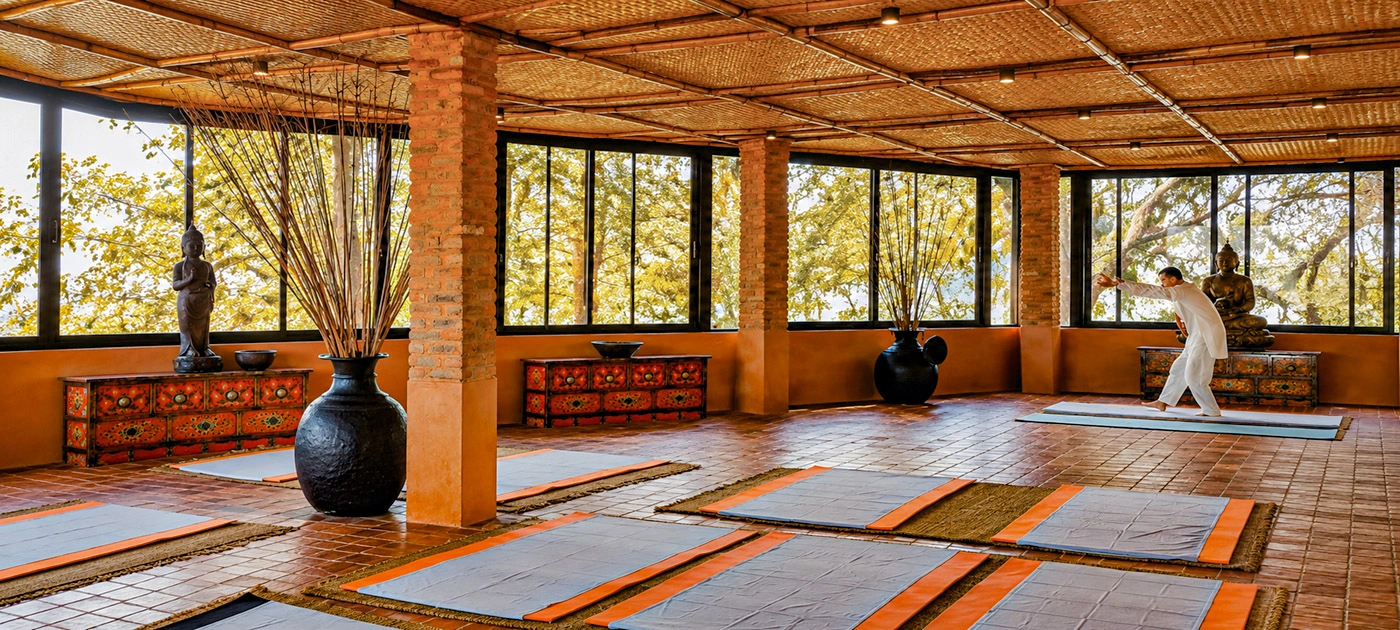
Expect resident practitioners offering Ayurvedic consultations, guided breathwork and open-air yoga, salt rooms, sound and crystal chambers, and walking-meditation labyrinths, alongside dining tailored to traditional principles and sourced from the retreats' own organic farms.
A highlight of the area is the walk to the sacred Namobuddha monastery, one of the most important Buddhist pilgrimage sites in Nepal, often finished with a conversation with a resident lama. For a trek, Dhulikhel plays two roles beautifully: a place to decompress and reset before you fly to the mountains, or a soft landing to recover afterward.
A note on wellness offerings: these are traditional and contemplative experiences the retreats provide, not medical treatments. Enjoy them for rest and culture rather than as therapy, and consult a doctor for any health concern.
Nagarkot: Cliffside Resorts and the Himalayan Sunrise
For the widest mountain views and the most dramatic modern architecture, Nagarkot is the valley rim's showpiece—a high ridge famous for its Himalayan sunrise and resorts built to frame it.
Nagarkot has drawn people for generations to watch the dawn break over the Himalaya, and on the clearest days, the view stretches all the way to Everest. The luxury properties here lean into that spectacle: cliff-edge infinity pools that seem to spill toward the peaks, walls of glass engineered into the hillside so the mountains fill your room, and spacious villa-style suites arranged around the panorama. Several run on renewable power with strict environmental policies, a quiet benchmark for high-altitude responsibility.
For a trek itinerary, Nagarkot is the place for a traveler who wants the mountains from the first morning—a sunrise over the Himalaya from a warm terrace before the trekking even begins, or a triumphant one to close the journey. It's also an easy, spectacular add-on for anyone whose schedule can't quite fit a full trek but who still wants to wake to the great peaks.
Chandragiri: Altitude, a Cable Car, and Adventure
For families and travelers who want comfort paired with a jolt of adventure, the Chandragiri hilltop offers something unusual—a resort at 2,500 meters, reached by cable car, with an attached adventure park.
Southwest of the city, Chandragiri solves the winding-mountain-road problem elegantly: you ride a modern gondola up to the ridge and step almost straight into the resort. The stay itself is calm and comfortable—rooms with wide valley views, some with jacuzzis positioned at panoramic windows so you can soak while looking at the snow peaks, plus a temperature-controlled pool.
What sets it apart is what's next door: a zipline, a skywalk bridge, wall climbing, a free-fall drop, and a cycling track, alongside a historic hilltop temple and a viewing tower with telescopes.
This is the valley-rim option we reach for with multi-generational groups. It pairs genuine comfort with accessible thrills that keep teenagers and energetic kids happy, without anyone having to leave the estate.
Gokarna: A Forest Estate and Golf
For travelers who want space, old trees, and sport rather than a cliffside or a spa, the Gokarna forest estate offers a sprawling, green alternative on the edge of the city.
Set inside a large, centuries-old forest reserve that once served as royal hunting grounds, this is a world of towering 200-year-old trees, winding streams, and wildlife—monkeys and shy spotted deer wandering the margins.
The estate is known for its full 18-hole golf course, a genuine horticultural feat at this altitude, and for guided "forest bathing" walks along sacred trails past shrines, caves, and a holy river confluence. Accommodation ranges from cottages tucked among the trees to palace-style suites, with a full spa and hydrotherapy at the center.
For a trek, Gokarna is a superb recovery base—gentle, green, and restorative, with just enough activity to keep the legs moving without strain. It's also a peaceful, characterful place to spend a buffer day while you wait on mountain weather.
Quiet Forest Hideaways: Lakuri Bhanjyang and Shivapuri
For travelers who want seclusion above all, the lesser-known forested corners of the valley rim—Lakuri Bhanjyang and the edge of Shivapuri Nagarjun National Park—offer the quietest luxury of all.
These are the retreats for people who want to disappear. In the forests of Lakuri Bhanjyang, minimalist estates sit within private woodland, with floor-to-ceiling windows, terraces that blur indoors and out, daily yoga, sunset aperitifs over the valley, and farm-to-table dining from their own gardens.
Some have private helipads for direct transfers or scenic mountain flights. Near Shivapuri, smaller boutique retreats offer a more intimate, rustic hideaway—plunge pools, hot tubs, cooking classes, and deep quiet just miles from the city.
For a trek, these hideaways are about total decompression—the place to spend a day or two in complete stillness before or after the intensity of the mountains, with almost nothing on the schedule but rest.
How We Build the Kathmandu Bookend
The real skill is matching the right retreat to the right moment in your trek, because arrival, acclimatization, and recovery each call for something different.
On the way in, we lean toward a heritage city stay to ease jet lag and set the cultural tone, sometimes followed by a night on the rim at Dhulikhel or Nagarkot for a gentle first taste of altitude and a mountain sunrise before you fly to the trailhead. On the way out, we lean toward rest—a forest estate or a wellness retreat where a tired body can recover in comfort, with a spa, good food, and no need to move fast.
We also use these retreats as weather buffers. Mountain flights don't always run on schedule, so building a flexible night or two on the valley rim into your itinerary means a delay becomes an extra day in beautiful surroundings rather than a stressful scramble.
We describe each option by its setting and character, and confirm the exact property in your booking proposal, matching it to what you want from that part of the trip.
Bringing It Together With Your Trek
These retreats are at their best not as standalone stays but as the frame around a Himalayan journey, giving the trek a gentle beginning and a restorative end.
Picture the shape of it: you arrive in a heritage courtyard in the old city and shake off the flight among carved wood and candlelit temples. You spend a night on the rim watching the Himalaya turn gold at dawn. You fly to the mountains and complete your trek.
Then you come back down to a forest estate or a wellness sanctuary, ease your legs into a spa, eat well, and let the whole experience settle before you fly home. The mountains are the center, but the valley rim is what makes the journey whole.
That's how we think about a complete luxury trek in Nepal—not as a walk bracketed by airport hotels, but as a single, considered journey from the first courtyard to the last sunset.
FAQs: Luxury Retreats Near Kathmandu
Why should I add a Kathmandu Valley retreat to my trek?
Because it solves real problems and adds real pleasure. A heritage city stay eases jet lag and settles you into Nepali culture on arrival. A valley-rim retreat gives a gentle first taste of altitude before you fly to the mountains. And a forest or wellness retreat afterward lets a tired body recover in comfort. Used well, these stays turn arrival and recovery into part of the journey rather than dead time.
Where are the best luxury retreats near Kathmandu?
They ring the valley and its rim, each with a distinct character. The old city has heritage courtyard hotels; Dhulikhel is the wellness heartland with Ayurvedic retreats; Nagarkot offers cliffside resorts with the finest Himalayan sunrise views; Chandragiri pairs comfort with adventure; and Gokarna and Lakuri Bhanjyang offer forest estates. We match the region to what you want and confirm the exact property in your proposal.
Which retreat is best for seeing the Himalaya without a full trek?
Nagarkot. Its high ridge is famous for a sunrise that, on clear days, reaches all the way to Everest, and its resorts are built to frame that view with terraces, glass-walled rooms, and infinity pools. It's the ideal choice for travelers whose schedule can't fit a full trek but who still want to wake to the great peaks. We can also combine it with a short valley trek.
Are there good options near Kathmandu for families with children?
Yes—the Chandragiri hilltop especially. You reach it by cable car; the resort is comfortable and calm, and right next door is an adventure park with a zipline, skywalk, wall climbing, and a free-fall drop. It pairs genuine comfort with accessible thrills that keep teenagers and energetic kids happy, all without leaving the estate. It's our usual pick for multi-generational groups near the city.
What kind of wellness experiences do the Dhulikhel retreats offer?
The Dhulikhel Retreats center on Ayurvedic and Buddhist traditions—resident practitioners offering Ayurvedic consultations, guided yoga and breathwork, salt and sound rooms, meditation labyrinths, and dining from their own organic farms, often paired with a walk to the sacred Namobuddha monastery. These are traditional and contemplative experiences rather than medical treatments, best enjoyed for rest and culture. Consult a doctor for any health concern.
Can these retreats double as a weather buffer for mountain flights?
Yes, and we use them exactly that way. Mountain flights don't always run on schedule, so we build a flexible night or two on the valley rim into itineraries. If a flight is delayed, your buffer day becomes extra time in beautiful surroundings rather than a stressful scramble at the airport. It's one of the quiet ways a well-planned trek protects your experience against the weather.
How far are these retreats from Kathmandu?
They're close. The heritage stays are in the city itself; Gokarna sits on the city's edge; Chandragiri is a short drive and cable-car ride southwest; and Dhulikhel and Nagarkot are roughly an hour to ninety minutes out on the valley rim. That proximity is the appeal—you can reach genuine forest, altitude, and mountain views without a long journey, making them ideal bookends to a trek.
Should I stay in a retreat before the trek, after the trek, or both?
Ideally, both, in different registers. Before the trek, we lean toward a stay in a heritage city for culture and jet-lag recovery, sometimes with a rim night for a first taste of altitude. After, we lean toward rest—a forest estate or wellness retreat where your body can recover with a spa and good food. Matching the retreat to the moment is the skill, and it's how we shape the whole itinerary.
The Journey We Build Around You
The luxury retreats near Kathmandu are the frame that makes a Himalayan trek feel whole—a heritage courtyard to arrive into, a rim retreat to meet the mountains gently, and a forest sanctuary to recover in afterward.
We match each stay to the moment in your trek and confirm the exact properties in your proposal, so arrival, acclimatization, recovery, and even weather delays all become part of the experience rather than gaps in it. The mountains are the heart of it.
The valley rim is what makes the whole thing sing.
If you'd like a Himalayan journey framed by the valley's finest retreats, our team will shape it around you from the first conversation. Explore our luxury Nepal treks, or write to us directly.
Need Help? Call Us+977 9851013196orChat with us on WhatsApp
Need Help? Call Us+977 9851013196