The Kumari is Nepal's Living Goddess—a young girl from the Newar community revered as the embodiment of divine feminine energy, honored by Hindus and Buddhists alike. She lives in the Kumari Ghar on Kathmandu's Durbar Square and appears at her window during festivals like Indra Jatra. Understanding her tradition, with respect and care, deepens any journey through the Kathmandu Valley.
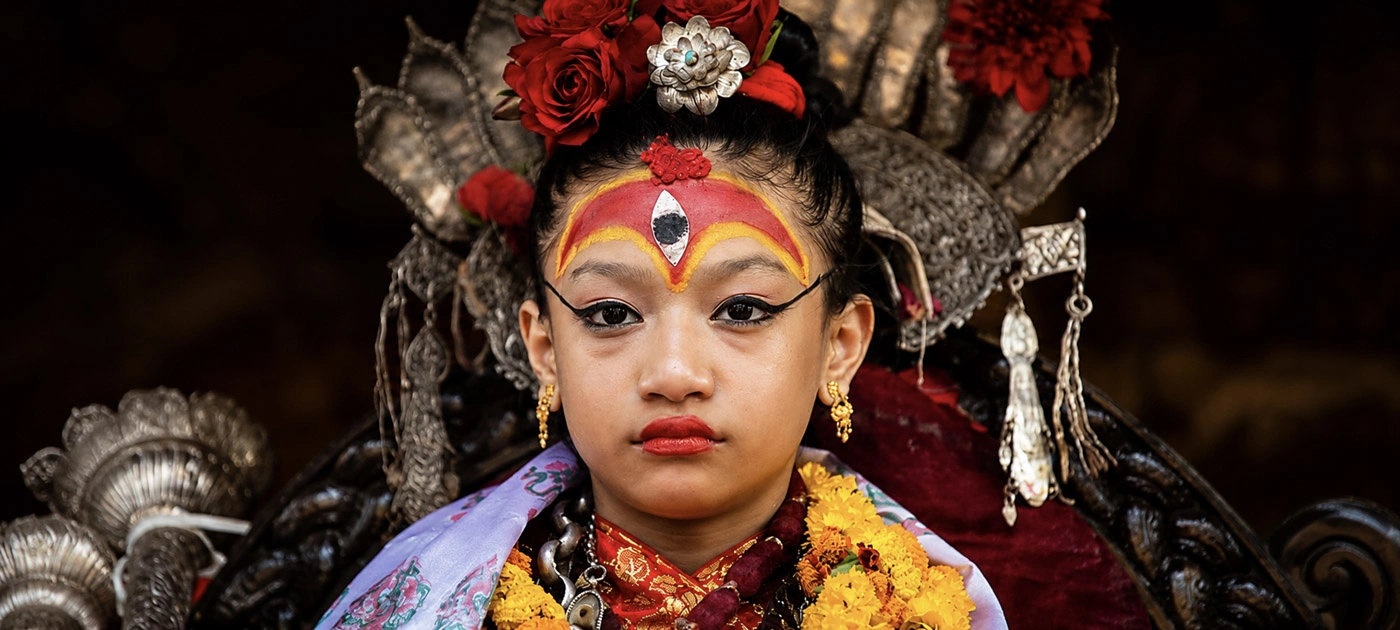
Kumari, the Living Goddess of Nepal

Who the Kumari Is
The Kumari is a young girl venerated across Nepal as a living goddess—the earthly embodiment of divine feminine energy, honored by both Hindus and Buddhists in one of the world's most remarkable spiritual traditions.
To Hindus, she is a living form of the goddess Taleju, a manifestation of Durga and of Shakti, the primordial feminine power. To Newar Buddhists, she embodies a supreme wisdom deity.
That a goddess of Hindu origin should be housed in a child of Buddhist lineage captures the deep religious harmony that has defined the Kathmandu Valley for centuries. She isn't seen as a girl representing a goddess; in the tradition, she is understood as the goddess present in human form.
For travelers, the Kumari is one of the most extraordinary living traditions you can encounter anywhere. You may glimpse her at her palace window on Durbar Square, or see her carried in procession during a festival.
This guide explains who she is, how the tradition works, and how to approach it with the respect it deserves—because this is a living faith and a real child, not a spectacle.
A Tradition Woven Into Nepal's History
The Living Goddess tradition is centuries old and was deeply tied to the legitimacy of Nepal's kings, making it a spiritual thread running through the country's political history.
The worship of young girls as vessels of divine energy has ancient roots, with evidence of Kumari veneration in the valley going back to at least the 13th century.
It was the Malla kings, in the 1600s and 1700s, who formalized the Royal Kumari as we know her, tied to their patron goddess Taleju. The palace of the Royal Kumari, the Kumari Ghar, was built in the mid-1700s, and the great chariot festival that centers on her dates from the same era.
The tradition carried real political weight. When the Gorkha king Prithvi Narayan Shah conquered Kathmandu in 1768, he didn't dismantle the cult of his defeated rivals—he bowed before the Royal Kumari and received her blessing, absorbing her divine mandate to rule. Every head of state since has sought her blessing, a custom that continued through the monarchy and, after its abolition in 2008, is now upheld by the President of the Republic.
The Meaning Behind the Goddess
At the heart of the Kumari tradition is the concept of Shakti—the dynamic feminine energy that Hindu philosophy holds responsible for the creation and sustaining of the universe.
Where much of Hindu thought treats the divine feminine as an abstract principle present in all women, the Kumari tradition makes it tangible and human.
The goddess is understood to dwell in the child throughout her tenure, making her a living tether between the human and cosmic worlds. This is why her public appearances—her darshan, or viewing—are considered a blessing, and why devotees travel to seek her protection and grace.
Anthropologists describe the Kumari as a rare kind of figure: a child who is honored above kings and a bridge between two faiths at once. That duality, more than any single ritual, is what makes the tradition so compelling and so unusual in the modern world.
The Kumari Ghar: The Goddess's Palace
The Royal Kumari lives in the Kumari Ghar, a beautiful three-story brick palace on Kathmandu's Durbar Square, and it's the place most travelers encounter her.
Built in the mid-1700s, the palace is a masterwork of traditional Newar craftsmanship, its windows and balconies covered in intricate carvings of deities and mythical beasts.
Its design echoes a Buddhist monastery courtyard, a physical expression of the tradition's Hindu-Buddhist blend. White stone lions guard the entrance, and the inner courtyard is reserved for the goddess and her caretakers.
Visitors and devotees gather in the central courtyard, hoping the Kumari will briefly appear at her upper window. Photography of the goddess herself is not permitted, and it's important to wait quietly and respectfully rather than call out or crowd.
A notable detail: a golden toran, an ornate carved arch, was stolen from the palace in 1999, later found in a foreign museum, and returned and reinstalled with full ceremony in 2022—a small triumph for Nepal's heritage.
How a Kumari Is Chosen
The selection of a Kumari is a secretive, sacred process overseen by senior priests and astrologers, and it's guided by tradition, lineage, and signs considered auspicious rather than by anything a traveler would witness.
A candidate is a young girl from the Newar community, from specific priestly or goldsmith lineages depending on the town, whose family has a long-standing presence in the traditional courtyards.
Tradition holds that she should be in perfect health, of calm and fearless temperament, and should embody a set of thirty-two auspicious qualities long described in sacred texts. Her horoscope is studied and must harmonize with the wider order that the goddess is meant to protect.
There is a well-known test of the child's composure during the Dashain festival, which foreign accounts often sensationalize.
It's worth hearing the correction from someone who lived it: the former Royal Kumari Rashmila Shakya, who later wrote a memoir about her years as the goddess, has explained that the experience is carefully managed by the priests and is not intended to frighten or distress the child.
Where the tradition is concerned, the voices of the women who have actually been Kumari matter far more than outside speculation.
The Living Goddess in Daily Life
A reigning Kumari lives a cloistered, highly ritualized life, appearing to the public only on a small number of festival days each year.
Dressed in red, the color of power and creative energy, with her hair bound up and the striking painted "fire eye" on her forehead symbolizing divine perception, the Kumari receives devotees from a gilded throne.
She rarely speaks during these audiences, and tradition holds that her expressions and gestures carry meaning that the priests interpret. She leaves her palace only for specific festivals, and when she does, she is carried, as tradition holds her feet should not touch the ordinary ground.
It's a life of great reverence and considerable restriction, and modern Nepal has thought carefully about how to balance the two—something we'll come to below.
Kathmandu is also unusual in venerating two living boy gods alongside the Kumari, representing Ganesh and Bhairav, though their lives are far less restricted; they live at home and attend ordinary school.
Indra Jatra: When the Goddess Comes Out
The one time the Kumari appears in full public view is during Indra Jatra, an eight-day September festival that offers the most spectacular window into this tradition for any traveler.
During Indra Jatra, Kathmandu's old city becomes a stage where the divine walks among people. The Royal Kumari rides through the streets in a great three-tiered golden chariot over three days, blessing different sectors of the city, accompanied by the chariots of the two boy gods. A tall ceremonial pole is raised at Basantapur Square to mark the opening of the festival.
Around the chariots swirls a whole world of ritual and theatre: masked dancers clearing the path, a whimsical white elephant of bamboo and cloth charging through the crowds, processions of families remembering their dead by lamplight, huge masks of protective deities, and shared feast plates of traditional Newari food.
It's joyful and solemn at once, and witnessing it—respectfully, as a guest—is one of the great cultural experiences in Nepal. We time journeys to it for travelers who want to see the valley's living faith at full intensity.
More Than One: The Network of Living Goddesses
The Royal Kumari of Kathmandu is the most famous, but she is one of a wider network of Living Goddesses across the valley, each serving her own community.
Patan and Bhaktapur, the valley's other historic royal cities, each maintain their own Kumari, and several ancient towns and courtyard communities do too. The traditions vary in telling ways.
The Kumari of Patan generally lives at home with her family. The Kumari of Bhaktapur enjoys notably more freedom, permitted to walk outside, play, and attend school with other children. Some smaller communities keep their goddess's identity fiercely private.
This decentralized web shows how deeply the tradition is woven into valley life—not a single spectacle in one square, but a living spiritual architecture spread across many communities.
For travelers drawn to living culture, the Kumari tradition is a doorway into the whole Newar world of the Kathmandu Valley.
Dignity, Rights, and the Voices of Former Goddesses
The modern story of the Kumari is one of a tradition thoughtfully evolving to protect the rights of the child at its center, and it's the part of the story most worth understanding.
A girl's tenure as Kumari ends with adolescence, and the return to ordinary life has historically been hard—children who never walked a public street learning to navigate a classroom and a crowd.
Old superstitions once stigmatized former Kumaris, including a myth that marrying one was dangerous; modern reality has flatly disproved it, and the great majority have married and lived full lives.
In 2008, Nepal's Supreme Court addressed the tension between honoring a millennia-old tradition and protecting a child's rights.
It ruled the tradition was not exploitation, but mandated that Kumaris receive education within the palace, follow the national curriculum, and be supported into adult life with a pension.
The results speak for themselves: former Royal Kumari Rashmila Shakya became a software engineer and an author, and former Patan Kumari Chanira Bajracharya earned a business degree and now advocates for the education and well-being of current and future goddesses. Their voices—dignified, articulate, and their own—are the truest guide to this tradition.
This is a living faith, and the Kumari is a real child. Approach her and her tradition as an honored guest: watch quietly, don't photograph the goddess, and follow your guide's lead on etiquette.
FAQs: Kumari, the Living Goddess of Nepal
Who is the Kumari, the Living Goddess of Nepal?
The Kumari is a young girl from Nepal's Newar community revered as the living embodiment of divine feminine energy. To Hindus, she is a form of the goddess Taleju and of Shakti; to Newar Buddhists, she embodies a supreme wisdom deity. She is honored by both faiths at once, which makes her a powerful symbol of the Kathmandu Valley's centuries-old religious harmony. The most famous is the Royal Kumari of Kathmandu.
Where can I see the Kumari in Kathmandu?
The Royal Kumari lives in the Kumari Ghar, a carved brick palace on Durbar Square. Visitors gather in the courtyard, hoping she'll briefly appear at her upper window. Photography of the goddess isn't permitted, and it's important to wait quietly and respectfully. The fullest public appearance is during the Indra Jatra festival in September, when she rides through the old city in a golden chariot.
Why is the Kumari honored by both Hindus and Buddhists?
Because Nepal's Kathmandu Valley has blended the two faiths for centuries. The goddess Taleju is Hindu in origin, yet the Kumari is chosen from a Buddhist Newar lineage, and her palace is built in the form of a Buddhist courtyard. This deliberate synthesis, forged by the Malla kings, united the valley's communities and remains one of the most striking examples of religious harmony anywhere in the world.
How is a Kumari chosen?
Through a secretive, sacred process overseen by senior priests and astrologers. A candidate comes from specific Newar lineages, should be in good health and of calm temperament, and is assessed against traditional auspicious qualities and her horoscope. It's a matter for the religious authorities, not something travelers witness. We'd encourage reading the memoirs of former Kumaris for an authentic, first-hand account of the tradition from those who lived it.
What happens to a Kumari when she grows up?
Her tenure ends with adolescence, and she returns to ordinary life. Historically, this transition was difficult and marked by superstition, but modern Nepal has significantly reformed the tradition. Since a 2008 Supreme Court ruling, Kumaris receive education and a lifelong pension. Former Kumaris have gone on to become engineers, business professionals, authors, and advocates, disproving old myths and shaping the tradition's future.
Is it respectful for tourists to visit the Kumari?
Yes, when done with care. The Kumari's window appearances and festival processions are public parts of a living tradition that travelers are welcome to witness respectfully. The key is to behave as an honored guest: wait quietly, never photograph the goddess herself, don't crowd or call out, and follow your guide's lead on etiquette. Remember she is both a revered deity and a real child.
When is the best time to see the Kumari at a festival?
Indra Jatra, held over eight days in September, is the great festival of the Living Goddess, when the Royal Kumari rides through Kathmandu's old city in her golden chariot alongside grand masked processions. It's the most vivid window into the tradition. Exact dates follow the lunar calendar and are confirmed closer to the time, so we align a journey with it when travelers wish.
Are there other Living Goddesses besides the one in Kathmandu?
Yes. The Royal Kumari of Kathmandu is the most famous, but Patan, Bhaktapur, and several ancient towns and courtyard communities across the valley maintain their own Kumaris, each serving her local community. The traditions vary—some of these goddesses live at home, attend school, and enjoy more freedom. Together they reveal how deeply the Living Goddess tradition is woven into the wider Newar culture of the valley.
The Cultural Journey We Build Around You
The Kumari tradition is one of the most extraordinary things a traveler can encounter in Nepal—a living goddess at the heart of a valley where two faiths have shared one spiritual world for centuries.
We weave the culture of the Kathmandu Valley into our journeys with care and respect: the Durbar Squares and the Kumari Ghar, the great festivals like Indra Jatra, and the wider Newar heritage that surrounds them.
Approached as an honored guest rather than a spectator, this tradition gives a journey through Nepal a depth that stays with you.
If you'd like a journey shaped around the living culture of the Kathmandu Valley, our team will design it with you from the first conversation. Explore our luxury journeys in Nepal, or write to us directly.
Need Help? Call Us+977 9851013196orChat with us on WhatsApp
Need Help? Call Us+977 9851013196