The Short Answer on Timing
The best months for the luxury Everest Base Camp trek are October and November in autumn, and April and May in spring — these four windows give you the clear skies, stable weather, and reliable flights the trek depends on.
If you want the single finest month, it's October: the monsoon has scrubbed the air clean, the peaks stand in razor-sharp relief from dawn to dusk, and the weather is at its most settled.
November trades a little warmth for even quieter trails and the calmest flying conditions of the year.
Spring's April and May bring warmer days, blooming rhododendron forests, and the electric buzz of climbing season at Base Camp, with just a little more afternoon haze and cloud.
The two seasons to approach with caution are summer and winter. The summer monsoon, roughly June through August, drowns the trail in rain, hides the mountains behind clouds, and grounds the flights to Lukla.
Deep winter, December through February, offers stunning clarity but genuinely dangerous cold at the top.
This guide walks through every season so you can match the trek to what you want — and what you can handle. Nepal's broader trekking calendar follows the same shape; see our best time to visit Nepal guide for the country-wide picture.
Why the Season Matters More Than Anything
The month you choose shapes your trek more than your fitness, gear, or itinerary, because the weather in the Khumbu governs three things at once: what you can see, when you can fly, and how cold you'll be.
Views come first. The whole point of this trek is the sight of Everest, Lhotse, Nuptse, and Ama Dablam. In the wrong season, the cloud simply erases them — you walk for two weeks and see grey.
In the right season, they stand crystal clear from morning to night.
Flights come second. The trek begins and ends with the flight to Lukla, and that flight lives or dies by the weather. In clear autumn, it runs reliably; in monsoon fog, it can be delayed for days.
A helicopter answers to the same sky, though it handles marginal weather far better. Comfort comes third: the same day that's mild and pleasant lower down can be lethally cold at Gorak Shep.
Get the season right, and everything else on the trek gets easier.
How Cold Does It Actually Get?
Temperature on this trek is really a story of elevation, because the air cools by about 6.5°C for every 1,000 meters you climb — so Kathmandu can be shirt-sleeve warm while Base Camp is deep below freezing on the very same day.
That single gradient is why you pack for two worlds. In the lower valleys around Lukla and Namche, daytime sun can feel genuinely warm, especially in Namche's natural amphitheater, which catches and amplifies the light.
Then the sun drops behind a ridge, and the temperature falls off a cliff — you go from shirt to down jacket in minutes.
Higher up, past the tree line at Dingboche and into the glacial zone at Lobuche and Gorak Shep, nights sit far below freezing for most of the year, and the days barely climb above it.
Here's a rough picture of typical daytime highs and nighttime lows across the trek:
| Location |
Elevation |
Autumn (Oct) high/low |
Spring (Apr) high/low |
Winter (Jan) high/low |
| Kathmandu |
1,400m |
26° / 13°C |
27° / 11°C |
18° / 2°C |
| Namche Bazaar |
3,440m |
12° / −1.5°C |
10° / −7°C |
3.5° / −14.5°C |
| Dingboche |
4,410m |
8° / −6°C |
6° / −8°C |
−1° / −18°C |
| Gorak Shep / Base Camp |
5,164–5,364m |
3° / −12°C |
1° / −12°C |
−6° / −25°C |
These are typical seasonal averages for orientation, not forecasts. Actual conditions vary year to year, and wind chill can make it feel far colder.
The takeaway is simple. Even in the best months, the top of this trek is a genuinely cold, high-alpine environment.
At Everest Base Camp, 5,364 meters, the air also holds roughly half the oxygen available at sea level — which is why warmth and pacing up there are safety measures, not comforts.
Spring: Warming Days and Climbing Season
Spring, from March through May, is the second of the two prime seasons — warming, colorful, and alive with the energy of the Everest climbing expeditions.
March is the thaw. The lower valleys wake up while the high country stays locked in deep freeze, so you get crisp, comfortable hiking below and lingering snow above — a surreal contrast and quieter trails before the crowds arrive.
By late March, the first Rhododendron arboreum blooms reach the lower forests, splashing deep red through the Phakding corridor.
April is the golden window: warmer days, very stable weather, and sharp views, with Base Camp transforming into a vast, colorful tent city as climbers stage their summit pushes.
The rhododendron bloom climbs the valley on a precise altitude schedule — the mid-elevation forests between roughly 2,500 and 3,500 meters peak early to mid-month along the Phakding–Namche corridor, while the high-alpine slopes between 3,500 and 4,500 meters flower mid to late April against the last of the snow.
The one caveat is haze—dust and distant agricultural fires from the plains can soften the air in the lower valley, and the best lodges book out many months ahead.
May brings the warmest trekking of spring, pleasant enough that the lodges barely need their heating, and it is the only window when Base Camp is a working expedition city at full strength — yak trains, supply lines, and climbers staging for the summit.
But it's also the turning point. As the month goes on, high-altitude winds strengthen above 5,000 meters, monsoon moisture begins to rise, and heavy afternoon clouds increasingly swallow the peaks by midday.
Fly early in spring for the clearest skies; by late May, the season is closing.
Summer: The Monsoon to Avoid
Summer, June through August, is the season we steer luxury trekkers away from because the monsoon erases the very thing you came for.
Temperature isn't the problem — these are the warmest months, and even Gorak Shep climbs near freezing at night. The problem is everything else.
The region is drenched: the lower valleys can see heavy rain on most days of the month. Trails turn to slick, hazardous mud, and the forested sections below Namche fill with leeches.
Worst of all, relentless cloud cover drops visibility to a fraction of what it should be, hiding the mountains almost entirely.
And the flights barely run. Persistent fog and rain in Lukla make flying highly unreliable during the monsoon, so your trek can be swallowed by delays before it even starts.
There are quieter, greener corners of Nepal that suit the monsoon — the rain-shadow regions beyond the main Himalaya — but Everest Base Camp isn't one of them. We honestly advise against it.
Autumn: The Finest Window
Autumn, September through November, is the undisputed peak of Himalayan trekking, because the departing monsoon leaves behind air scrubbed completely clean of haze.
September is a gamble worth understanding. The first couple of weeks often carry the monsoon's tail — muddy trails, afternoon showers below the tree line — but as the month turns, the sky clears dramatically, and the post-monsoon green below contrasts brilliantly with fresh snow above.
Late September rewards anyone willing to risk a little early dampness with pristine air and trails not yet crowded.
October is the crown jewel. The most stable weather of the year, the lowest rain risk outside deep winter, and crystalline visibility that holds the peaks in sharp focus from dawn to dusk, with none of spring's afternoon cloud.
October is also the cultural high point of the Khumbu year. Nepal's biggest national festivals, Dashain and Tihar, usually fall in this window, and in most years the Mani Rimdu festival at Tengboche Monastery (3,867 m) stages its masked dances and fire rituals in October or early November — the dates follow the Tibetan lunar calendar and shift each year, so we confirm them at booking and build the itinerary so you're at Tengboche on the public ceremony days.
Read our full Mani Rimdu festival guide for what the ceremonies involve. The only real drawback of October is popularity: trails are busy, and the best lodges book out many months to a year in advance.
November is the quiet sweet spot. The deep post-monsoon blue holds, the haze stays gone, and it's statistically the calmest month for flying — the most reliable window for the helicopter legs.
The trade-off is a fast plunge into cold as the winter jet stream arrives, plus brutally dry air that dehydrates you and cracks skin.
By late November, the coldest, most basic high teahouses begin to close, which is when a properly organized trek with guaranteed places matters.
Winter: Clarity at a Cost
Winter, December through February, offers some of the clearest views of the entire year, but the cold at altitude is severe, and the trek becomes a test of endurance.
The skies are often brilliant and the trails empty — total solitude, if that's what you're after.
But January is the coldest time of year, with Base Camp daytime highs well below freezing, nights dropping toward −25°C, and wind chill pushing the felt temperature even lower.
The winter jet stream drops onto the exposed ridges, bringing sustained freezing winds; the trail above Lobuche ices over, and most of the high teahouses shut down until spring.
A winter trek is for the hardiest travelers who want uncompromising solitude and clear peaks, and it demands serious expedition kit for the nights before a helicopter extraction.
The added complication is fog in the Kathmandu Valley on winter mornings, which delays flights and demands a flexible schedule. It's possible, and it's beautiful, but it isn't gentle.
Flights, the Manthali Problem, and Why We Fly Helicopters
The single biggest friction point on any Everest trek isn't altitude or distance — it's getting to Lukla. Tenzing-Hillary Airport sits at 2,860 meters on a short, steeply angled runway, and how you reach it decides if your trek starts rested or exhausted.
Under current regulations, most fixed-wing Lukla flights divert from Kathmandu to Manthali Airport in Ramechhap during peak trekking seasons to relieve air traffic congestion.
For fixed-wing passengers, that means a 4–5 hour pre-dawn drive out of Kathmandu — hotel departures around one or two in the morning — before the 15–20 minute flight even begins. It is the most common unpleasant surprise in the entire Everest industry.
Our guests skip all of it. On our luxury Khumbu programs, you fly by private helicopter in both directions between Kathmandu and Lukla — a civilized morning departure from the city, no Ramechhap drive, no terminal queue.
Helicopters also work marginal weather windows that ground fixed-wing aircraft, which is why our schedule holds together in shoulder weeks when airline timetables fall apart.
Higher on the mountain, the same aviation physics that limit Lukla apply even more sharply: above 4,500 meters, shuttles carry a maximum of two passengers per flight, which is how we stage the lift-out after Base Camp.
One distinction worth making: a luxury trek with helicopter legs is not an Everest helicopter day tour. The Everest helicopter tour is a half-day flight from Kathmandu with brief landings—spectacular and right for travelers short on time or mobility.
The trek is the full walking journey with proper acclimatization; the helicopter removes the friction of transit, never the mountain.
How the Luxury Everest Base Camp Trek Handles the Cold
Warmth at altitude is a safety measure, not a comfort, and this is where the season and the trek's design meet — because a warm night is what lets your body adapt to the thin air.
Most of your acclimatization happens in deep sleep, and cold sabotages it.
When you're shivering in an unheated room, your body diverts energy to staying warm rather than adapting to altitude, and broken, freezing sleep raises your risk of altitude sickness.
Removing the cold lets your system focus on the one job that matters up there: oxygenating your blood.
That's also why our itineraries hold full acclimatization nights at Namche and Dingboche rather than compressing the ascent — pace is the other half of the same physiology.
Our guides check every guest daily with a pulse oximeter from Namche onwards; for the deeper medical picture, see our altitude sickness and safety guide for the luxury Everest trek.
The heated lodges of the lower and mid-valleys are therefore a genuine physiological advantage, not a frill — you come off a bitter trail into warmth, rest properly, and climb stronger the next day.
Good food helps too, since altitude kills appetite and warm, appealing meals keep your fuel up.
There's an honest limit worth knowing. Above roughly 4,200 meters, the environment makes heated rooms and running water impossible, so the highest nights — at Lobuche and Gorak Shep — are spent in simple stone lodges, however you travel.
We manage those nights with proper bedding, hot water bottles, and the cold-weather kit we provide.
And it is a large part of why our guests fly out by helicopter straight after Base Camp and Kala Patthar: it spares extra nights of extreme cold and the long, hard descent that punishes knees more than the climb ever did.
This is general information, not medical advice. Anyone with a heart or lung condition should consult a doctor before a high-altitude trek and tell their guide about any symptoms.
Wind Chill and the Kala Patthar Dawn
The coldest hours of the whole trek aren't captured by any temperature reading, because wind chill — especially on the pre-dawn climb of Kala Patthar — is what actually threatens you at the top.
Above 4,000 meters, wind becomes the dominant force. Base Camp might read −10°C on the thermometer, but a steady wind off the Khumbu Glacier can strip body heat until it feels closer to −25°C. That's the difference between cold and dangerous.
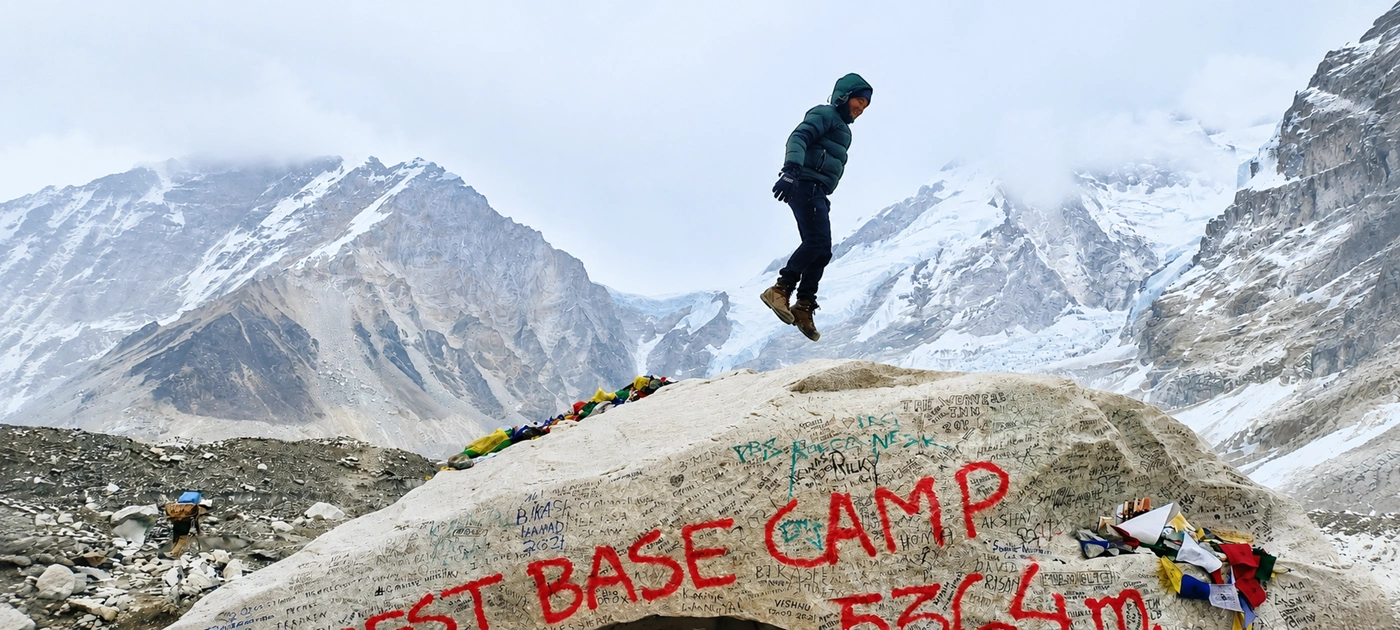
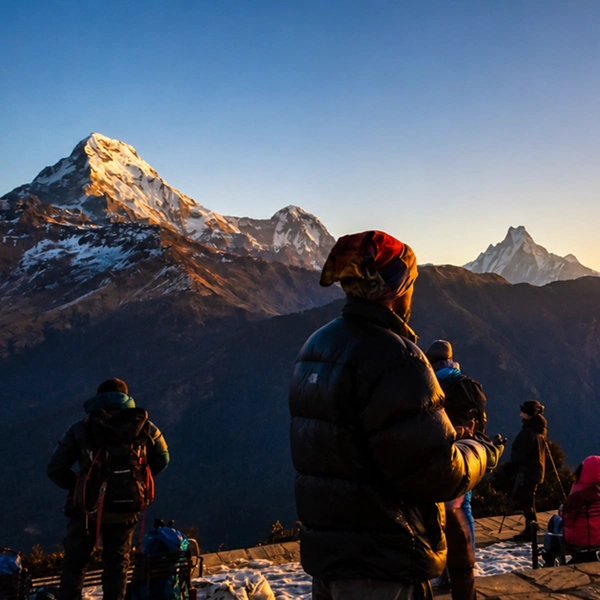
The climb of Kala Patthar, at 5,545 meters, is traditionally done about two hours before dawn to catch sunrise over the Everest summit.
With no sun and high-altitude gusts, those are the coldest hours of the trip and the moments when the body is most vulnerable to frostbite.
Proper down layers aren't optional here — they're what keep the summit morning safe.
The good news on timing: October and November are historically the calmest months above 4,500 meters, offering still, clear pre-dawn skies that make the Kala Patthar sunrise especially rewarding.
What to Pack for the Cold, Whatever the Season
Even on a comfortable, well-supported trek, the upper camps demand real cold-weather gear, because no lodge can heat the highest nights and no season makes Gorak Shep warm.
We provide the heavy cold-weather kit — the down jacket and the sleeping system for the highest nights — so you don't buy an alpine wardrobe for one trip.
You bring broken-in boots, good merino base layers, and sun protection. The full gear picture, item by item and season by season, is in our luxury EBC packing list.
A few practical notes for the top. Electricity in the alpine zone is solar-powered, so charging is slow and often charged per device—a power bank is essential.
Mobile signal now reaches the whole route on NCell and NTC, though lodge Wi-Fi up high slows when rooms are full.
None of this is a hardship; it's just the reality above the tree line, and knowing it in advance is half the battle in being comfortable with it.
Which Month Matches Your Priorities?
| Your priority |
Best window |
| Maximum clarity and photography |
October — the most stable month of the year |
| Quiet trails and late-season light |
November, or March in spring |
| Rhododendron bloom |
April — color climbs from 2,500 m to 4,500 m through the month |
| Climbing-season energy at Base Camp |
May — the expedition tent city at full strength |
| Festivals on the trail |
October–November — Dashain, Tihar, and usually Mani Rimdu at Tengboche |
| Warmest walking days |
Late April through May |
| Total solitude, at a price |
Deep winter — for the hardiest only |
The Trek We Time Around You
The best time for the luxury Everest Base Camp trek comes down to a simple trade: autumn for the clearest skies and reliable flying, spring for warmth, blooms, and climbing-season energy, winter for solitude at a hard price, and the monsoon best avoided. Get the season right, and the mountains reward you completely.
We plan every trek around the weather window that matches what you want — the sharpest views, the quietest trails, the warmest days, or the calmest flying — and we build in the buffer days that let the season work for you rather than against you.
If you'd like help choosing your window and shaping the trek around it, our team will plan it with you from the first conversation. Explore the full Everest Base Camp Luxury Trek: 14 private days with helicopter flights in both directions — or write to us directly.
FAQs
What is the best month for the luxury Everest Base Camp trek?
October is the finest single month — the most stable weather of the year, the lowest rain risk, and crystal-clear views from dawn to dusk after the monsoon scrubs the air clean. November is a close second: quieter, with the calmest flying conditions of the year, though noticeably colder. April and May are the spring equivalents, warmer and full of rhododendron color, with slightly more afternoon haze.
Can you do the Everest Base Camp luxury trek during the monsoon?
It's possible, but we advise against it. The summer monsoon, June through August, brings heavy rain, muddy leech-filled lower trails, and relentless clouds that hide the peaks almost entirely. Flights to Lukla become deeply unreliable in the fog, so delays can swallow your itinerary before it even starts. The temperatures are mild, but you'd likely walk for two weeks and never see the mountains.
Is a winter Everest Base Camp trek realistic on a luxury itinerary?
For the right traveler, yes — winter brings brilliantly clear skies and empty trails. But January cold is severe: Base Camp nights fall toward −25°C before wind chill, the trail above Lobuche ices over, and most high teahouses close until spring. It demands full expedition kit, high cold tolerance, and a flexible schedule for fog-delayed flights out of Kathmandu. Beautiful, genuinely demanding, and only for the well-prepared.
Do Everest flights really leave from Manthali instead of Kathmandu?
For fixed-wing aircraft in peak season, yes — under current regulations, most Lukla-bound planes divert to Manthali in Ramechhap, which means a 4–5 hour drive out of Kathmandu starting around 1–2 AM before a 15–20 minute flight. Our luxury Khumbu programs avoid this entirely: guests fly private helicopter both directions between Kathmandu and Lukla, departing the city at a civilized morning hour.
When is the Mani Rimdu festival on the Everest Base Camp route?
Mani Rimdu is staged at Tengboche Monastery (3,867 m), usually in October or early November — the dates follow the Tibetan lunar calendar and shift every year, so we confirm them at booking. The public ceremony days bring masked dances and fire rituals to the monastery courtyard directly on the trekking route. Timing a departure around it adds a cultural high point to the clearest-sky season of the year.
When are mountain views clearest on the Everest Base Camp trek?
October and November offer the clearest views of the year. The departing monsoon leaves the atmosphere scrubbed of dust and haze, so Everest, Lhotse, Nuptse, and Ama Dablam stand in sharp relief from dawn to dusk with none of the afternoon cloud that builds in spring. November in particular holds a deep, haze-free blue. If unobstructed views are your priority, book in autumn.
How cold does the luxury Everest Base Camp trek get by season?
It depends more on elevation than on the calendar: air cools roughly 6.5°C per 1,000 meters climbed. During the trekking season, Namche sits around 10–12°C during the day and near or below freezing at night, while Gorak Shep drops to about −12°C overnight. Deep winter pushes Gorak Shep toward −25°C. Lower valleys stay pleasant by day in every trekking month; the top is always a cold, high-alpine world.
When do rhododendrons bloom on the Everest Base Camp trail?
Through April, climbing with the altitude. The forests between roughly 2,500 and 3,500 meters — the Phakding-to-Namche corridor — peak early to mid-April, and the high slopes between 3,500 and 4,500 meters flower mid to late April against the melting snow. The first Rhododendron arboreum reds appear in the lowest forests by late March. For peak color, walk the lower valley in the first half of April.