The luxury Ghorepani to Dhampus trek is a lodge-to-lodge circuit that skips the brutal Ulleri staircase by driving to the trailhead, catches the Poon Hill sunrise at 3,210 meters, then descends village by village—Ghandruk, Landruk, Majhgaon, Dhampus—through the Gurung heartland, sleeping in heated boutique lodges almost every night. It's the most comfortable introduction to the high Himalaya there is.
The Luxury Ghorepani to Dhampus Trek: Lodge to Lodge Through the Annapurna Foothills

What Makes This Route Different
The Ghorepani to Dhampus trek is a lodge-to-lodge circuit designed so you sleep in real comfort nearly every night, skip the trek's worst climb entirely, and still stand beneath three of the world's 8,000-meter peaks at sunrise.
Most Poon Hill treks start at the bottom and grind up the infamous Ulleri staircase—over 3,000 uneven stone steps that punish knees and calves before the good part even begins. This route deletes that. We drive you up a mountain road straight to the trailhead at Banthanti, so your walking starts in high forest instead of on a two-day slog. From there, the trek runs mostly downhill and across, village to village, through the richest Gurung settlements in the Annapurna foothills.
The genius of the route is its shape. You touch the high-mountain world just long enough for the Poon Hill sunrise, then spend the rest of the trek descending back into the zone where genuine comfort is possible. It's the gentlest, most comfortable way into the great peaks we know—and this guide walks it with you, stage by stage.
The Altitude Rule: Why Comfort Follows Elevation
Understanding one simple rule explains the entire shape of this trek: real built comfort in the Himalaya is only possible below about 2,800 meters, and this route is designed around that ceiling.
Below roughly 2,800 meters, heated rooms, en-suite bathrooms with hot water, and reliable power are all achievable, because building materials can be carried in and solar and micro-hydro systems can be maintained. That's the zone where purpose-built boutique lodges exist. Above it, the environment and conservation rules make that level of infrastructure impossible, and accommodation shifts to simpler teahouses. Higher still, built comfort disappears entirely.
This route threads that needle beautifully. It sleeps at its highest in Ghorepani at 2,860 meters—just one night at the edge of the comfort ceiling—and climbs to 3,210 meters only for the Poon Hill sunrise before descending.
Every other night is spent comfortably below the line, in heated boutique lodges. You get the high-mountain spectacle with almost none of the high-mountain hardship. That's the whole design, and it's why this trek works for people the harder routes rule out.
Skipping the Ulleri Staircase: The Drive to Banthanti
The single best decision on this route is bypassing the Ulleri stairs by road, because those steps are where most trekkers wreck their knees and their mood before the trek even gets good.
The traditional trek begins low, at around 1,100 meters, and climbs the Ulleri staircase—thousands of steep, uneven stone steps that turn the first two days into an orthopedic ordeal. Fit trekkers survive it, but it drains the joy out of the early trail and leaves many people sore and discouraged.
We skip it. A private vehicle carries you up the winding mountain road from Pokhara to Banthanti, a roughly two-and-a-half to three-hour drive that replaces two days of punishing uphill with a scenic, comfortable transition. Banthanti sits at 2,290 meters—its name means "rest house in the forest"—and it's where your trek actually begins. You meet your team, hand your duffel to a porter, and step straight into the high forest carrying only a light daypack. The grind is gone; the walking that remains is the walking worth doing.
Into the Rhododendron Forest: Banthanti to Ghorepani
The walk from Banthanti to Ghorepani is a gentle four-to-five-hour climb through ancient, moss-draped forest, and it's one of the most beautiful stretches of trail in Nepal.
You leave the farmed terraces behind and enter old forests of oak, pine, and rhododendron, where the canopy keeps the air cool and the light soft. In spring, from March to May, these woods erupt with pink and red rhododendron blooms—the trail runs straight through a fire-colored forest. The undergrowth is alive: with a good guide, you'll spot the Danfe, the iridescent Himalayan monal pheasant, along with langur monkeys at the forest edge, barking deer in the shade, and forest squirrels everywhere.
The trail climbs beside clear streams, pausing at a small settlement for a hot lunch, before reaching Ghorepani at 2,860 meters. This is the highest you'll sleep on the whole trek, and it's the one night where the comfort ceiling shows itself.
An Honest Word About Ghorepani
Ghorepani is the one place on this trek where we set expectations honestly, because at 2,860 meters, the purpose-built boutique lodges give way to upgraded teahouses—and we'd rather you know that in advance.
Ghorepani sits right at the edge of the comfort ceiling, on an ancient trade route where heavy construction is both restricted and impractical. So the boutique-lodge standard doesn't reach here. What does exist is a handful of genuinely upgraded teahouses—the best have private attached bathrooms, hot showers, thick mattresses, heavy blankets, and private balconies facing the Dhaulagiri range. We secure the best available rooms, and we confirm the property in your booking proposal.
The honest caveat: the bedrooms here aren't centrally heated, electricity can flicker, and hot water depends a little on the mountain weather. We handle the cold the way serious operators do—with proper expedition-grade sleeping bags rated well below freezing, so you sleep warm no matter the conditions. It's one night, it's comfortable, and it's the price of admission for the sunrise that follows. Managing that expectation is part of doing this properly.
The Reason You Came: The Poon Hill Sunrise
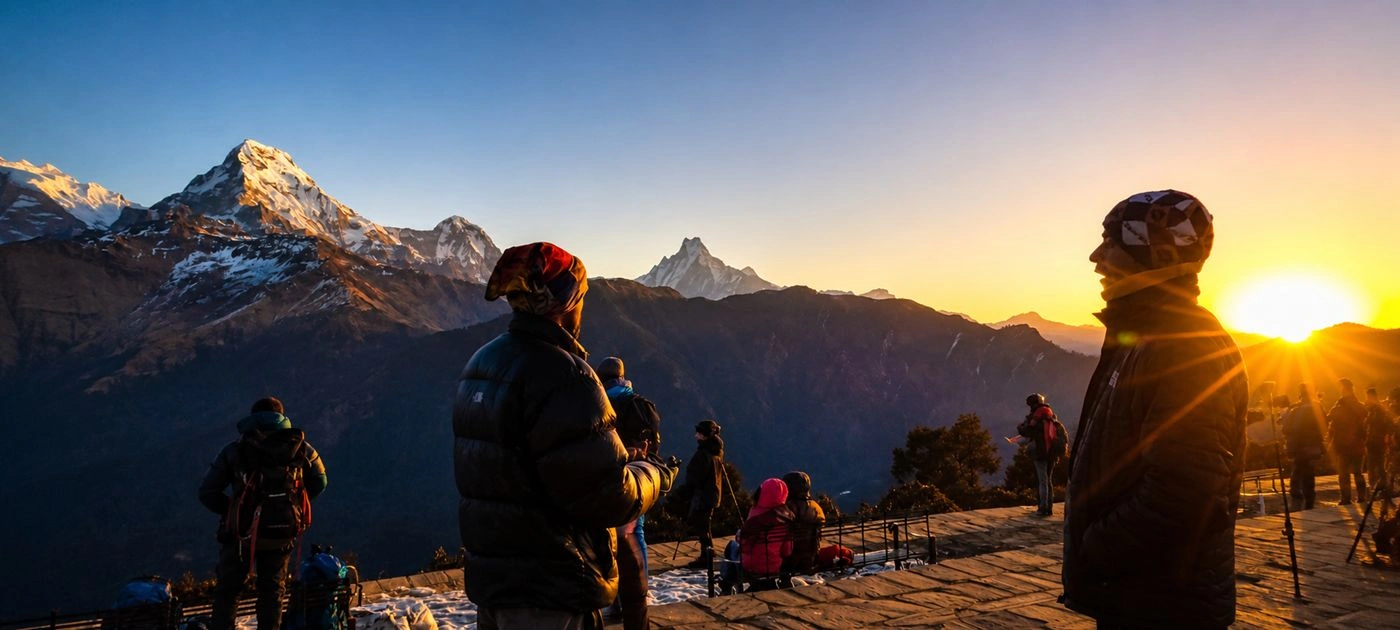
Poon Hill is the apex of the trek, and the pre-dawn climb to its 3,210-meter summit rewards you with one of the greatest mountain panoramas on earth.
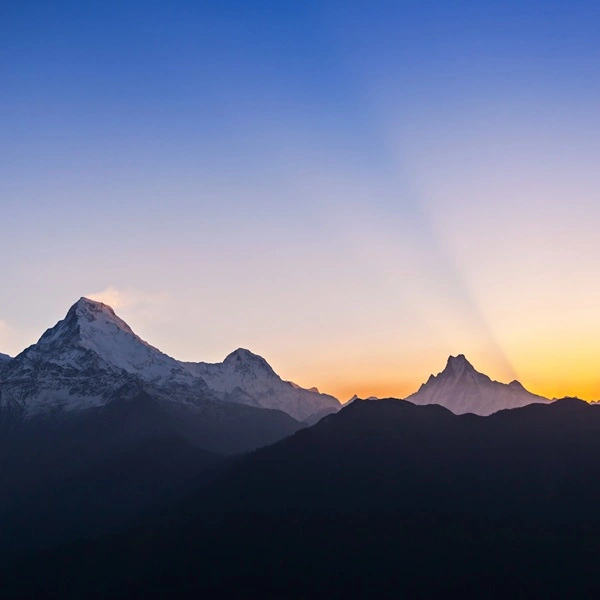
You wake around 4:30 AM and climb by headlamp up a steep, well-stepped trail—about an hour in the dark. It isn't technical, just a walk, but the payoff at the top is staggering. Poon Hill gives a 360-degree amphitheater of the Himalaya with a rare concentration of giants: three 8,000-meter peaks in one view—Dhaulagiri, Annapurna I, and Manaslu—flanked by Annapurna South, Hiunchuli, and the sacred, unmistakable Fishtail summit.
Then the sun breaks the horizon and sets the snow alight in magenta, orange, and gold, one ridge at a time. Your guide helps you catch the shot. Afterward, you descend to a hot breakfast—Gurung bread, eggs, coffee—and turn east to begin the descent into the true comfort zone. From here, the trek only gets warmer, lower, and softer.
Descending Into the Gurung Heartland: Ghandruk
The descent to Ghandruk is a physical relief and a cultural highlight, dropping you into the wealthiest and most beautiful Gurung village in the Annapurna foothills.
As you descend through the temperate forest, oxygen returns, and the high-mountain harshness gives way to green terraces. Ghandruk, at 1,981 meters, is a village with a story: it was a major recruitment home for the legendary Gurkha regiments, and generations of military pensions and worldly experience have made it prosperous and immaculate.
You walk labyrinths of stone paths between white-washed, slate-roofed houses with carved wooden windows, past workshops where traditional rugs are still hand-woven. It's also a headquarters for the region's conservation work.
Here you settle into a genuine boutique lodge—the full comfort standard returns. Picture a restored 19th-century Gurung farmhouse as the heart of the property, en-suite rooms with hot showers and real water pressure, beds piled with down duvets, a hot water bottle slipped under the covers at turndown, and a fireside "happy hour" as the sun drops behind Annapurna South. We can arrange a private evening of traditional Gurung music and dance in the courtyard. We describe the lodge by its character and confirm the exact property in your proposal.
Across the Modi Valley: Landruk
The trek from Ghandruk to Landruk is the most dramatically vertical day, plunging into a river gorge and climbing the far wall to a quieter, equally scenic village.
You descend thousands of stone steps through terraced farmland and jungle to the floor of the Modi Khola gorge, cross a steel suspension bridge strung with prayer flags, then switch back upward through oak forest to Landruk, around 1,600 meters. If Ghandruk is the bustling heart of the Gurung world, Landruk is its quieter twin—narrow alleys, ancient slate-roofed houses, and a hush that Ghandruk's popularity has cost it.
The lodge here faces directly back across the valley toward Ghandruk and the Annapurna South wall. Imagine a crescent of terraced bungalows, every room oriented so you wake to the mountains without lifting your head from the pillow, with vaulted ceilings and polished parquet floors. It's a mid-altitude sanctuary, and we confirm the property in your proposal.
The Bee Village: Majhgaon
The walk to Majhgaon drops into warm subtropical country, and the stop here is built around one of the most memorable cultural experiences on the whole circuit.
The trail from Landruk to Majhgaon is a gentle four-to-five-hour contour through old hamlets and fertile terraces, the air warming as you lose height. Majhgaon sits around 1,400 meters, framed by the sacred Fishtail summit. The lodge here has black-slate en-suite bathrooms and wide windows onto the peaks—but its real luxury is human.
Majhgaon sits beside a traditional Gurung "bee village," where local women keep log hives hollowed from tree trunks under the eaves of their homes, cultivating the wild Himalayan honeybee. With a guide translating, you can tour the hives and share a meal in a villager's home, breaking bread with a Gurung family. It's the kind of genuine encounter that turns a trek into something more, and it's the sort of access a private guide opens that independent trekkers never find.
The Final Ridge: Dhampus and the Return
Dhampus is the trek's gentle finale—an intimate ridge-top lodge with the widest views of the whole circuit and a focus on putting your body back together before you leave.
The last trekking day winds through shaded bamboo, rhododendron, and conifer forest to the ridgeline village of Dhampus at 1,740 meters. The lodge here is the smallest and most private on the route, runs entirely on solar power, and is perched so its terrace opens onto the widest panorama of the trek—the Phedi and Mardi valleys, the full Annapurna range, and Fishtail.
Knowing you've earned it, the evening centers on restoration: foot massages on the garden terrace at sunset, a drink in hand, as the peaks fade from white to alpine pink. After a final dawn breakfast with sweet Nepali tea, a short two-to-three-hour descent brings you to the road, where a private vehicle returns you to Pokhara. For travelers short on time, a helicopter can also lift you from the trail back to Pokhara in minutes—the whole trek retraced from the air.
What We Handle So You Don't
The comfort of this trek is really the sum of everything you never have to think about—the permits, the porters, the guiding, and the safety net all run in the background.
The Annapurna region requires conservation and trekker permits, and a licensed guide is mandatory—independent foreign trekking is no longer permitted here. We arrange every permit and all documentation in advance, so you walk past each checkpoint without breaking stride. Your trek is a private departure led by a senior, English-speaking guide trained in wilderness first aid, who also serves as a cultural bridge to the villages.
Porters carry your gear under fair, ethical weight limits, so you walk with only a daypack—and because the lodges provide the warm bedding and even evening layers, you don't need to pack a bulky expedition kit at all.
On safety: this is a low-altitude trek and the risk is modest, but our guides still carry medical kits and satellite communication, check blood oxygen daily as routine, and the region is fully covered by the helicopter rescue network, with helipads at Ghorepani and Ghandruk.
FAQs: The Luxury Ghorepani to Dhampus Trek
How is the Ghorepani to Dhampus trek different from a standard Poon Hill trek?
- It skips the brutal Ulleri staircase by driving to the Banthanti trailhead, then runs mostly downhill village to village—Ghandruk, Landruk, Majhgaon, Dhampus—through the Gurung heartland, sleeping in heated boutique lodges nearly every night. A standard Poon Hill trek climbs the stairs and often loops back the way it came. This route is gentler, more comfortable, and richer in culture and scenery.
Do I have to climb the Ulleri steps on this route?
- No. That's the point of this itinerary. Instead of grinding up more than 3,000 uneven stone steps, you take a private vehicle up the mountain road from Pokhara to the Banthanti trailhead at 2,290 meters, replacing two days of punishing uphill with a scenic two-to-three-hour drive. Your walking starts in high forest, and the trek runs mostly downhill from there—far kinder on the knees.
How high does this trek go, and is altitude a concern?
- You sleep at your highest in Ghorepani at 2,860 meters and climb to 3,210 meters only for the Poon Hill sunrise before descending. That's well below the elevation where serious altitude sickness develops, so the risk is low—one reason this route suits older travelers and first-timers. Guides still check blood oxygen daily as routine, and anyone with a heart or lung condition should see a doctor first.
Are the lodges genuinely comfortable the whole way?
- Almost everywhere, yes. The route is designed so you sleep in heated boutique lodges with en-suite bathrooms and real hot water every night except one—Ghorepani, at 2,860 meters, where the best available option is an upgraded teahouse with a private bathroom but no bedroom heating. We handle that night with expedition-grade sleeping bags so you stay warm, and confirm every property in your booking proposal.
What will I see from Poon Hill?
- A 360-degree Himalayan panorama with a rare concentration of giants—three 8,000-meter peaks in one view: Dhaulagiri, Annapurna I, and Manaslu—flanked by Annapurna South, Hiunchuli, and the sacred Fishtail summit. You climb about an hour by headlamp before dawn, then watch the sunrise set the snow alight in magenta, orange, and gold. It's the defining spectacle of the whole circuit.
What's the cultural highlight of the trek?
- The Gurung villages, and especially the "bee village" near Majhgaon, where local women keep traditional log hives of wild Himalayan honeybees under the eaves of their homes. With a guide translating, you can tour the hives and share a meal in a family's home. Combined with Ghandruk's Gurkha heritage and hand-weaving, the route offers genuine cultural access, not just scenery.
How much walking is there each day?
- Moderate and manageable—typically four to five hours a day, with the steepest single day being the descent-and-climb across the Modi Khola gorge between Ghandruk and Landruk. Because you skip the Ulleri stairs and carry only a daypack while porters handle the gear, the physical demand stays well within reach of anyone reasonably active, including older travelers and families.
When is the best time to do this trek?
- Spring, mid-March to mid-June, and autumn, mid-October to mid-December, are the two reliable windows. Spring fills the forests with blooming rhododendrons, while autumn delivers the clearest, most stable mountain views. Winter is possible with the quietest trails, but cold mornings even indoors. We plan around the season that best matches what you want to see.
The Trek We Build Around You
The luxury Ghorepani to Dhampus trek proves you can meet the great Himalayan peaks without meeting their hardships. You skip the worst climb, catch one of the finest sunrises on earth, and spend nearly every night in real comfort as you descend through the most beautiful villages in the Annapurna foothills.
We build the whole thing around you—the road that skips the stairs, the boutique lodges, the porters who carry everything, the guides who open the villages, and the safety net running quietly in the background. You walk, you look, you rest. We hold the rest.
If this is the introduction to the Himalaya you've been imagining, our team will shape the circuit around you from the first conversation. Explore our Luxury Annapurna & Poon Hill treks, or write to us directly.
Need Help? Call Us+977 9851013196orChat with us on WhatsApp
Need Help? Call Us+977 9851013196