The most sacred sites in Nepal span Hindu and Buddhist traditions that share the same landscape—from Pashupatinath and Boudhanath in the Kathmandu Valley to Lumbini, the Buddha's birthplace, and high-altitude shrines like Muktinath and Gosaikunda. Many sit on or near our trekking routes, so a journey through Nepal is as much a spiritual passage as a physical one. Here are the ten that define the country's sacred geography.
The 10 Most Sacred Sites in Nepal

Nepal's Living Sacred Landscape
The sacred sites of Nepal are remarkable not just for their age but for their shared faith, where Hindus and Buddhists have worshipped in the same spaces for centuries in a way you rarely see anywhere else in the world.
Nepal rises from the subtropical plains to the high Himalaya, and its spiritual geography climbs with it. Hindu temples, Buddhist stupas, and indigenous shrines overlap constantly—Hindus bathe at Buddhist sites, Buddhists pray in Hindu caves, and indigenous priests run major orthodox temples. This blending isn't a modern gesture; it's a deeply rooted reality that gives Nepal one of the most fluid, welcoming sacred landscapes on earth.
For us, these sites are woven through the journeys we design. Several sit directly on our trekking routes; others frame the start and end of a trip in the Kathmandu Valley, and a few are pilgrimages in their own right.
This guide walks through the ten most significant, with a note on how each fits into a journey through Nepal. Whether you come as a pilgrim or a traveler, standing in these places changes the shape of a trip.
1. Pashupatinath Temple: The Heart of Shaivite Nepal
Pashupatinath, on the banks of the sacred Bagmati River in Kathmandu, is the most revered Hindu temple in Nepal and one of the most important Shiva shrines in the world.
A shrine has stood here since at least 400 CE, and the present gold-and-copper-roofed temple, rebuilt in 1692, is a masterpiece of Newari pagoda architecture—a gilded spire above silver doors, sheltering a four-faced stone Shiva linga. A UNESCO World Heritage Site, the vast complex holds over 500 auxiliary shrines, a deer park, and the Bagmati cremation ghats, where open-air funeral rites are performed on the riverbank.
Non-Hindus can't enter the inner courtyard, but the experience from the eastern terraces across the river is unforgettable, especially during the evening Aarti ceremony as lamps and chanting fill the dusk. We often begin a journey in Nepal here, easing travelers into the country's spiritual rhythm before the mountains.
2. Lumbini: The Birthplace of the Buddha
Lumbini, in the southwestern Terai plains, is the exact birthplace of Siddhartha Gautama—the Buddha—in 623 BCE and the single most important pilgrimage site in the Buddhist world.
Its authenticity is anchored in stone: the Mauryan emperor Ashoka visited in 249 BCE and raised a commemorative pillar, discovered in 1896, whose inscription confirms this as the Buddha's birthplace. The Maya Devi Temple stands directly over the birth spot, marked by an ancient stone and the nativity sculpture of Queen Maya Devi, beside a sacred bathing pond.
The modern site follows a visionary master plan by the Japanese architect Kenzo Tange, laid out as a cosmological diagram that guides pilgrims from a village of worldly logistics, through a monastic zone of monasteries funded by Buddhist nations worldwide, to the serene Sacred Garden at its heart. It's a place of deep calm and a natural anchor for any culturally minded journey through Nepal.
3. Boudhanath Stupa: The Great Mandala of Kathmandu
Boudhanath, on the eastern edge of Kathmandu, is one of the largest stupas on earth and the most important center of Tibetan Buddhism outside Tibet.
Roughly 120 meters across and 43 meters high, the stupa is a three-dimensional mandala of the Buddhist cosmos: terraced platforms for earth, a great white dome for water, the all-seeing eyes of the Buddha gazing from the gilded tower for air, a thirteen-tiered spire for fire, and the golden pinnacle for ether. Built during the Licchavi era, it sat on the old trade route to Lhasa and drew Tibetan patronage for centuries.
Following the events of 1959, many thousands of Tibetans settled around Boudhanath, establishing dozens of monasteries and turning it into a living hub of Vajrayana practice. After the 2015 earthquake, the community restored it using some 30 kilograms of gold. Walking the stupa clockwise among monks, pilgrims, and butter lamps at dusk is one of the great experiences of the valley.
4. Muktinath: Where Two Faiths Meet at Altitude
Muktinath, at around 3,750 meters in the arid Mustang district below the Thorong La pass, is one of the most striking examples of shared faith in the Himalaya—worshipped with equal devotion by Hindus and Buddhists.
For Hindus, it is Mukti Kshetra, the Place of Liberation, one of the 108 sacred abodes of Vishnu and the only one outside India. For Buddhists, it is Chumig Gyatsa, the Hundred Springs, linked to Guru Rinpoche, who is believed to have meditated here on his way to Tibet. The same golden deity is revered by one faith as Vishnu and by the other as the Bodhisattva of Compassion.
The rituals imbue the harsh environment with meaning: 108 bull-headed spouts pour freezing glacial water for pilgrims to bathe beneath, an eternal natural-gas flame burns above the water inside a nearby shrine, and the Kali Gandaki river below is the world's only source of the sacred ammonite fossils called shaligram. Muktinath sits on our Mustang and Annapurna journeys, reachable on foot or, for those who prefer, by a gentler route.
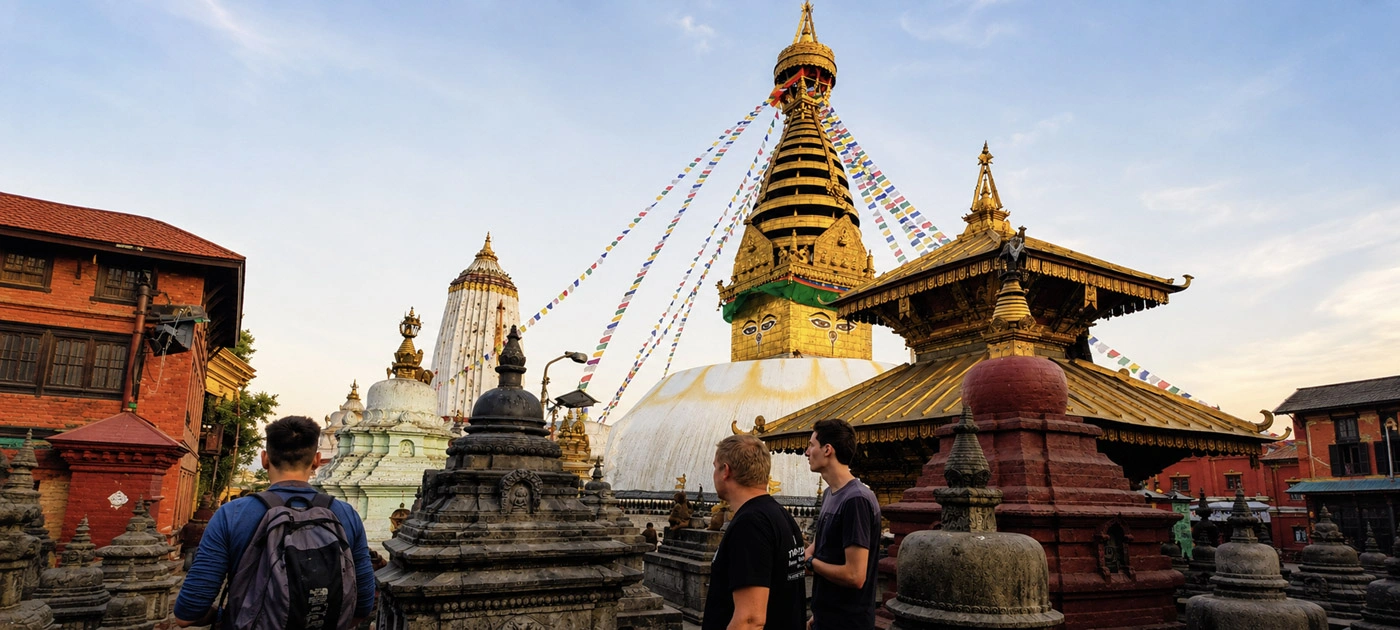
5. Swayambhunath: The Self-Arisen Stupa
Swayambhunath, crowning a hill above the Kathmandu Valley and known affectionately as the "Monkey Temple," is among the oldest and most atmospheric Buddhist sites in Nepal.
Tradition holds that the valley was once a great lake, and that a self-created eternal flame blazed on a lotus at its center. The bodhisattva Manjushri cut a gorge to drain the lake into habitable land, and the flame was enshrined beneath this stupa.
A demanding 365-step stairway climbs to a gilded thunderbolt at the summit, where the same all-seeing eyes and thirteen-tiered spire as Boudhanath preside over the valley.
What sets Swayambhunath apart is its cluster of esoteric shrines—elemental temples set to balance cosmic forces, a secretive subterranean sanctuary, and a shrine to a former child-devouring ogress converted by the Buddha into the protector of children, still visited by Hindu and Buddhist mothers alike. The view over Kathmandu at sunrise is worth the climb alone.
6. Janaki Mandir: The Jewel of Mithila
The Janaki Mandir in Janakpur, in the southeastern plains, is Nepal's most spectacular non-pagoda temple and the heart of the ancient Mithila culture, marking the birthplace of the goddess Sita.
Built in 1910, this blindingly white marble palace-temple stands in stark contrast to the wood-and-brick pagodas of the hills, blending Mughal, Rajput, and local styles across 60 ornate rooms, arches, and domes. Its legendary cost gave it the nickname Nau-Lakha Mandir, the "nine-hundred-thousand" temple.
Janakpur is defined by dozens of sacred ponds and by the annual Vivah Panchami festival, when hundreds of thousands gather to witness a grand reenactment of the marriage of Rama and Sita.
The surrounding villages keep alive the matriarchal folk tradition of Mithila art, painting intricate mythological patterns on their walls. For travelers drawn to living culture over mountains, the Terai's sacred sites are a revelation.
7. Changu Narayan: Nepal's Oldest Temple
Changu Narayan, on a hill east of Kathmandu near Bhaktapur, is the oldest functioning Hindu temple in Nepal and a treasury of classical stone and woodcraft.
Its stone pillar, inscribed in 464 CE during the reign of the Licchavi king Manadeva, is the earliest dated historical record in Nepal—documenting royal genealogies and the king's plea to his mother to abandon ritual self-immolation. That single pillar makes this hilltop foundational to the country's recorded history.
Dedicated to Vishnu, the two-tiered pagoda features some of the finest ancient stone carving in Nepal, with its struts and courtyard covered in fifth- to seventh-century reliefs of Vishnu's incarnations.
Remarkably, the descendants of the temple's mythical founders still serve as its priests and conservators today. A UNESCO World Heritage Site, it pairs naturally with a visit to the medieval city of Bhaktapur.
8. Gosaikunda: The Sacred Lake of Langtang
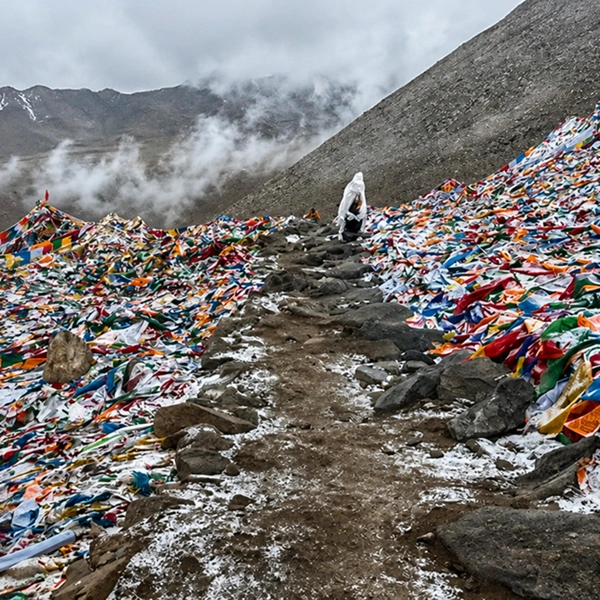
Gosaikunda, an alpine lake at 4,380 meters in Langtang National Park, is one of Nepal's most important high-altitude pilgrimages and a highlight of the Langtang trekking region.
Its origin ties to one of Hinduism's central myths: when Shiva drank the poison that arose from the churning of the cosmic ocean to save creation, his throat burned, and he thrust his trident into the mountainside. Three streams of freezing water burst out, forming this lake and cooling him—which is why the Trishuli River, named for his trident, flows from here.
During the Janai Purnima festival in August, tens of thousands of pilgrims and traditional shamans trek up to plunge into the near-freezing water.
Tradition even holds that there is an underground link between Gosaikunda and a temple complex in Patan, over 40 kilometers away, so that those who can't make the high climb can earn the same merit in the city. We reach Gosaikunda on our Langtang journeys, where pilgrimage and trekking become the same path.
9. Manakamana: The Wish-Fulfilling Goddess
Manakamana, on a ridge at 1,302 meters in the Gorkha district, is one of Nepal's most visited temples, dedicated to a goddess believed to fulfill the wishes of those who reach her—her name means exactly that.
The temple's origin lies in a 17th-century Gorkha royal tragedy, in which a queen revealed as a goddess promised to return to protect the realm, her manifestation later discovered by a farmer whose plow struck a bleeding stone. In a rare arrangement, the temple's priesthood is reserved to this day for the descendants of the queen's indigenous Magar servant—a striking example of indigenous authority over a major royal Hindu shrine.
Since 1998, Nepal's first cable car has turned a long uphill hike into a scenic ten-minute ride, making this one of the most accessible major pilgrimages in the country—an easy, rewarding cultural add-on to a journey through the central hills.
10. Namobuddha: The Place of Ultimate Compassion
Namobuddha, on a peaceful, pine-forested hill at 1,750 meters southeast of Kathmandu, ranks with Boudhanath and Swayambhunath as one of the three holiest Buddhist sites in the valley.
Its sanctity comes from a story set long before the historical Buddha: a prince, an earlier incarnation, encountered a starving tigress too weak to feed her cubs, and gave his own body so they might live. It is one of the most moving parables of compassion in Buddhist tradition, and the stupa here is said to hold his relics, beside an ancient carved stone depicting the sacrifice.
Today, a large monastery crowns the hill, its hundreds of monks filling the air with chanting and butter-lamp offerings. Namobuddha sits close to the Dhulikhel retreats on the valley rim, making it a natural, contemplative stop at the start or end of a Himalayan journey.
Beyond the Ten: The Wider Sacred Network
Nepal's sacred landscape extends well past these ten, and a few auxiliary sites reward travelers who want to go deeper.
Budhanilkantha, at the base of Shivapuri Hill, holds a five-meter stone Vishnu reclining on a cosmic serpent in a recessed pool—Nepal's largest such image, dating to the seventh century.
South of Kathmandu, the caves of Pharping preserve the meditation sites of Guru Rinpoche, with a handprint said to be his set into the stone. Far to the east, the great Halesi cave is sacred to Hindus as a hiding place of Shiva and to Buddhists as a site of long-life attainment.
Higher still, Pathibhara Devi at 3,794 meters near Kanchenjunga is a powerful wish-fulfilling shrine, once worshipped by the indigenous Limbu people, with sweeping views of the world's third-highest peak—a genuine pilgrimage that pairs with our Kanchenjunga journeys.
And on the plains, Devghat Dham, at the meeting of two holy rivers, draws pilgrims for ritual bathing. Together, these sites show how completely faith and landscape intertwine across Nepal.
How the Sacred Fits Into a Journey
The beauty of Nepal's sacred sites is that you don't have to choose between pilgrimage and trekking—many of the greatest sites lie directly on the trails.
Several of these places sit on our routes: Muktinath on the Mustang and Annapurna trails, Gosaikunda in Langtang, Pathibhara near Kanchenjunga, Namobuddha beside the Dhulikhel rim.
Others frame a trip beautifully from the Kathmandu Valley—Pashupatinath, Boudhanath, Swayambhunath, and Changu Narayan make a rich cultural opening or close around a mountain journey. And Lumbini and Janakpur reward travelers seeking the spiritual depth of the plains.
A high-altitude pilgrimage carries its own logic. The hard climb to a site like Muktinath or Gosaikunda strips away comfort and ego before you arrive, and the ritual plunge into freezing water at the top completes a sense of renewal. Whether you come as a believer or simply as a traveler open to the experience, these places give a journey through Nepal a meaning that the mountains alone don't quite reach.
FAQs: Sacred Sites in Nepal
What are the most sacred sites in Nepal?
The most significant span both major faiths: Pashupatinath, Boudhanath, and Swayambhunath in the Kathmandu Valley; Lumbini, the Buddha's birthplace, in the Terai; the shared Hindu-Buddhist shrine of Muktinath in Mustang; the alpine lake of Gosaikunda in Langtang; and the temples of Janaki Mandir, Changu Narayan, Manakamana, and Namobuddha. Many sit on or near trekking routes, so they weave naturally into a journey through Nepal.
Why do Hindus and Buddhists share the same sacred sites in Nepal?
Because Nepal's faiths have coexisted and blended for centuries, sharing deities, architecture, and pilgrimage circuits. Muktinath is the clearest example—the same shrine is revered by Hindus as an abode of Vishnu and by Buddhists as a site of Guru Rinpoche. You'll find Hindus bathing at Buddhist stupas, Buddhists praying in Hindu caves, and indigenous priests running orthodox temples. This fluid, shared spirituality is one of the most distinctive things about the country.
Which sacred sites can I visit on a trek?
Several major ones lie directly on trekking routes. Muktinath sits on the Mustang and Annapurna trails; Gosaikunda is a highlight of the Langtang region; and Pathibhara Devi is near Kanchenjunga. Namobuddha sits close to the Dhulikhel valley rim. This means a trek in Nepal can double as a pilgrimage, with the sacred site as a natural high point of the walking route rather than a separate trip.
Can non-Hindus enter Pashupatinath Temple?
Non-Hindus cannot enter the inner courtyard of Pashupatinath, but the experience from the eastern terraces across the Bagmati River is remarkable—especially the evening Aarti ceremony, with its lamps, chanting, and riverside rituals at dusk. Many of Nepal's other sacred sites, including Boudhanath, Swayambhunath, and Lumbini, welcome visitors of all faiths freely.
Where was the Buddha born?
The Buddha, Siddhartha Gautama, was born in Lumbini in Nepal's southwestern Terai plains in 623 BCE. The exact spot is marked within the Maya Devi Temple, and its authenticity is confirmed by a pillar erected by Emperor Ashoka in 249 BCE. Lumbini is the most important pilgrimage site in the Buddhist world and is laid out as a serene, planned sacred park anchored by monasteries from Buddhist nations worldwide.
What makes Muktinath so special?
Muktinath is one of the finest examples of shared faith in the Himalaya, revered equally by Hindus and Buddhists at an elevation of around 3,750 meters in Mustang. Pilgrims bathe beneath 108 sacred water spouts, visit an eternal natural flame burning above water, and seek the ammonite fossils from the nearby river that Hindus worship as forms of Vishnu. It sits on our Mustang and Annapurna routes, reachable on foot or by a gentler approach.
Are any of Nepal's sacred sites easy to reach without trekking?
Yes. The Kathmandu Valley sites—Pashupatinath, Boudhanath, Swayambhunath, and Changu Narayan—are all short drives from the city. Manakamana is reached by a ten-minute cable car ride, and Lumbini and Janakpur are accessible by road or by a short flight to the plains. These make ideal cultural additions to a trip for travelers who want spiritual depth without a demanding trek, and we build them into itineraries easily.
When are the best festivals to see at these sites?
Timing your visit to a festival transforms the experience. Gosaikunda draws tens of thousands for the Janai Purnima plunge in August; Janakpur reenacts the marriage of Rama and Sita during Vivah Panchami around November to December; and Boudhanath and Pashupatinath are electric during major Hindu and Buddhist festival days. We can align a journey with these wherever you'd like, though exact dates follow the lunar calendar and are confirmed closer to the travel date.
Need Help? Call Us+977 9851013196orChat with us on WhatsApp
Need Help? Call Us+977 9851013196