The choice between the Luxury Everest View Trek and the Luxury Everest Base Camp Trek comes down to altitude and time. The Everest View Trek tops out near 3,880 meters in about a week and suits first-timers and families. Everest Base Camp sits at 5,545 meters, and reaching it takes roughly two weeks for travelers set on standing at Base Camp itself.
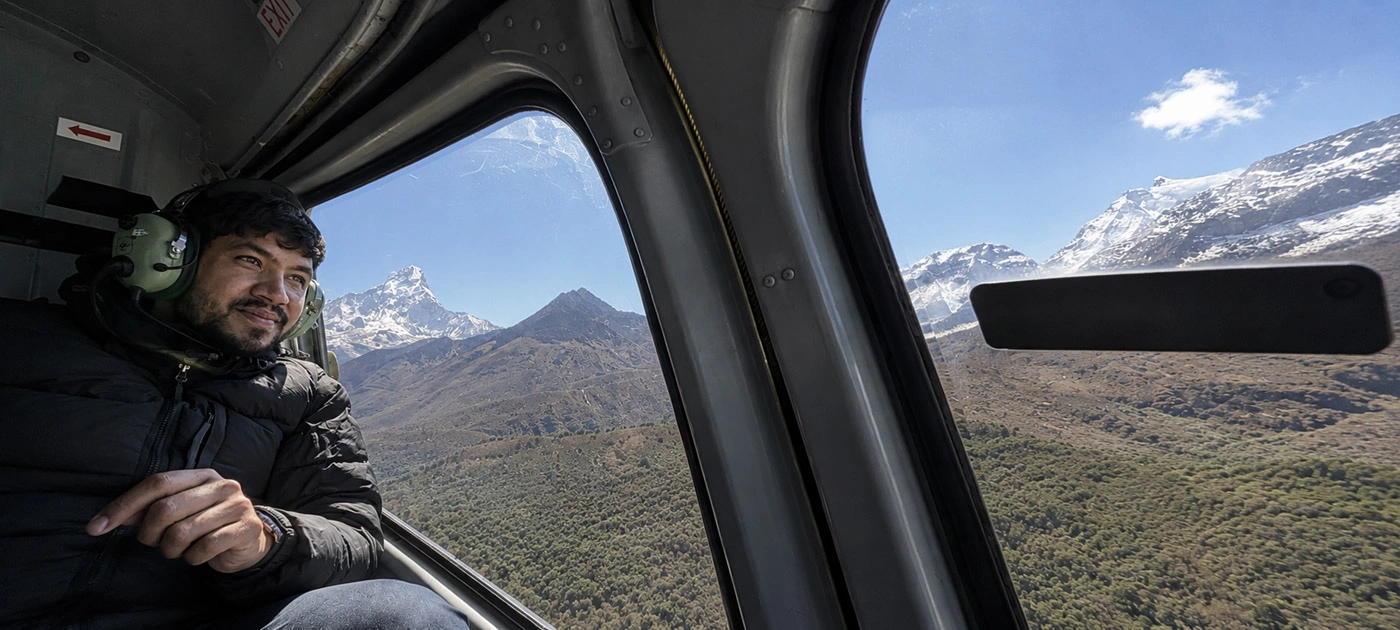
Luxury Everest View Trek vs Luxury Everest Base Camp Trek

The Everest View Trek vs Everest Base Camp Trek question is the most common one we field about the Khumbu, and the honest answer is that they are two different trips with the same mountain. One shows you Everest from a warm stone terrace at 3,880 meters.
The other walks you all the way to the foot of the mountain at 5,364 meters, with a dawn climb to 5,545 meters for the view. Both are run privately, both are lodge-based, and both fly you in by helicopter. What separates them is how high you go, how long you're out, and how hard your body has to work.
Here's how to tell which one is yours.
- The quick answer: who each trek is for
Choose the Luxury Everest View Trek if this is your first Himalayan trek, if you're traveling with children or older parents, if you have about a week, or if you want the Everest skyline without altitude risk hanging over the trip. It reaches a maximum of roughly 3,880 meters.
Choose the Luxury Everest Base Camp Trek if standing at Base Camp is the whole point, if you have around two weeks, and if you're fit enough to walk for many days above 4,000 meters. It reaches 5,545 meters at Kala Patthar.
- That's the short version. The rest of this is the detail behind it.
At a glance
| Luxury Everest View Trek | Luxury Everest Base Camp Trek | |
|---|---|---|
| Maximum altitude | ~3,880 m (Hotel Everest View / Tengboche ridge) | 5,545 m (Kala Patthar) |
| Trip length | About a week | About two weeks |
| Highest overnight | ~3,440–3,870 m (Namche / Tengboche) | 5,164 m (Gorak Shep) |
| Difficulty | Moderate | Challenging |
| Reaches Base Camp? | No | Yes |
| Best viewpoint | Hotel Everest View terrace | Kala Patthar |
| Altitude-risk level | Low | Significant, actively managed |
| Best for | First trek, families, limited time | Base Camp goal, fit and experienced walkers |
Altitude is the real dividing line
The single fact that determines most of this is that the Everest View Trek tops out near 3,880 meters, while the Everest Base Camp Trek reaches 5,545 meters at Kala Patthar. That 1,665-meter gap changes everything about how each trek feels and how it's built.
Below about 4,000 meters, serious altitude illness is uncommon in reasonably healthy walkers. The Everest View Trek stays under that line, so you sleep well and wake up hungry. We still run oximeter checks and pace you carefully, but the risk profile is genuinely low.
Everest Base Camp lives in a different world. You sleep at Gorak Shep (5,164 meters), where oxygen is roughly half that at sea level. Acute mountain sickness is a real possibility, and the itinerary has to be designed around it — extra acclimatization nights at Namche and Dingboche, slow daily gains, and a clear evacuation plan. We build all of that in. But it means the trek is longer and asks more of you, by design.
How many days do you actually need?
Time is often the deciding factor. Our Luxury Everest View Trek runs in about a week from Kathmandu and back. That includes a rest and orientation day in the capital after you arrive, so you start the trail unhurried.
The Luxury Everest Base Camp Trek runs closer to two weeks. The extra days aren't padding — they're acclimatization. You physically cannot safely rush from 2,860 meters in Lukla to 5,545 meters, so the calendar has to breathe. If you only have seven or eight days, Base Camp isn't an option, and the View Trek is the trip that fits.
What you actually see — and a fact most people get wrong
Here's the nuance that surprises people. From Everest Base Camp itself, you don't get a clean view of Everest's summit. The peak hides behind the shoulder of Nuptse and the Khumbu Icefall. What Base Camp gives you is proximity — the icefall groaning a few hundred meters away, the tents of expedition season, the sheer scale of the place. The classic postcard view of Everest on that trek comes from Kala Patthar the next morning, not from Base Camp.
The Everest View Trek, oddly enough, often delivers a cleaner sit-down view of the mountain. From the terrace at Hotel Everest View, Everest, Lhotse, Nuptse, and Ama Dablam line up in one sweep while you drink coffee at 3,880 meters. You trade the achievement of reaching Base Camp for a more comfortable, arguably more photogenic, panorama.
So the question underneath the question is: do you want to stand at Everest, or look at it? Both are valid. They're just not the same want.
How the luxury versions differ from the standard trek
On both routes, we remove the parts that make the standard trek a slog. You fly from Kathmandu to Lukla and back by private helicopter — no Ramechhap road transfer, no pre-dawn drive, no baggage-weight panic. Accommodation is the most comfortable available on each route, described by style on our public pages and named in your private proposal.
On the Base Camp trek, there's one extra lever worth knowing about. Many of our guests add a helicopter lift-out from the high valley on the way down, flying from the Gorak Shep or Pheriche area back toward Lukla or Kathmandu. It skips the long descent, where many trekkers get worn down or picked off by a stomach bug. We can build that in from the start or keep it as a decision you make on the trail.
At the Thukla ridge memorials on the Base Camp route — a field of stone cairns for climbers lost on Everest — you feel the difference between the two treks most sharply. The View Trek never takes you to a place that is so solemn or so high. That's not a flaw. It's the point of choosing it.
Difficulty and fitness, honestly
The Everest View Trek is moderate. The hardest parts are the 600-meter climb to Namche and the 1,055-meter ascent to Tengboche. Most reasonably fit walkers manage it well, and it's realistic for families and older travelers.
The Everest Base Camp Trek is challenging. You're walking six to eight hours on the longest days, at altitudes where every step costs more, for many days in a row. You don't need to be an athlete, but you do need to arrive fit and prepared to be cold and tired. If the fitness question makes you hesitate, the View Trek is the smarter first Himalayan trip — and a natural stepping stone to Base Camp later.
Cost and value
The Base Camp trek costs more than the View Trek. It's longer, uses more helicopter time, and incurs higher logistics costs. That's the straightforward reason. Whether the extra cost is worth it depends entirely on whether reaching Base Camp is a goal you'll regret not meeting. For many travelers, it is. For many others, a week of seeing the same peaks in greater comfort is a better trip and better value. We confirm the exact pricing for both in your proposal, as it varies with the season, group size, and helicopter arrangements.
So which one is right for you?
Pick the Everest View Trek if you want the Everest skyline, Sherpa culture, and Tengboche Monastery in a week, with low-altitude risk and room for family. Pick the Everest Base Camp Trek if reaching Base Camp is non-negotiable, you have two weeks, and you're ready for the altitude. If you're genuinely torn, tell us your dates, your fitness, and who's coming — we've walked both routes every season, and we'll tell you plainly which one fits.
FAQs
Which is harder, the Everest View Trek or the Everest Base Camp Trek?
The Everest Base Camp Trek is significantly harder. It reaches 5,545 meters over about two weeks, with many days above 4,000 meters. The Everest View Trek is moderate and tops out near 3,880 meters in about a week, which is why it suits first-timers and families.
Do you reach Everest Base Camp on the Everest View Trek?
No. The Everest View Trek reaches around 3,880 meters and offers views of Everest from Hotel Everest View and Tengboche. It never goes to Base Camp. If standing at Base Camp is your goal, you need the longer Luxury Everest Base Camp Trek.
Which trek has the better view of Everest?
It depends on what you mean by better. Base Camp itself has a blocked view of Everest's summit; the clear view there comes from Kala Patthar at dawn. The Everest View Trek gives a cleaner sit-down panorama of Everest, Lhotse, and Ama Dablam from the Hotel Everest View terrace.
How many more days does the Everest Base Camp Trek take than the Everest View Trek?
Roughly a week more. The Luxury Everest View Trek runs about seven to nine days in total; the Luxury Everest Base Camp Trek runs about twelve to fourteen days. The extra time is acclimatization, not padding — you cannot safely rush to 5,545 meters.
Can beginners do the Luxury Everest Base Camp Trek?
It's possible but demanding. Base Camp asks for good fitness, tolerance for altitude, and many long walking days. If it's your first Himalayan trek, we usually suggest the Everest View Trek first — it builds confidence at a lower altitude and leaves Base Camp as a stronger option for a return trip.
Is the Luxury Everest Base Camp Trek worth the extra cost over the Everest View Trek?
It's worth it if reaching Base Camp is a goal you'd regret missing. You pay more for the longer duration and additional helicopter time. If a week of the same peaks in more comfort satisfies you, the Everest View Trek is the better value. We lay out both prices in your proposal.
Can I switch to a helicopter if I struggle on the Everest Base Camp Trek?
Yes. Many guests add a planned helicopter lift-out from the high valley near Gorak Shep or Pheriche to skip the long descent, and we can also arrange an unplanned evacuation flight if altitude or illness makes continuing unwise. Your guide monitors this daily.
Still deciding? The full day-by-day for both is on our Luxury Everest View Trek and Luxury Everest Base Camp Trek pages. Send us your dates, your group, and how much time you have, and we'll tell you which one we'd put you on — no hard sell.
Need Help? Call Us+977 9851013196orChat with us on WhatsApp
Need Help? Call Us+977 9851013196