The Luxury Everest View Trek reaches roughly 3,880 meters and offers views of the Everest massif without the strain of Base Camp. We fly you in by private helicopter, and the route stacks its highlights close together: Hotel Everest View, Tengboche Monastery, the Khumjung Yeti scalp, and Namche's ridge-top market.
What Not to Miss on the Luxury Everest View Trek
The Luxury Everest View Trek is the shortest way to stand level with the highest mountains on earth and still sleep warm every night. It tops out near 3,880 meters. That ceiling keeps the thin-air risk low while the views stay enormous. This guide walks you through what actually earns your time on the trail — and what we handle so you never have to.
Everest Base Camp asks for two hard weeks. This route asks for a handful of days. You get Everest, Lhotse, and Ama Dablam from a stone terrace, not from a glacier moraine at 5,300 meters. It suits travelers who want the Khumbu's culture and skyline without the grind of the upper valley.
How the luxury version begins: a private helicopter, not a 1 a.m. drive
The standard route to Lukla now runs through Ramechhap. That means a midnight hotel checkout and roughly five hours on a mountain road before you even see a runway. We remove that entirely.
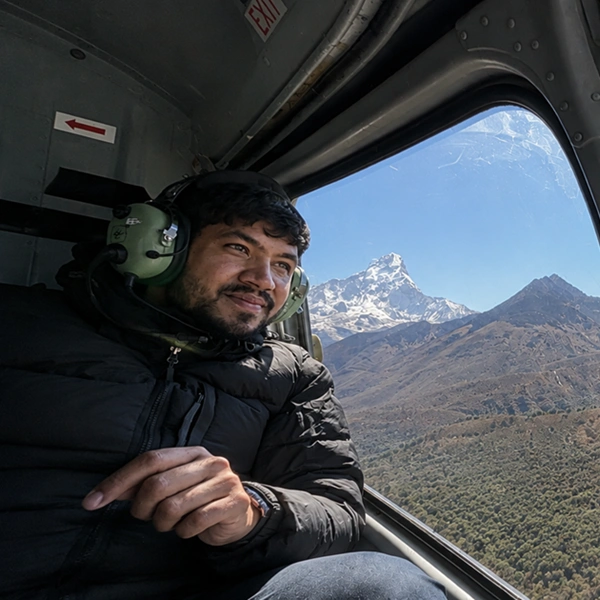
On our Luxury Everest View Trek, you lift off from Kathmandu by private helicopter and land at Lukla (2,860 meters) in about 40 minutes. No pre-dawn convoy. No 15-kilogram baggage scramble. We fly you out the same way at the end, straight back to Kathmandu, so the trek closes on a rooftop view of the peaks rather than a tarmac queue.
That single change reshapes the whole trip. You arrive rested. You keep your own pace from the first step. And the days below stay entirely about the mountains, the villages, and the food.
Namche Bazaar: the Sherpa capital you'll wish you had longer in
Namche Bazaar sits at 3,440 meters inside a natural horseshoe of hillside, facing Kongde Ri and Thamserku. It is the trading and cultural heart of the Khumbu, and it earns a full day.
The climb up to it is the famous one. After the Hillary Suspension Bridge — a steel span 44 meters above the Dudh Koshi, strung with prayer flags — the trail rears up into a continuous 600-meter wall through pine and juniper. Halfway up, on a clear morning, the forest opens, and you catch your first far-off wedge of Everest. We time this climb slowly, with oximeter checks, so the altitude works with you.
At the top, Namche rewards the effort. On the ridge above town, the Sherpa Culture Museum and the Sagarmatha National Park visitor center present the region's history and Buddhist life. In the courtyard stands a life-size bronze of Tenzing Norgay, framed against the real Everest behind him.
If you're here on a Friday or Saturday, the Haat Bazaar fills the town center from around 8 a.m. Traders come up from the lower valleys and over the passes with vegetables, yak butter, and cloth. It clears out before midday, so it's a morning event, not an afternoon one.
And yes — the highest Irish pub on earth is here, at about 3,450 meters. The pool tables and the drinks were carried up on porters' backs over two days. The Guinness arrives in cans, never kegs: pressurized beer tends to explode at altitude. It's a strange, cheerful footnote to a Sherpa town.
Hotel Everest View: the highlight of the trek is named for
Hotel Everest View, on the Syangboche ridge at 3,880 meters, is the single view you do not skip. Built in 1971 and later logged in the Guinness Book of World Records as the highest-placed luxury hotel on earth, it faces the Everest group head-on.
Every room and its stone terrace look straight at the massif. On a clear morning, you see Everest (8,848 m) trailing its jet-stream plume, the sheer south face of Lhotse (8,516 m), the crevassed edge of Nuptse (7,861 m), and the pyramid of Ama Dablam (6,812 m), often called the Matterhorn of the Himalayas. To the side sits Khumbila (5,761 m), a peak the Sherpa hold so sacred it has never been climbed.
We build the acclimatization day here on the "climb high, sleep low" principle: you hike up to the hotel's terrace, have breakfast with that skyline in front of you, then descend to sleep at a lower elevation. It is the best coffee-with-a-view stop in Nepal, and it doubles as a health check-in.
Khumjung and Khunde: the Hillary legacy and a padlocked Yeti scalp
A short descent from Syangboche drops you into the twin villages of Khumjung and Khunde at about 3,790 meters, under the sacred wall of Mount Khumbila. Khumjung is the largest traditional Sherpa village in the Khumbu, and it holds its old shape: white stone houses under bright green roofs, ringed by terraced barley and potato fields.
These villages carry Sir Edmund Hillary's legacy directly. He founded the Khumjung school in 1961 and the Khunde hospital in 1966; both still serve the valley today. The trail here is quieter than Namche, and it's the closest you get to daily Sherpa life on this route.
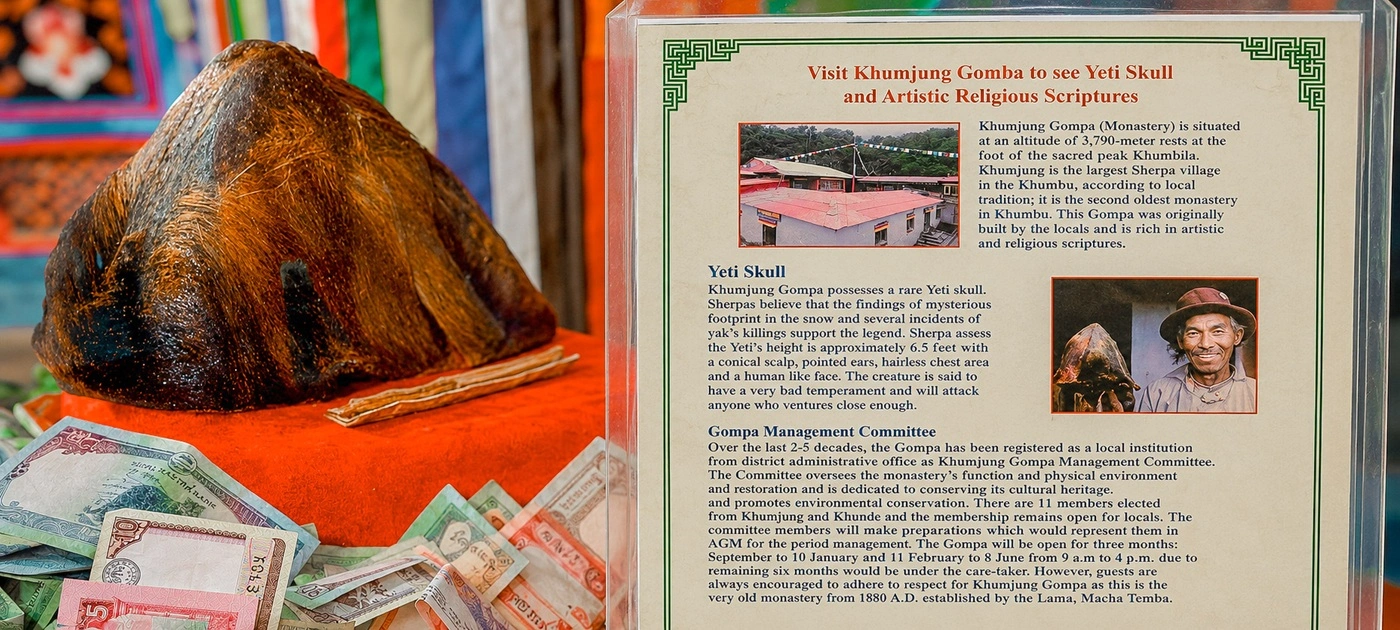
Khumjung's monastery also keeps one of the Himalaya's strangest relics: a purported Yeti scalp, locked in a glass case. A 1960 examination in Chicago concluded it was shaped from the hide of a Himalayan serow, a local goat-antelope. The village kept it anyway. Its meaning to the community never depended on the verdict — which tells you a lot about the Khumbu.
Tengboche Monastery: the spiritual high point
Tengboche Monastery, at 3,867 meters, is the emotional summit of the trek. You reach it after dropping to the river at Phunki Thenga and then climbing a steep 1,055 meters through rhododendron and birch. It's the hardest single ascent of the trip, and the payoff is total: the monastery sits on an open ridge with Ama Dablam, Everest, and Lhotse lined up behind it.
Founded in 1916, Tengboche is the oldest celibate monastery in the Khumbu and follows the Nyingma tradition, the oldest school of Tibetan Buddhism. It has been rebuilt twice — after a 1934 earthquake and a later fire — and the current golden-roofed stone hall is the spiritual center of the whole region. Sit through an afternoon prayer session if the schedule allows; we arrange it quietly with the monks.
Travel in the autumn lunar cycle, and you may catch Mani Rimdu, the Sherpa calendar's most striking festival. Over its public days, monks perform masked Cham dances in silk robes and towering masks, hold empowerment blessings, and close with a fire ceremony that sweeps away a sand mandala built over days — a lesson in impermanence you watch happen. Exact dates shift with the lunar calendar each year, and we confirm them at the time of booking.
The food you shouldn't leave without trying
Sherpa cooking is engineered for altitude: dense, warm, and built around the potato, which reached the high Khumbu in the mid-1800s and now anchors the diet.
Try Rildok, a potato soup where boiled Khumbu potatoes are pounded in a wooden mortar into a silky dough, then dropped into a garlicky broth sharp with Timur — the local Sichuan pepper that numbs and clears your sinuses in one bite. Rikikur, a crisp grated-potato pancake fried in yak butter, comes with a sour yak cheese and a fierce tomato-chili achhar that cuts the richness. At dinner, Syakpa or Thenthuk — thick stews with hand-pulled dough strips and root vegetables — does the real recovery work after a climbing day. And Suja, the salted yak-butter tea, is less a drink than a warm, savory broth that props you up against the cold.
On our departures, we make sure you eat at least one full Sherpa dinner rather than defaulting to international menus. It's part of the place.
Wildlife and the park around you
The entire trek takes place within Sagarmatha National Park, a 1,148-square-kilometer UNESCO World Heritage Site since 1979. The lower forests of birch, fir, and rhododendron — Nepal's national flower, ablaze in spring — give way to alpine scrub as you climb.
This is snow leopard country, though sightings are rare; more likely you'll spot Himalayan tahr picking across cliff faces, or the iridescent Danphe pheasant, Nepal's national bird, flushing from the undergrowth. Over 200 bird species live here. Keep your eyes on the thermals above the valleys for the huge bearded vulture riding the updrafts.
Best time to walk this route
For Nepal, we run this trek in two windows: mid-March to mid-June (spring) and mid-October to mid-December (autumn). Spring brings the rhododendron bloom and warmer forest walking lower down. Autumn brings the year's clearest air and the sharpest mountain views — and, in its early lunar cycle, the chance of Mani Rimdu at Tengboche. On our last autumn departure, the Ama Dablam skyline was cloud-free from Namche all the way to the Tengboche ridge for four straight mornings.
Quick facts worth remembering
The Luxury Everest View Trek reaches a maximum altitude of about 3,880 meters, well below the elevations where serious altitude illness becomes common. Hotel Everest View, at 3,880 meters, is recorded as the highest-placed luxury hotel in the world. And on our version, the Lukla flight is a roughly 40-minute private helicopter transfer in both directions — no Ramechhap road transfer at all.
We arrange every permit for you — the Sagarmatha National Park entry permit and the Khumbu Pasang Lhamu Rural Municipality fee — so you never queue at a checkpoint. (Permit fees are set by the issuing authorities and confirmed at booking.)
FAQs
How high does the Luxury Everest View Trek go?
It tops out at roughly 3,880 meters at Hotel Everest View and the Tengboche ridge. That's well under the altitude where serious mountain sickness usually starts, which is exactly why this route suits travelers who want the Everest skyline without the risk profile of Base Camp.
Do you fly to Lukla by plane or helicopter on the Luxury Everest View Trek?
Private helicopter, both directions. We skip the Ramechhap road transfer and the pre-dawn drive entirely. You lift off from Kathmandu and land at Lukla in about 40 minutes, and we fly you back the same way at the end.
Is Hotel Everest View worth the climb to Syangboche?
Yes — it's the view the trek is named for. From its terrace at 3,880 meters, you see Everest, Lhotse, Nuptse, and Ama Dablam in one sweep. We use the hike up as an acclimatization day, so you gain the view and a health check in the same morning.
Can I see the Mani Rimdu festival at Tengboche on this trek?
Only if your dates fall in the autumn lunar cycle, when Tengboche Monastery holds it. The festival runs on the lunar calendar, so exact dates change each year. Tell us you want to be there, and we'll build the itinerary around it and confirm timing at booking.
How difficult is the Luxury Everest View Trek?
Moderate. The hardest sections are the 600-meter climb to Namche and the 1,055-meter ascent to Tengboche. Days are shorter and lower than on Base Camp routes. With private pacing, oximeter checks, and no early-morning transfers, most reasonably fit walkers manage it comfortably.
What's the best time of year for the Everest View Trek? Mid-March to mid-June and mid-October to mid-December. Spring gives you rhododendron forests and warmer lower trails; autumn gives you the clearest air, the sharpest peaks, and the chance of Mani Rimdu at Tengboche.
Is the Khumjung Yeti scalp real?
A 1960 scientific examination concluded it was made from the hide of a Himalayan serow, a local goat-antelope. The Khumjung monastery still keeps it in a locked glass case, and it remains a genuine cultural relic regardless of the findings. It's one of the more memorable stops on the route.
What food will I eat on the Luxury Everest View Trek?
Sherpa cooking built for altitude: Rildok potato soup, Rikikur potato pancakes fried in yak butter, hearty Syakpa and Thenthuk stews, and salted Suja butter tea. On our departures, we make sure you try at least one full Sherpa dinner rather than only international menus.
If a few unhurried days with Everest, Ama Dablam, and Tengboche — and a helicopter in and out — sound right, our Luxury Everest View Trek itinerary lays out the full day-by-day. We'll shape the pacing and dates around you, Mani Rimdu included, if you want it.
Need Help? Call Us+977 9851013196orChat with us on WhatsApp
Need Help? Call Us+977 9851013196