The Everest View Trek luxury lodges run from Lukla to Tengboche, each offering heated en-suite rooms, hot showers, and Everest-facing dining between roughly 2,600 and 3,880 meters. On our private departures, we sequence these lodges for both comfort and acclimatization, so every night after the trail is a real rest rather than a compromise. This guide walks the route stop by stop.
Everest View Trek Luxury Lodges
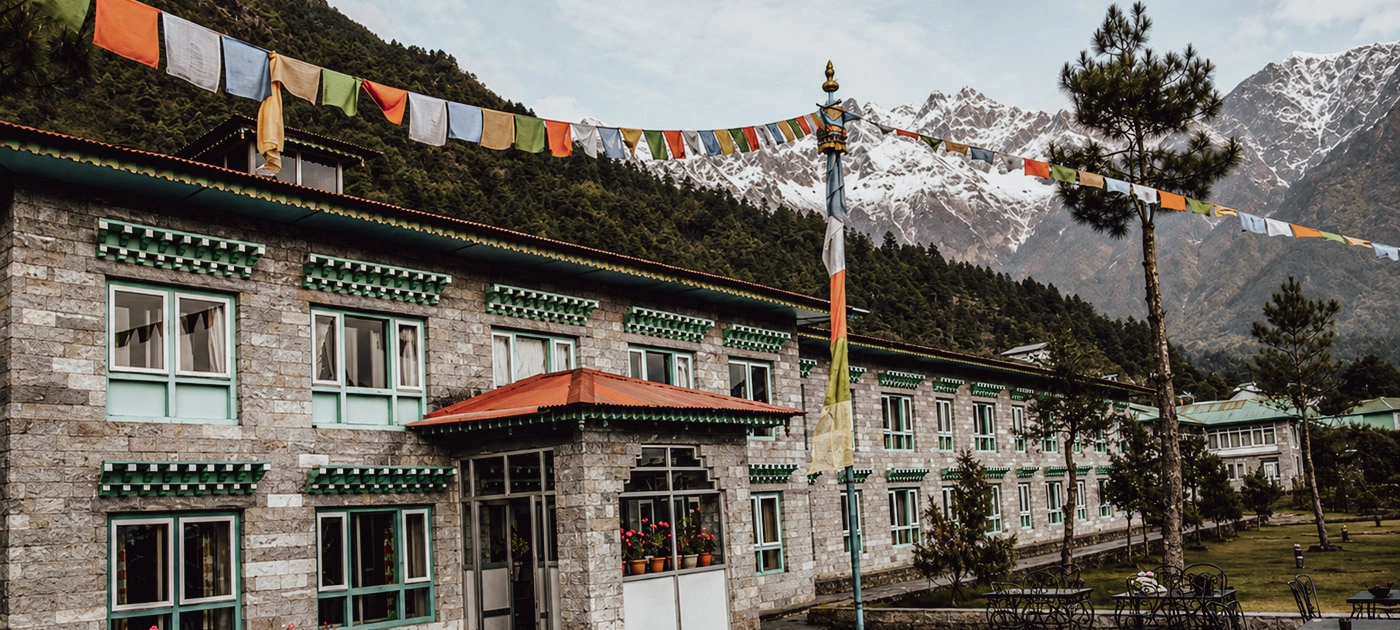
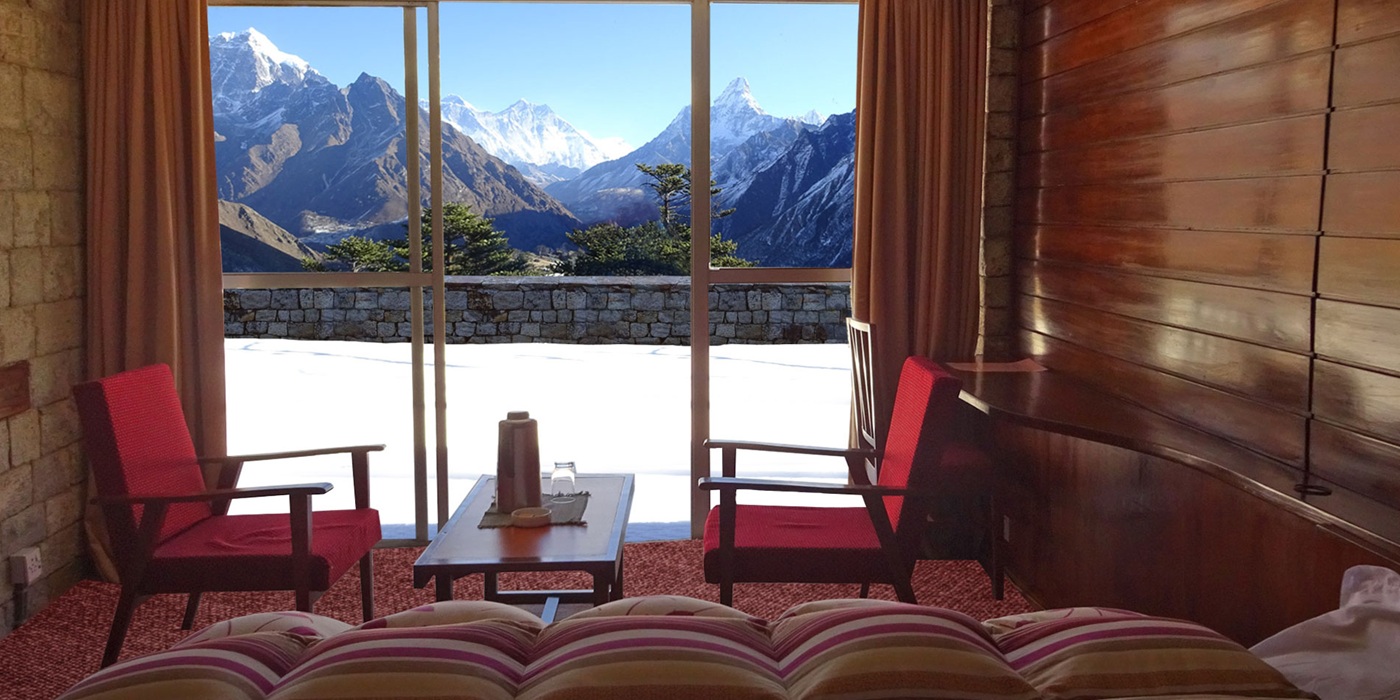
The Everest View Trek luxury lodges are what make a hard walk comfortable. This is the short Khumbu loop, Lukla to Namche to Tengboche and back, and it sits well below Everest Base Camp in both altitude and effort. That lower ceiling changes what a good night looks like. You are not surviving a teahouse dorm at 5,000 meters. You are choosing between properties that offer heated en suite bathrooms, hot showers on demand, insulated rooms, and dining rooms with the Everest range in the window.
We run this trek privately, with guided and paced options
Why lodge choice defines the Everest View Trek
Lodge choice is the single biggest lever on how this trek feels, because you spend more waking hours resting in the lodge than moving on the trail. On a five- to seven-night loop, a warm room and a hot shower after a cold afternoon are not extras. They are the difference between arriving at Namche tired and arriving at Namche wrecked.
The Khumbu has changed fast. Ten years ago,
The Everest View Trek luxury lodges, stop by stop
Here is the route as we walk it, lowest to highest, with what each stop offers.
Lukla (2,840 m)
Most trekkers pass through Lukla in an hour and forget it. We often stop on the first or last night here because, after a helicopter transfer and the altitude change, an easy first evening pays off. The leading option sits right beside the airstrip: around twenty twin and double rooms, all en suite, with 24-hour hot showers, heated blankets, and a lounge bar. Solar heating and power backup keep the lights and water running when the town grid does not.
The value of a Lukla luxury night is not the view. It is the soft landing. You have just gained altitude fast, and a warm room with a proper bathroom lets the body settle before the trail proper.
Phakding (2,610 m)
Phakding sits low on the Dudh Koshi riverbank, roughly a four-hour descent-and-flat walk from Lukla. It is warmer than anywhere higher, which makes it a pleasant first or second night. Two properties compete at the top end here.
One is a Mountain Lodges of Nepal riverside lodge, with around 18 en-suite rooms in a modern stone building, a library, garden seating over the water, and organic Sherpa cooking. The other is a newer resort-style property with riverside cottages, heated soaking tubs, a wood-burning fireplace in the lounge, and double-glazed insulated rooms. Both give you hot water, full-board dining, and the sound of the river all night.
We tend to favor the cottage-style option for couples who want the tub, and the established lodge for its food and its staff, with whom we have worked for years.
Monjo (2,835 m)
Monjo is the quiet one. It sits at the Sagarmatha National Park entrance gate, and most groups blow straight through it toward Namche. We sometimes break here on purpose, especially with travelers who prefer shorter days. The luxury lodge in the village runs about eleven en-suite rooms, hot showers, heated bedding, a fireplace common room, and a bar. Wi-Fi exists but comes and goes.
What Monjo offers is calm. No bazaar bustle, pine forest around the building, and an early, quiet start toward the Namche climb the next morning.
Namche Bazaar (3,440 m)
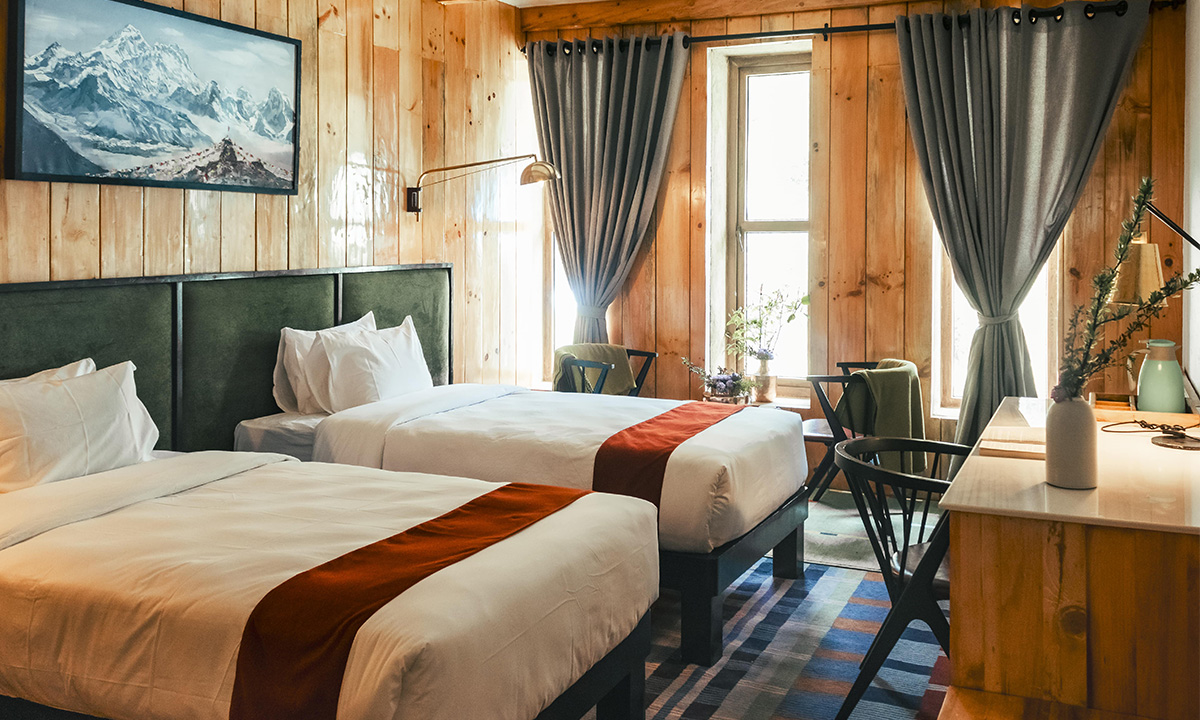
Namche is the hub of the Khumbu and the natural acclimatization base. This is where you sleep two nights on a well-built trek, and where lodge quality matters most, because you are here the longest. The leading luxury lodge sits above the amphitheater of the town, with around twenty en-suite rooms with underfloor heating, thick rugs, hot-water flasks in the room, and a farm-to-table Sherpa menu. There is a fireplace lounge, a bar, and a massage on request, which is not a small thing after the climb up from the river.
Guests who have walked the standard teahouse route before tend to react the same way when they reach a room like this: relief. Hot shower, private bathroom, a bed that holds heat. Namche is also where we build in a rest day, so a comfortable base earns its keep across two nights, not one.
Syangboche and Hotel Everest View (3,880 m)
This is the high point of the trek and the reason many people book it. Above Namche, a steep climb of roughly 300 meters reaches Syangboche and the Hotel Everest View, long regarded as one of the highest-placed hotels in the world. It has twelve rooms, each facing Everest, with en suite bathrooms, private balconies, electric blankets, and supplemental oxygen available on request. There is a dining room, a solarium, and a bar where the whole Everest range fills the glass.
On our itineraries, this is usually an acclimatization excursion from Namche rather than a fixed overnight; we walk on the rest day so the body climbs high and sleeps low. Travelers who want to wake up to Everest from the pillow can overnight here instead, weather and availability permitting. Either way, the climb to Syangboche is the acclimatization walk that catches most people out. It is short but steep, and it is best done slowly before breakfast.
Deboche (around 3,820 m)
Past Tengboche, the trail drops into a forested pocket at Deboche, quieter than the monastery ridge above it. A recent high-end lodge here blends Sherpa building style with real comfort: en suite hot-water bathrooms, heated bedding, a sauna, and a yoga space, with veranda dining that opens onto Ama Dablam and Thamserku. Many groups prefer sleeping at Deboche rather than exposed Tengboche, because it is warmer and calmer at night while keeping the same mountain wall in view.
Tengboche (around 3,867 m)
Tengboche is the spiritual heart of the Khumbu, home to the region's most important monastery, and the turnaround point on this loop. A new resort-style lodge here runs around twenty-three rooms, including Everest-view suites, with underfloor heating, insulated windows, heated soaking tubs, a fireplace restaurant, and a meditation hall. From the terraces, you look straight at Everest, Nuptse, and Ama Dablam. Waking here, with the monastery bells and that skyline, is the memory most travelers carry home.
"luxury" here meant a slightly cleaner teahouse. Now several purpose-built lodges run underfloor heating, spa tubs, and full-board menus that would pass in Kathmandu. Two brands lead the upper end: Mountain Lodges of Nepal, formerly Yeti Mountain Home, with a chain of properties spaced almost perfectly for the walking days, and The Himalayan, a newer resort brand building larger, hotel-style lodges at Phakding and Tengboche.
We do not book a fixed chain out of habit. We match the lodge to the night, the group, and the weather. Some stops have one clear best room in the valley. Others give a real choice.
. Below is how the accommodation actually works along the trail, what each stop gives you, and where the money goes.
What "luxury" actually means at altitude on this route
Luxury in the Khumbu means specific, boring, wonderful things: a private en suite bathroom, hot water that stays hot, a room that holds heat overnight, and well-cooked food. That is the honest definition, and it is worth stating plainly, because glossy marketing tends to promise more than the mountain allows.
Here is the reality check we give every client. Wi-Fi at these altitudes is satellite-based, slow, and unreliable. Power is solar with generator backup, so charging happens in the dining room, not always in the room. Hot showers are real and reliable at every lodge above, but water pressure varies. None of this diminishes the comfort. It simply means the value is in warmth, privacy, rest, and food, not in five-star hotel infrastructure that no supply chain can carry to 3,800 meters.
The lodges above deliver on exactly that. Everyone has private Western-style toilets, hot showers, heating, and full-board dining. That combination, in a region where the standard trek still means shared squat toilets and cold nights, is the whole point.
How we sequence the lodges on a private Everest View Trek
We sequence these lodges around acclimatization first and comfort second, and the two mostly agree. A typical private loop flies you from Kathmandu to Lukla by helicopter, walks down to Phakding or Monjo for a low first night, climbs to Namche for two nights with a rest and acclimatization day, pushes up to Tengboche or Deboche, then returns via Namche and flies back to Kathmandu by helicopter.
The helicopter matters. On every luxury Khumbu trek we run, we fly both ways between Kathmandu and Lukla, never on a fixed-wing aircraft on the return. Lukla's fixed-wing schedule is weather-dependent and prone to backlogs that can cost days. A private helicopter keeps the trip on its rails and gives you the aerial run up the valley as a bonus. We also build a rest and orientation day in Kathmandu before the trek begins, and a buffer night in Kathmandu before your international flight home.
That structure means you never sleep more than a few hundred meters higher than the night before once you are on the trail, and you always have a warm, private room waiting at the top of each day.
Best time to stay: seasons on the Everest View Trek
The best windows are mid-March to mid-June for spring and mid-October to mid-December for autumn, and the lodge experience changes with them. Spring brings rhododendron color to the lower forest sections and longer, milder days, with the trade-off of occasional afternoon haze. Autumn brings the clearest mountain views of the year and cold, sharp nights, which is exactly when heated rooms and soaking tubs earn their keep.
These are also peak seasons, so the best lodges fill up early, and rates are at the top of their ranges. We hold rooms well ahead for private departures. Winter and monsoon see quieter trails and lower prices, but colder nights, more cloud, and a real chance of flight disruption around Lukla.
What luxury lodge nights actually cost
Luxury lodge nights on this route run roughly US$100 to US$260 per room in high season, depending on the property and altitude, with lower stops cheaper and Namche and Tengboche at the top. Off-season rates fall by around twenty to thirty percent. These are lodge-only figures and will vary with the season and demand, so treat them as a guide rather than a quote.
On a private Alpine trip, the lodge cost is included in a single all-in price that covers your helicopter flights, guide, permits, park fees, and full board. That is deliberate. It means you are not settling bills at every stop or negotiating room rates on the trail. We confirm the exact property and rate in your booking proposal.
Frequently asked questions
Which Everest View Trek luxury lodge has the best Everest view?
The Hotel Everest View at Syangboche, at around 3,880 meters, is the standout, with all twelve rooms facing Everest and a dining room that frames the full range. The Tengboche lodge runs it close, with Everest, Nuptse, and Ama Dablam from its terraces. On our trips, we build in time at both.
How much do luxury lodges on the Everest View Trek cost per night?
Expect roughly US$100 to US$260 per room per night in high season, with lower stops like Lukla and Monjo at the bottom of that band and Namche and Tengboche at the top. Rates drop by around twenty to thirty percent off-season. On our private trips, the lodge cost is included in one all-inclusive price.
Do the Everest View Trek luxury lodges have hot showers and heating?
Yes. Every luxury lodge we use on this route, from Lukla to Tengboche, has private en suite bathrooms, reliable hot showers, and room heating, usually electric blankets or underfloor systems. It is the core difference from standard teahouses, where showers are shared, cold, or paid by the bucket.
Is the Everest View Trek high enough to be a concern for altitude?
The trek tops out around 3,880 meters by day and sleeps near 3,800 at its highest, well below Everest Base Camp. Altitude sickness is possible but far less likely than on higher treks. We still pace it with a Namche rest day, run daily oximetry checks, and design the climb: high, then sleep low.
Can I fly by helicopter instead of walking sections of the Everest View Trek?
Yes. On our luxury Khumbu trips, we fly from Kathmandu to Lukla and back by private helicopter as standard, and we can arrange helicopter segments within the trek for travelers short on time or managing mobility. The trail sections between lodges are walked, but the long, weather-prone transfers are flown.
How far apart are the lodges on the Everest View Trek?
Walking days on this loop run roughly three to five hours between stops. Lukla to Phakding is a gentle half-day, Phakding to Namche is the biggest climb, and Namche to Tengboche is a full but manageable day. The short distances are what allow us to stay at a comfortable, well-heated lodge every night.
Which is better for a luxury base, Namche or Tengboche?
Namche, for length of stay and amenities, since it is where you rest and acclimatize across two nights with the widest choice of comforts. Tengboche wins on setting and drama, with the monastery and the Everest wall at dawn. Our loop gives you both, so it is not an either-or.
Do I book the lodges myself or does Alpine handle it?
We handle everything. Room holds, upgrades, dietary requests, and the helicopter timing are all arranged and confirmed in your booking proposal before you travel. On the trail, you carry no bills and make no bookings. That is the point of a private, held trip.
Plan your Everest View Trek
If a warm room and an Everest-facing breakfast sound like the right way to see the Khumbu, this is the trek built for it. We run it privately, with a set pace and fully arranged, from the first helicopter out of Kathmandu to the buffer night before you fly home. Tell us your dates, and we will match the lodges to your trip.
Need Help? Call Us+977 9851013196orChat with us on WhatsApp
Need Help? Call Us+977 9851013196