The top luxury experiences in Bhutan are the multi-valley lodge circuit, private helicopter and jet access, the Sowa Rigpa hot stone bath, private spiritual and astrological audiences, and guided day hikes on the Trans Bhutan Trail. Together they turn the whole kingdom into one slow, private journey.
The Top Luxury Experiences in Bhutan
The best luxury experiences in Bhutan aren't about marble or gold; they're about access. This is a country that deliberately filters tourism through a high-value, low-impact policy and a daily visitor fee, and the result is a rare kind of quiet. You travel with a private guide and driver throughout, which is required here, and that turns the whole kingdom into one long, unhurried journey. We build private Bhutan trips every season, and these are the five experiences we'd point you toward first.
Every visitor pays Bhutan's daily Sustainable Development Fee, which funds the country's healthcare, Education, and conservation, and the amount shifts with policy, so we confirm the current figure when you book
Luxury experiences in Bhutan: the short answer
The five defining elements of a luxury trip are the lodge circuit, aerial access, the hot stone bath, private spiritual audiences, and the Trans Bhutan Trail. Most travelers combine three or four of them across a single route.
None of these works as a bolt-on. They depend on Bhutan's tightly held system of licensed guides and private transport, which is exactly what keeps the crowds out and the access in. The sections below explain each one and how we thread them together.
The multi-valley lodge circuit
The classic way to see Bhutan is to move, not to sit. Rather than staying put in one resort, you travel a circuit of intimate lodges across distinct valleys, from the pine forests of Paro to the rice terraces of Punakha and the glacial plain of Gangtey, so the country itself becomes the resort, and the lodges are the waystations.
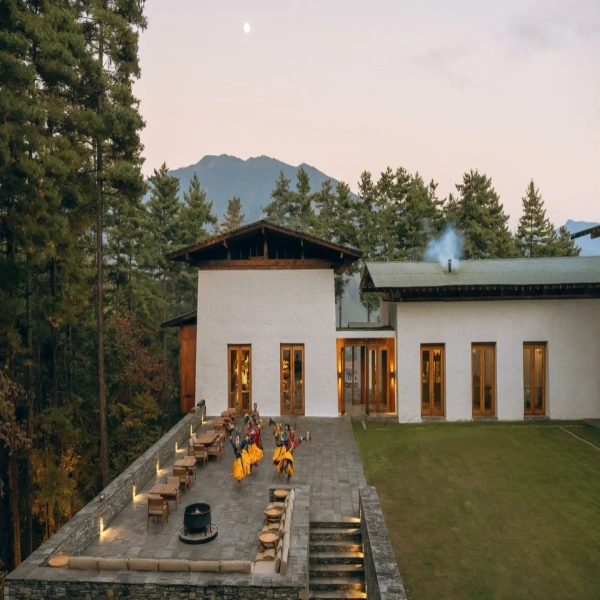
Two brands set the standard. Amankora runs five lodges built as a minimalist take on the Bhutanese dzong, in rammed earth and whitewashed stone, each suite warmed by a Bukhari wood stove, and it works best over a longer, seven-night-plus journey. Six Senses also runs five, each tuned to its valley, from the glass-and-pond "palace in the sky" above Thimphu to the "flying farmhouse" over the Punakha paddies, with the largest spa in the country and a heavy focus on wellness and sleep.
A newer style has appeared alongside the circuits: the standalone enclave. Pemako Punakha sits on the Mo Chhu river, reached by crossing a long suspension bridge hung with prayer wheels, a deliberate line between the outside world and the retreat. It trades hotel rooms for tented villas with private heated pools and puts its dining in a restored heritage house where dishes like ema datshi and river-weed soup are cooked in clay pots over fire.
Each valley on the circuit earns its night. Paro is home to the airport and the Tiger's Nest, so it tends to be the starting and ending point of a trip. Thimphu, the capital, is the cultural anchor, within walking distance of markets and the great dzong. Punakha, lower and warmer, brings the country's most beautiful riverside fortress, and Gangtey opens onto the glacial Phobjikha plain where black-necked cranes winter. Pushing east into Bumthang reaches the spiritual heartland, a run of ancient temples in a quiet high valley.
The magic of the circuit is invisible logistics. Behind the scenes, someone moves your luggage, clears your permits, and routes your driver, so you cross rugged country without friction. A private guide and driver stay with you the whole way, keeping the cultural thread unbroken as you move between valleys. We cover where to stay in detail in our Paro and Thimphu lodge guides; here, it's enough to know the circuit is the backbone most luxury trips hang on.
Private helicopter and jet access
Bhutan's roads are slow by nature, so the top of the market flies. Aerial access is the experience that opens the country's wildest corners to travelers with the budget but not the weeks for a trek.
Many journeys begin before Bhutanese airspace, with a private charter from Kathmandu to Paro, a roughly 55-minute hop over one of the world's most demanding airport approaches. Inside the country, high-altitude helicopters handle the rest. A short scenic flight lifts you over the Paro Dzong and gives an eye-level view of the Tiger's Nest that no trekker gets, from around US$2,500.
From there, the flights get wilder. A charter north toward Mount Jomolhari, a sacred peak on the Tibet border, crosses the Paro river and the high fortresses in under an hour and a half. The most ambitious tour compresses the Snowman Trek, widely rated the hardest long trek on earth, into a three-hour flight over Laya, Lingzhi, and hidden glacial lakes, for roughly US$15,000 and up
The finest version pairs flight with food. With the right permits, which we arrange, a helicopter can land at a remote high base camp near 4,000 meters, where a chef has set up a private breakfast among the peaks, with blue sheep on the slopes above. Mountain weather is fickle, so these flights run in the early morning and depend on clear conditions, which we plan around.
Aerial access also solves a real problem: time against terrain. A road transfer between distant valleys can eat most of a day, while a helicopter crosses the same ground in a fraction of it, handing that time back to the trip. For travelers who want the wild heart of Bhutan but not the weeks of trekking it usually demands, a single flight opens a country that would otherwise take a fortnight on foot.
The hot stone bath and Sowa Rigpa wellness
Wellness in Bhutan isn't imported; it's the oldest luxury here. The traditional hot stone bath, the Dotsho, is the cornerstone, drawn from Sowa Rigpa, the Himalayan medical system that balances the body's elements and goes back well over a thousand years.
The method is elemental. River stones are roasted in an open fire until they glow, then dropped into a partitioned end of a pine or oak tub filled with cold spring water. The water cracks into steam, the stones release calcium, magnesium, and iron, and the bath is steeped with wild Artemisia, the local Khempa, whose sage-and-mint scent works as a natural anti-inflammatory. Farming families used these baths for centuries to ease sore muscles before festivals.
The luxury lodges have raised the ritual without losing it. At Bhutan Spirit Sanctuary, a wellness-only retreat in the Neyphu valley, a traditional doctor reads your pulse and prescribes daily treatments included in the stay, from Ku Nye herbal-oil massage to the Dotsho. Six Senses folds the bath into longer rituals with singing bowls and salt scrubs, and Pemako pairs it with a full Sowa Rigpa consultation.
There's a functional payoff too. The heat, the mineral soak, and the rush of blood genuinely help with altitude recovery and sore legs, which is why a Dotsho after the steep climb to the Tiger's Nest feels less like indulgence and more like medicine.
Private spiritual access and astrology
The rarest luxury in Bhutan is spiritual access, not a suite. In a country where Buddhism shapes daily life and even the timing of national events, being allowed a genuine, private audience with monks and astrologers is something mass tourism can't buy.
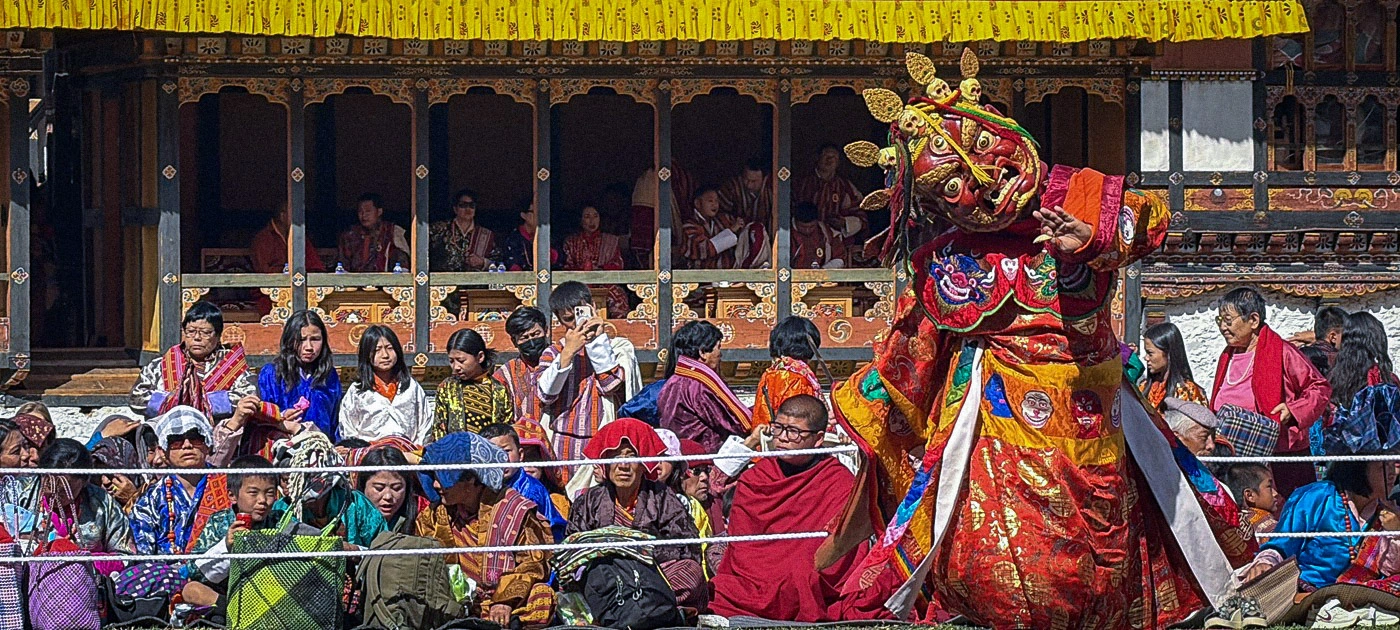
Bhutanese astrology, Tsi, is a respected science that sets naming days, wedding dates, and festival timing. Its center is Pangri Zampa, a 16th-century riverside monastery near Thimphu that trains the state's astrologers beneath two of the largest cypress trees in the country. With the right introductions, you can sit for a private reading: you give your exact birth details, and a master astrologer casts a chart from old texts, offering insight into character and path, and prescribing simple remedies like a prayer-flag hoisting to smooth a difficult year.
Beyond a reading, we can arrange private ceremonies at working monasteries, from a short water-purification blessing led by a lama to a longevity rite chanted by several monks, up to a full-day ritual with drums, horns, and cymbals to clear obstacles. These are structured as donations that directly support the monks.
The most moving experiences are the humblest. You can buy rice and vegetables at the market and serve a meal to an entire monastery, ladling out rice, chili paste, and butter tea to the monks yourself. It's a quiet exchange that outlasts any sightseeing, and it puts your visit straight into the spiritual economy that keeps these institutions alive.
This is where Bhutan's whole model shows itself. The country measures its success by Gross National Happiness rather than raw output, and its tourism is built to protect culture, not sell it off. Structuring these encounters as donations that feed and school the monks means that your visit strengthens the tradition rather than thins it. For many travelers, that shift, from consuming a culture to quietly supporting it, is the part of the trip they remember longest.
Luxury day-hikes on the Trans Bhutan Trail
For walking without the hardship, the Trans Bhutan Trail is the answer. This ancient 403-kilometer network once carried royal messengers, traders, and monks across the kingdom, lay lost for decades, and reopened in 2022 after a community restoration.
Walking the whole thing takes around a month. The luxury version doesn't try. Instead, you're driven to a scenic trailhead, walk a chosen segment of roughly eight to fifteen kilometers in one direction, and find a vehicle waiting at the far end, so there's no backtracking and no heavy pack.
The finest segment drops from the Dochula pass into the Punakha valley, past the 108 memorial chortens on the ridge, then twelve kilometers down through moss-hung rhododendron and oak, following the old path of the 16th-century "Divine Madman." Others cross high passes to yak-herder meadows, or link the sacred temples of Bumthang on foot rather than by road. On our spring departures, we've set a linen table in a forest clearing where the messenger path crests a ridge, hot momos waiting, the valley falling away below.
At the end of the walk, a vehicle carries you straight to a tented villa or a valley-view suite, where a heated pool or a Dotsho meets your tired legs. It's soft adventure done properly, the real rural heartbeat of Bhutan reached on your own terms.
What it costs and when to go
A luxury Bhutan trip is priced by its parts, and the fixed one is the government's. In addition to your lodges and guiding, every traveler pays a daily Sustainable Development Fee per person and a one-time visa fee, with a tourism tax on services. We fold all of it into a single quoted price, so nothing is a surprise on the ground.
The lodge circuits are priced at four figures per night, all-inclusive; helicopter charters run from a few thousand dollars to well over ten thousand for the long aerial tours; and private spiritual ceremonies are modest donations. What you're buying across the board is space and access, not fixtures.
Set against tiger safaris in India or camps in East Africa, the numbers hold up because so few places can deliver this much privacy, access, and untouched space at once. The fee you pay is not a surcharge in the usual sense; it funds a country that has chosen to stay whole rather than sell itself to volume.
The best seasons are spring, roughly March to May, and autumn, roughly September to November, for stable weather, clear mountain views, and the finest flying and hiking conditions. Both spring and autumn also carry major tshechu festivals, held over several days in the dzong courtyards, whose exact dates follow the lunar calendar and are confirmed at booking. Rooms and helicopters both book out months ahead for those weeks.
How we put it together
We don't own lodges or aircraft in Bhutan; we choose and arrange them for you, which lets us build the trip around what you actually want. A strong week might open with a wellness-led night to shake off the flight, add a scenic helicopter flight over the Tiger's Nest, a Dotsho after the climb, a private blessing, and a guided day on the Trans Bhutan Trail, moving valley to valley on the lodge circuit.
Once we know your dates, pace, and priorities, we handle the permits, the Sustainable Development Fee, the flights, the guiding, and the right base at each stage. Tell us what you want the days to feel like, and we will shape the kingdom around it.
FAQs
What is the best luxury experience in Bhutan?
There's no single best; the strongest trips combine several. Most travelers pair the multi-valley lodge circuit with a scenic helicopter flight, a traditional hot stone bath, and a private spiritual audience, adding a guided day on the Trans Bhutan Trail. We build the mix around your interests, whether that leans toward wellness, culture, or soft adventure.
Do you travel in Bhutan on a lodge circuit, or do you stay in one place?
Most luxury trips use a circuit, moving between intimate lodges in different valleys so the whole country becomes the journey. Standalone enclaves like the tented villas at Pemako Punakha suit travelers who prefer to settle in one place. We can build either, or blend them, mixing a circuit with a couple of nights at a single standout retreat.
Can you see the Tiger's Nest or the Snowman Trek by helicopter?
Yes. A short scenic charter gives an eye-level view of the Tiger's Nest that trekkers never get, and a longer aerial tour flies the remote Snowman route, widely considered the hardest long trek on earth, in about three hours. Flights run early in the morning for clear weather, and we arrange permits and timing.
What is a Bhutanese hot stone bath, and is it worth it?
The Dotsho is a traditional bath in which fire-heated river stones are dropped into spring water infused with wild Artemisia, releasing minerals and a herbal aroma. It comes from the ancient Sowa Rigpa medical system and genuinely aids muscle and altitude recovery, which makes it perfect after the Tiger's Nest climb. Nearly every luxury property offers a version.
Can luxury travelers meet monks or have an astrology reading in Bhutan?
Yes, with the right introductions. You can sit for a private astrology reading at a historic monastery, commission a blessing or longevity ceremony led by monks, or serve a meal to a monastery yourself. These are respectfully arranged as donations supporting the monks, and they offer a depth of cultural access that mass tourism cannot reach.
How much does a luxury trip to Bhutan cost?
It depends on the lodges, flights, and length of stay, and every traveler also pays Bhutan's daily Sustainable Development Fee and a one-time visa fee on top. Circuit lodges run into four figures a night, helicopters add several thousand per flight, and ceremonies are modest donations. We confirm current fees and quote a single all-in price when you book.
Need Help? Call Us+977 9851013196orChat with us on WhatsApp
Need Help? Call Us+977 9851013196