Luxury hotels in Thimphu range from the minimalist Amankora and the wellness-led Six Senses to the Bhutanese-owned Pemako and intimate eco-retreats like The Postcard Dewa. This guide covers where to stay in Bhutan's capital, what each property excels at, and how Thimphu anchors a broader Bhutan circuit.
Luxury Hotels in Thimphu
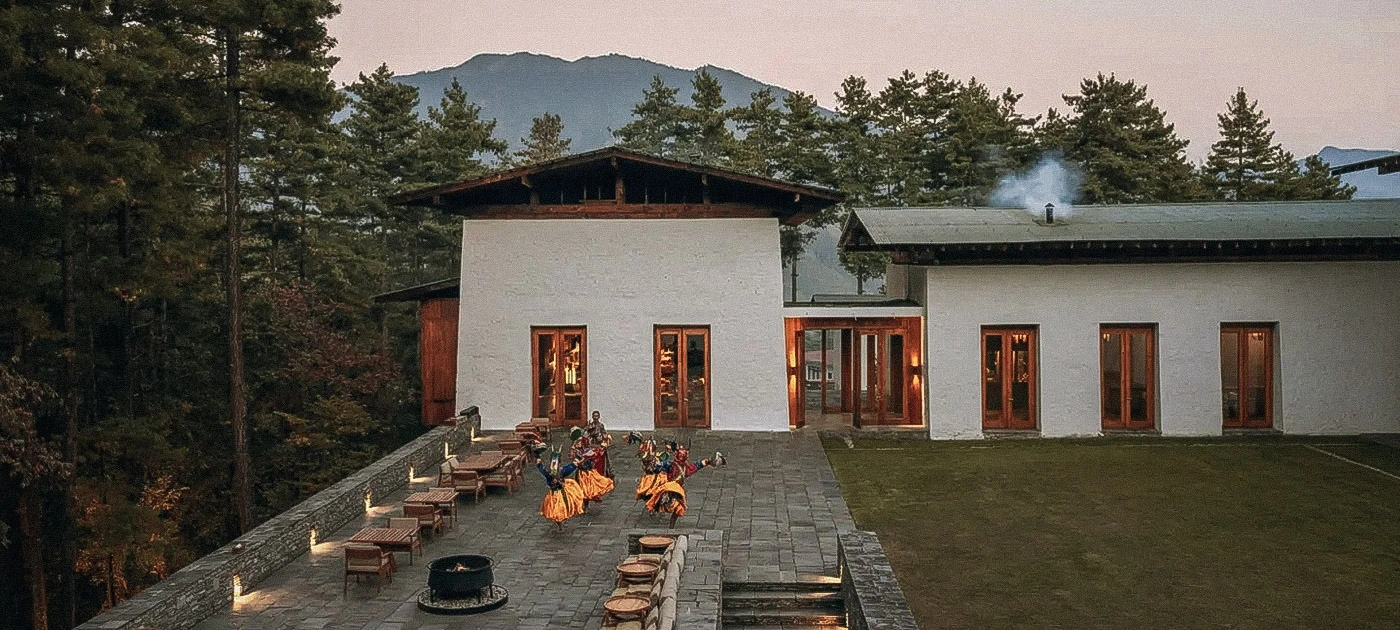
Luxury hotels in Thimphu turn Bhutan's capital from a transit stop into a proper stay. Thimphu sits at around 2,320 meters, one of the few capital cities on earth without a single traffic light, where fortress-monasteries and quiet markets sit beside a handful of the finest hotels in the Himalayas. Almost every Bhutan trip passes through here, so it pays to stay well. We build private Bhutan journeys every season, and this is an honest look at where to stay in Thimphu and how to choose.
What luxury means in Thimphu
In Thimphu, luxury blends deep cultural access with genuine calm, held in place by Bhutan's own rules. Every visitor pays a daily Sustainable Development Fee that funds the country's healthcare, education, and conservation. The amount varies with policy, so we confirm the current figure when you book.
That system keeps the capital unhurried even at the top of the market. There is no package tourism here, only a small, varied set of properties competing on architecture, wellness, and food.
Thimphu also plays a role no other valley can. It's the cultural and administrative heart of the country, the natural place to acclimatize after the flight into Paro, and the base from which the wider circuit unfolds. The best stays here use that position rather than fight it.
Amankora Thimphu: monastic minimalism
Amankora Thimphu is the choice for travelers who want silence, restraint, and heritage. Aman opened the first international luxury lodges in Bhutan in 2004, effectively inventing the country's modern luxury model, and this property was awarded two Michelin Keys in 2025.
The lodge hides in a blue-pine forest in the upper Motithang area, a fortress-like retreat set apart from the commercial center. Designed by the late Kerry Hill, it uses stabilized-earth construction and inward-facing courtyards that block city noise and hold a monastic calm, much like a traditional dzong. There are just 16 identical suites, each around 52 square meters.
Rooms are spare and warm, in wood paneling and deep brown tones, and there are no televisions, by design. A traditional Bukhari wood stove sits between the bedroom and bathroom, and at turndown, the staff lay pinecones with the wood so the suite fills with cedar smoke, the kind of heat no modern system replicates at this altitude.
The service runs on quiet anticipation, down to cleaning your boots after a muddy monastery walk without being asked. The property can also arrange rare cultural access, including a private audience with a senior reincarnate lama for meditation and a blessing, and a candlelit Forest and Stream dinner cooked over an open fire beside a woodland brook. For understated calm, nothing in the capital matches it.
Six Senses Thimphu: the palace in the sky
Six Senses Thimphu is the opposite of Amankora, and the pick for wellness and wide views. Opened in 2018 and set high at around 2,755 meters, it overlooks the valley to the giant Buddha Dordenma statue, which is why it's nicknamed the palace in the sky.
It's the largest of the brand's Bhutan lodges, with 25 rooms and villas, from lodge suites of around 67 square meters up to three-bedroom villas of some 312 square meters that sleep as many as eleven, each with a butler and a private courtyard. The design is all clean lines, solid oak, and huge windows, with reflecting ponds that mirror the sky and blur the line between room and mountain.
Wellness is the headline. The spa spans around 1,400 square meters, making it the most advanced in the country, with an indoor pool, five treatment rooms, a meditation pavilion above the clouds, and an alchemy bar where you mix scrubs from the garden. Treatments often open with crystal rituals and Bhutanese singing bowls.
The experiences are structured and cultural. You might visit a 16th-century monastic school of astrology to have a chart cast and a Bhutanese name bestowed, take afternoon tea on a short hike among prayer flags, or eat at the sunken-deck barbecue where chefs grill local meats over fire with the valley below. For families and wellness-first travelers, it leads.
Pemako Thimphu: indigenous grandeur in the city
Pemako Thimphu is the grand urban choice and a landmark in Bhutan's hospitality story. It opened in 2008 as the country's first true five-star city hotel and, after a long international management run, was rebranded in 2023 under a Bhutanese-owned luxury brand, marking the coming of age of domestic management to world standards.
It sits centrally in the Chubachu district, built to feel like a medieval fortress. Inside, it's palatial, with a tea lounge rising four stories in hand-carved timber, accented by brass prayer wheels and ritual horns. There are 66 rooms and suites, from around 39-square-meter rooms up to 93-square-meter suites and unusual duplex suites with a spiral staircase between floors, many looking over the Wang Chhu river.
Rooms carry soft hand-drawn Buddhist murals, so you sleep inside a piece of regional art, with floor warmers and marble bathrooms. The Lotus Realm spa draws on Sowa Rigpa medicine and the five elements, with an indoor pool, infrared saunas, and hot-stone baths.
Its trump card is location. You can walk straight out to the Textile Museum, the Clock Tower square, the National Memorial Chorten, and the farmers' market, and the hotel arranges resonant urban experiences like the ceremonial lighting of 108 butter lamps, private weaving demonstrations, and archery on its own grounds.
The urban internationals: Yarkay and Le Méridien
Two international city hotels round out central Thimphu, each with a clear strength. Both suit travelers who value walkable access and reliable standards over forest seclusion.
Yarkay Thimphu, part of the IHCL SeleQtions portfolio, is the largest hotel in the capital by room count, with 83 rooms. Its entire interior is themed around the Buddhist folk tale of the Four Harmonious Friends, with each floor representing a value from the legend, and it features a well-regarded spa known for Thai massage, a holdover from earlier management. It's a comfortable, characterful base with a wide spread of restaurants and bars.
Le Méridien Thimphu, under Marriott, opened in 2014 on Chorten Lam with 78 rooms and a cosmopolitan feel. Its real edge is event space, the largest in the city, which makes it the practical choice for a corporate retreat, a delegation, or a large wedding. It also runs one of the few dedicated Pan-Asian fine-dining rooms in Thimphu.
Micro-luxury and eco boutiques
For travelers who want extreme privacy or a lighter footprint, two small properties stand apart from the big houses. Both trade scale for intimacy.
The Postcard Dewa, in the forested Khasadrapchu valley on the city's edge, is the most intimate luxury stay in Bhutan, with just 15 keys. The space per guest is remarkable: entry rooms start at around 92 square meters, and the largest suite runs to some 195 square meters, with its own garden, terrace, and river-facing gazebo, making it a quiet choice for travelers who want anonymity. The food is fiercely local, built on Bhutanese heritage dishes and river trout, often served as a private riverfront picnic.
Zhiwa Ling Ascent sits on the edge of the Motithang Takin Preserve, home to Bhutan's odd national animal, the takin. It's a 20-room boutique hotel designed by an Austrian architect in a Bhutanese-Austrian collaboration, drawing on farmhouse forms with a clean Scandinavian edge.
It runs on tight ecological principles, capturing solar heat, recycling rainwater, and heating with solar panels, and it doubles as a training hotel with the national tourism institute, so you're quietly helping teach the next generation of Bhutanese hoteliers. A rooftop lounge offers 360-degree views of the valley.
Riverfront and the four-star tier
A few more properties earn a place, either for their setting or for real value. They challenge the big names in design without the top-tier price.
Terma Linca Resort & Spa holds a prime riverfront spot on the Wang Chhu, about five kilometers from the center, with 30 rooms in a sprawling resort layout that feels far from the city. Its spa is unusual for Bhutan, adding a Turkish hammam to the traditional hot-stone baths, and it runs a strict farm-to-table kitchen and archery on the lawns.
Below the five-star tier sits a strong group of four-star boutiques, generally around US$80 to US$150 a night. The Pema by Realm in Lower Motithang blends contemporary and traditional design across 27 rooms, with a lively rooftop bar and a good spa.
Norkhil Boutique Hotel and Spa leans into wellness with hot-spring baths and city views from private balconies. Pelyang Boutique, near the Clock Tower, offers 36 rooms with warm personal service and a central, walkable base. For design-led value, these three punch well above their rate.
What you'll pay
Thimphu spans a very wide range, and every figure shifts with the season and demand, so treat these as indicative and confirm before booking. The circuit lodges and grand city hotels reach into four figures per night, while the four-star boutiques sit far lower, from around US$80.
In addition to the room rate, Bhutan charges a daily Sustainable Development Fee per person and a one-time visa fee. We fold it all into one quoted price when you book, so there's no guesswork on the ground.
How Thimphu fits a Bhutan circuit
Thimphu is rarely the whole trip; it's the anchor of a circuit, and how long you give it depends on how far you go. Bhutan is best traveled slowly, partly because the flight into Paro and the jump to altitude reward an unhurried start.
A five-night trip within the Paro–Thimphu corridor is ideal for a wellness or short cultural stay, taking in the Tiger's Nest and intensive spa time while missing the deeper valleys. Seven nights is the sweet spot for a first visit, adding the drive over the Dochula Pass into the warmer Punakha valley and its great riverside dzong.
Ten days to a fortnight is the full circuit, pushing on to the Gangtey valley for the black-necked cranes and into the remote Bumthang heartland. On any of these, we often start with a wellness-led night in Thimphu or Paro to shake off jet lag, then vary the style from valley to valley, and return to central Thimphu before departure for last textile and craft shopping.
When to go
The best seasons are spring, roughly March to May, and autumn, roughly September to November, with stable weather and clear mountain views. These are also the windows for the clearest flights and the finest Tiger's Nest climbs from Paro.
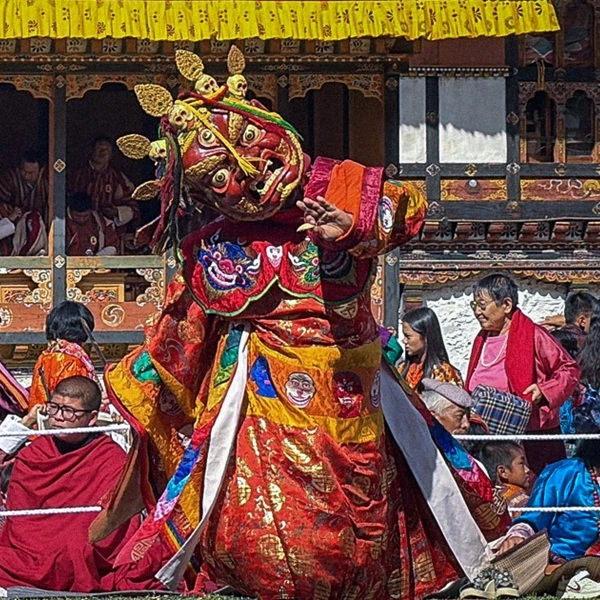
Autumn brings the Thimphu Tshechu, one of Bhutan's largest masked-dance festivals, held over several days in the courtyard of the Tashichho Dzong. On our autumn departures, we've timed a Thimphu night around it, when the dzong fills with dancers and the whole city empties into the festival. Exact dates follow the lunar calendar and are confirmed at the time of booking, and rooms sell out well ahead of that week.
How we build your Thimphu stay
We don't own hotels in Bhutan; we choose and secure them for you, which lets us place you in the property that suits your trip rather than one house we happen to run. In Thimphu, that might mean a wellness-led first night to recover, or a central grand hotel at the end for easy access to the markets.
Once we know your dates, pace, and whether wellness, heritage, or design matters most, we build the entire journey, including permits, the Sustainable Development Fee, flights or helicopter transfers, guiding, and the right hotel in each valley. Tell us what you want the days to feel like, and we'll shape Bhutan around it.
FAQs
Which is the best luxury hotel in Thimphu?
t depends on what you want. Amankora is the choice for minimalist calm, Six Senses for wellness and views, Pemako for grand Bhutanese-owned scale in the city center, and The Postcard Dewa for extreme privacy. For design-led value, the four-star boutiques like The Pema by Realm are strong. We match the property to your trip.
How many nights should you spend in Thimphu?
Two to three nights suit most travelers, enough to acclimatize, see the dzong, the giant Buddha Dordenma, and the markets, and fit in wellness time. On a longer circuit, you often split Thimphu into an arrival night and a final shopping night before departure. Wellness-focused guests may stay longer to complete a spa program.
Which Thimphu hotel is closest to the city center?
Pemako, Yarkay, and Le Méridien are centrally located, within easy walking distance of the Clock Tower, the National Memorial Chorten, and the markets. The circuit lodges like Amankora and Six Senses sit in the forest on the edges for seclusion, a short drive out. Choose central hotels for walkable sightseeing, forest lodges for quiet.
Is Amankora Thimphu different from Amankora Paro?
Yes. They're separate lodges within the same five-property Bhutan circuit, so guests can move between them under a single service system. Amankora Thimphu is a small forest retreat in the capital, while the Paro lodge sits near the ruins of the old dzong in the Tiger's Nest valley. Both share the brand's minimalist style but suit different stages of a trip.
Which Thimphu hotel is best for wellness and hot stone baths?
Six Senses Thimphu leads on scale, with the country's largest spa and a full biohacking-meets-tradition program. Pemako and Terma Linca both offer strong Sowa Rigpa and hot-stone-bath experiences in the city, and Terma Linca adds a Turkish hammam. The traditional Bhutanese hot-stone bath, the Dotsho, is available at luxury properties across Bhutan.
When is the Thimphu Tshechu festival?
The Thimphu Tshechu is held over several days in autumn, in the courtyard of the Tashichho Dzong, with masked dances and huge local crowds. Exact dates follow the Bhutanese lunar calendar and are set each year, so we confirm them at the time of booking. It's one of the country's biggest festivals, so hotels fill up months in advance for that week.
Need Help? Call Us+977 9851013196orChat with us on WhatsApp
Need Help? Call Us+977 9851013196