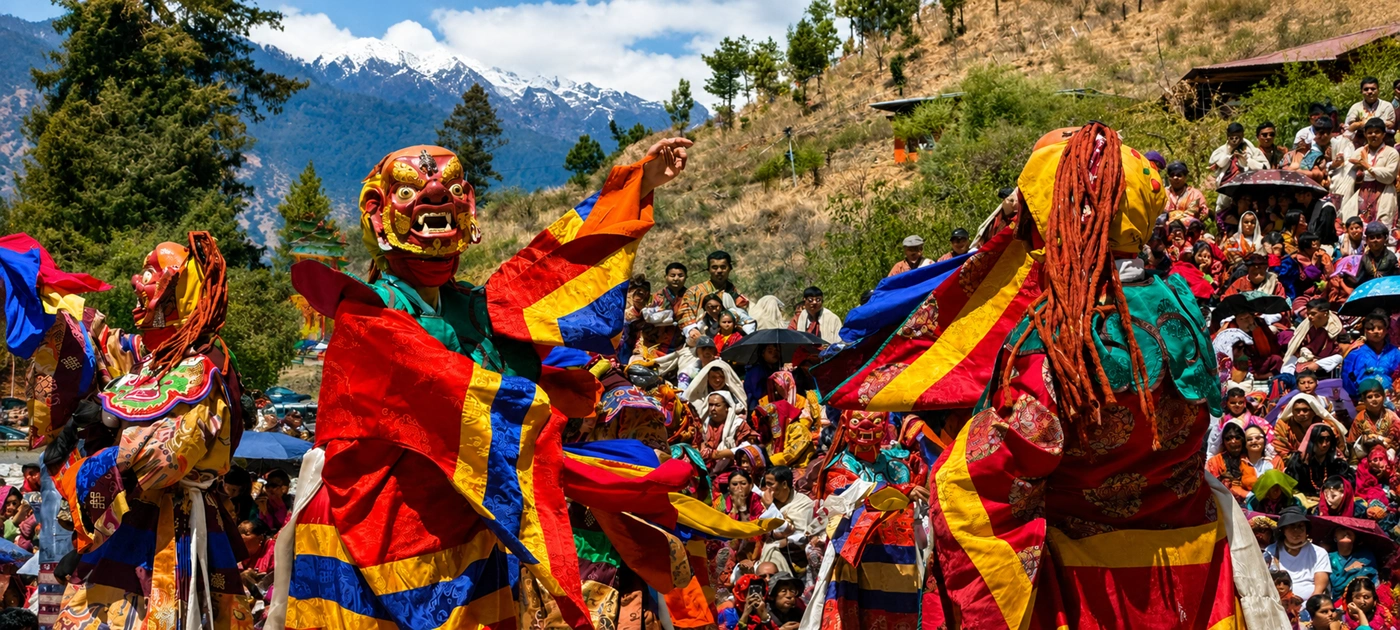
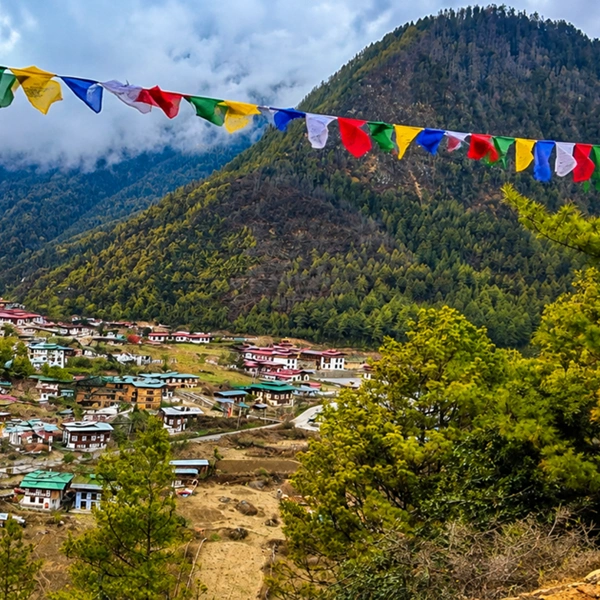
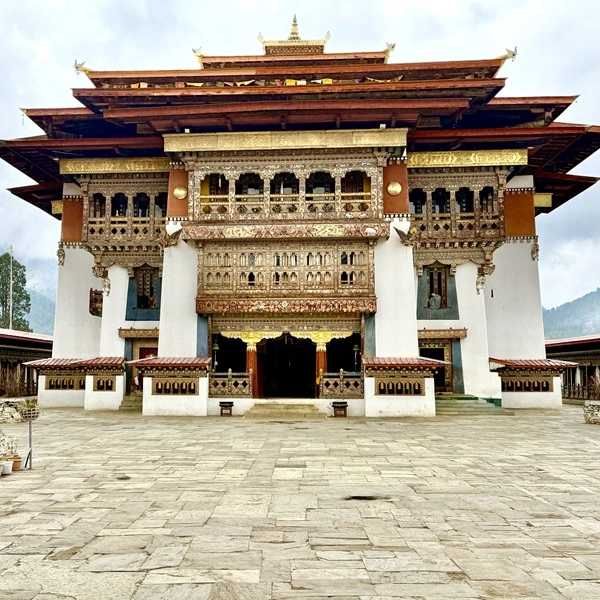
Thimphu Tshechu is the biggest gathering in Bhutan, and it doesn't feel like a show staged for visitors.
For three days, the courtyard of Tashichho Dzong fills with masked dancers, monks, and thousands of Bhutanese families in their finest gho and kira, and the capital reorganizes its whole week around it. You are welcome there. But you're a guest at someone else's celebration, and that's exactly what makes it worth flying in for.
This guide covers what the festival is, why its dates move, what happens inside the dzong, and how we build a private trip around it.
What Is Thimphu Tshechu?
Thimphu Tshechu is a three-day religious festival honoring Guru Rinpoche, the master who carried Buddhism across the Himalayas, held in the capital's fortress-monastery, Tashichho Dzong.
Every tshechu in Bhutan honors Guru Rinpoche, and every one centers on the tenth day of its lunar month; the word tshechu means "tenth day."
The capital's version is the country's largest. It was established by Gyalse Tenzin Rabgye, Bhutan's fourth temporal ruler, in the late seventeenth century, and it has run in the same dzong precinct ever since.
The dances are the heart of it. Monks and trained lay dancers from the Royal Academy of Performing Arts perform cham, sacred masked dances that act out the defeat of demons, the judgment of the dead, and the protection of the faith.
For Bhutanese spectators, watching confers a blessing. Attendance is worship, not entertainment.
When Does Thimphu Tshechu Happen?
Thimphu Tshechu begins on the tenth day of the eighth month of the Bhutanese lunar calendar, which usually lands in September or early October on the Western calendar. The dates shift every year because the lunar calendar does, so we confirm exact dates at booking and build the itinerary around them.
That timing is a gift for trip planning. It sits at the front edge of Bhutan's clearest autumn weather, when the monsoon has washed the valleys green and the high peaks start to show. Mornings are crisp at Thimphu's altitude of roughly 2,350 meters, afternoons warm enough for shirtsleeves in the courtyard.
It also means the festival pairs naturally with everything else autumn offers. Dochula Pass views, the drive down to Punakha, and even a short trek can all fit into the same dates.
Inside Tashichho Dzong: The Three Days
Each festival day runs from mid-morning to late afternoon in the dzong's open courtyard, with a rotating program of cham dances and folk interludes. Tashichho Dzong stands on the west bank of the Wang Chhu, north of the city center, and during festival week its approach road becomes a slow river of national dress.
The days preceding the public festival are dedicated to Thimphu Drubchen, a quieter set of ceremonies performed by monks in honor of Palden Lhamo, the protective deity. Most visitors never see it mentioned.
If your dates allow an extra morning, the contrast between the Drubchen's near-empty courtyard and the tshechu crowds two days later teaches you more about Bhutan than any museum.
Then the festival proper opens, and the courtyard transforms. Cymbals and long horns set the pace, dancers spin in silk and bone ornaments, and the atsaras work the crowd between sets.
Families arrive with packed lunches of red rice, ema datshi, and thermoses of suja, settle onto the flagstones, and stay the whole day.
We time our entrances deliberately. The courtyard fills from the shaded gallery edges inward, so we walk guests in mid-morning on the second day, when the opening-day crush has eased, but the full dance cycle is still ahead, and our guide has cushions and a briefing card for the day's program already in hand.
The Dances and the Atsaras
You'll follow the festival far better if you can read three or four of the dances before you arrive, so we brief our guests the evening before over dinner.
The Shanag, the black hat dance, shows tantric masters subduing hostile forces with slow, weighted turns. The Durdag dancers wear white skull masks as lords of the cremation grounds.
The one that stops the courtyard is the Raksha Mangcham, the dance of judgment. A deer-headed figure weighs the deeds of the dead while a stage-wide cast of animal-masked jurors looks on, and even first-time visitors feel the temperature of the crowd change.
It's a morality play the whole country knows by heart.
Between dances come the atsaras, red-masked clowns who tease spectators, mimic the dancers, and collect donations.
They look like comic relief. They're actually understood as enlightened figures whose mockery clears pride and bad luck, and Bhutanese spectators treat their attention as auspicious rather than embarrassing.
What Festival Week Does to Thimphu
The whole capital tilts toward the dzong for the week, and that changes how you should plan your days in the city.
Government offices are empty for the holidays, Norzin Lam fills with festival stalls, and the Centenary Farmers' Market runs in full color as families shop for festival meals. Restaurants that are sleepy on normal weeks need bookings.
This is also the best people-watching of the Bhutanese year. Festival week is when wardrobes come out: hand-woven kira passed down through families, ceremonial scarves, silver belt hooks.
The textile-minded should keep a morning free for the weaving shops while everything is on display in the surrounding streets.
The city's quieter landmarks make ideal counterweights to the festival crush. The Buddha Dordenma, the great seated Buddha above the valley, and the Memorial Chorten with its circumambulating elders both sit within twenty minutes of the dzong and barely feel the crowds.
We slot them into festival afternoons, after the dances wind down.
How We Plan a Thimphu Tshechu Visit
We build festival trips around one rule: two festival days inside the dzong, never just one. A single day forces you to fight the biggest crowd for a program you can't yet read. Two days let you learn the rhythm on the first and settle into the best of the dances on the second.
Around those anchor days, the shape is straightforward. Fly into Paro on Drukair or Bhutan Airlines, and we drive the roughly 50-kilometer valley road to Thimphu, about an hour and a quarter with a tea stop.
After the festival days, we typically cross Dochula Pass to Punakha for a night or two of warmth and dzong architecture without the crowds, then loop back to Paro for the flights out and, for those with the legs, the Tiger's Nest walk.
Two cautions from experience. Festival-week rooms in Thimphu sell out far ahead, so this is a trip we confirm early, with the property itself named in your booking proposal.
And because the lunar dates move each year, we anchor flights only after the festival dates are fixed; Bhutan's entry requirements and Sustainable Development Fee are covered in our Bhutan SDF and visa guide, and we handle the whole process.
Dress and Etiquette at the Dzong
Dress for a cathedral, not a concert. Long trousers or a long skirt, sleeves past the elbow, collared rather than casual, and no hats inside the dzong precinct. Bhutanese attendees are in their finest national dress; matching their care is the courtesy that opens conversations.
Photography is welcome in the courtyard, with limits. No flash during dances, no stepping into the performance space for an angle, and always ask before photographing individuals up close, especially monks.
Your guide will show you the gallery positions where a long lens works well.
Walk clockwise around chortens and prayer wheels, keep your voice low in the temple wings, and never point your feet at the dance ground while seated. Small things. Locals notice all of them warmly when you get them right.
Planning a Festival Journey
Thimphu Tshechu rewards travelers who come to Bhutan and let the festival be the centerpiece, not a checkbox.
The dances explain the country's faith better than any guide can, and autumn frames it all in the year's best weather. If the timing calls to you, our private Thimphu Tshechu Festival Tour builds the full journey around the festival's confirmed dates, with everything held for you before the capital sells out.
Frequently Asked Questions
Why is the Thimphu Tshechu held on the tenth day of the lunar month?
Because every tshechu commemorates Guru Rinpoche, whose key deeds are traditionally tied to the tenth day of the Bhutanese lunar calendar, tshechu literally means "tenth day." Thimphu Tshechu opens on the tenth day of the eighth lunar month, which is why its Western-calendar dates shift each year, usually landing in September or early October. Exact dates are confirmed at booking.
How many days does Thimphu Tshechu last?
The public festival runs for three full days in the courtyard of Tashichho Dzong, each from mid-morning to late afternoon. It's preceded by Thimphu Drubchen, several days of quieter monastic ceremonies inside the dzong. We recommend attending two of the three festival days, which is enough to see the major cham dances without festival fatigue.
Can tourists attend the Thimphu Tshechu inside Tashichho Dzong?
Yes. Thimphu Tshechu is open to visitors, and no separate festival ticket is required beyond having a valid visa and travel arrangements in place for Bhutan. The courtyard is shared with thousands of Bhutanese spectators, so timing and positioning matter far more than access; a private guide who knows the dzong's galleries makes the difference between watching and squinting.
What should visitors wear to the Thimphu Tshechu?
Modest, respectful dress: long trousers or a long skirt, sleeves past the elbow, a collared top, and no hats within the dzong. Bhutanese attendees wear formal gho and kira, so err on the side of smart. Mornings at Thimphu's 2,350-meter altitude are cool, and afternoons in the open courtyard can be warm, so a layer you can shed works best.
What are the atsaras at Thimphu Tshechu?
Atsaras are the red-masked clowns who joke, mimic dancers, and tease spectators between cham performances. They read as comedians, but Bhutanese tradition regards them as enlightened figures whose irreverence dispels pride and misfortune, and their attention is considered auspicious. Play along, laugh, and offer a small donation if one singles you out; it's part of the festival's blessing.
Is Thimphu Tshechu or Paro Tshechu better for a first visit?
Thimphu Tshechu is larger and takes place in the autumn; Paro Tshechu is a spring festival famous for its giant dawn thongdrel unfurling. For a first Bhutan journey we usually favour Thimphu: the scale is unmatched, autumn weather is more reliable, and the capital's restaurants and day sights fill the non-festival hours easily. Spring travelers should choose Paro without hesitation.
How early should we arrive at Tashichho Dzong during Thimphu Tshechu?
For a good gallery position, plan to be inside the courtyard by mid-morning, before the day's first major cham dance begins. Opening day draws the heaviest crowd, which is one reason we anchor our guests' main viewing on the second day. Your guide will time the approach so you're seated with cushions and the day's program before the horns start.
Does Thimphu Tshechu clash with Bhutan's trekking season?
No, it opens it. The festival's usual September-to-early-October window sits at the start of Bhutan's prime autumn trekking and touring season, when monsoon haze clears and passes dry out. That's why we often pair the festival with Dochula Pass, Punakha, and the Tiger's Nest walk in Paro, or extend into a short trek for guests who want mountains with their festival.