An Annapurna Circuit luxury trek buys you better access, better pacing, and a better crew — not better rooms above 4,000 meters. This guide covers the three things buyers actually ask about: what Thorong La demands on pass day, where the jeep road touches the trail, and what the lodges are really like.
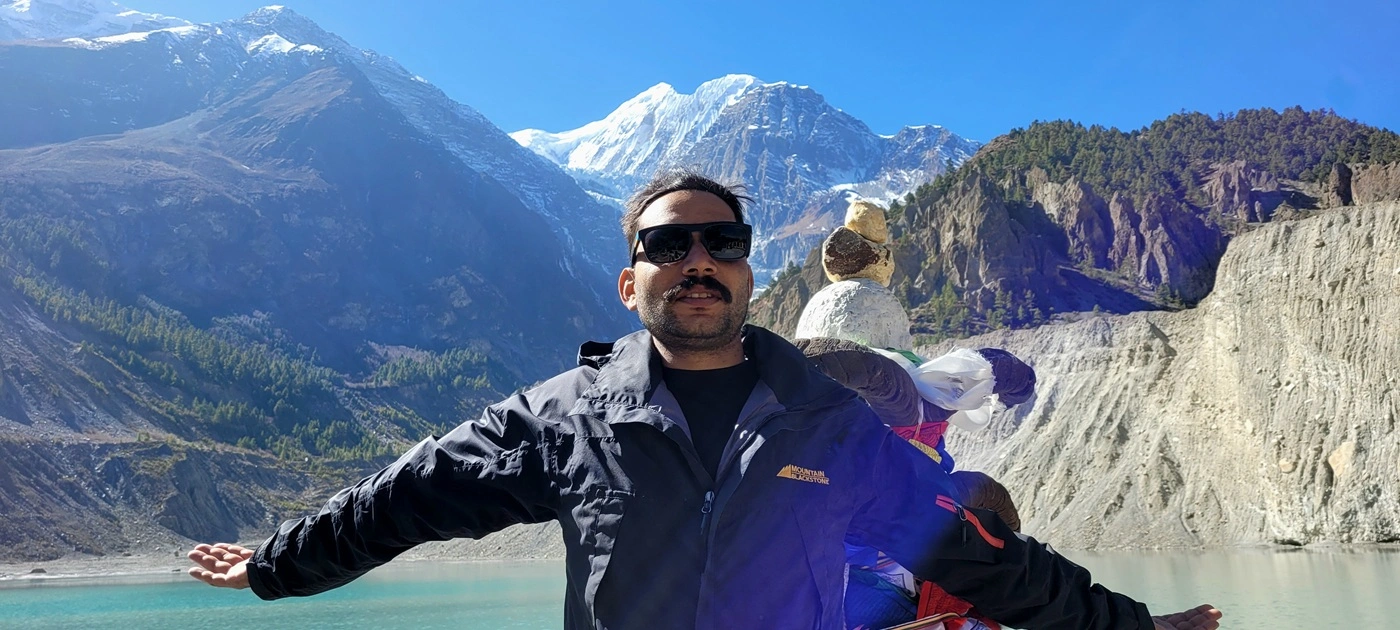
The Annapurna Circuit Luxury Trek: Thorong La, the Road Question, and Lodge Reality

An Annapurna Circuit luxury trek is not the same product as a luxury Everest trek, and pretending otherwise is how people end up disappointed on the trail. There is no lodge above 4,000 meters on this route that any serious operator would call luxury.
What money genuinely changes here is the access, the pacing, the crew and the margin for error.
Three questions come up in almost every inquiry we take about this route. Is Thorong La going to be too much? Have the roads ruined it?
The third is the one people ask last and worry about most: what are the rooms actually like?
Answering those three plainly is more useful than a highlights list. Here they are, in the order they matter, from a company that walks the route as part of how we build private travel across the Himalaya.
What makes an Annapurna Circuit luxury trek different
Four things change, and rooms are not the main one.
Access. The standard trip starts with six to eight hours in a vehicle to Besisahar, on roads that are the most dangerous part of most Nepal treks. We fly instead, privately, in both directions.
Pacing. A private trip has no group consensus to satisfy. Your acclimatization profile is built around your party alone, and the day stops when the slowest walker needs it to.
Crew. A licensed private guide, evening oximetry above 3,500 meters, permits and checkpoints handled before you arrive, and a support ratio that means nobody carries their own load or waits for a lodge to find a room.
Margin. A rest day held in reserve, a buffer night in Kathmandu before your flight home, and a helicopter option that is planned rather than improvised.
The rooms improve where rooms can improve, which is the lower half of the route and the Mustang side. In the high middle, comfort comes from a warm sleeping system, hot water arriving when you want it, and food our own kitchen has had a hand in.
Thorong La: the one day everything is built around
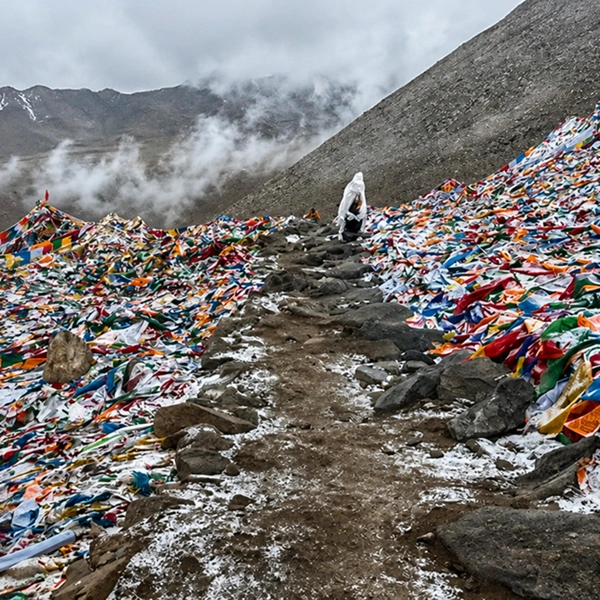
Thorong La sits at 5,416 meters and is the highest point on the circuit, and every decision earlier in the trek exists to get you across it in reasonable shape.
What pass day actually asks of you
The climb from Thorong Phedi at about 4,540 meters gains roughly 875 meters on a graded switchback. There is no technical ground, no rope, no exposure that would worry a hillwalker.
The difficulty is the hour, the cold and the air. Parties leave in the dark to beat the wind that builds across the saddle through the morning, and at that altitude each breath delivers around half the oxygen it would at sea level.
Then comes the part people misjudge. From the pass you lose about 1,600 meters in a single descent to Muktinath, and that hill hurts far more people than the climb does. Quadriceps that coped all week give out on it, and poles stop being optional.
How we set you up for it
Acclimatization is built long before the pass. We keep the low days slow, sleep at Manang for a proper acclimatization stop, and use the steep half-day to Ice Lake at about 4,600 meters as an honest test of how your body is behaving before anyone commits to the crossing.
Your guide takes an oxygen saturation reading every evening once you are sleeping above 3,500 meters, and the numbers make the decision, not the itinerary. The pacing logic behind that sits in our altitude and health guide.
Kit matters on this one day more than any other. Insulated boots, a down jacket rated colder than you think you need, and working gloves are the difference between a good morning and a miserable one, and the full list is in our Himalaya packing guide.
The road question: has the jeep track ruined the circuit?
No — but the answer depends entirely on how your trip is built, and plenty of trips are built badly.
Where the road actually touches the trail
Motorable track now runs up the Marsyangdi as far as Manang on the eastern side, and up the Kali Gandaki through Jomsom to Muktinath on the western side. Roughly half the original walking line has been overlaid.
The high middle of the circuit is untouched. Nothing drives over Thorong La, and nothing drives the approach from Manang to the pass.
The alternative footpaths, and how to read them
A network of marked alternative paths runs alongside most of the road sections, built out of old trade routes, irrigation channels and forest tracks by local trail workers with conservation-area support.
The marking system is simple once you know it. Red-and-white paint on rock and tree marks the main alternative route away from the road; blue-and-white marks side variants that go deeper into villages.
Walking those puts you on footpaths for the great majority of the circuit. You will still see the valley being modernized, and we would rather tell you that now than have you discover it at a switchback.
The acclimatization trap nobody sells you
Here is the part that matters more than dust. Because the road exists, most operators now jeep guests straight up to Chame or Manang and sell it as a time-saving.
It is the single riskiest thing you can do on this route. Those lower days are what acclimatize you, and driving from Kathmandu to 3,540 meters in two days removes the adaptation that Thorong La depends on.
We do not shortcut altitude. We fly the road section that is dangerous and dull, then walk the section that does the physiological work — which is the opposite of how the jeep upgrade is usually pitched.
Lodge reality, band by band
Accommodation on the Annapurna Circuit is best understood by altitude, not by star rating, because the ceiling drops as you climb.
Below about 2,500 meters
This is the comfortable half. Buildings are concrete, rooms have attached bathrooms, hot water is reliable, hydro power is steady, and the internet mostly works.
Food is varied and good. This is where the route earns its reputation for eating well, and where a rest day is genuinely restful.
About 2,500 to 3,500 metres
Standards hold up well through this band, and Manang is the high-water mark. It runs like a small alpine town — bakeries, gear shops, coffee, a cinema of sorts, and menus that stretch well beyond trekking food.
Manang is also where the good hot water stops being dependable. Above it, heating is a stove in a dining room and nothing in the bedrooms.
Above 3,500 meters, and what money cannot buy
This is the part worth being straight about. Yak Kharka, Thorong Phedi and High Camp offer a bed, thin walls, shared bathrooms and a cold night, and no operator on earth changes that, because there is nothing else built up there.
What we can change is everything around the room. Proper four-season sleeping systems rather than lodge blankets, hot water bottles at bedtime, our own kitchen involvement in what you eat, and rooms held in advance so you are never negotiating for space at 4,500 meters.
The reward nobody mentions: it gets better after the hard day
The Annapurna Circuit is unusual among Nepal's long routes in that comfort improves after its hardest day.
Cross Thorong La and you drop into Mustang — dry, bright, Tibetan in feel, and materially better served than anywhere above 3,500 meters on the eastern approach. Muktinath, Kagbeni, Jomsom and Marpha have proper hotels, apple orchards, real bathrooms and wind you can set a watch by.
Most routes finish with their roughest nights. This one finishes with its best. The regional picture is set out in our guide to lodges in the Annapurna region.
Where the helicopter belongs on this route
Helicopters solve three specific problems here, and none of them is skipping the walk.
The first is the road. Flying in and out privately removes the long mountain drive at both ends, which is a safety decision before it is a comfort one.
The second is the exit. From the Mustang side, a flight out means you finish in Pokhara or Kathmandu the same day rather than losing time to another rough road.
The third is contingency. If someone in your party is not right at altitude, a planned evacuation route beats an improvised one.
Flights run in daylight and need visibility, which is why cloud grounds them by early afternoon on many days. Any operator who promises a helicopter on demand at altitude is promising weather they do not control.
How long a luxury Annapurna Circuit takes
Plan on the better part of three weeks door to door, and treat anything under two weeks with suspicion.
The walking circuit itself runs 12 to 21 days depending on where you start and finish. Our version adds a full rest and briefing day in Kathmandu after your international flight, before anyone walks anywhere, and a buffer night in Kathmandu before you fly home.
Those two days are not padding. Arriving jet-lagged into a trek start and booking a same-day connection after a 5,416-meter pass are the two most common ways a good trip turns bad.
Many guests add a few nights in Pokhara at the end, which is the natural decompression stop and where our Pokhara guide is useful.
What fitness the circuit actually asks for
Hill legs, not gym cardio — and the ability to repeat a long day for two weeks running.
Most days on the circuit run five to seven hours of walking. None of them is technically hard. The demand is cumulative, and it is the fourteenth consecutive day that finds the gap in your training, not the first.
Two things predict how people cope. The first is time on your feet on real hills with a daypack, ideally back-to-back weekends rather than one long effort. The second is downhill conditioning, because the 1,600-meter drop off Thorong La punishes quadriceps that have only ever climbed.
Altitude is the part fitness does not solve. Strong athletes get sick as readily as anyone else when they ascend too fast, which is why the acclimatization profile matters more than your resting heart rate.
Age is rarely the limiting factor. We take guests well into their sixties across this pass, and the ones who struggle are usually the ones who trained hard for six weeks instead of walking regularly for six months.
When to walk it
Nepal's two trekking windows are mid-March to mid-June for spring and mid-October to mid-December for autumn, and the Annapurna Circuit works in both.
Spring gives you rhododendron forest through the lower Marsyangdi, longer daylight and warmer nights, at the cost of more haze in the middle distance. Autumn gives you the cleanest air of the year over Thorong La and the most reliable pass-day weather, and it is the busier of the two.
The pass is the deciding factor either way. Early spring and late autumn both raise the odds of snow on the crossing, and the crossing is not something we push a party into.
What we handle, and what we will not promise
We handle permits, checkpoints, private flights, guide licensing, room bookings, sleeping systems and the daily health checks.
We will not promise you a five-star room at Thorong Phedi, because it does not exist. We will not promise a helicopter will fly on a specific afternoon, because weather decides that. And we will not compress your acclimatization to shorten the trip, however much easier that would make the sale.
If that reads like the trek you want, our Annapurna Circuit luxury trek is the place to start, and we will build the pacing around your party rather than the other way round.
Annapurna Circuit luxury trek FAQs
What makes an Annapurna Circuit luxury trek different from a standard teahouse trek?
Access, pacing, crew and margin — not the rooms at altitude. A luxury trip replaces the long mountain drive with private flights, builds acclimatization around your party alone, provides a private licensed guide with daily oxygen checks, and holds a spare day in reserve. Lodges improve at lower elevations and on the Mustang side, but no operator can upgrade what exists above 4,000 meters.
How difficult is Thorong La Pass on the Annapurna Circuit?
Non-technical but long and cold. Pass day climbs roughly 875 meters from Thorong Phedi at about 4,540 meters to the top at 5,416 meters, then descends about 1,600 meters to Muktinath. The descent injures more trekkers than the climb, so poles and conditioned quadriceps matter. Parties start in the dark to cross before the wind builds.
Will I be walking on the jeep road during the Annapurna Circuit?
Very little, if the trip is planned properly. Marked alternative footpaths run beside most road sections — red-and-white paint for the main variant, blue-and-white for village side routes — and the high middle of the circuit has no road at all. Trips that jeep straight to Chame or Manang trade away acclimatization, which is a worse problem than dust.
Are there luxury lodges on the Annapurna Circuit?
At lower elevations and on the Mustang side, yes. Below about 2,500 meters and again beyond Thorong La around Muktinath, Jomsom and Marpha, you will find proper hotels with attached bathrooms and reliable hot water. Between about 3,500 meters and the pass there is nothing of that standard, and comfort comes from sleeping systems, food and service instead.
How many days does a luxury Annapurna Circuit trek take?
Budget the better part of three weeks door to door. The walking circuit runs 12 to 21 days depending on start and finish points, and our version adds a rest and briefing day in Kathmandu after arrival plus a buffer night before your flight home. Anything sold under two weeks has usually compressed the acclimatization days.
Can you take a helicopter on the Annapurna Circuit luxury trek?
Yes, and it is standard in our version for the road sections at each end. Private flights replace the six-to-eight-hour drive to Besisahar and the road exit from the Mustang side. Flights need daylight and visibility, so afternoon cloud regularly grounds them — a helicopter is planned into the trip, never promised on demand.
What is the best time for an Annapurna Circuit luxury trek?
Mid-March to mid-June for spring, or mid-October to mid-December for autumn. Spring brings rhododendron through the lower Marsyangdi and warmer nights with more haze. Autumn brings the clearest air over Thorong La and the steadiest pass weather, and draws more walkers. Snow risk on the crossing rises at the early and late edges of both windows.
Do you need previous trekking experience for the Annapurna Circuit?
Not strictly, but you need genuine hill fitness and honest preparation. The circuit asks for five to seven hours of walking on most days, a night above 4,500 meters, and a 5,416-meter pass with a long descent behind it. Multi-day hill walking with a pack beforehand matters far more than gym cardio, and prior altitude exposure helps.
Need Help? Call Us+977 9851013196orChat with us on WhatsApp
Need Help? Call Us+977 9851013196