Archery in Bhutan is not a pastime. It is the national sport, a social institution, and on most Saturdays, the loudest thing happening in any given valley.
Bhutan declared archery its national sport in 1971, the year the kingdom joined the United Nations, and it remains the one discipline the country has entered at every Summer Olympics it has attended.
The version played at home has almost nothing in common with the Olympic lanes. Targets stand 145 meters apart. Teammates dance when an arrow lands. Opponents stand beside the target and mock your aim while you draw.
We have watched matches run from mid-morning to a floodlit final end in Thimphu. This guide covers how the game works, where to see it, and how to hold a bamboo bow yourself on a private cultural tour.
What Makes Archery in Bhutan Different
Archery in Bhutan — called datse in Dzongkha — is shot at wooden targets set 145 meters apart, more than double the 70-meter Olympic distance.
The targets themselves are small: painted wooden boards roughly a meter tall and about the width of a stretched hand, angled slightly back into the earth.
At that range, the arrow spends long enough in the air for the wind off the ridgelines to bend its path. Hitting the board at all is an achievement. Hitting the painted center earns a roar you can hear across the valley.
The second difference is social. Olympic archery demands silence; Bhutanese archery demands the opposite.
A match is a full-day event with food, drink, singing, and organized heckling, and the crowd is part of the contest rather than an audience.
The Rules of a Bhutanese Archery Match
A datse match is played between two teams, usually of eleven to thirteen archers, shooting alternately between two targets set at either end of the range.
Each archer shoots two arrows per end, then the whole match walks 145 meters to the other target and shoots back the way it came.
Scoring, in the most common format, is simple. An arrow in the target scores two points. An arrow landing within one arrow's length of the board scores one, and the first team to 25 wins the set.
Every hit earns the archer a small coloured scarf, tucked into his belt sash. By late afternoon, the best shooters walk the line trailing a rainbow of them, which is the only scoreboard most village matches keep.
Songs, Dances, and Deliberate Distraction
Teams dance and sing during archery in Bhutan because celebration and distraction are both written into the game.
When an arrow strikes the target, the shooter's teammates gather at the board and perform a slow, circling victory dance, singing verses in praise of the shot.
Distraction is just as formal. Opposing players stand startlingly close to the target — a meter or two off the line of flight — shouting jokes about the archer's form, his eyesight, or his prospects at the next end.
Wives and supporters join from the sidelines with teasing songs of their own.
None of it is bad temper. The taunting is scripted, affectionate, and answered in kind, and holding your draw steady through it is considered the real measure of an archer.
Matches pause for butter tea, rice, and rounds of ara, the local grain spirit, which does not noticeably improve anyone's aim after lunch.
Bamboo Bows and Compound Bows: Two Games in One
Bhutanese archery is now played with two kinds of equipment, and the choice changes the character of the match.
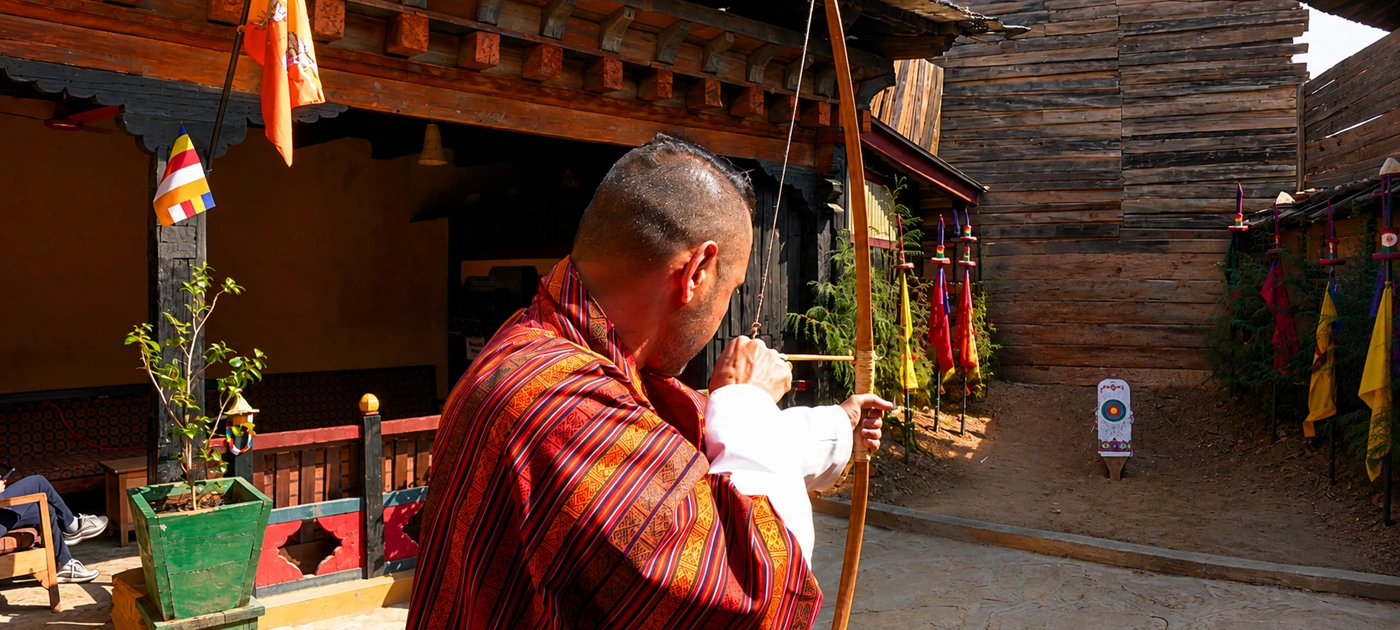
The traditional bow is a two-piece bamboo layup with a bamboo arrow fletched in feather, made by hand and tuned by feel.
From the 1980s onward, imported compound bows with sights, cams, and carbon arrows arrived, and most serious tournament play in Thimphu now uses them.
The distance stayed at 145 meters. The hit rate did not — compound rounds ring the board constantly, while a bamboo match can go several ends between hits.
Village and festival matches still lean bamboo, and many archers keep one of each.
If you want to see the sport as it looked for centuries, ask your guide to find a bamboo match.
The rhythm is slower, and the celebrations are louder, because every hit is earned against the wind.
Where to Watch Archery in Bhutan
The most reliable place to watch archery in Bhutan is the Changlimithang archery ground in Thimphu, beside the national stadium, where matches are held most weekends and entry is free.
Archers compete in the gho, the knee-length national dress, which is required wear for formal matches.
Paro has an active ground near the willow-lined riverbank below Ugyen Pelri Palace, and almost every village of any size keeps a range — a strip of flat ground with a board at each end.
In Haa, Punakha, and the Bumthang valleys, we regularly come across matches nobody advertised.
On our Thimphu days, we route the afternoon drive past Changlimithang, and when a match is on, we stop.
There is no ticket and no barrier; you stand where the families stand, close enough to hear the fletching.
Our guides will read the match for you — the score, the scarves, and what the songs are actually saying.
Stand behind the shooting line, always. At 145 meters, long arrows overshoot the target zone, and the locals' relaxed posture reflects practice reading trajectories, not an absence of arrows.
When Matches Happen
Archery in Bhutan runs year-round, but the biggest concentrations come in winter and around festivals.
After the harvest is in, villages have time, and the weeks around Losar, the lunar new year, fill with inter-village tournaments that carry old rivalries and serious side-betting in oranges and ara.
Tshechu season is the other sure bet. Wherever a dzong hosts its annual festival, an archery tournament usually runs alongside it, and the two crowds trade audiences through the day.
Exact festival timing follows the lunar calendar and shifts each year, so we confirm dates against the official calendar when we build your itinerary.
For a weekend Changlimithang match, no planning is needed. Clear winter mornings in Thimphu, from late autumn through early spring, are the most dependable window, with the Himalayan air still and the light sharp on the boards.
Trying a Bow Yourself
Visitors can try archery in Bhutan, and on our private cultural tours, we arrange it as a standing option rather than a staged show.
A local archer sets up bamboo bows at a shortened range — usually 20 to 30 meters, which is humbling enough — and coaches you through stance, draw, and release.
The bamboo bow has no sight and no release aid.
You aim by feel, losing high and letting the arrow fall onto the line, which is exactly why a single hit earns you the full teammate treatment: the dance, the song, and a scarf for your belt.
It pairs naturally with a Thimphu or Paro cultural day, between dzong visits and time with the painters and carvers of the traditional arts.
Allow an unhurried hour. Most guests planned fifteen minutes and stayed for the area.
Khuru and Degor: The Sister Games
Datse is not Bhutan's only traditional target sport. Khuru is outdoor darts, thrown overarm across roughly 20 meters at a palm-sized wooden peg, with the same team structure, the same victory dances, and arguably rowdier heckling.
Degor is older and plainer: a pair of flat, rounded stones pitched at target sticks, a shepherd's game still played on high pastures and monastery grounds.
You will see khuru at most festival grounds and degor wherever herders gather.
If a khuru match is running near your route, tell your guide you want twenty minutes there.
The darts are heavy, the throws are wild, and it is the fastest way we know to end up laughing with strangers in a Bhutanese field.
Watching the National Sport With Us
A match at Changlimithang costs nothing and explains more about Bhutan in an hour than most museum rooms.
The teamwork, the teasing, the gho, the patience with wind and luck — the country's character is all on the range.
Our private Bhutan journeys build in time for exactly this kind of unscheduled culture, with a guide who knows which valley is playing and can put a bamboo bow in your hands.
If that sounds like your kind of travel, start with our Best of Bhutan tour, and we will shape the days around what is actually happening when you arrive.
FAQs: Archery in Bhutan
Why is archery the national sport of Bhutan?
Archery was declared Bhutan's national sport in 1971, the year the kingdom joined the United Nations, formalizing a practice that had run through village life, folklore, and military history for centuries. Bows appear throughout Bhutanese legend, and every region maintained its own ranges and rivalries long before the declaration. It is also the sport that Bhutan has entered at every Summer Olympics it has attended.
How far away are the targets in Bhutanese archery?
Targets in traditional Bhutanese archery stand 145 meters apart, more than twice the 70-meter Olympic distance. The wooden boards are roughly a meter tall, so at that range, even strong archers treat a single hit as an event. Both bamboo-bow and compound-bow matches in Bhutan keep the same 145-meter distance.
Can tourists watch archery matches at Changlimithang in Thimphu?
Yes. The Changlimithang archery ground beside Thimphu's national stadium hosts matches most weekends, entry is free, and spectators stand close to the action with local families. No booking is involved; your guide simply checks whether play is on. Stay behind the shooting line, since long arrows can overshoot the target area at 145 meters.
Can visitors try traditional archery in Bhutan?
Yes. On a private tour, a session with bamboo bows is arranged at a shortened range of about 20 to 30 meters, coached by a local archer. The traditional bow has no sight, so you aim by feel — and a hit earns you the same victory song and coloured scarf the locals get. It fits easily into a Thimphu or Paro cultural day.
Why do Bhutanese archers sing and dance during matches?
Singing and dancing are part of the rules of engagement in datse, not a sideline. Teammates perform a circling victory dance at the target after every hit, while opponents stand near the board shouting scripted taunts to break the shooter's concentration. Composure under this organized distraction is considered the true test of a Bhutanese archer.
What is the difference between datse and khuru?
Datse is Bhutanese archery, shot with bows at wooden targets 145 meters apart. Khuru is a traditional outdoor darts game: heavy, hand-made darts thrown overarm at a small wooden peg about 20 meters away. Both are team games with the same victory dances and heckling culture, and festival grounds often host the two side by side.
What do archers wear during matches in Bhutan?
Formal matches require the gho, Bhutan's knee-length national dress for men, usually worn with knee socks and, in tournaments, the team's colors. The dress code is part of the sport's status as a national institution. Archers who score hits tuck a small coloured scarf into the belt sash for each one, so the day's best shooters are visible at a glance.
When is the best time to see village archery in Bhutan?
Winter is the richest season, once the harvest is in and villages have time for inter-valley tournaments, especially in the weeks around Losar, the lunar new year. Festival periods are another reliable window, since most tshechus host an archery tournament alongside the dances. Weekend matches in Thimphu and Paro happen year-round.