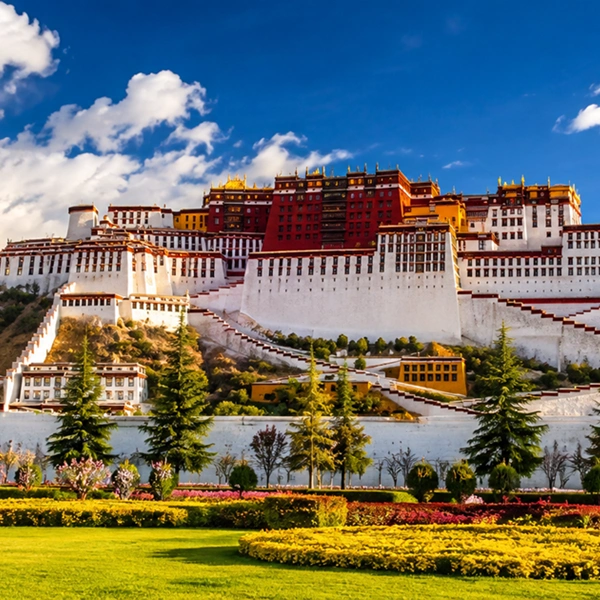
The Jokhang Temple is where Tibet actually beats. The Potala is the postcard, but every pilgrim who walks, rides, or prostrates their way to Lhasa is aiming here — at a golden-roofed seventh-century temple and the Jowo Rinpoche statue inside it.
Around the temple runs the Barkhor, part pilgrimage circuit, part market street, always moving clockwise. Stand in the square at dawn, juniper smoke drifting off the burners, and you understand Lhasa in ten minutes flat.
This guide covers what the Jokhang is, what the Barkhor does, and how our private Lhasa days put you inside both without the crowds swallowing the experience.
Why the Jokhang Temple Is Tibet's Holiest Site
The Jokhang Temple houses the Jowo Rinpoche, a statue of the Buddha said to have been made during his lifetime and blessed by him personally — the single most sacred object in Tibetan Buddhism.
That statue, not the building, is why pilgrims cross the plateau on foot to reach this spot.
King Songtsen Gampo founded the temple in the seventh century. Tradition credits his two wives with its treasures: Princess Wencheng of China, who brought the Jowo statue, and Princess Bhrikuti of Nepal, whose dowry shaped the temple's earliest shrines.
UNESCO added the Jokhang to the World Heritage list as part of the Potala ensemble.
The building itself mixes four worlds. Tibetan walls, Nepalese carved timber, Chinese Tang roof lines, and an Indian vihara floor plan — a marriage of the routes that met in Lhasa.
On the roof, two gilded deer flank a golden dharma wheel, facing the square where it all converges.
The Legend Beneath the Floor
Legend holds that the Jokhang stands on a filled-in lake, pinned over the heart of a giant demoness stretched across Tibet.
Songtsen Gampo's geomancers, the story goes, read the land as her sleeping body and built temples at key points to hold her still — the Jokhang at the heart, driven home by a thousand goats carrying earth to fill Lake Wothang.
You can still hear the older Lhasa in the name locals use: Rasa, "place of goats," the city's early name, honors those animals.
Historians read the demoness map as a memory of how Buddhism spread through a resistant landscape, one temple district at a time. Both readings sit side by side comfortably here.
Your guide will show you the spot inside where pilgrims press an ear to the flagstones, listening — so the tradition says — for the lake still moving underneath.
Inside: Jowo Rinpoche and the Chapel Circuit
Inside the Jokhang Temple, you join the Nangkor, the innermost of Lhasa's pilgrimage circuits, moving clockwise past a ring of chapels toward the Jowo.
The main hall runs on butter-lamp light and low chanting. Gold catches what little sun reaches in.
The Jowo Rinpoche sits crowned and jeweled at the heart of it, and the queue of pilgrims waiting to touch their foreheads to his knee can wrap the hall.
Watch what people carry: thermoses of melted yak butter, topping up lamps chapel by chapel, an offering economy running exactly as it has for centuries.
We time our visits so you see this at a human pace. Our guides walk the chapel ring with you, naming the protector deities and the kings, then take you up to the roof — the best close view in Lhasa, straight down onto the square with the Potala rising in the distance.
The Barkhor Kora: Walking the Middle Circuit
The Barkhor is the middle of Lhasa's three sacred circuits — the Nangkor inside the Jokhang, the Barkhor around it, and the Lingkor looping the old city — and every one of them runs clockwise. Walk it the wrong way, and you'll be politely swimming against all of Tibet.
The circuit takes about twenty minutes at pilgrim pace, longer once the market pulls you in. Prayer wheels spin in hands, coral and turquoise flash on braided hair, and elderly walkers count beads through a full round.
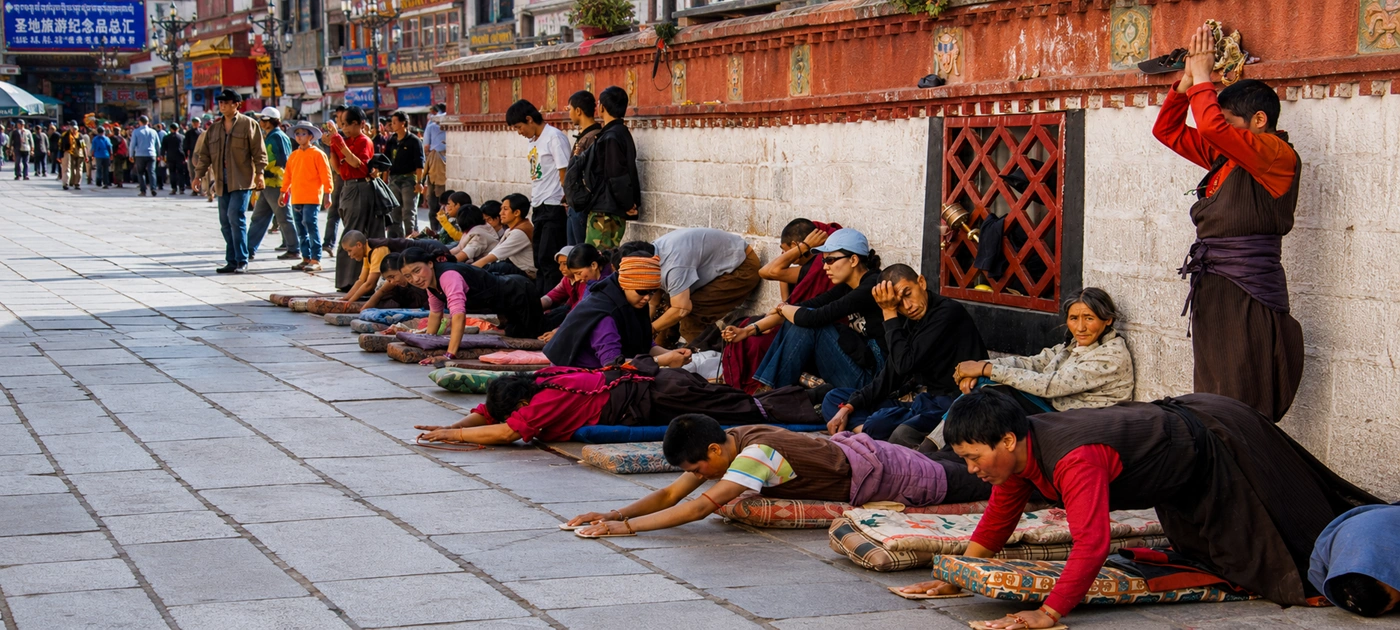
In front of the temple's main gate, pilgrims perform full-body prostrations on boards worn glassy by decades of exactly this — some completing sets of thousands.
Our standing rule on every Lhasa departure: we walk the Barkhor with the flow, clockwise, always. Your guide will place you at the temple gate at first light, when the sangkang burners are freshly fed, and the circuit belongs to Lhasa's own devout.
Visiting the Jokhang Temple: Permits, Entry, Timing
Visiting the Jokhang Temple works the same way as everywhere in Tibet: a Chinese visa, a Tibet Travel Permit, and a licensed guide with you — there's no independent travel in the region.
We arrange all of it before you fly, and our Tibet permits and entry guide will walk you through the required documents.
Entry runs through security screening at the edge of the Barkhor and ticketed access to the temple itself. Interior time in the main hall can be managed when pilgrim queues peak — your guide reads the flow and sequences the chapels, the hall, and the roof so nothing feels cut short.
The Barkhor itself needs no ticket. That's the quiet gift of the old town: the richest free experience in Tibet circles its most sacred building, open from before dawn.
When to Go: Dawn Smoke and Festival Seasons
Early morning is the Jokhang at its truest — the hour after dawn, when juniper smoke pours from the burners, prostrations line the gate, and the light comes low and gold across the square.
We build our Lhasa mornings around it as standing practice, saving the drive-based sights for later in the day.
Season-wise, April to October brings the mild, bright weather that suits the plateau, while winter empties the tour buses and fills the circuit with pilgrims traveling in the farming off-season.
Saga Dawa, the month honoring the Buddha's birth, enlightenment, and passing, multiplies everything: more smoke, more prostrators, more of the plateau in one square.
Exact festival timing follows the lunar calendar and shifts each year, so we confirm dates at booking.
For a wider look at the city beyond the square, our Lhasa cultural highlights guide covers the monasteries and palaces that complete a Lhasa stay.
Around the Square: The Old Town at Street Level
The streets off the Barkhor are Lhasa's living room. Stalls and small shops sell prayer flags, incense bricks, thangka paintings, and strings of dzi-patterned beads; teahouses pour sweet milk tea from thermos to tables of card players. Bargaining is expected at the stalls and unhurried — start friendly, stay friendly.
Look for the ochre-yellow house on the circuit's southeast corner, tied by legend to the Sixth Dalai Lama's love songs — a landmark verse-lovers still seek out.
A few lanes back, the old town's whitewashed courtyards show you domestic Lhasa: painted lintels, potted marigolds, prayer wheels set into walls at hand height.
This is where the Potala Palace and the Jokhang stop being separate tickets and become one city.
Palace above, temple at the heart, circuit binding it together — the pairing is the whole point of giving Lhasa the time it deserves, and it sits at the center of how we design luxury travel across the Himalaya.
Ready to stand in the smoke at first light? Our private Lhasa tour gives the Jokhang and Barkhor a full, unhurried morning — or see the 4-day Lhasa private tour for the complete city at an acclimatization pace.
Frequently Asked Questions
What makes the Jokhang Temple holier than the Potala Palace?
The Jowo Rinpoche statue. Tibetan Buddhists hold it was crafted during the Buddha's lifetime and blessed by him, making it the most sacred object on the plateau — so the temple housing it outranks any palace in spiritual terms. The Potala was the seat of government; the Jokhang is the destination pilgrims prostrate across provinces to reach.
Which direction do you walk the Barkhor circuit?
Clockwise, always, keeping the Jokhang on your right — the direction of every Tibetan Buddhist circumambulation. The full circuit takes about twenty minutes at a steady pace. Walking against the flow marks you instantly and disrupts pilgrims mid-practice, so fall in with the current and let it carry you; it's half the pleasure.
Can tourists go inside the Jokhang Temple's main hall?
Yes, with a guide, a ticket, and the same Tibet Travel Permit that covers your whole trip. Visits move clockwise through the chapel circuit toward the Jowo Rinpoche, and access to the central hall is paced around pilgrim queues at busy times. The rooftop is open too — the best elevated view of the Barkhor Square in the city.
Is photography allowed inside the Jokhang?
Not in the interior chapels, where photography is prohibited as it is in most active Tibetan shrines. The rooftop and the square are fair game, and they're the better pictures anyway: gilded deer and dharma wheel against the sky, prostrators at the gate, smoke rising off the burners. Your guide will confirm the current rules on the day.
What is the story of the demoness under the Jokhang?
Legend holds that the temple pins the heart of a demoness whose body sprawled across Tibet, with Songtsen Gampo's temples built at points along her limbs to still her. Historians read the tale as a map of Buddhism's spread through the region. Pilgrims still listen at a flagstone inside for the lake said to lie beneath — myth and history sharing one floor.
When is the best time of day to visit the Barkhor?
The hour after dawn. Juniper smoke is thickest, prostrators line the temple gate, the light runs low and gold, and the circuit belongs to local devotees rather than tour groups. We schedule it first thing as standing practice on our Lhasa mornings. Late evening offers a quieter second act, with the square lit and the stalls winding down.
What should you buy around the Barkhor Square?
Prayer flags, incense bricks, and thangka paintings make honest, packable purchases, and the bead stalls are an education in coral, turquoise, and dzi patterns. Bargain gently — it's expected and good-humoured. For serious thangkas, ask your guide to point out working painters' studios in the old town rather than buying the first roll off a tourist stall.