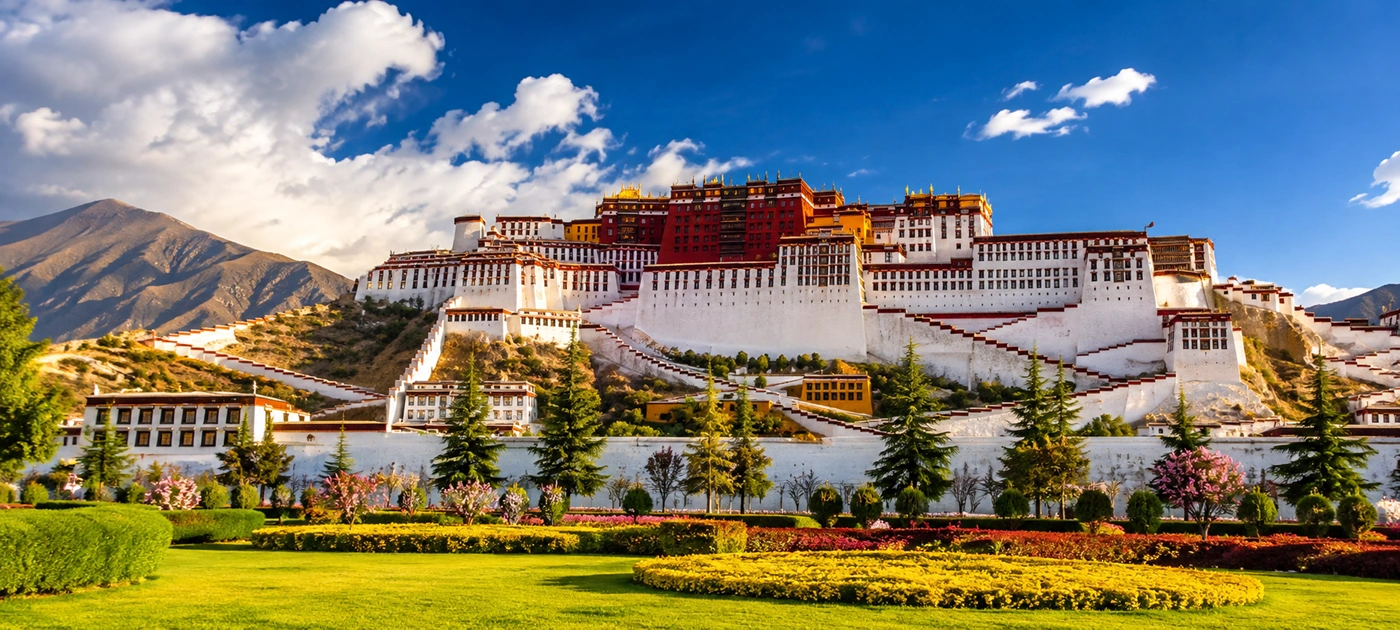
The Potala Palace is the winter palace of the Dalai Lamas, built on Marpo Ri hill above Lhasa, and is one of the most impressive buildings in Asia to visit. Not because entry is complicated — we handle the permits and the timed ticket. Because it sits at altitude, runs on a clock, and rewards preparation the way few monuments do.
Most visitors get one hour inside. Many spend half of it out of breath and the other half lost. This guide covers what the palace actually is, how entry works, how we design the day around the climb, and where the views that fill your camera roll really are.
What Is the Potala Palace?
The Potala Palace was the winter residence and seat of government of the Dalai Lamas, begun on the site of a seventh-century fort built by King Songtsen Gampo.
The palace you see today dates mainly from 1645 onward, when the Fifth Dalai Lama — the Great Fifth — ordered its reconstruction as Lhasa returned to the center of Tibetan power.
It climbs thirteen storeys up the Red Hill. Inside are chapels, assembly halls, living quarters, and the gold burial chortens of past Dalai Lamas, with the Fifth's tomb plated in several tonnes of gold.
UNESCO inscribed the palace as a World Heritage Site in 1994, later extending the listing to the Jokhang Temple and Norbulingka.
The name matters. This was the winter palace: the Dalai Lamas moved each summer to Norbulingka, the garden palace on the western edge of Lhasa.
Seeing both in one trip, as our Lhasa programs do, shows you the ceremonial state and the private man side by side — part of how we build luxury travel across the Himalaya.
White Palace and Red Palace: What You Actually See
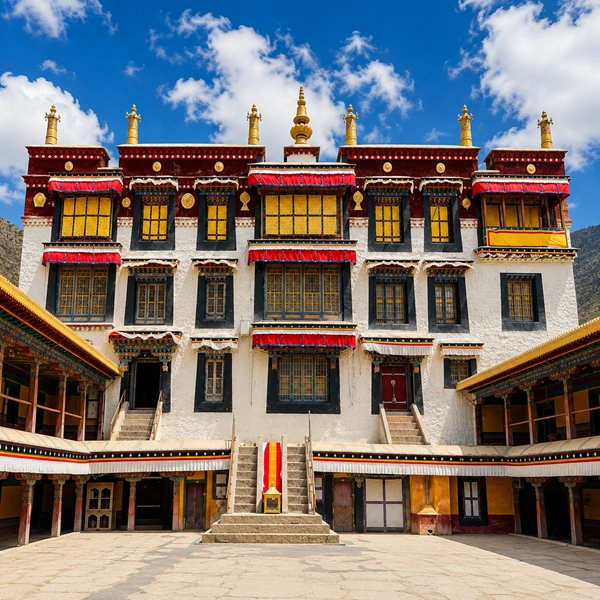
Your visit moves through two connected buildings, each with a different job. The White Palace, the Potrang Karpo, held the government offices, the Dalai Lama's living quarters, and the great Deyang Shar courtyard where monastic dances were staged.
The Red Palace, the Potrang Marpo, is the spiritual core: chapel after chapel of statues, murals, and the jeweled tomb stupas.
The room that stops people is the Phakpa Lhakhang, the small seventh-century chapel holding the Arya Lokeshvara statue — for many pilgrims, the holiest object in the building, older than almost everything around it.
Butter lamps burn in near darkness. Pilgrims press forward with white kata scarves while your guide keeps you moving at the pace the route demands.
You'll smell the palace before you can name it: juniper smoke, old sandalwood, and melted yak butter, soaked into timber over centuries. No photograph carries that home. It's the strongest argument for going in person.
Permits and Entry: How a Potala Palace Visit Works
All foreign travelers need a Chinese visa plus a Tibet Travel Permit to visit the Potala Palace, and must travel in Tibet with a licensed guide on an organized itinerary.
There is no independent entry. We arrange the permit before you fly, which requires your passport and visa copies several weeks in advance — we confirm the current lead time in your proposal.
Full details are in our Tibet permits and entry guide.
The entry itself is timed. Daily visitor numbers are capped, tickets are tied to your passport, and once inside the palace proper, your group works to a fixed time window — one hour at the time of writing.
Our Lhasa operations team secures the slot the day before, which is why we ask for passports that evening; you'll have them back at breakfast.
The clock is the reason preparation matters. Security screening sits at the gate — no lighters, no liquids beyond a small bottle, and large bags stay behind.
Arrive sorted, and the hour belongs to the chapels, not the queue.
The Climb at 3,650 Meters
The honest challenge of the Potala Palace is the climb. Lhasa sits at about 3,650 meters, and the entrance ramps and stone stairs rise roughly 100 vertical meters to the White Palace gate.
At this altitude, that modest climb works like triple its size at sea level. We never schedule the Potala on your first morning in Lhasa.
Our programs place it on your second or third day, after at least one full night's sleep at altitude, gentle first-day walking around the Barkhor, and an oxygen-saturation check with your guide each morning — standing practice on every Tibet departure we run.
On the climb itself, our guides hold a deliberately slow pace with two planned stops at the ramp landings, where the views back over the old town make the pauses feel earned rather than needed.
Twenty-five to thirty minutes up is the right speed. Racing is the single most common mistake we see other groups make.
Best Time to Visit the Potala Palace
Late spring through autumn gives the Potala Palace its best combination of weather, light, and access — roughly April to October, with May, June, September, and October the sweet spots.
Days run mild and bright, and Lhasa's thin, dry air turns the white walls almost painful to look at by mid-morning. Our guide to the best time to visit Tibet covers the wider plateau season by season.
High season brings its own pressure: summer holidays put real strain on the daily ticket cap, which is exactly why we lock entry slots in advance rather than chance the queue.
Winter flips the equation. From November to March, visitor numbers fall away, pilgrim numbers rise as farming communities travel to Lhasa, and you share the chapels with Tibetans rather than with tour buses.
Light is a schedule of its own. The east face catches the morning sun; the classic full-frontal view glows warmest in the late afternoon. We build the day so you're inside mid-morning and at the viewpoints when the light is right.
Etiquette Inside the Winter Palace
The Potala is a working religious site before it is a monument, and conduct inside follows Tibetan Buddhist practice. Move through chapels clockwise, as the pilgrims around you do. Hats come off indoors. Shoulders and knees stay covered — bring a layer even in summer, since the stone halls hold their chill.
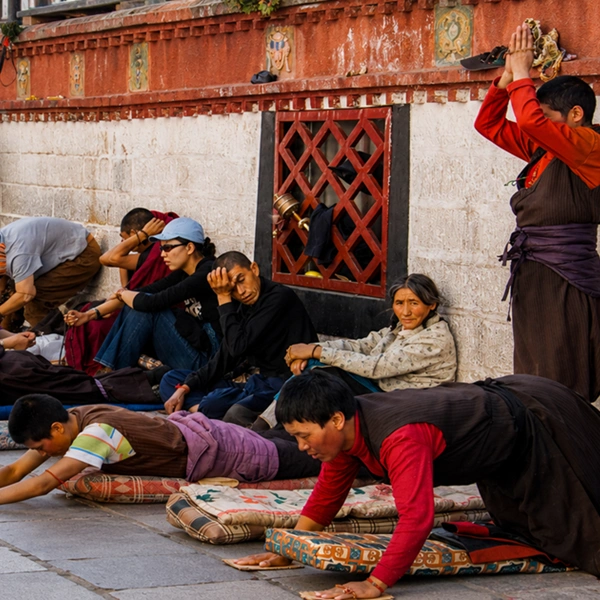
Photography is not permitted inside the chapels, without exception, and your guide will tell you where exteriors and courtyards are fine. Don't point your feet at statues when resting, don't touch the murals, and step past prostrating pilgrims rather than through their line.
None of this is complicated with a good guide by your side. Our brief you the evening before, in plain terms, so nothing inside feels like a test.
The Kora and the Best Views
Some of the finest moments at the Potala Palace happen outside its walls. The palace kora — the pilgrim circuit around the base of Marpo Ri — runs clockwise past long banks of prayer wheels, busiest just after dawn when Lhasa's older residents walk it with prayer beads in hand.
Walking a stretch of it costs nothing and needs no ticket.
For photographs, two spots do the work. Chakpori Hill, directly opposite the palace, gives the elevated straight-on view that appears on the fifty-yuan banknote — best in soft morning light.
Zongjiao Lukhang Park, tucked behind the north face, holds the reflection pool where the palace doubles itself at dusk on still evenings.
Our guide's time both around your entry slot, so the day reads as one clean arc: kora early, palace mid-morning, park at last light. For the rest of the old town, our luxury Lhasa city guide picks up where the palace walls end.
How We Build a Potala Day
A Potala Palace visit on our private Lhasa tours is one shaped day, not a line on a checklist. Permits and the timed ticket are handled before you think about them.
The climb is placed after proper acclimatization and paced by a guide who reads how you're doing.
The Jokhang Temple and Barkhor Street woven around it, so old Lhasa makes sense as a whole.
That's what "Held, not handled" means at 3,650 meters. If Lhasa is calling, our4-day private Lhasa tour covers the palace, the Jokhang, and the great monasteries at exactly this pace — or start with our full Lhasa tour and let us tailor the days from there.
Frequently Asked Questions
Do I need a permit to visit the Potala Palace in Lhasa?
Yes. Every foreign traveler needs a Chinese visa plus a Tibet Travel Permit, and must visit with a licensed guide on an organized itinerary — independent visits aren't possible. We arrange the permit before you fly, using copies of your passport and visa, and carry the paperwork throughout your trip. You never queue at an office or handle the process yourself.
How long do you get inside the Potala Palace?
One hour inside the palace proper, at the time of writing, with entry tied to a timed ticket and your passport. The limit prevents the building from becoming overcrowded. A good guide makes the hour feel unhurried by choosing the chapels that matter and briefing you the evening before, so you spend the time looking rather than orienting.
Is the Potala Palace climb hard at altitude?
It's a short climb that feels long. The ramps and stairs gain roughly 100 vertical meters, but at Lhasa's 3,650 meters, your body works far harder than the numbers suggest. Taken slowly over 25–30 minutes with rest stops, most reasonably fit visitors manage it comfortably — provided it's scheduled after a night or two of acclimatization, never on arrival day.
When is the best season to see the Potala Palace?
April to October offers the best weather and light, with May, June, September, and October as the standouts. Summer is the busiest and puts pressure on the daily ticket cap. Winter brings cold, clear days, far fewer tourists, and many more Tibetan pilgrims — for some guests, the most atmospheric time of all to stand in the chapels.
Can you take photos inside the Potala Palace?
Not inside the chapels — photography there is strictly prohibited, and your guide will confirm where courtyards and exteriors are allowed. The celebrated exterior shots come from elsewhere anyway: Chakpori Hill opposite the palace for the straight-on morning view, and the Zongjiao Lukhang Park pool behind it for dusk reflections.
What's the difference between the White Palace and the Red Palace?
The White Palace held government offices, ceremonial courtyards, and the Dalai Lama's living quarters. The Red Palace is the religious heart, housing the chapels, murals, and the gold-plated stupas of past Dalai Lamas. Your visit moves through both, and the contrast between statecraft and devotion is much of what makes the building read as a world of its own.
Why is the Potala called the Winter Palace?
Because the Dalai Lamas lived there only in the cold months, moving each summer to Norbulingka, the garden palace on Lhasa's western edge. The pairing shaped Tibetan court life for centuries. Our Lhasa itineraries visit both, which turns two separate tickets into one story about how Tibet was actually governed and lived in.