Khumjung, at 3,790 meters, is the largest Sherpa settlement in the Khumbu and an irreplaceable stop on any Luxury Everest View or Everest Base Camp trek. It solves the acclimatization issue, unlocks authentic culture without the tourist crush of Namche Bazaar, and sits 45 minutes below the world's highest luxury hotel. Most trekkers skip it. You shouldn't.
Why Khumjung Village Is Essential to Your Luxury Everest Trek
The Khumbu Valley has a secret that most trekkers never discover. They fly into Lukla, stay in Namche Bazaar, push toward Base Camp, and leave thinking they've seen the Sherpa homeland. They haven't. They've seen a trading hub and a hiking route. Khumjung is where the actual Sherpa life is.
The village sits in a natural bowl beneath Mount Khumbila, just 4–5 kilometers northwest of Namche. It's high enough to be genuinely alpine—3,790 meters means you're above cloud cover most mornings—but low enough that it remains a functioning agricultural community, not a transactional waystation.
This is where families harvest potatoes in autumn. Where monks spin prayer wheels at dawn. Where children attend school in buildings designed by a Pritzker Prize-winning architect after the 2015 earthquake destroyed the originals.
We bring every luxury trekker through Khumjung. It's the difference between visiting the Himalayas and understanding them.
The Acclimatization Strategy That Actually Works
If you're doing the Luxury Everest Base Camp Trek, Day 4 matters more than you think. You've climbed hard on Day 3 from Phakding (2,610m) to Namche Bazaar (3,440m). Your body is adjusting. Your guide will tell you not to push higher that day—medical protocol in the mountains is "climb high, sleep low." But sitting still in your lodge doesn't accelerate adaptation. Movement at moderate altitude does.
The Namche-Khumjung loop is the acclimatization strategy that mountain medicine actually recommends. You ascend 440 vertical meters from Namche to the ridge above Khumjung—high enough to trigger your body to produce more red blood cells, low enough that you're not inviting altitude sickness. You spend 4–5 hours exploring the village and monastery at that elevation. Your cardiovascular system gets the signal it needs. Then you descend back to Namche and sleep well.
The climbing distance is gentle. The total loop is 5–7 kilometers, depending on which monastery routes you take. No scrambling, no exposure, no summits. But you've just told your body to adapt, and you've done it safely. By the time you reach 4,000 meters the next day, you're physiologically ready.
This is why guides used to call Day 4 "acclimatization." It's not a rest day. It's a work day disguised as a cultural outing.
The Last Living Sherpa Village on the Trail
Once you leave Khumjung, the landscape changes completely. Within two days, you're in Tengboche. Within four, you're at Dingboche on a high-altitude plateau. Within seven, you're at Gorak Shep, surrounded by glacial moraine and prayer flags marking memorials to climbers. The human settlements become sparse. Lodges exist purely to shelter trekkers, not to house families.
Khumjung is the last stronghold of multi-generational Sherpa settlement before that transition. The village has 551 households and roughly 1,900 residents. People here own land. Kids attend school. Families tend stone-walled potato fields and manage yak herds.
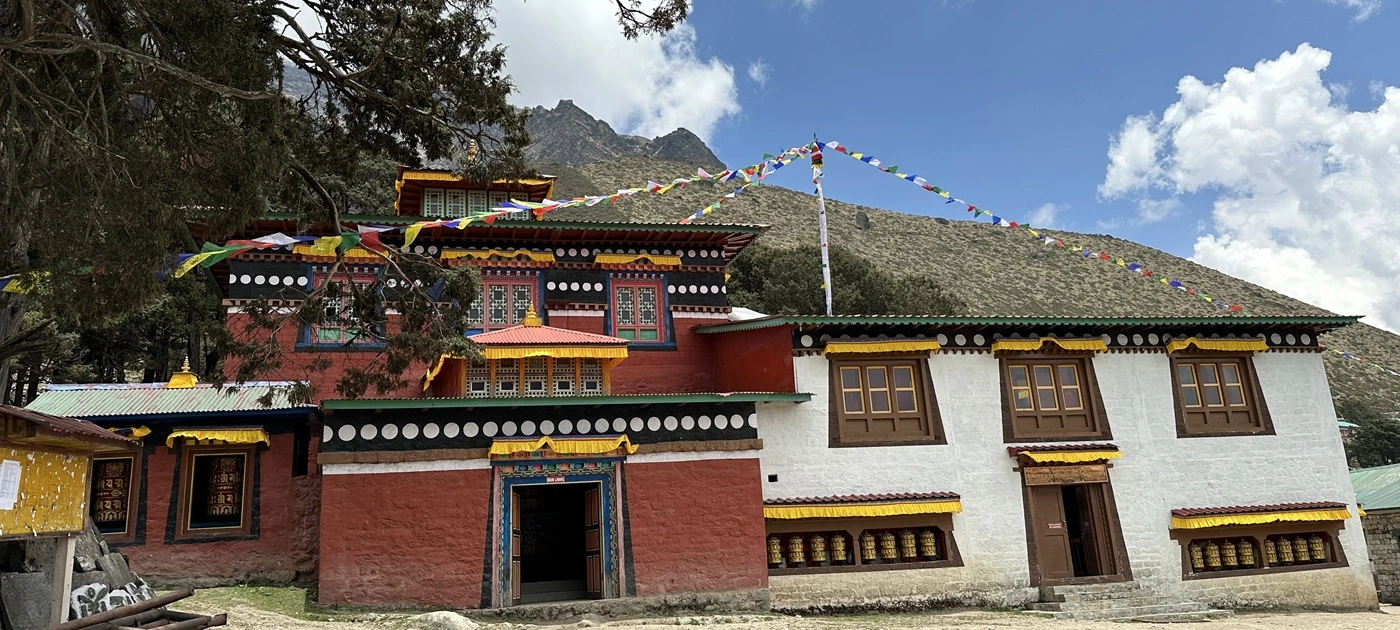
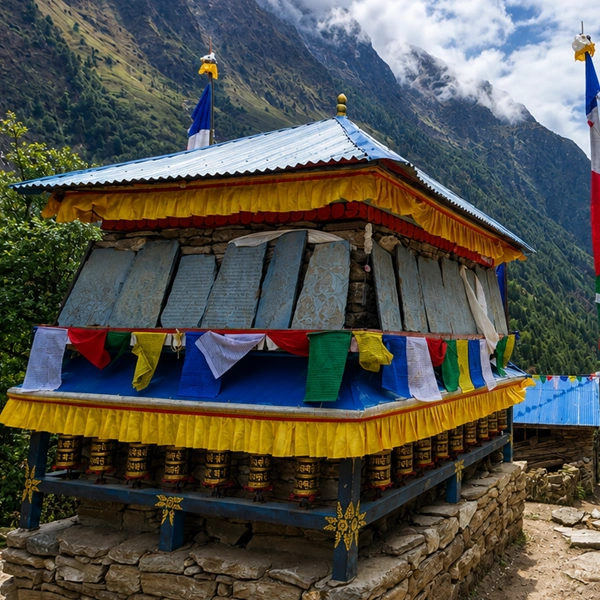
The architecture is uniform by choice—nearly every roof is painted the same emerald green, a decision the community made collectively to preserve visual harmony. Prayer flags and mani walls mark family entrances. The spiritual rhythm of the village runs on monastery ceremonies, not on trekker arrivals.
When you walk through Khumjung, you're not in a museum. You're in a place where people live. That distinction matters.
Hillary's School and the Reconstruction That Inspired the World
In 1953, Edmund Hillary and Tenzing Norgay Sherpa summited Everest. Hillary's legacy is the climbing record. His actual impact is something else entirely.
After the expedition, Hillary asked the community how he could repay the Sherpa people for their sacrifices. A local named Urgen Sherpa answered with a single sentence: "Burah Saheb, our children have eyes, but they cannot see." There was no school. The region had no secular Education. Hillary spent the next eight years raising money and shipping materials to build one.
The 1961 construction was a logistics miracle. No roads existed to Khumjung. No helicopters for cargo. Hillary convinced the Indian Aluminum Company to donate a prefabricated aluminum structure. The International Committee of the Red Cross flew it to a high-altitude airstrip. Sherpa porters carried the pieces overland and assembled them by hand.
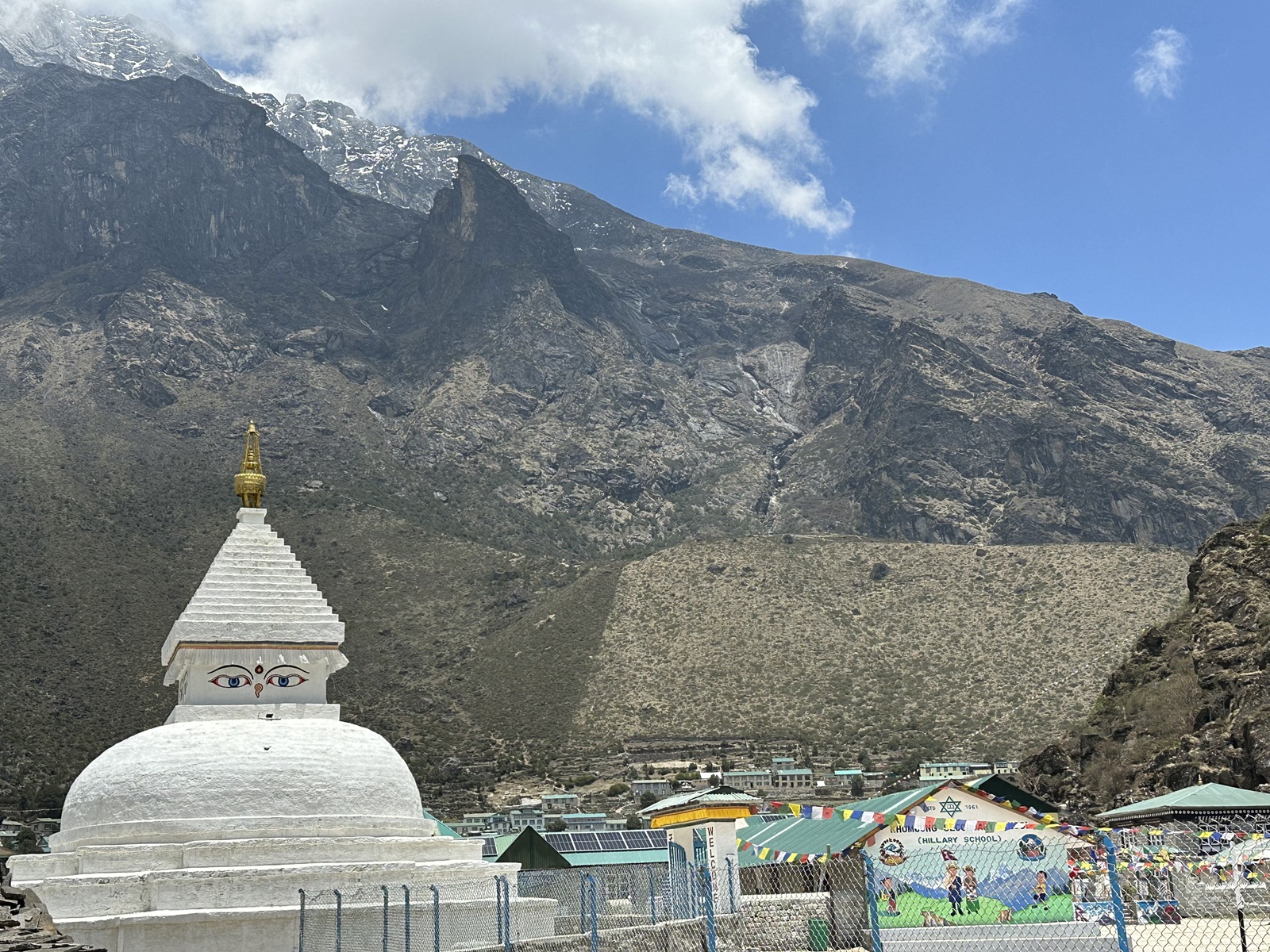
That aluminum building still stands. It's now the Sir Edmund Hillary Visitor Center, and it opened in May 2023—exactly 70 years after the first summit.
We always include time here with our trekkers. The museum is small and intimate. You see 3D-printed topographic models of the 1953 route. You read the full story of Hillary and Tenzing. You see the school's academic records. On our last October departure, one client spent 45 minutes alone in there, reading Hillary's correspondence with the village headman. When he came out, he said it was the moment the whole trip made sense to him.
The school itself is now the top-performing secondary institution in the entire Solukhumbu district. Shigeru Ban—the Japanese architect famous for disaster-relief designs in Rwanda and Christchurch—rebuilt the classrooms after the 2015 earthquake using a system of locally salvaged stone and timber frames. It's beautiful architecture that honors both modern engineering and traditional Sherpa building.
The Yeti Scalp: Where Science Meets Sacred
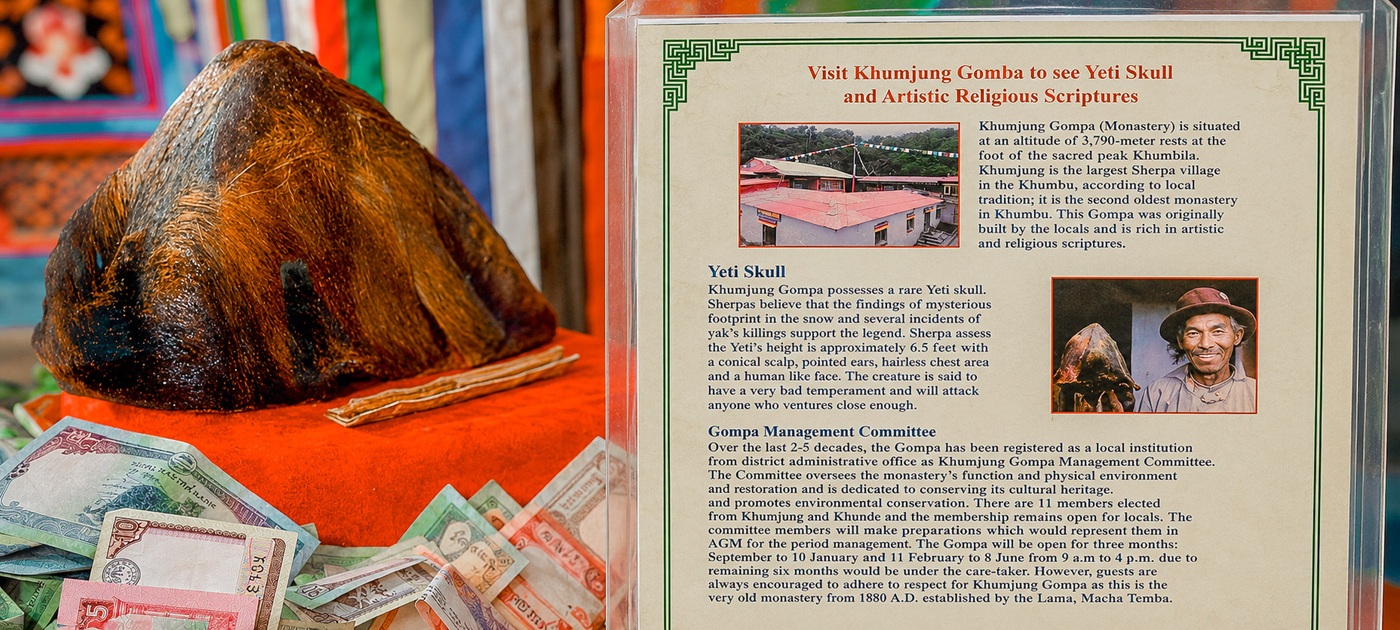
The Khumjung Monastery houses an artifact that has puzzled Western science for 60 years. It's kept in a locked glass cabinet in the main chamber: a dome-shaped, hair-covered scalp that local devotees believed was the remains of a yeti, the "Abominable Snowman" of Himalayan mythology.
In 1960, Edmund Hillary negotiated with the village to take the scalp to the United States for scientific analysis. He had to offer a substantial donation to the school and monastery to convince them. A local guardian monk, Khumjo Chumbi, accompanied the scalp on a world tour—to Chicago, Europe, and Japan—to ensure its spiritual safety.
The result? Zoologist Marlin Perkins determined it was the hide of a serow, a native Himalayan goat-antelope. Not a yeti. No evidence of an unknown primate.
But here's what Khumjo Chumbi said to Western media during that tour: "We don't believe in giraffes and lions in Nepal because there aren't any. Likewise, you do not believe in yetis because you have none in your country."
The scalp sits in the monastery today. For a small donation in rupees, the resident monks will show it to you. It's a perfect symbol of the mountain itself—a place where Western rationalism and Himalayan spirituality don't need to agree. They coexist.
Hotel Everest View Is Right There—But Khumjung Keeps You Grounded
If you're on the Luxury Everest View Trek, you're probably staying at or visiting Hotel Everest View, the Guinness-certified highest luxury hotel in the world at 3,880 meters. The views are extraordinary. You can see Everest, Lhotse, Ama Dablam, and Thamserku from the dining room.
Khumjung is a 45-minute descent from that ridge. It's the perfect counterbalance to mountain glamour. After breakfast overlooking the highest peaks on Earth, you walk down into a working village where the economic logic is farming and tourism work, not five-star hospitality. You see how the land actually sustains people.
We often structure the day this way: sunrise views at Everest View, breakfast there, then a guided walk down into Khumjung for the monastery and school visit. Lunch is simple—usually at a family-run lodge that serves fresh buckwheat noodles or vegetable momos. Afternoon, back to your Namche property for a spa treatment and dinner. You've touched both worlds in one day.
That balance is what luxury trekking should feel like.
The 2015 Earthquake and What the Community Rebuilt
On April 25, 2015, a 7.8-magnitude earthquake devastated Nepal. Khumjung's monastery and school both suffered severe structural damage. The national government's reconstruction efforts stalled—due to bureaucracy, funding gaps, corruption, and logistics.
The village didn't wait. Households pooled personal money and committed two weeks of labor per family. They cleared debris, salvaged sacred texts, and rebuilt walls by hand. The monastery reopened in August 2017. The school's reconstruction, designed by Shigeru Ban, was completed by 2017.
What strikes us most about that story is the autonomy. The Sherpa people decided they wouldn't wait for permission or state resources. They decided for themselves what their community needed and built it. That's not just a construction timeline. That's cultural preservation by choice, not chance.
Seasonal Timing and What You'll Actually See
Spring (mid-March to mid-June): Rhododendron blooms blanket the lower forests. Khumjung sits above the bloom zone, but the views are crystal-clear, and the community is busy with early-season potato planting. Temperatures range from near-freezing at dawn to mild afternoon sun.
Autumn (mid-October to mid-December): The potato harvest is underway. The air is completely clear. Morning temperatures can drop to freezing, but afternoons are warm. This is when we see the most vibrant daily life in the village—families working in fields, the school fully in session, monastery ceremonies on a full schedule.
The village is accessible year-round, but we only run treks in spring and autumn. Summer brings heavy clouds and monsoon rain. Winter brings snow that can block the higher passes.
Practical Information for Your Visit
- Distance from Namche Bazaar: 4–5 kilometers. Plan 45 minutes to 1.5 hours, depending on your pace and how many monastery detours you take.
- Elevation gain on the loop: 440 meters up from Namche to the Syangboche ridge, then down into Khumjung, then back to Namche. Total walking: 4–5 hours at a leisurely pace.
- What to bring: Layers. Mornings are cold at 3,790 meters; afternoons are warm. Bring a camera—the village is photogenic, and the monastery's interior artwork repays close attention. Bring small rupee notes for monastery donations.
- Guide role: Our guides navigate village protocols, explain the monastery's layout, and provide context on the Hillary school. They handle all permissions required for photography in sacred spaces.
- Accommodation: Khumjung has simple lodges for independent trekkers, but we route luxury clients back to Namche for the night. The difference in comfort is substantial, and you've already done the acclimatization work.
FAQs on Khumjung and Luxury Everest Treks
Is Khumjung on the standard Everest Base Camp route, or is it a detour?
- It's a deliberate acclimatization stop, not a detour. On Day 4 of the Luxury EBC Trek, the medically recommended activity is the Namche-Khumjung loop. You gain elevation safely, explore culture, then descend to sleep lower. Standard Base Camp treks often skip this. Luxury itineraries build it in because proper acclimatization prevents altitude sickness and makes the rest of the trek safer.
How difficult is the walk from Namche to Khumjung?
- Moderate but not strenuous. The ascent to Syangboche is steady, gaining 440 meters over about 1.5–2 hours. The trail is well-maintained and used daily by locals. There's no scrambling or exposure. The difficulty is altitude, not terrain.
Can we visit Khumjung if we're staying at Hotel Everest View?
- Yes. Hotel Everest View sits on the ridge above Khumjung at 3,880 meters. From the hotel, it's a 45-minute descent into the village. Many guests do a dawn viewing from the hotel, then walk down to explore Khumjung before returning for lunch. It's a perfect half-day activity if you're staying at the highest luxury hotel.
What's inside the Hillary Visitor Center, and is it worth the visit?
- Yes. The museum occupies the original 1961 aluminum schoolhouse and tells the full story of Hillary's relationship with Khumjung, the construction of the first school, and the 1953 Everest climb. You'll see a 3D topographic model of the climbing route, school records, and historical photos. Budget 45 minutes to 1.5 hours, depending on your level of interest. Our trekkers consistently say it's one of the most meaningful moments of the entire trip.
Can we see the yeti scalp in the monastery?
- Yes. The monastery keeps the scalp in a locked case in the main chamber. Resident monks will show it for a small donation of 500–1,000 Nepalese rupees (roughly $4–8 USD). It's a brief but memorable moment—part museum piece, part spiritual artifact, entirely unique.
What is the altitude risk of spending hours at Khumjung on Day 4?
- Minimal if you're following proper acclimatization protocol. Khumjung sits at 3,790 meters, only 350 meters higher than Namche Bazaar. You've already spent a night at 3,440 meters (Namche). Ascending 350 meters during the day and descending again to sleep lower is the textbook "climb high, sleep low" strategy. It accelerates adaptation rather than triggering altitude sickness.
Is the village touristy, or does it feel authentic?
- Authentic. Unlike Namche Bazaar, which is heavily commercial and crowded during peak season, Khumjung remains a functioning Sherpa community. You'll see families, school children, agricultural work, and genuine monastery life. Tourism is present but not dominant. Our guides ensure trekkers move through respectfully and spend money at local family lodges rather than chain operations.
Do we need a special permit to enter Khumjung village?
- No additional permit. Khumjung sits within Sagarmatha National Park, which you've already entered with your park entry fee (approximately $3 USD). The monastery requests a small donation for entry, and the Hillary Visitor Center has a suggested contribution. Both are voluntary and nominal.
The Reason We Always Include It
Every Luxury Everest Trek we run—whether a 5-day Everest View or a 12-day Base Camp expedition—includes Khumjung. It's never rushed. It's never an afterthought add-on.
It's because the village holds something the high mountains alone can't give you: the human story underneath the landscape. You see where Hillary's vision was built.
You acclimatize safely using terrain and culture together. You stand in a monastery that survived an earthquake by the community's will alone. You look at a yeti scalp and think about the gap between what we believe and what matters.
That's what separates a trek from a pilgrimage.
Need Help? Call Us+977 9851013196orChat with us on WhatsApp
Need Help? Call Us+977 9851013196