Manaslu Circuit vs Annapurna Circuit comes down to one trade-off: isolation or infrastructure. Manaslu is shorter but harder, needs four permits and a licensed guide, and has no roadside medical support. Annapurna is longer, gentler underfoot, better supplied and easier to reach. Both cross a pass above 5,000 metres.
Manaslu Circuit vs Annapurna Circuit: Which Trek Is Right for You

Manaslu Circuit vs Annapurna Circuit is the comparison we field most often from guests who have already walked to Everest Base Camp and want something longer, wilder, or simply different. Both routes circle an eight-thousander. Both cross a pass above 5,000 meters.
After that they separate fast. One is a restricted border zone with four permits, a legal guide requirement and no road out of the upper valley. The other is Nepal's most developed long trail, with an altitude clinic, an apple-pie belt and a jeep track running most of the way up the eastern valley.
We run both as private trips, so we have nothing to gain by pushing you toward either. What follows is the same comparison we give guests on the phone, and the reasoning behind how we build luxury travel across the Himalaya generally.
Manaslu Circuit vs Annapurna Circuit: the short answer
Take Manaslu if you want isolation and are ready for a harder walk. Take Annapurna if you want variety, comfort, and a wider safety margin.
| Manaslu Circuit | Annapurna Circuit | |
|---|---|---|
| Distance | 130–180 km | 160–230 km |
| Typical duration | 13–18 days | 12–21 days |
| High point | Larkya La, 5,106 m | Thorong La, 5,416 m |
| Walking hours per day | 6–8 | 5–7 |
| Trail character | Rugged, constant undulation | Wide, graded, gradual |
| Permits | Four | Two |
| Licensed guide | Required by law | Rules have tightened; confirm current status |
| Roads on the route | Lower gorge only | Roughly half the classic line |
| Medical support en route | None above the trailhead | Volunteer altitude clinic at Manang |
| Trekker numbers | A small fraction of Annapurna's | Nepal's busiest long trail |
Neither is a beginner's route. Both put you above 5,000 meters on foot, in a country where the nearest hospital is a helicopter ride away.
Which circuit is physically harder?
Manaslu is the harder walk, even though its pass is lower.
The Annapurna Circuit follows old trade arteries. The paths are wide, the gradients were built for laden mule trains, and the climbing spreads thin across many days. Most days run five to seven hours.
Manaslu gives you none of that. The trail hugs the Budhi Gandaki gorge, a steep V-shaped cut where the only flat ground is a suspension bridge. Days run six to eight hours, and the terrain rarely holds a steady angle for twenty minutes together.
The elevation figures most comparisons quote are misleading
You will often see the Manaslu Circuit summarised as roughly 4,450 meters of elevation gain. That is a net figure — the difference between a trailhead near 700 meters and a pass at 5,106.
It is not what your legs do. The gorge takes back most of what it gives, again and again, and the true cumulative ascent across the circuit is far higher than that number suggests. This gap between net and cumulative gain is the biggest reason trekkers reach Larkya La more tired than the altitude chart predicted.
Annapurna has the opposite profile: more total distance, gentler accumulation. A fit walker with limited hill training usually copes better there, despite the higher pass. Our Manaslu Circuit trek guide breaks the gorge section down village by village.
Larkya La and Thorong La are not the same kind of day
Thorong La is higher. Larkya La is harder.
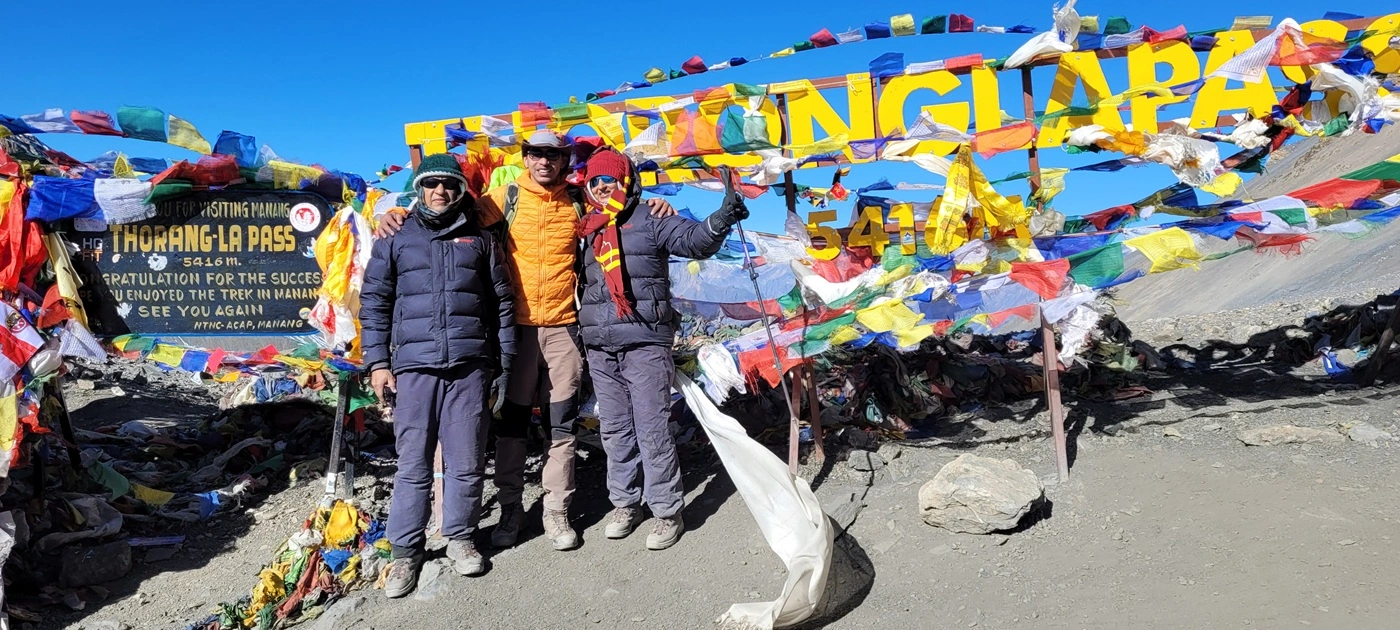
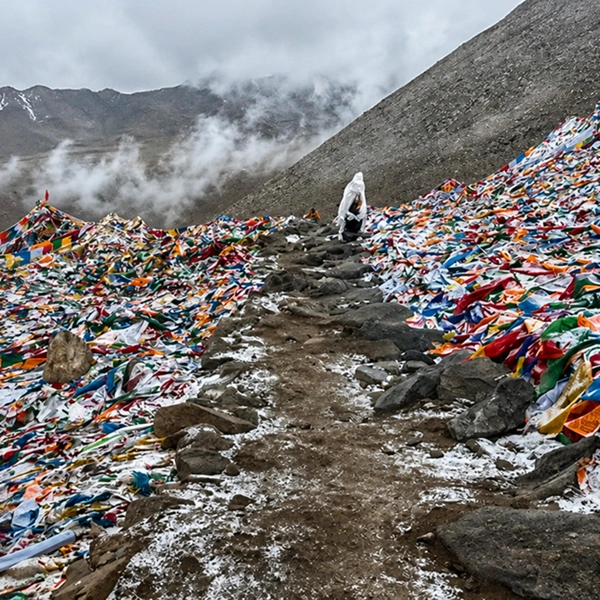
Thorong La, 5,416 meters
The climb from Thorong Phedi at about 4,540 meters is a graded switchback with a clear line, gaining roughly 875 meters to the top. Nothing about it is technical.
The descent is what people underestimate. From the pass you drop about 1,600 meters into Muktinath in one continuous fall, and knees that behaved all week can quit on that hill.
Weather is the real hazard at that height. The October 2014 blizzard driven by Cyclone Hudhud remains the worst trekking disaster in Nepal's history, and it changed how agencies equip and insure their Nepali crews.
Larkya La, 5,106 meters
Larkya La starts from Dharamsala at roughly 4,460 meters, usually in the dark, often around four in the morning. You are already high before you begin.
The ground is lateral moraine, glacial rubble and ice rather than a groomed path. Micro-spikes earn their weight here in most conditions.
The far side drops around 1,400 meters into the Bimtang basin over loose gravel and irregular footing, at the point in the day when concentration runs thinnest. Landing ground for a helicopter between Dharamsala and Bimtang is scarce, and cloud usually arrives by early afternoon.
A trekker who stops moving on that descent may be spending the night where they stopped.
Altitude support: where the help is, and where it isn't
The Annapurna Circuit has a medical safety net. The Manaslu Circuit has your guide.
Manang, at about 3,540 meters, is the difference. The Himalayan Rescue Association — a non-profit set up in 1973 by a group of doctors and mountaineers — runs a seasonal altitude clinic there, staffed by volunteer physicians, with daily talks, oximetry and treatment for altitude illness.
If you deteriorate in Manang, you have choices: rest under supervision, take oxygen, or drop fast by road.
Manaslu has no equivalent above the trailhead. No clinic, no road, no quick descent. That is precisely why Nepal makes a licensed guide compulsory there — spotting the shift from a headache to loss of coordination is often the only warning system on that trail.
Above 5,000 meters, each breath carries roughly half the oxygen it would at sea level. Altitude illness tracks how fast you climbed rather than how fit you are, and strong endurance athletes get sick as readily as anyone else when they ascend too quickly. That is the reasoning behind the pacing in our altitude and health guide.
Helicopters cannot rescue what they cannot see
Rescue flights in Nepal fly on single-engine machines of the AS350 B3 / H125 class, in daylight, with visibility. Cloud grounds them.
Cost rises with altitude and distance, and a high-pass evacuation followed by hospital care in Kathmandu runs well into five figures before repatriation is discussed at all. Rescue is a backstop, never a plan.
Three things matter in your policy before you book either circuit: trekking cover to at least 6,000 meters, helicopter evacuation named in the wording, and an insurer who will guarantee payment directly to the operator.
A pay-and-claim policy can leave a helicopter on the ground while someone hunts for a credit card, which is why what your policy needs to cover is worth ten minutes before you pay.
Permits and the guide rule
The Manaslu Circuit needs four permits and a licensed guide by law. The Annapurna Circuit needs two permits.
Manaslu's set covers the Manaslu Restricted Area Permit, the Manaslu Conservation Area Permit, an Annapurna Conservation Area Permit — the route finishes inside the Annapurna area at Dharapani — and a Chumanubri Rural Municipality development fee. The restricted-area permit is priced by season and by day, and it costs more in the autumn peak than the rest of the year.
Annapurna asks for the Annapurna Conservation Area Permit and a TIMS card.
Two rules have moved recently, and both are worth reconfirming when you book. Current regulations no longer require a second foreign trekker on the Manaslu restricted-area application, which ended years of paperwork theatre for solo walkers. The guide requirement has not moved: it is statutory on Manaslu, checkpoints enforce it, and Nepal has been extending guide rules across its other trekking areas too.
We handle all of it. Permits, checkpoint paperwork, and the guide license are ours to organize, not yours.
What the roads did to each route
Roads have changed the Annapurna Circuit far more than the Manaslu Circuit, but they have not ruined it.
Motorable track now reaches Manang up the Marsyangdi, and runs through Jomsom to Muktinath up the Kali Gandaki. Something close to half the classic walking line has been overlaid.
The answer came from inside the region. A network of marked alternative footpaths, developed by a local guide and a foreign trekker with conservation-area backing, threads old trade paths, irrigation channels and forest tracks away from the traffic. Red-and-white paint marks the main alternative; blue-and-white marks the side routes.
Walk those, and you get most of the old circuit back. You will still hear the valley.
The road did something less visible too. Trekkers now jeep straight up to Chame or Manang, cutting the trek to under two weeks and skipping the slow low-altitude days that used to do the acclimatizing. Faster is not safer here.
Manaslu is not road-free either. Construction is pushing up the lower Budhi Gandaki, and the trailhead shifts further in every few seasons. Above Jagat, the circuit is still footpath and mule train, and the upper valley cannot be driven at all.
Comfort, food and where you sleep
Annapurna is comfortable. Manaslu is basic, and honestly so.
Lower Annapurna villages have concrete buildings, attached bathrooms, hydro power, and working internet. Manang runs like a small alpine resort — bakeries, gear shops, coffee, and menus that stretch to pizza and yak steak. The Marpha apple pie is not a tourist myth; it sits on top of a real local orchard industry.
Manaslu's teahouses have improved a great deal in a decade and are still, above 3,500 meters, cold rooms with thin walls. Shared squat toilets are normal. Power is solar, and the weather decides how much of it you get.
Food narrows to dal bhat, momo and noodle soup, because everything above Jagat arrives on a mule. In Lho, Samagaun and Samdo you will often be the only guests in the building.
Neither route has a hotel we would describe as luxury, and we will not pretend otherwise. What we can control is how you arrive, how hard each day is, who walks beside you, and what happens when something goes wrong.
The side trips that do your acclimatizing for you
Both circuits offer day hikes that climb high and sleep low, which is the acclimatization rule that actually works.
From Manang, the steep haul to Ice Lake at about 4,600 meters is the most honest test of how your body is handling altitude before Thorong La. Tilicho Lake at 4,919 meters, among the highest lakes in the world, adds two to three days on a landslide-prone trail. On the southern flank, Poon Hill at 3,210 meters is still the classic Dhaulagiri sunrise.
Samagaun is Manaslu's equivalent hub, and its options run deeper culturally. Birendra Lake sits an easy couple of hours away, turquoise with glacier melt. Pungyen Gompa, a seventeenth-century monastery at around 4,050 meters, stands in a broad valley under Manaslu's eastern face with almost nobody else on the path.
Manaslu Base Camp at roughly 4,800 meters is a six- to seven-hour round trip over moraine. During the climbing season, you look down on the expedition tents from the rim.
Tsum Valley: the extension that changes the trip
Tsum Valley turns the Manaslu Circuit from a trek into an anthropological journey, at a cost of seven to ten extra days.
The valley branches north near Jagat and was closed to foreign visitors until 2008. Tibetan Buddhists know it as Beyul Kyimolung, a hidden valley blessed — tradition holds — by Guru Rinpoche in the eighth century as a refuge in hard times.
What makes it unusual is a living law. Early last century, the community formalized a shagya vow, a valley-wide commitment to non-violence, and it still holds today.
There is no hunting of wild animals, no trapping of birds, no honey hunting, no selling of livestock to butchers, no killing of calves, no moving animals through the valley for meat, and no burning of forest or pasture.
A century of that produces wildlife that does not run from people. It also means you visit as a guest inside a rule, not as an observer of a custom.
The monasteries carry the same weight: Rachen Gompa's nunnery, Mu Gompa high at around 3,700 meters, and Piren Phu, the cave where the poet-saint Milarepa is said to have meditated a thousand years ago.
Can you walk both?
Yes. The Manaslu Circuit ends where the Annapurna Circuit passes through, at Dharapani, and the two link into one traverse of roughly three and a half weeks.
The combination is neat for a specific reason. It swaps Annapurna's road-heavy lower eastern section for the restricted wilderness of Manaslu, and gives you Larkya La and Thorong La in a single unbroken walk.
It is also a serious undertaking: two passes above 5,000 meters, a month on your feet, and long stretches with no simple exit.
How we run both circuits privately
Our version of each circuit changes the parts worth changing — the arrival, the pacing and the crew.
Access is the first thing to go. The drive to Machha Khola for Manaslu runs eight to ten hours over landslide ground; Besisahar for Annapurna is six to eight. Where a standard route hands you four or more hours of mountain road, we fly you privately by helicopter instead, in both directions.
That one decision buys back two days and removes what is statistically the most dangerous part of most Nepal treks: the drive.
Every trip carries a full rest and briefing day in Kathmandu after your international flight, before anyone walks anywhere. Every trip ends with a buffer night in Kathmandu before you fly home. We do not book tight connections on the back of a high pass.
Your guide is private and licensed, carries a pulse oximeter, and checks every guest each evening once you are sleeping above 3,500 meters. Pacing follows the slowest person in your party, never the fastest.
We arrange every permit. On Manaslu, that means four of them, filed early enough that a checkpoint is never your problem.
So which one should you walk?
Choose the Annapurna Circuit for a first long Himalayan trek, for warmer lower valleys and real food, for the widest scenery range in Nepal, and for the reassurance of a clinic and a road.
Choose the Manaslu Circuit if you already have altitude experience, if you want the trail mostly to yourself, and if a cold room matters less to you than an empty valley. Add Tsum Valley if the culture is the point rather than the pass.
Nepal's trekking windows are mid-March to mid-June for spring and mid-October to mid-December for autumn, and both circuits work in either. Spring gives you rhododendron in the lower gorges and warmer nights; autumn gives you the cleanest air over both passes.
If you would like the two routes mapped against your own dates and fitness, start with our Manaslu Circuit trek or our Annapurna Circuit luxury trek. We will tell you plainly if we think you have picked the wrong one.
Manaslu Circuit vs Annapurna Circuit FAQs
Is the Manaslu Circuit harder than the Annapurna Circuit?
Yes, and by a clear margin, despite crossing a lower pass. Days run six to eight hours against Annapurna's five to seven, the Budhi Gandaki gorge forces constant climbing and descending instead of steady gain, and the trail surface stays rough for long stretches. Annapurna spreads its altitude across more distance on wider paths built for trade caravans.
Why is Larkya La harder than Thorong La when it is 310 meters lower?
Because of where the day starts and what you cross. Larkya La begins near 4,460 meters in pre-dawn cold and traverses lateral moraine, glacial rubble, and ice, often needing micro-spikes. Thorong La is higher at 5,416 meters but follows a clear switchback with no technical ground. The descent from Larkya La is also looser and more punishing underfoot.
How many permits do you need for the Manaslu Circuit compared with the Annapurna Circuit?
Four for Manaslu, two for Annapurna. Manaslu requires the Manaslu Restricted Area Permit, the Manaslu Conservation Area Permit, an Annapurna Conservation Area Permit for the final descent through Dharapani, and a Chumanubri Rural Municipality fee. Annapurna requires the Annapurna Conservation Area Permit and a TIMS card. We arrange all of them for our guests.
Can you trek the Manaslu Circuit without a guide?
No. A licensed guide is a legal requirement on the Manaslu Circuit, and checkpoints enforce it, so attempting to pass without one gets you turned back. The rule exists because there is no clinic and no road in the upper valley, which leaves early recognition of altitude illness entirely to the guide. Solo travelers can now apply for the restricted-area permit alone, but still walk accompanied.
Have roads ruined the Annapurna Circuit?
No, but they have changed it. Motorable track now reaches Manang and Muktinath, overlaying much of the classic line. Marked alternative footpaths — red-and-white for the main variant, blue-and-white for side routes — keep walkers off the road for most of the circuit. The bigger risk is that jeeping to a high trailhead skips the days that used to acclimatize you.
Which is better for a first Himalayan trek, the Manaslu Circuit or the Annapurna Circuit?
Annapurna, in almost every case. It has the altitude clinic at Manang, road access for a fast descent if you fall ill, warmer lower valleys, varied food and comfortable lodges at the lower elevations. Manaslu suits trekkers who already know how their body behaves above 4,500 meters and who want isolation more than comfort.
Can the Manaslu Circuit and Annapurna Circuit be combined into one trek?
Yes. The Manaslu Circuit finishes at Dharapani, which sits on the Annapurna Circuit, so the two link into one continuous traverse of roughly three and a half weeks. The combination swaps Annapurna's road-heavy lower section for restricted wilderness and delivers both Larkya La and Thorong La. It is a month on your feet with few exit points.
What travel insurance do you need for Larkya La and Thorong La?
A policy covering non-technical trekking to at least 6,000 meters, with helicopter evacuation named in the wording and a limit high enough to cover a rescue plus hospital care in Kathmandu. Ask if the insurer guarantees payment directly to the helicopter operator. Standard leisure policies usually cap altitude cover around 3,000 meters, which is no use on either circuit.
Need Help? Call Us+977 9851013196orChat with us on WhatsApp
Need Help? Call Us+977 9851013196