The best luxury treks in Nepal for 2027 are the Everest View Trek, the Everest Base Camp Luxury Trek, and the Annapurna Luxury Lodge Trek: the three routes where a private room with its own bathroom, helicopter or flight access, and a private guide hold for every night of the trek, not only in Kathmandu.
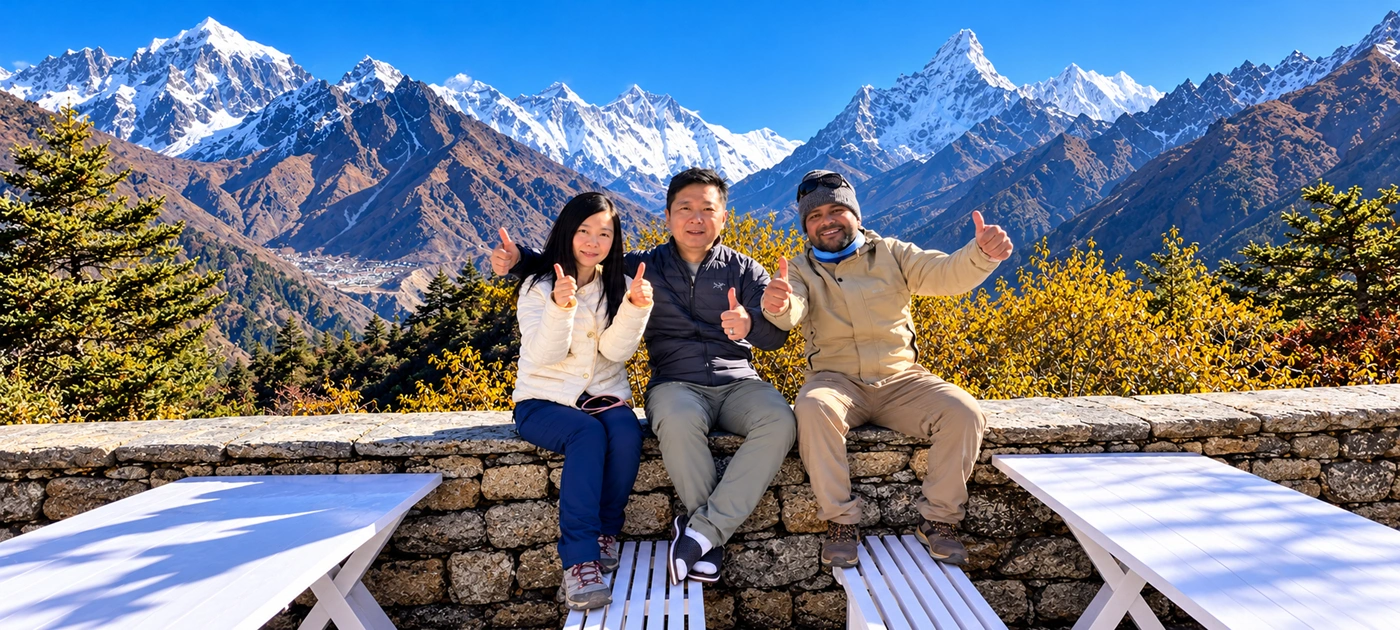
Best Luxury Treks in Nepal for 2027: The Only Three That Meet the Definition

The best luxury treks in Nepal for 2027 are the three where the luxury holds for every night of the trip, not only in Kathmandu: the Everest View Trek, the Everest Base Camp Luxury Trek, and the Annapurna Luxury Lodge Trek. Each gives you a private room with its own bathroom on the trail, helicopter or flight access that saves a day rather than filling one, and a private guide who answers only to you.
That is a short list on purpose. Nepal has more than a dozen trails sold with the word luxury in front of them, and on most of them, the word covers a five-star hotel at either end and a standard teahouse in the middle. We walk these routes every season, and we grade them by what happens at 4,000 meters, not at the airport.
Below are the tests we apply, the three treks that pass it, the trails that don't, and why, and what is different for our 2027 departures.
What "luxury trek" means in the Himalaya: the five-point test
A luxury trek in Nepal is one where the service system never breaks between your arrival in Kathmandu and your departure, however high the trail climbs. We test every route against five points before we put the word on a page.
One: a private room every night, with an attached bathroom wherever the mountain has one and a plain statement wherever it doesn't. Two: warmth where you sleep, which, above the tree line, means an electric blanket or a heated room, not a promise. Three: meals ordered from the lodge menu, with no fixed set menu and nobody counting your cups of tea.
Four: access that fits the trip. Where a trail begins with a mountain flight, we fly a helicopter in both directions, because in peak season, fixed-wing Lukla flights operate from Manthali, a four-to-five-hour drive from Kathmandu, while helicopters still leave from Kathmandu. Five: a licensed guide who works for your party alone, with assistant guides added as the party grows, an oximeter check after dinner every night from Namche Bazaar onward, and an evacuation we launch first and settle with the insurer afterward.
Two house rules sit behind the test. Every trek we run holds a rest day in Kathmandu after you land and a buffer night in Kathmandu before you fly home, so the weather in the mountains never touches your international flight. We also insure each guide and porter for NPR 1 million and pay them above the standard rate, which is part of what the price buys.
The bar we set for luxury travel across the Himalaya is the same in Bhutan and Tibet. In Nepal, exactly three trekking routes cross it.
1. Everest View Trek: the Khumbu below 3,900 meters
The Everest View Trek is the Khumbu with every lodge night behind its own bathroom door and no bed above 3,880 meters. Our version runs 13 days door-to-door, with a private helicopter both ways between Kathmandu and Lukla, and seven walking days linking Phakding, Namche Bazaar, the Syangboche ridge, and Tengboche.
The flight east takes 40 to 45 minutes, the Rolwaling range filling the left window before the tilted runway at Lukla (2,860 m) comes into view. The first afternoon is a gentle 8 km down the Dudh Koshi to Phakding (2,610 m), past whitewashed chortens and the first swaying suspension bridge. The second day has teeth: the Hillary bridge hangs 120 meters above the river, and 600 meters of switchbacks through pine lead up into the horseshoe bowl of Namche (3,440 m).
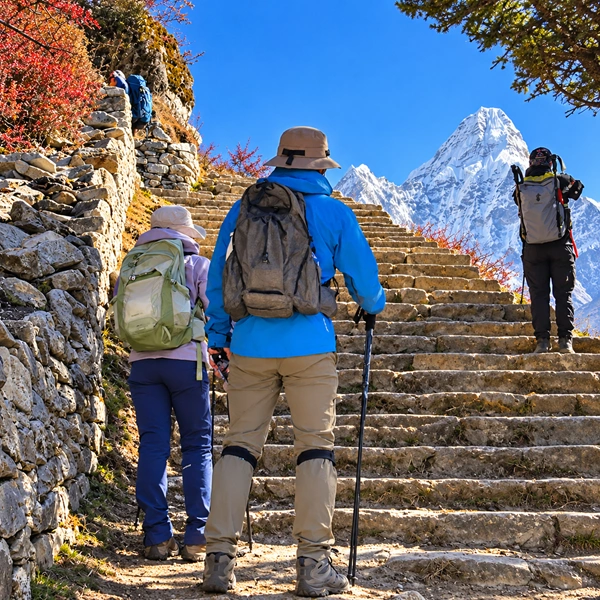
From Namche, a stone staircase climbs to the Syangboche airstrip (3,780 m) and onto a ridge where Everest, Lhotse, Nuptse, and Ama Dablam stand in one line. You sleep up there, at 3,880 meters, in a view hotel with the peaks in your bedroom window. An hour's level walk reaches Khumjung village and its green-roofed Hillary School.
Tengboche (3,867 m) comes next: down to the river at Phunki Tenga, then a long, steady climb through rhododendron and fir to the monastery meadow in time for the afternoon prayer ceremony. The walk back retraces the valley to Lukla over three easy days, and the helicopter lifts you to Kathmandu from there.
We grade the trek easy, which is honest for the altitude profile; the Namche climb is still a real morning's work. It suits first-time trekkers, parents walking with teenagers, and anyone who wants the Sherpa Khumbu without the glacier days. The full route, inclusions, and from price are on the Luxury Everest View Trek page.
2. Everest Base Camp Luxury Trek: the full trail, with an honest asterisk
The Everest Base Camp Luxury Trek takes you to 5,364 meters, with a private room every night, and we put an asterisk next to the two highest ones. Our 14-day program flies a helicopter from Kathmandu to Lukla, walks the classic Khumbu trail over ten days, and lifts you out from Gorak Shep by helicopter after the Kala Patthar sunrise at 5,545 meters.
The pacing is what makes it ours. We split the Lukla-to-Namche stage with a night at Monjo, 5 km and 225 meters of gain, rather than stacking 800 meters onto unacclimatized legs. We sleep on the Syangboche ridge at 3,880 meters instead of taking a second night in Namche.
Above Dingboche (4,410 m), we climb to the Nangkartsang viewpoint at around 5,000 meters and come back down to sleep. It is the single most useful acclimatization day on the route.
Lodges stay luxury-class through Dingboche: with attached bathrooms, heated dining rooms, and a sunroom that traps the afternoon warmth. Then the asterisk. On our 2027 departures, the Lobuche lodge (4,910 m) has an attached bathroom and an electric blanket, and Gorak Shep (5,164 m) has an electric blanket with a shared toilet.
Those are the two most comfortable beds available at those altitudes, and they are comfort, not luxury. We say so before you book rather than after you arrive. Everything around them, the private room, the menu meals, your guide, and the nightly oximeter, stays at the standard.
The Thukla ridge between Dingboche and Lobuche carries the stone memorials to climbers lost on Everest, and our guides stop there without exception. The helicopter operates in pairs: above 4,500 meters, a shuttle carries two passengers, so a party of four leaves Gorak Shep in two rotations to Lukla, then one flight of four to Kathmandu.
Graded moderate, with eight nights above 2,800 meters, this is the trek for travelers with solid hill fitness and exactly two weeks. The day-by-day route is on the Everest Base Camp Luxury Trek page.
3. Annapurna Luxury Lodge Trek: five lodge nights below 2,000 meters
The Annapurna Luxury Lodge Trek is the one trek on this list with no altitude question at all: its highest bed is Ghandruk at 1,940 meters, facing Annapurna South (7,219 m) and Machhapuchhre (6,993 m) across the valley. Five nights move between mountain lodges with en-suite bathrooms and hot showers, on stone-paved Gurung trails between the Pokhara foothills and the Modi Khola gorge.
The published program is 13 days. It opens with the half-hour flight from Kathmandu to Pokhara and a two-hour riverside walk along the turquoise Modi Khola to the first lodge. The climb to Ghandruk takes about five hours through terraced rice fields, and a full rest day there gives you the Gurung Museum and the slate-roofed village lanes.
Ghandruk to Landruk drops to the river, crosses a high suspension bridge, and climbs the far ridge in about four hours. Landruk to Majgaun is a four-hour forest traverse where the Himalayan monal, Nepal's national bird, flashes through the undergrowth. Majgaun to Dhampus follows a ridge with a 180-degree panorama from Dhaulagiri in the west to Manaslu in the east, and the last morning is a two-hour descent to the road and Pokhara.
One porter is assigned to every two guests. Your duffel never touches your shoulders. The program continues by road to Chitwan National Park for a jeep safari and a canoe trip along the Rapti, then flies back to Kathmandu from Bharatpur. When the jungle days don't fit your dates, we run the lodge circuit on its own from Pokhara.
This is the trek we recommend to families with younger children, to travelers in their sixties and seventies, and to anyone who wants the Himalaya at eye level without ever thinking about oxygen. Details are on the Annapurna Luxury Lodge Trek page.
Why Annapurna Base Camp and the remote circuits didn't make the list
They fail the first point of the test: a private bathroom wherever the mountain has one, stated plainly where it doesn't. On the Annapurna Base Camp trail, the last attached bathroom is at Chhomrong (2,170 m). Above it, at Deurali (3,230 m) and in the Sanctuary (4,130 m), washrooms are shared, and in the cold months, they are squat units because the fittings freeze.
We run that trail with a private helicopter out of the Sanctuary and think it is one of the finest walks in Nepal. It is also three nights in the teahouse washrooms, which keeps it off this list.
The remote circuits fail for a different reason. A helicopter solves the access problem for Langtang, Manaslu, or Kanchenjunga, where the standard approach is a four-hour-plus mountain road, but it does not change the lodges, which remain teahouse-tier. A five-star hotel in Kathmandu and a helicopter at the trailhead make a well-supported trek, not a luxury one.
What is different about our 2027 departures
Three things change for 2027, and all of them are operational rather than cosmetic. First, the lodge standard at the top of the Everest trail: our Lobuche night now has an attached bathroom and an electric blanket, and Gorak Shep has electric blankets, which closes most of the gap between the glacier nights and the rest of the trek.
Second, helicopter loads. The Kathmandu-to-Lukla helicopter carries four passengers per flight under current weight rules, and shuttles above 4,500 meters carry two, so we plan the rotation for every party size in advance and tell you the sequence before you fly.
Third, phone coverage. NCell and NTC now reach the whole Everest route, including the high Khumbu, so your guide speaks with our Kathmandu office every day, and you can call home from most lodges. What has not changed: the Kathmandu rest day after arrival, the buffer night before departure, menu meals, and the oximeter after dinner.
When to go, and how to choose between the best luxury treks in Nepal
Nepal's trekking windows are mid-March to mid-June (spring) and mid-October to mid-December (autumn). For the two Khumbu treks, we prefer November, particularly after the 10th, when the post-monsoon air is at its clearest and the October trail traffic has thinned. Spring brings rhododendron bloom between 2,500 and 3,500 meters, and the expedition tents at Everest Base Camp.
The Annapurna Lodge Circuit stays comfortable at both ends of the windows because nothing on it sits above 2,000 meters. Our Khumbu departures are subject to helicopter and lodge availability, so autumn dates are best booked early in the year.
Choose the Everest View Trek if this is your first Himalayan trek, if you want Everest in the window without sleeping above 3,900 meters, or if you have 13 days. Choose the Everest Base Camp Luxury Trek if standing at Base Camp is the point and you have the fitness and two weeks to do it properly. Choose the Annapurna Luxury Lodge Trek for children, for travelers who want no altitude concerns, or to pair mountains with the jungle.
The two Khumbu options are compared line by line in our Everest View versus Everest Base Camp comparison. At the time of writing, our published from-prices for the three treks run from US$ 5,890 to US$ 9,350 per person; the exact figure for your party, dates, and helicopter configuration sits in your proposal.
Frequently asked questions
What makes a trek in Nepal a luxury trek rather than a comfortable teahouse trek?
A luxury trek includes a private room with its own bathroom, warmth where you sleep, menu meals, a guide who works for your party alone, and helicopter access throughout the whole trek, not only in Kathmandu. A comfortable teahouse trek upgrades the city hotels and the best lodge on the trail, then shares washrooms higher up. We grade a route by its hardest night: if we cannot describe that night plainly, we don't call the trek luxury.
Which of the best luxury treks in Nepal suits a first high-altitude trek?
The Everest View Trek: its highest bed is 3,880 meters on the Syangboche ridge, the ascent to Namche Bazaar is staged over two walking days, and every lodge night has an attached bathroom. You see Everest, Lhotse, and Ama Dablam from the ridge and visit Tengboche Monastery without a single glacier day. First-timers who want to reach Base Camp should plan the 14-day Everest Base Camp Luxury Trek and do eight to twelve weeks of hill training beforehand.
Does the Everest View Trek need acclimatization if it stays below 3,900 meters?
Yes, and the itinerary includes it. Namche Bazaar sits at 3,440 meters, high enough for altitude headaches in anyone who climbs there on the day they land at Lukla, so the trek sleeps at Phakding (2,610 m) first, reaches Namche the next afternoon, and climbs only 440 meters to the ridge the day after. Your guide runs an oximeter check after dinner from Namche onward, and the private helicopter can bring you down the same day if the readings are low.
Why does the Everest Base Camp Luxury Trek still count as luxury above Lobuche?
Because the system holds even where the lodges thin out. On our 2027 departures, the Lobuche lodge has an attached bathroom and an electric blanket, Gorak Shep has an electric blanket with a shared toilet, and you keep a private room, menu meals, your own guide, and the nightly oximeter check before the helicopter lifts you out from Gorak Shep after Kala Patthar. We call those two nights comfort rather than luxury, so say so before you book, and keep everything around them at the standard.
Why does the helicopter out of Gorak Shep on the Everest Base Camp Luxury Trek leave in pairs?
Air thins with altitude, and a helicopter's lifting capacity falls with it, so above 4,500 meters each shuttle from Gorak Shep carries two passengers. A party of four leaves in two rotations to Lukla, where one helicopter of four continues to Kathmandu. We set the rotation order the night before, weigh and tag the duffels, and keep a buffer night in Kathmandu so a weather hold in the Khumbu never touches your international flight.
Can the Annapurna Luxury Lodge Trek run without the Chitwan extension?
Yes. The published 13-day program adds two nights in Chitwan National Park after the five lodge nights, with a jeep safari and a canoe along the Rapti, then flies back to Kathmandu from Bharatpur. When the jungle days don't fit your dates, we run the lodge circuit on its own from Pokhara: Ghandruk, Landruk, Majgaun, and Dhampus, nothing above 1,940 meters, and a half-hour flight back to Kathmandu at the end.
How long are the walking days between the Annapurna mountain lodges from Ghandruk to Dhampus?
About four hours each, on stone-paved Gurung trails: Ghandruk to Landruk drops to the Modi Khola, crosses a high suspension bridge, and climbs the opposite ridge. Landruk to Majgaun is a forest traverse, and Majgaun to Dhampus follows a ridge with the Dhaulagiri-to-Manaslu panorama. The climb up to Ghandruk on the second walking day is the longest at about five hours, and the final descent to the Pokhara road takes about two hours.
Which months are best for the three best luxury treks in Nepal?
Mid-March to mid-June (spring) and mid-October to mid-December (autumn). For the two Khumbu treks, we prefer November, particularly after the 10th, when the air is clearest, and the October trail traffic has thinned. Spring gives rhododendron bloom and the expedition tents at Everest Base Camp, while the Annapurna lodge circuit, below 2,000 meters, is comfortable at both edges of both windows. We confirm exact dates against helicopter and lodge availability when you enquire.
Do the best luxury treks in Nepal include a rest day in Kathmandu before the Lukla helicopter?
Yes, on every trek we run: you land, sleep at 1,400 meters, and spend the next day on a briefing, a gear check, and an easy cultural circuit before the helicopter the following morning. The day exists so you start the trail rested rather than jet-lagged, and we hold it even for travelers who ask to fly to Lukla the morning after they land. A buffer night in Kathmandu before departure closes the trip the same way.
What does the price of a luxury trek in Nepal pay for compared with a standard trek?
The nights and the margins. It buys a private room with its own bathroom at every lodge that has one, helicopter flights in place of fixed-wing lotteries, a guide who works for your party alone, menu meals with no per-cup charges, guides and porters paid above the standard rate and insured for NPR 1 million each, and an evacuation that launches before the insurer answers the phone. At the time of writing, our published from-prices range from US$5,890 to US$9,350 per person; your proposal confirms that figure.
The short version
Three treks in Nepal carry the word luxury all the way to the last lodge: the Everest View Trek below 3,900 meters, the Everest Base Camp Luxury Trek with its two honest glacier nights, and the Annapurna Luxury Lodge Trek that never leaves the foothills. Everything else we run, we describe for what it is.
If you are planning for the 2027 season, start with the trek that matches your altitude history and your days off, then tell us your window. We will hold the helicopter seats and the ridge rooms, and send a proposal that names every lodge.
The three are listed side by side with all our luxury treks in Nepal. Held, not handled, from the arrivals hall to the Kala Patthar sunrise.
Need Help? Call Us+977 9851013196orChat with us on WhatsApp
Need Help? Call Us+977 9851013196