Three Passes vs Everest Base Camp: The Short Answer
The Everest Base Camp trek follows one valley to Everest's foot and flies out from the top; the Three Passes trek links three valleys over three high cols and returns to Lukla. Base Camp takes two weeks. Three Passes takes three.
Both routes share the first week. You land at Lukla by helicopter, walk through Phakding, Namche Bazaar and Tengboche, and sleep two nights at Dingboche to acclimatise. From there, the base camp route climbs to Lobuche, Gorak Shep, Everest Base Camp and Kala Patthar, and your helicopter lifts off from Gorak Shep.
The Three Passes route turns east instead, to Chhukung, and crosses Kongma La into the Khumbu valley. It then visits Base Camp and Kala Patthar, crosses Cho La into the Gokyo Valley, climbs Gokyo Ri, crosses Renjo La into the Bhote Koshi Valley, and walks out through Thame and Namche to Lukla.
| |
Everest Base Camp Luxury Trek |
Luxury Everest Three Passes Trek |
| Length door to door |
14 days |
About 20 days |
| Days on the trail |
10 |
16 |
| Nights above 4,300 m |
4 |
10 |
| High point |
Kala Patthar, 5,545 m |
Kongma La, 5,535 m |
| Passes |
None |
Kongma La, Cho La, Renjo La |
| Glacier crossings |
None on the trail |
Khumbu Glacier (after Kongma La), Cho La, Ngozumpa Glacier |
| Longest day |
7 to 8 hours |
8 to 10 hours, three times |
| Helicopter out |
From Gorak Shep |
From Lukla, after walking out |
What the Three Passes Trek Adds to the Base Camp Route
The Three Passes trek adds three cols above 5,300 metres, the Gokyo Lakes and the quiet Bhote Koshi valley to everything the base camp route already offers. You lose nothing. Everest Base Camp and the Kala Patthar sunrise are both still on the itinerary.
We run the circuit counter-clockwise, Chhukung first. Kongma La (5,535 m) comes after two nights at Dingboche and a short positioning day up the Imja valley, so you cross the highest pass with the most acclimatisation behind you. The descent ends with a crossing of the rubble-covered Khumbu Glacier before you reach Lobuche.
Cho La (5,420 m) is the technical one. From Dzongla, the trail climbs moraine and a boulder field to a glacier at the pass, then drops steeply over loose rock to Thagnak. Renjo La (5,360 m) is the gentlest and quietest, and its summit view of Everest, Lhotse, Makalu, and Cho Oyu above the Gokyo Lakes is the one most guests name afterwards.
Our Everest Three Passes trek guide walks the circuit each day. This post stays on the decision.
Everest Three Passes Trek Difficulty: Why It Is Not About Altitude
The Three Passes trek is harder than Everest Base Camp because of what comes in a row, not because of how high it goes. Kala Patthar at 5,545 metres is higher than any of the three passes. A fit trekker who manages Kala Patthar can breathe on Kongma La.
What that trekker may not manage is the sequence. Between Chhukung and Lungden you spend eight nights above 4,700 metres with three pass days of eight to ten hours, each starting before dawn in the cold. On the base camp route you spend two nights that high and then fly home.
Terrain adds the rest. Kongma La's descent is a long, ankle-testing boulder field, and Cho La's glacier can be bare ice in a dry autumn, so microspikes come out of the pack on your guide's call.
Renjo La's Gokyo side is a stone staircase that goes on longer than anyone expects. None of it is climbing. All of it is tiring.
Trekkers crossing the glacier at the top of Cho La on the Everest Three Passes trek
Recovery is the hidden variable. On a private trek, your guide can add a rest day at Dzongla or Gokyo without asking anyone else, and that single day often decides whether the third pass feels like a triumph or a grind.
Three Passes Trek Days Against Base Camp Days
Our Three Passes itinerary runs about twenty days from landing in Kathmandu to flying home, against fourteen for the base camp trek. Of those, sixteen are trail days against ten. Both include a rest and briefing day in Kathmandu after you arrive and a buffer night before your international flight.
The extra week sits entirely above Dingboche. Chhukung, the three pass days, the Gokyo nights and the walk out through the Bhote Koshi valley add seven trail days that the base camp route never sees. No shortcut keeps all three passes and cuts the time.
The exit works differently too. On the base camp trek, your helicopter lifts from Gorak Shep at 5,164 metres, where thin air limits each shuttle to two passengers, so a party of four goes down in two rotations. On the Three Passes, you walk back to Lukla, and the helicopter carries four from there, one lift, about 40 minutes to Kathmandu.
If three weeks is more than your calendar allows, the honest middle option is our Everest Gokyo Lakes trek, which takes the Gokyo Valley and Gokyo Ri without the passes.
Where You Sleep on the Pass Side
Lodges on the pass side are plainer than anything on the base camp corridor, and we say so before you book. Chhukung, Dzongla, Thagnak and Lungden are small seasonal settlements with a handful of lodges each. Expect an unheated room with a shared toilet, a dining room warmed by a yak-dung stove, and a kitchen that does simple food well.
The base camp corridor runs at a higher standard. Heated rooms and attached bathrooms carry you to about 4,200 metres; Lobuche has rooms with an attached bathroom and an electric blanket, and Gorak Shep offers the blanket with a shared toilet. Gokyo sits a tier above the pass-side villages, and we book two nights there so the Gokyo Ri climb comes with a rest day.
This is the trade. The Three Passes buys the finest high views in the Khumbu with four of the plainest nights. We confirm the exact property in your booking proposal, and we don't dress up those four nights in the meantime.
Lodge dining room at Dzongla with the stove lit, a plain night on the Three Passes vs Everest Base Camp route
How Private Pacing Changes the Three Passes
A private Three Passes trek can change its route the morning a pass closes, and that matters more here than on any other Khumbu trek. Each pass has a bypass. Kongma La can be skipped by walking the main corridor from Dingboche through Dughla to Lobuche, losing only the pass itself.
If fresh snow closes Cho La, the way round drops to Pheriche, crosses to Phortse, and climbs the Gokyo valley through Dole and Machhermo. That adds two to three extra days, which is why our itinerary includes a buffer. If Renjo La closes, you walk down the Gokyo valley to Namche instead, the same route the Gokyo trek uses.
On a group departure, the group votes, or a leader manages twelve different fitness levels. On your own trek, it is a conversation over breakfast with one guide who has already checked your oxygen saturation at Chhukung and knows how you slept. Your Kathmandu briefing covers all three crossings and the helicopter logistics before you fly to Lukla.
When to Go: Spring Timing Differs for the Passes
For the Three Passes trek, we start spring departures in mid-May, later than most operators and our own base camp departures. By then the winter snow has gone from the passes, the days are warmer, and the April crowds have left the Khumbu. Cho La's glacier is at its most straightforward.
Nepal trekking windows run from mid-March to mid-June (spring) and mid-October to mid-December (autumn), and the base camp trek runs well across both. The passes narrow those windows. In autumn, late October to mid-November offers the most stable weather on the cols; from mid-November, pre-dawn starts to turn bitterly cold, and an early storm can close a pass for a day or two.
That is the practical reason to hold a day in reserve on any Three Passes itinerary. On the base camp route, a weather day costs you a view. On the passes, it can cost you a crossing.
EBC, Gokyo or Three Passes: Picking by Experience and Time
Choose Everest Base Camp if this is your first trek above 5,000 metres or you have two weeks. Choose the Three Passes if you have already slept above 5,000 metres on a previous trek, have three weeks, and want the Gokyo Lakes and the quiet valleys as much as Everest itself. Choose Gokyo if you have two weeks and want lakes and solitude over the base camp moment.
Fitness is the second filter. For Base Camp, steady walking fitness and two acclimatisation days are enough for most healthy adults. For the Three Passes, you need to walk eight to ten hours on consecutive days with a pre-dawn start, and your training should include back-to-back long hill days, not single outings.
The viewpoints are not the deciding factor. Both routes reach Kala Patthar, and the Three Passes adds Gokyo Ri; our Gokyo Ri vs Kala Patthar guide settles which view wins if that is what you are weighing.
If you are still deciding between regions, our Which Nepal Trek Fits You guide sets Everest beside Annapurna and the rest. Both treks are included in our wider guide to luxury travel in the Himalayas.
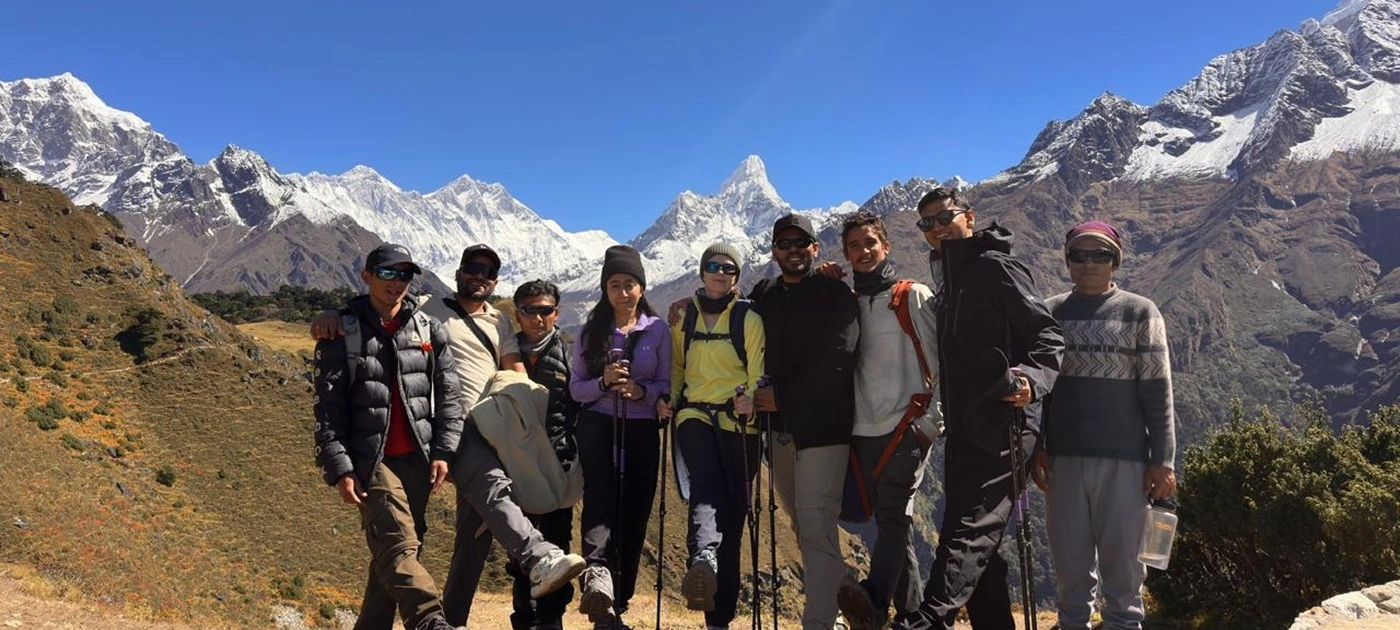
Everest Base Camp Luxury Trek party at Kala Patthar sunrise, the high point of the base camp route
Frequently Asked Questions
Does the Everest Three Passes trek include Everest Base Camp and Kala Patthar?
Yes, both. Our Three Passes itinerary crosses Kongma La into the Khumbu valley, then visits Everest Base Camp and climbs Kala Patthar for sunrise before turning west over Cho La. You give up nothing from the base camp route; you add the passes, the Gokyo Lakes, Gokyo Ri, and the Bhote Koshi valley on top of it.
How many more days does the Everest Three Passes trek take than the Everest Base Camp Luxury Trek?
About six more days door to door: roughly twenty against fourteen. On the trail the gap is sixteen days against ten, because the Three Passes adds Chhukung, three pass crossings, two nights at Gokyo and the walk out through Thame and Namche, while the base camp trek flies out from Gorak Shep the morning after Kala Patthar.
Which pass on the Everest Three Passes trek is the hardest: Kongma La, Cho La or Renjo La?
Kongma La is the highest and the longest day, with a boulder-field descent and a Khumbu Glacier crossing at the end. Cho La is the most technical because of the glacier across its top, and Renjo La is the gentlest climb. Most guests find Kongma La the hardest physically and Cho La the one that demands the most care underfoot.
Do you need crampons or climbing experience for Cho La on the Three Passes trek?
No climbing experience is needed, and you won't use ropes. Cho La's glacier is walked, not climbed, and microspikes or light crampons go on when the ice is bare or the snow is hard; your guide carries them and makes the call at the glacier edge. Sure footing on loose rock matters more than any technical skill.
Can a first-time Himalayan trekker do the Everest Three Passes instead of Everest Base Camp?
We advise against it, because the Three Passes gives you eight consecutive nights above 4,700 metres with no fly-out option until Lukla and no record of how your body behaves at altitude. Base Camp lets you find that out with a helicopter waiting at Gorak Shep if the answer is poor. Earn the passes on a second trip.
Why does Alpine Luxury Treks run the Three Passes from mid-May?
Because the passes are at their best then. By mid-May, winter snow has cleared from Kongma La, Cho La, and Renjo La, the days are warmer, and the busiest spring weeks on the base camp corridor are over. Our base camp departures run from mid-March; the Three Passes waits for the cols to clear.
What happens if snow closes one of the three passes during the trek?
Each pass has a bypass, and on a private trek you take it the same morning. You bypass Kongma La through Dughla to Lobuche, and Renjo La by walking down the Gokyo Valley to Namche. To bypass Cho La, you drop to Pheriche and climb the Gokyo Valley through Dole, which adds two to three days and is why the itinerary includes buffer.
Is the Gokyo Lakes trek a middle option between Everest Base Camp and the Three Passes?
Yes, and it is the one we suggest most often to trekkers with two weeks who want quiet. The Gokyo Lakes trek climbs the Gokyo Valley to the lakes and Gokyo Ri without crossing a pass, sleeps in better lodges than the pass-side villages, and flies out from Gokyo. It trades the base camp moment for turquoise lakes and far fewer people.
If the three-week version is the one you keep coming back to, our Luxury Everest Three Passes Trek page lays out the full circuit, and the Everest Base Camp Luxury Trek is there if two weeks is the right answer. Tell us your dates and your previous high point, and we will tell you straight which one fits.