A luxury Bhutan tour from India runs on a permit rather than a visa, a Sustainable Development Fee set at INR 1,200 per night at the time of writing, and direct flights to Paro from Delhi, Kolkata, Bagdogra, and Guwahati. We plan it privately from our own Paro office, or pair it with Nepal through Kathmandu.
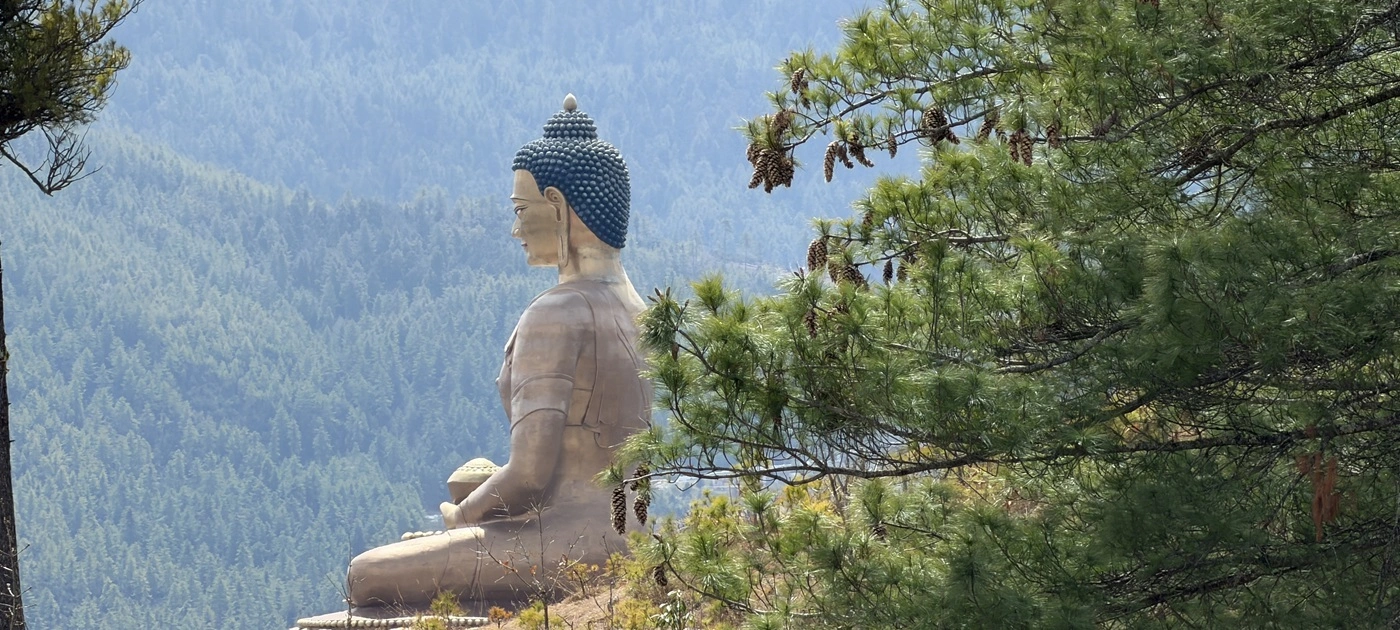
Luxury Bhutan Tour from India
A luxury Bhutan tour from India runs on different paperwork and currency than the trip a European or American guest books, and both differences work in your favor. You enter on a permit, not a visa, and your Sustainable Development Fee is set in rupees at a fraction of the dollar rate. From Delhi, Mumbai, or Bengaluru, you can also reach Paro via Kathmandu in a day, with the Himalaya outside the left-hand window for the last hour.
We run Bhutan from our own office in Paro and Nepal from our base in Kathmandu, so one team files all permits and handles both halves of a two-country trip. This guide covers only what changes for an Indian passport: documents, the SDF, gateway flights, permits for the valleys beyond Thimphu, and the weeks that align with Indian holidays.
Luxury Bhutan tour from India: a Drukair aircraft on the Paro runway below forested ridges
Do Indian Citizens Need a Visa for Bhutan?
No. Indian nationals enter Bhutan on a permit issued by the Royal Government of Bhutan's Department of Immigration, not on a visa. It is issued on arrival at Paro International Airport or at the land border, and a licensed operator can file it in advance through the Department's online permit portal.
The document rule catches people out. The Department accepts a passport with at least 6 months' validity, or an Election Commission Voter ID card, and no other identity document. Aadhaar cards, PAN cards, and driving licenses are not accepted at immigration, which is why we confirm each Indian guest's documents at booking, not at the airport.
Children under 18 without a passport can travel on a birth certificate. Carry originals, because the permit is checked again at every post between districts.
The entry permit itself covers only Thimphu and Paro. Punakha, Wangdue, Phobjikha, and Bumthang require a route permit from the immigration office in Thimphu, and the Department quotes 5 working days once an application is endorsed. We file both before you fly, so our guide meets you at the aircraft steps with the paperwork done.
What the SDF Costs an Indian Traveler
At the time of writing, Indian nationals pay Bhutan's Sustainable Development Fee of INR 1,200 per person per night, compared with US$100 per night for most other nationalities. On a seven-night trip, that is INR 8,400 a person instead of US$700, the single largest cost difference between an Indian passport and any other.
The Department of Tourism has locked the US$100 rate for several more years. Both rates are set by the Royal Government and can change with notice, so every figure here reflects "at the time of writing," and your proposal reflects the confirmed number.
Our published from-prices include the SDF at the dollar rate, because we quote all-in. On an Indian passport, the SDF line in your proposal is recalculated at the regional rate, and the difference is deducted from the total. Children get a concession at both rates, applied in your quote.
One rule reads like a loophole and is not. The SDF is waived for up to 24 hours within border towns; there is a provision for day trade into Phuentsholing, and nothing worth a holiday sits inside that line.
The full fee mechanics, what the SDF funds, and the refund rules are in our Bhutan SDF and visa guide. The arithmetic of a complete quote, lodge by lodge, is in our post on luxury Bhutan tour cost.
Flights from India to Paro, and the Kathmandu Way In
Drukair and Bhutan Airlines both fly to Paro from Delhi and Kolkata; Drukair adds Bagdogra and Guwahati, and both run seasonal services from Gaya, with Mumbai on Bhutan Airlines' seasonal schedule. Timetables shift with the season, so we confirm the routing in your proposal rather than print it here.
Paro is the reason you fly in daylight and land with margin. The runway sits just above 2,200 meters, every approach is flown by hand between forested ridges, and only a small number of pilots hold the certification. Weather holds are routine, which is why we never book a same-day onward connection out of Paro.
Our preferred routing from India runs through Kathmandu. Kathmandu has direct flights from Delhi, Mumbai, Bengaluru, and Kolkata; Indian citizens need no visa for Nepal, and the onward flight from Kathmandu to Paro takes about 65 minutes along the spine of the range. On a clear morning, Everest, Makalu and Kangchenjunga pass at eye level on the left side of the aircraft, with Jomolhari filling the window on the descent; ask us for a left-hand window seat, and we request it at booking.
Everest and Kangchenjunga seen from the left-side window on the Kathmandu to Paro flight
Entering Bhutan by Road from India
Indian travelers can enter Bhutan by road at Phuentsholing, opposite Jaigaon in West Bengal, and at Gelephu and Samdrup Jongkhar on the Assam border. Each Regional Immigration Office issues the entry permit on arrival.
Phuentsholing is the crossing that matters for a holiday, and also the argument against arriving by road. It sits about four hours from Bagdogra airport, and Thimphu is another five to six hours of mountain road beyond the gate. That road day buys nothing a lodge terrace in Paro cannot give you by lunchtime.
The road has two sound uses. It is the natural way in for guests already in Darjeeling, Sikkim, or the Dooars, and the way out of an eastern Bhutan itinerary ending near Trashigang, where Samdrup Jongkhar and then Guwahati airport are closer than Paro. For everyone else, fly.
Do You Need a Guide in Bhutan as an Indian Tourist?
Yes. Under the Department of Tourism's current notification, every tourist in Bhutan must be accompanied by a licensed guide beyond the first designated checkpoint, including at monument sites and on the drive from Paro airport to any other district, and a licensed trekking guide is compulsory on any trek. The idea, still common on Indian travel forums, that you can self-drive to Thimphu and Paro without a guide no longer holds true.
For a private trip this changes nothing, because the guide was always the point. One licensed Bhutanese guide and one driver travel with you from the aircraft steps to departure; nobody else shares the vehicle, and the day moves at your pace: a dzong at opening time before the coaches, Tiger's Nest started early enough to climb in cool air.
The guide also carries the permits. Route permits are checked at the posts between districts, at Chuzom on the road from Paro and at Hongtsho before the Dochula climb to Punakha, and our guide handles each check from the front seat while you stay in the car.
Private guide and driver meeting guests at Paro International Airport on a luxury Bhutan tour from India
Which Weeks of the Year Fit an Indian Holiday?
The best weeks for a luxury Bhutan tour from India are mid-October to the end of November, the Christmas to New Year fortnight, and March to April, around Paro Tshechu, because each coincides with an Indian holiday or clear skies. May is a good time for a short Paro and Punakha loop before the June monsoon.
Dussehra and Diwali fall inside Bhutan's sharpest season. The post-monsoon air gives Jomolhari a clean outline from the Chele La road, and Thimphu Tshechu falls in early autumn by the lunar calendar, dates confirmed at booking. It is the window that fills first.
The year-end fortnight is colder and emptier, and we plan it to sleep low. Punakha, at about 1,200 meters, runs roughly 10 degrees warmer than Thimphu and Paro, at 2,200 to 2,300 meters, so the loop gives Punakha its nights. Druk Wangyel Tshechu at Dochula falls on the same mid-December date each year, with the exact date confirmed at booking, and the black-necked cranes are on the Phobjikha marsh from late autumn to February.
Dochula Pass and its 108 chortens on a private luxury Bhutan tour from India in December
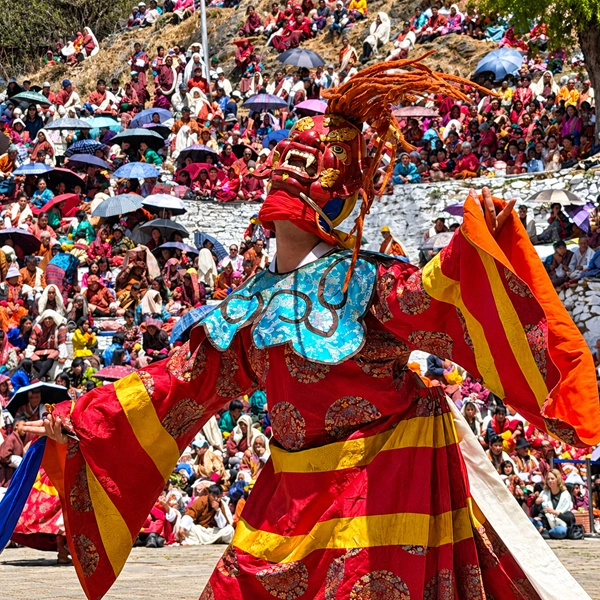
Spring brings Paro Tshechu, which falls in March or April by the lunar calendar. Indian families ask us for it most, because it lands inside the spring school break, and the giant thongdrel unrolled at dawn on the final morning is the one sight in Bhutan worth building a whole trip around. Paro's lodges fill first for that week, so confirm it early.
What a Private Luxury Bhutan Tour from India Looks Like
A private luxury Bhutan tour from India is seven to ten days in the western valleys, with your own guide and driver, lodges confirmed in your proposal, and all permits filed before you land. Our seven-day Paro, Thimphu and Punakha loop is the shape most Indian guests choose for a first visit, and our 7-day Bhutan itinerary posts walks that week day by day, so here we cover only what differs for you.
Food is the first difference, and a small one. Bhutanese kitchens cook chili as a vegetable, so ema datshi, red rice and a vegetarian thali sit comfortably on one table, and we brief every lodge on dietary needs at booking, with vegetarian and Jain meals arranged on notice.
Money is the second. Indian rupees circulate at par with the ngultrum, so there is no currency to buy, though higher-denomination notes are not always accepted, and cards are accepted in the lodges and larger shops. Keep small notes for a temple offering and the archery range.
Pace is the third, and the one luxury actually buys. The Tiger's Nest climb, 900 meters above the valley floor, starts at first light so you are past the cafeteria before the sun hits the upper steps, and Punakha Dzong is seen at opening time, when the courtyards are empty, and the river light is still soft on the whitewash.
Every trip we run in Bhutan is private, priced with the SDF included, and planned from Paro. Compare them all in our collection of luxury Bhutan tours.
Punakha Dzong at the river confluence, the winter-sun stop on a luxury Bhutan tour from India
Nepal and Bhutan in One Trip from India
Combining Nepal and Bhutan in one trip from India works because Indian citizens need no visa for either country, the two capitals are a 65-minute flight apart, and one company can hold both halves. Our eleven-day version runs Kathmandu, a private Everest helicopter morning, then Thimphu, Punakha and Paro, and flies you back to Kathmandu before you go home.
The helicopter morning is the piece Bhutan cannot give you. You lift off from Kathmandu at first light, land at Kala Patthar at 5,545 meters for a strictly timed stop of about ten minutes with oxygen on board, and are back in the city roughly four hours after leaving it.
It also solves the Paro weather problem. The Kathmandu nights at either end are the buffer: a morning hold at Paro costs you a few hours, not an international connection, and your flight home leaves Kathmandu with a night in hand. Where Bhutan sits beside Nepal and Tibet for a first Himalayan journey is covered in our guide to luxury travel in the Himalayas.
Frequently Asked Questions
Do Indian citizens need a visa for a luxury tour of Bhutan from India?
No, Indian citizens enter Bhutan on a permit rather than a visa, issued by the Royal Government of Bhutan's Department of Immigration at Paro Airport or the land border against a valid passport or an Election Commission Voter ID card. On our private trips, the entry permit and any route permits are filed before you fly, so there is nothing to apply for yourself on arrival.
Which identity documents does Bhutan accept from Indian travelers at Paro or Phuentsholing?
Bhutan's Department of Immigration accepts two documents from Indian travelers: a passport with at least 6 months' validity or a Voter Identity Card issued by the Election Commission of India, while Aadhaar cards, PAN cards, and driving licenses are refused. Children under 18 without a passport can enter on a birth certificate. Carry originals, because they are checked again at the posts between districts.
How much SDF does an Indian passport holder pay on a luxury Bhutan tour?
At the time of writing, Indian nationals pay the Sustainable Development Fee of INR 1,200 per person per night, while most other nationalities pay US$100 per night, so seven nights cost INR 8,400 versus US$700 per person. Our published prices include the SDF at the dollar rate, and an Indian-passport proposal is rebuilt at the regional rate, with the difference deducted from the total. The Royal Government sets both rates and can change them with notice.
Can Indian travelers go beyond Thimphu and Paro on a Bhutan tour from India?
Yes, with a route permit, because the entry permit issued to Indian nationals covers only Thimphu and Paro. Punakha, Wangdue, Phobjikha, Bumthang, and the east need a route permit from the immigration office in Thimphu, which a licensed operator applies for online, and the Department of Immigration issues it within five working days after endorsement. We file it before you travel, and our guide presents it at the Chuzom and Hongtsho checkpoints on your behalf.
Do Indian tourists need a licensed guide on a luxury Bhutan tour?
Yes, because the Department of Tourism's current notification requires every tourist to be accompanied by a licensed guide beyond the first designated checkpoint, including at monument sites and on the drive from Paro airport to other districts, with a licensed trekking guide on any trek. Indian travelers are not exempt. On a private trip with us, one licensed Bhutanese guide and one driver stay with you throughout, so the rule costs you nothing.
When is the best time for a luxury Bhutan tour from India around Indian holidays?
Mid-October to the end of November is the best time because Dussehra and Diwali fall within Bhutan's clearest post-monsoon window, and Thimphu Tshechu occurs in early autumn by the lunar calendar. The Christmas to New Year fortnight brings the Druk Wangyel Tshechu at Dochula and the cranes in Phobjikha, with warm Punakha nights, and the spring school break coincides with Paro Tshechu in March or April. June to September is monsoon and best avoided.
Does flying to Bhutan via Kathmandu make sense for travelers from India?
Often, yes: Kathmandu has direct flights from Delhi, Mumbai, Bengaluru, and Kolkata; Indian citizens need no visa for Nepal, and the onward flight from Kathmandu to Paro takes about 65 minutes, with Everest and Kangchenjunga on the left side of the aircraft. The routing adds a private Everest helicopter morning and gives you a Kathmandu night as a buffer against Paro weather holds. For travelers in south and west India, it is often the easier connection.
If you are considering the two-country version, send us your dates and passport details, and we will come back with a proposal priced at the regional SDF rate, including the morning Everest helicopter flight, the Kathmandu-to-Paro flight, and all permits in one plan. The day-by-day itinerary is on our Nepal and Bhutan luxury tour page, and every day of it can be adjusted around you.
Need Help? Call Us+977 9851013196orChat with us on WhatsApp
Need Help? Call Us+977 9851013196