The Kailash Yatra by flight is the route we now run for pilgrims who cannot wait for the Kerung road. You fly from Kathmandu to Lhasa, spend three nights acclimatizing at 3,650 meters, fly west to Purang, and reach Darchen the same afternoon.
The kora follows, three days over the Dolma La at 5,630 meters, and you fly home the way you came. Nine days in total.
The flood that took out the Bhote Koshi crossing at Rasuwagadhi closed the overland corridor most Nepal-based yatras depended on. That road carried the fourteen-day drive-in, drive-out program.
The new route drops the road entirely. Two flights replace roughly 1,300 kilometers of driving, and the time you save goes into Lhasa, where your body adjusts, and the mountain itself.
How the Kailash Yatra by flight is structured
The route stacks three flights and one short drive around a three-day kora. Kathmandu to Lhasa takes about ninety minutes in the air. Lhasa to Purang is a roughly two-hour flight across the western plateau.
From Purang Airport, a paved road runs north past Rakshas Tal and along the Manasarovar shore to Darchen, about 110 kilometers and two to two and a half hours by private vehicle.
That gives the trip a clear shape. Three nights in Lhasa. One night in Darchen. Two nights on the kora. One night in Purang on the way out, one more in Lhasa, and the return flight to Kathmandu on the ninth morning.
Every day below is adjustable, and the exact hotels are confirmed in your booking proposal.
Two things set this route apart from every Kailash program we ran before the flood. No border crossing, so no queue at Rasuwagadhi immigration with a group of forty.
And Lhasa does the acclimatizing that Kerung, Saga, and two long driving days used to do.
Is the Kailash Yatra still running after the Kerung flood?
Yes, the Kailash Yatra is running after the Kerung flood, on the flight route rather than the road. The flood destroyed the road-bridge link between Rasuwagadhi on the Nepali side and Kerung on the Tibetan side, and a temporary crossing cannot handle pilgrim coaches at scale. The corridor will reopen, but nobody can give a date that survives the next monsoon.
Until then, the honest choices are the alternative routes to Kailash: the Lhasa fly-in described here, a helicopter shuttle to Hilsa in far-west Nepal, or a longer overland loop from Lhasa. The fly-in route wins on time and certainty.
Flights are canceled due to the weather, but they do not wash away.
What changes for you is mostly administrative. Instead of the Nepal group visa processed at the Chinese Embassy in Kathmandu for an overland crossing, this route uses a Tibet Travel Permit tied to your flight, with visa handling as set out in your proposal.
We cover the current structure in our Tibet visa and permit guide for Kailash, and we handle the filing.
Day by day on the Lhasa–Purang route
Kathmandu to Lhasa: the arrival flight
The arrival flight leaves Kathmandu in the morning and lands at Lhasa Gonggar in time for lunch. On a clear day, the aircraft passes north of the main Himalayan chain, and the left-hand windows look straight at Everest, Makalu, and Kanchenjunga in the first half hour.
Gonggar sits about 60 kilometers from the city, a one-hour drive along the Yarlung Tsangpo and then the Kyichu valley. Your Tibetan guide meets you at arrivals, and the rest of the day is deliberately empty: water, a slow walk, an early night at 3,650 meters.
Here is a standing rule we apply on every Lhasa arrival. No Potala, no stairs, no monastery visits on the first afternoon, however well you feel. The first night at altitude is when the headache arrives if it is coming, and an empty afternoon is the cheapest insurance on the whole trip.
Two Lhasa days: Potala, Drepung, Sera, Jokhang, Barkhor
The two sightseeing days are acclimatization days with a cultural purpose. The first covers the Potala Palace, the former winter residence of the Dalai Lamas rising 13 storeys above the city, and Drepung Monastery on the hillside to the west. The Potala climb alone is several hundred steps, taken slowly, exactly the gentle exertion the body needs on its second day.
The second day pairs Sera Monastery, where the monks' afternoon debating courtyard fills with clapping and challenge, with the Jokhang Temple and the Barkhor circuit around it. The Barkhor is a kora in miniature. Pilgrims walk it clockwise, and by the second circuit, most of our guests have picked up the rhythm they will need on the mountain.
We keep both days short. Lunch is long, afternoons end early, and your guide checks oxygen saturation with a pulse oximeter each evening. Readings, not feelings, decide whether the Purang flight goes ahead as planned. Our guide to the great monasteries of Lhasa explains what you will see inside each one.
Lhasa to Purang: the flight west and the drive to Darchen
The Purang flight is the day the route earned its name. The aircraft crosses the whole of western Tibet in about two hours, and the landscape below turns from the green Kyichu valley to the brown and ochre of Ngari.
Purang Airport is one of the highest commercial airfields in the world, and stepping out of the cabin feels like it. You have gained close to a kilometer of altitude since breakfast. The drive to Darchen runs north past Rakshas Tal, then along the western shore of Lake Manasarovar at an elevation of 4,590 meters.
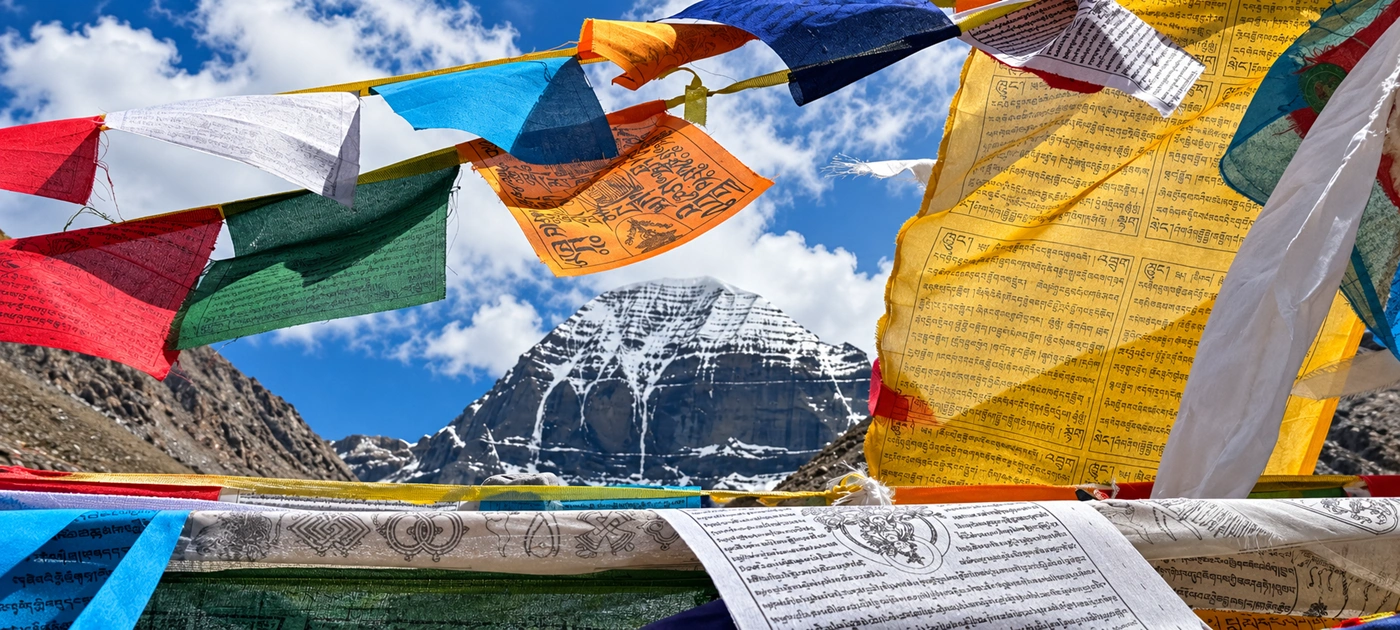
Kailash appears on this drive, first as a white pyramid above the ridgeline north of the lake, then as the full south face with its vertical cleft as the road bends toward Darchen at 4,575 meters. Most pilgrims ask to stop. We build the time in.
The Kora, first day: Darchen to Dirapuk
The first kora day is 12 kilometers from the Yamdwar gateway to Dirapuk, five to seven hours on foot at a pilgrim's pace. A short drive takes you from Darchen to Yamdwar at Tarboche, where the great prayer-flag pole stands, and the walking begins.
The trail runs up the Lha Chu valley on a wide gravel track, gaining about 150 meters over the course of the day. It feels flat. It is not, because the air at 4,800 meters carries roughly half the oxygen of Kathmandu.
Dirapuk at 4,900 meters faces the north face of Kailash directly across the valley. The guesthouse is a dormitory with a shared bathroom, and we say so plainly in every proposal. This is the simplest night of the journey, and the view from the doorstep at first light is the reason nobody minds.
The kora, second day: Dolma La and Gauri Kund
The Dolma La day is 18 to 22 kilometers and eight to ten hours, the hardest day of the trip by a wide margin.
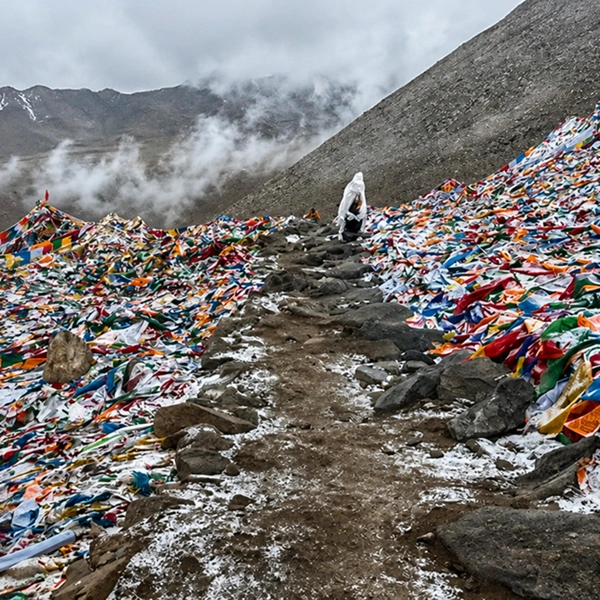
The climb from Dirapuk to the pass gains about 730 meters over the first five kilometers, with the last stretch on steep, rocky switchbacks past the Shiva-tsal, where pilgrims leave a garment or a lock of hair to symbolize death and rebirth.
The pass itself at 5,630 meters is a mass of prayer flags draped over a boulder. A few minutes of prayer, a photograph, and then down. Just below the far side lies Gauri Kund, the emerald tarn Hindu pilgrims associate with Parvati.
The descent is steep and loose for the first hour, then a long, gentle walk down the Lham Chu to Zuthulpuk at 4,790 meters.
Our guide sets a pace on this day that is slower than most guests expect. Oxygen cylinders travel with the group, and a pony can be arranged for anyone who wants one for the ascent. Read our Dolma La pass guide before you go.
The kora, final day: Zuthulpuk to Darchen and on to Purang
The last kora stretch is 7 to 10 kilometers, two to three hours of easy walking beside the river to the roadhead. Zuthulpuk means "cave of miracles," after the meditation cave of Milarepa beside the guesthouse, and most groups visit it before setting off.
Back at Darchen, the kora is complete. After lunch, you drive south past Manasarovar to Purang town, at an elevation of about 3,900 meters. The drop of nearly 700 meters is noticeable within an hour. Appetite returns. Sleep comes easily.
Purang to Lhasa, and Lhasa to Kathmandu
The two return flights retrace the route: Purang to Lhasa in the morning, a free afternoon in the city, and the flight to Kathmandu the next day. We recommend a night in Kathmandu before any onward international connection, because plateau flights shift with the weather, and a same-day connection is a gamble we do not take.
The altitude profile of the Kailash Yatra by flight
The altitude profile is steeper per day than any overland Kailash route, and Lhasa is the reason it works. The overland Kerung route climbed from 1,400 meters in Kathmandu to 2,700 at Kerung, 4,640 at Saga, and 4,575 at Darchen over five days.
The flight route goes 1,400, then 3,650 for three nights, then lands at roughly 4,600 and sleeps at 4,575 on the fourth night.
Three nights at Lhasa's altitude do most of the physiological work. By the time you land at Purang, your body has started producing the extra red blood cells that make 4,600 meters manageable, which is why we never compress the Lhasa stay to save a day.
A guest who arrives from sea level and takes this route sleeps above 4,500 meters on four consecutive nights. That is demanding, and it is not for everyone. Our training guide for the Kailash Yatra outlines a 12-week program suited to this profile.
Who does the flight route suit, and who should not take it
The flight route suits pilgrims who are fit, short on time, and want to reach Kailash this season rather than wait for a road. It suits anyone who dreads long jeep days and anyone for whom three nights in Lhasa is a reason to go rather than a delay.
It suits anyone with a history of altitude sickness above 4,000 meters less well, because there is no slow overland stage to fall back on. If a guest struggles in Lhasa, the honest answer is to stay in Lhasa, and we say so before the Purang flight.
The Lhasa-to-Kailash overland route offers a gentler option for those with extra days.
Meals in our standard program include breakfast only; lunches and dinners are arranged locally by your guide. Full-board vegetarian catering is available upon request and will be confirmed in your proposal.
What we handle on this route
We handle the Tibet Travel Permit, the Alien's Travel Permit for Ngari, the military-area clearance for the Kailash region, and every internal flight.
The original permit is required at the check-in counter in Kathmandu for the flight to Lhasa, so a member of our Kathmandu team will hand it to you in person before you leave for the airport.
On the mountain, our crew arranges yaks and porters for group kit, carries supplementary oxygen, and keeps a pulse oximeter at every overnight stop. A private guide and vehicle from Lhasa mean the schedule bends to your group.
Booking is simple. You enquire, we talk through dates and fitness, and a written proposal follows, confirming the route, hotels, and price. Plateau flight schedules are confirmed at booking, and where a departure moves, the ground plan moves with it.
Frequently asked questions
How long does the Kailash Yatra by flight via Lhasa and Purang take?
Nine days from Kathmandu to Kathmandu: one arrival day and two sightseeing days in Lhasa, one flight-and-drive day to Darchen, three days on the kora, the return through Purang and Lhasa, and the flight home. A spare day in Lhasa is the single most useful extension for anyone worried about altitude.
How high is Purang Airport on the Lhasa–Purang Kailash route?
Purang Airport sits at roughly 4,600 meters, which places it among the highest commercial airports in the world. You land about a kilometer higher than Lhasa, which is why we never fly to Purang without first spending three full nights in Lhasa. The drive to Darchen the same day keeps you at a similar altitude, and the Purang town night on the return is about 700 meters lower.
Is the Kailash Kora on the flight route the same as on the Kerung route?
Yes. The kora is identical whichever way you reach Darchen: 12 kilometers to Dirapuk, 18 to 22 kilometers over the Dolma La to Zuthulpuk, and 7 to 10 kilometers back to the roadhead. The difference lies entirely in how you arrive and how well acclimatized you are when you start walking.
Does the Kailash Yatra by flight visit Lake Manasarovar?
It does, twice. The drive from Purang to Darchen follows the western shore of Manasarovar at 4,590 meters, and the return drive passes it again. A stop for prayers or a ritual dip at the lakeshore is built into the outbound drive, and a lake overnight can be added with a spare day.
Why does the Lhasa route to Kailash skip the Kerung border crossing?
Because the flood destroyed the Rasuwagadhi–Kerung bridge link, the corridor cannot currently carry pilgrim traffic. The Lhasa route avoids the border entirely, entering Tibet by air on a Tibet Travel Permit. When Kerung reopens, the flight route will remain the faster option, and the overland route will return as the lower-cost one.
How cold are the dormitory nights at Dirapuk and Zuthulpuk on this route?
Expect near- or below-freezing overnight from May to October, and colder at the edges of the season. Both guesthouses are unheated dormitories with shared bathrooms, so we supply a warm down jacket on loan and recommend a four-season sleeping bag. The two nights are the only simple accommodations on the route.
What permits does the Kailash Yatra by flight require from Nepal?
A Tibet Travel Permit, an Alien's Travel Permit for the Ngari prefecture, and military-area clearance for the Kailash and Manasarovar region, alongside the appropriate Chinese visa. We file all of these. The original Tibet Travel Permit must be shown at check-in in Kathmandu for the Lhasa flight, so plan to be in Kathmandu the day before departure at the latest.
Can senior citizens do the Kailash Yatra via the Lhasa–Purang flight?
Fit seniors do, and a pony over the Dolma La makes the hardest day manageable. The route's steep elevation gain means we ask for a doctor's clearance for guests over 65 and a frank conversation about any history of heart or lung conditions. The three Lhasa nights help, and our guide's daily oximeter readings decide each stage rather than a fixed schedule.
The Kailash Yatra by flight is the route we recommend for this season. Our Lhasa to Kailash Mansarovar Yatra is the private program built on it, and a conversation with our Kathmandu team is the right first step.
Part of our Luxury Travel in the Himalayas series.