Most of what a Kathmandu shopping guide should tell you comes down to one habit: ask how a thing was made before you ask what it costs. The maker's answer, or the lack of one, tells you almost everything.
The Kathmandu Valley still produces work at a level very few places do. It also produces a great deal of printed, cast, and blended stock aimed squarely at people who are only in town for two nights.
Here is how we teach our guests to tell the two apart.
What the Kathmandu Valley actually makes
Four crafts are genuinely local to this valley, and the rest is trade. Metal statues, devotional painting, hand-loomed textiles, and wood carving all have unbroken workshop lineages here, most of them Newar.
The casting families of Patan work in cire perdue, the lost-wax method, in the lanes around Oku Bahal. Bhaktapur holds the wood-carving tradition that produced the fifteenth-century Peacock Window, and its pottery square still turns and fires by hand. These trades sit inside the same seven monument zones of the Kathmandu Valley World Heritage property that most visitors photograph and walk straight past.
Plenty else on the shelves comes from elsewhere and is sold openly enough: Ilam tea, Dhaka cloth woven in the eastern hills, lokta paper from Daphne bark, Mithila painting from the Janakpur plains.
None of that is a problem. It becomes a problem when Indian machine-spun bowls or Chinese printed scrolls are sold as Valley handwork, at handwork prices.
Thangka and paubha: how to read a scroll painting before you buy
A real thangka is painted by hand with mineral pigment on primed cotton, and it shows it under angled light. Bring a small torch. Tilt the light across the surface and look for the raised, burnished sheen of gold that has been laid on and polished with an agate stone, plus the faint texture of brushwork in the flat color fields.
A print gives you none of that. Screen-printed and digitally printed scrolls read perfectly flat, the outlines are uniform in weight, and the color often bleeds through to the reverse of the canvas in a way hand-painting never does.
Six things we check in the shop
Faces first. The eyes, eyebrows, and mouth are painted last by the senior artist with a brush of a few hairs, and this is where a rushed copy falls apart.
Then the grid. Traditional painters lay out deities on an iconometric grid before any color goes down, so proportions follow a fixed canon rather than the painter's eye. Figures that look subtly off usually are.
Then the pigments. Ground malachite, azurite, lapis and cinnabar have depth and slight unevenness that acrylic poster paint cannot fake.
Then the back of the canvas, then the gold, then the shop itself: if three identical pieces hang on one wall, none of them is a one-off.
Paubha is not the same thing as thangka
Paubha is the Newar tradition of the Kathmandu Valley, and art historians place it earlier than the Tibetan thangka it influenced. Paubha work tends to be denser, with tighter architectural framing around the central deity and Hindu subjects appearing alongside Buddhist ones.
Boudhanath is where most thangka studios and painting schools sit today, along the kora that circles the stupa. A student there spends years on line work alone before touching a face. Ask how many months a piece took.
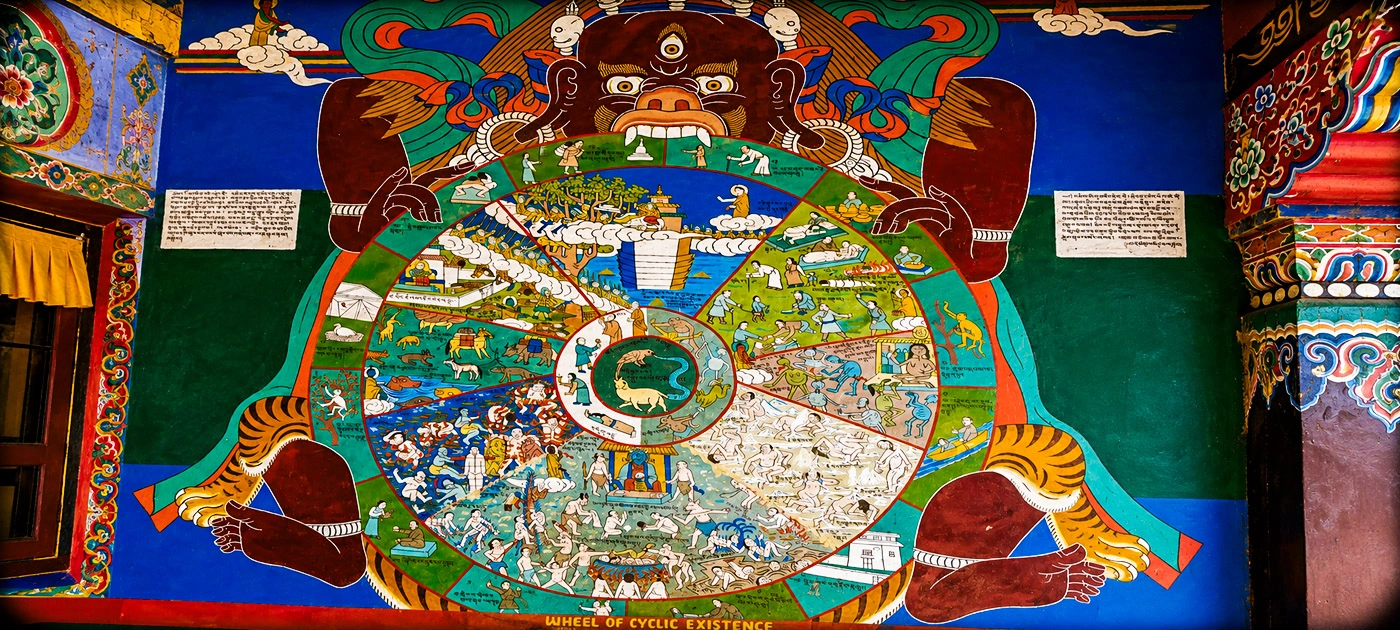
A detailed Wheel of Life or Kalachakra mandala takes several months of real work, and the painter's answer should come back immediately and specifically.
Singing bowls: hammered, spun, and the seven-metal story
A hand-hammered bowl and a machine-spun bowl sound different, and you can hear it in ten seconds. Strike the bowl once with a padded mallet, rest it on an open palm rather than gripping it, and listen for how long the note holds and whether it wobbles.
Hand-hammered bells sustain for twenty to forty seconds and beat gently, because no two points on a hammered rim are identical. Machine-spun bowls give one bright, clean, short tone and then stop.
Look inside for hammer marks that vary in depth and spacing. Stamped fake dimples repeat on a regular pitch, which is the giveaway. Concentric lathe rings on the base mean the bowl was spun, and a perfectly round rim on an old-looking bowl means it is neither old nor hand-raised.
The trade names are worth knowing, because they describe shape rather than age: thadobati with straight walls and a flat base, jambati large and heavy with a rolled rim, manipuri small and shallow, ultabati with the deep wobbling voice collectors chase. Sellers use these terms correctly far more often than they use "antique" correctly.
About the seven metals. The story that each bowl carries seven metals matched to seven planets is a lovely piece of trade lore, and it is repeated in almost every shop in Thamel.
Metallurgical analysis of old bowls generally finds bell metal, a copper and tin bronze, sometimes with trace amounts of other elements. Enjoy the story, buy the sound.
Pashmina: what Chyangra means and the tests that work
Real pashmina comes from the undercoat of the Chyangra goat, and the fiber measures roughly 12 to 16 microns against 25 or more for standard sheep wool. That difference is the whole point. It is why a real shawl warms without scratching, and why viscose copies feel cool and slippery against the neck.
Nepal's answer to the counterfeit problem is Chyangra Pashmina, a collective trademark administered by the country's pashmina industry association and carried on a hologram tag.
It is not a guarantee of taste, but it is a real chain-of-custody mark, and it is the single fastest filter in a crowded shop.
The burn test works. The ring test does not.
Ask to burn one fringe thread. A protein fiber smells like burning hair and leaves a crumbly ash you can rub to powder between two fingers. Viscose smells like burning paper; polyester melts into a hard bead. A shop confident in its stock will hand you the lighter.
The ring test, pulling a shawl through a wedding ring, proves only that the weave is fine. Good viscose passes it easily. So does silk.
Know what blend you are buying. The classic Kathmandu shawl is 70 percent pashmina to 30 percent mulberry silk, which adds sheen and strength and drapes beautifully.
A 100 percent pashmina piece is softer and more matte, pills a little with wear, and costs considerably more. Both are honest. Neither is what you are being handed at a souvenir price on a Thamel pavement.
Where to shop, district by district
Four areas cover almost everything, and they suit different moods. Thamel is convenient and carries the widest range, with the widest quality spread to match, so it rewards people who already know what they are looking at.
Patan is where you go for metal. The workshops around Oku Bahal and the lanes off the Durbar Square let you watch wax models, chasing and finishing before you buy, and a slow morning in Patan
is the best possible preparation for a serious statue purchase. Look for fire gilding, which gives a deep, faintly uneven gold, rather than the thin uniform brassiness of electroplate.
Boudhanath belongs to thangka and Tibetan carpet, plus more incense than one street needs. Bhaktapur is pottery, wood, and black-clay work you can watch being thrown.
For fixed prices and no negotiation at all, the restored Rana courtyards at Babar Mahal Revisited and the boutiques around Jhamsikhel carry vetted work from cooperatives and named artisans. You pay more. You also stop guessing.
Bargaining, payment, and what a fair price reflects
Bargaining is normal in Thamel, Asan and Indra Chowk, and out of place almost everywhere else. In market lanes, ask the price, ask about the making, then make one reasonable counter and settle warmly.
A cooperative or a certified store with printed tickets is not negotiating with you, and pushing there reads as rude rather than shrewd.
Price tracks labor and material far more than it tracks shop address. A large hand-hammered bowl, a fire-gilded statue and a six-month thangka are all expensive for the same reason.
Carry rupees for the market lanes, since card acceptance thins out fast and many small shops add a surcharge.
Our notes on currency, payment and tipping in Nepal cover the practical side.
Getting it home without a customs problem
Nepal prohibits the export of cultural objects more than 100 years old, and metal statues, religious paintings and similar items need a non-antique clearance certificate from the Department of Archaeology before they leave the country.
Reputable dealers handle this as a matter of course and will tell you so without being asked.
Do not buy shahtoosh under any name. The shawls come from the Tibetan antelope, the trade is banned under CITES, and possession is an offense in most countries you would be carrying it back to.
The same caution applies to anything containing ivory, wild animal parts, or old temple fittings of uncertain origin.
Khukuri knives travel in hold luggage only. Thangkas should be rolled painted-side out around a tube, never folded, and large statues almost always ship better than they fly.
If you care about the makers as well as the object, our approach to responsible travel and cultural etiquette explains how we choose cooperatives and family workshops over volume showrooms.
How we build a Kathmandu shopping guide into a private trip
We put buying at the end of a trip, not the start, and the reason is logistics rather than taste. Nothing you buy should ride with you to altitude, and the Kathmandu buffer night we hold before every international departure is exactly the window for collection, packing and paperwork.
Our guides open craft mornings in Patan before the workshops fill, when there is enough daylight in the lanes to read a chisel line properly. Where a purchase needs a Department of Archaeology certificate, we start that process the day it is bought rather than the day you fly, and we consolidate shipping through one dealer instead of four.
This sits inside the wider way we plan private luxury travel across the Himalaya: fewer stops, more time in each, and a local hand on the parts that go wrong quietly.
Frequently asked questions
How can I tell a hand-painted thangka from a printed one in Kathmandu?
Tilt a torch across the surface. Hand-painted work shows raised, burnished gold and visible brush texture in the flat color, while prints read perfectly flat with uniform outlines and often bleed through to the back of the canvas. Faces are the fastest tell, since the senior artist paints eyes and mouth last with a brush of a few hairs.
Are singing bowls sold in Thamel actually made in Nepal?
Many are, and many are not. A good number of cheap bowls are machine-spun in northern India and finished with stamped hammer marks that repeat on a regular pitch. Genuine hand-hammered Nepali bowls have irregular dimples, a slightly out-of-round rim, and a note that sustains twenty to forty seconds with a gentle wobble.
What does the Chyangra Pashmina trademark mean?
Chyangra Pashmina is Nepal's collective trademark for pashmina made from the undercoat of the Chyangra goat, carried on a hologram tag issued through the national pashmina industry association. It certifies fiber origin and processing chain rather than design quality. Treat it as your first filter, then run the burn test on a fringe thread anyway.
Can I take a Buddha statue or thangka out of Nepal?
Yes, provided the piece is not an antique. Nepal bars the export of cultural objects over 100 years old, and metal statues and religious paintings require a non-antique clearance certificate from the Department of Archaeology. Allow a working day or two for the paperwork, and buy from a dealer who arranges it routinely.
Is bargaining expected in Kathmandu's craft shops?
In Thamel, Asan and Indra Chowk, yes, politely and briefly. In cooperatives, certified pashmina stores, gallery boutiques and workshop showrooms with printed prices, no. The line is usually visible: if prices are ticketed and the staff can name the maker, you are not in a negotiating shop.
Where in the Kathmandu Valley is metalwork actually made?
Patan, in the lanes around Oku Bahal and the streets radiating from Patan Durbar Square. Newar casting families work there in cire perdue, the lost-wax process, and many workshops let visitors watch wax modeling, casting, and chasing. Fire-gilded finishes from these workshops look deeper and less even than electroplated gold.
Should I shop in Kathmandu before or after my trek?
After. Purchases add weight and risk on a trek, and lodge storage at altitude is not the place for a rolled thangka. We schedule craft time into the Kathmandu buffer night we hold before international departures, which also leaves room for export paperwork and shipping.
Does Nepal offer a VAT refund for tourists on craft purchases?
No general tourist VAT refund scheme operates in Nepal at the time of writing, so budget on the ticketed price rather than expecting a rebate at the airport. Ask for a proper receipt anyway, since it supports both the export certificate process and any customs question on arrival home.
Buy one good thing
One well-made piece outlasts a suitcase of souvenirs, and the difference is almost always the hour you spend understanding it. That hour is much easier with someone beside you who knows the workshops.
If you want that built into your time in the Valley, our private Kathmandu Valley heritage journey puts craft mornings alongside the temple squares, at your own pace.